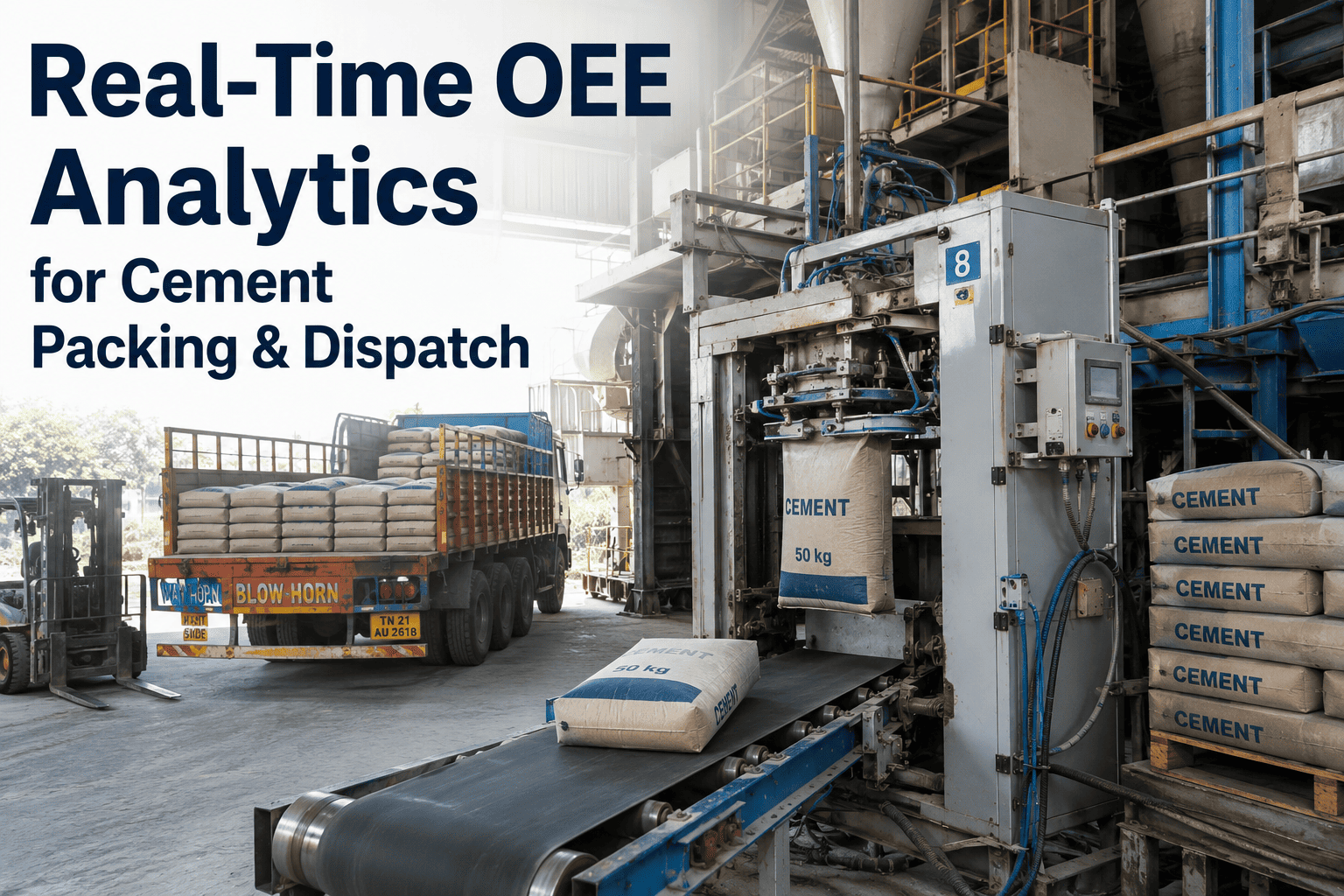
The dispatch bay is where cement plants win or lose their day. A kiln can run beautifully, a mill can hold its Blaine to the gram, but if the rotary packer starts leaking cement at spout 6, if the load cell on head 3 drifts 80 grams overweight, or if the palletizer robot misaligns a stack by 15mm and knocks the pattern down, the whole shift's throughput collapses at the last hundred feet. Packing lines running 2,400–3,000 bags per hour have zero tolerance for reactive maintenance — one spout seal failure during peak dispatch cascades into rejected bags, dust compliance risk, palletizer jams, and trucks queued outside the gate on detention. And most plants only find out something drifted when the checkweigher reject rate spikes or a customer files a short-count claim for a 498-bag truck that was billed as 500. iFactory's Predictive Maintenance with AI Vision catches packer valve wear, weigher drift, and palletizer alignment issues before they hit the dispatch queue — so bag-count integrity and throughput hold across every shift.
iFactory Predictive Maintenance + AI Vision
Protect Every Bag, Every Pallet, Every Truck — Before the Dispatch Bay Feels It
Detect packer spout wear, load cell drift, impeller degradation, and palletizer misalignment early. AI Vision watches the bag stream in real time. SPC watches the weigher. Dispatch keeps flowing.
±50g
load cell drift threshold
99.7%
bag applicator target
<0.1%
bag-count error goal
Where Packing Lines Actually Fail — The Cost Chain
Every silent drift in the packing hall has a downstream price tag. This is what a single unmonitored failure mode costs when it reaches dispatch instead of getting caught at the source. The gap between "caught early" and "caught at the truck" is where predictive maintenance pays for itself.
Spout seal wear
flows to
Cement dust leak, bag torn on discharge, filling inaccuracy
Line stop 45–90 min at peak dispatch
Load cell drift 50–100g
flows to
Silent overfill on every bag, legal metrology risk
Largest single source of overfill loss
Impeller blade erosion
flows to
Filling rate drop, dust emission spike, longer cycle time
Throughput falls 8–15% before anyone notices
Bag applicator suction drop
flows to
Shot rate falls below 97%, manual rejects compound
Entire line throughput collapse
Palletizer gripper wear
flows to
Bag slip during pick, pattern misalignment, stack collapse
Palletizer jam, downstream conveyor backup
Bag counter miscount
flows to
Truck loaded 498 instead of 500 bags, billed as 500
$180–$320 redelivery cost per incident
The Five Failure Signatures iFactory Watches For
Predictive maintenance in packing plants comes down to five signature patterns. Each has a specific sensor path, a specific early-warning indicator, and a specific action window. Get all five wired into one dashboard and the dispatch bay stops being a source of surprises.
01
Packer Spout & Valve Wear
Vibration signature on filling head, dust emission rise at bag discharge, per-spout fill time increase
Early-warning at 1.5mm cone wear. Replace at 2mm. Prevents mid-shift spout failure.
02
Load Cell / Weigher Drift
SPC control chart on per-head fill weight, running mean shift, correlation with reject rate
Drift >30g flags before overfill compounds. Calibration verified before shift, not after audit.
03
Turbine Impeller Erosion
Motor current draw trend, per-head bag cycle time, dust load in filter
Erosion detected on current signature 40–60 hours before filling rate loss becomes visible.
04
Palletizer Gripper & Alignment
AI vision on bag placement per pick, gripper pressure log, cycle-to-cycle X-Y deviation
Vision flags 5mm alignment drift. Correction before a stack collapse takes down the line.
05
Bag Counter Integrity
Sensor pulse pattern, sequence-gap detection, count vs. weighbridge cross-check
Missed bag flagged in real time. No 498/500 truck ever leaves the yard.
How AI Vision Changes the Palletizer Game
The palletizer used to be a black box — bags went in, pallets came out, and jams were "just what happens." AI Vision watches every pick, every place, every layer. When alignment drifts by millimeters, it's flagged. When a bag slips during gripping, the pattern is corrected before the next layer. When a pallet stack looks unstable, the line is paused for one bag, not for a full collapse.
Traditional palletizer
Blind cycles, reactive fixes
Alignment drift only visible after collapse
Gripper wear caught during scheduled service — sometimes too late
Bag slip during pick means torn bag, cement on the floor
Pattern faults debugged from PLC logs after the jam
30–45 min recovery per jam during peak dispatch
iFactory AI Vision
Every pick, every place, monitored
Per-pick alignment measured to the millimeter
Gripper pressure trend flags pad hardening before slip
Stack stability assessed layer by layer, corrected in cycle
Pattern deviation triggers auto-hold, not auto-collapse
Palletizer jams reduced by 60–80% in first quarter
Want to see AI Vision replay one of your recent palletizer jams? Book a demo — we'll walk through the missed signals frame by frame.
The Bag-Count Integrity Layer
Short-count claims are one of the most expensive line items in cement dispatch — and one of the hardest to trace after the fact. A 498-bag truck billed as 500 doesn't just cost the two bags. It costs redelivery, admin overhead, customer trust, and eventually the account. iFactory's bag-count integrity layer builds three independent checks into every truck load, so no shipment leaves the yard without cross-verified count.
01
Real-time bag counter
Optical + inductive sensor pair on the loading conveyor. Every bag pulses a sequence. Gap detection triggers alert on any missed pulse — before the truck moves.
02
In-line weight gate
Individual bag weight checked against nominal ±2% tolerance. Underweight and overweight bags rejected upstream of the truck, not discovered downstream at the customer.
03
Weighbridge cross-check
Total loaded weight compared against expected weight for confirmed bag count. Discrepancy above threshold holds the truck at the weighbridge until reconciled.
What Predictive Maintenance Looks Like on One Packing Line
Here's the practical anatomy of what predictive maintenance actually replaces. Same line, same equipment, same operators — different signal flow. The measurements weren't missing. They were sitting in disconnected instruments and paper logs, unreadable in real time.
01
Rotary packer
Was: Daily spout inspection, manual notes, replace on failure
Now: Vibration + acoustic sensor per head, wear trend live, replace at threshold
02
Load cells
Was: Weekly calibration, drift found at audit
Now: SPC on every fill, drift flagged per head, auto-recalibration schedule
03
Bag applicator
Was: Shot rate reviewed end of shift
Now: Live shot-rate tracking, suction alert at 98%, robot arm grease log automated
04
Conveyor + reject
Was: Belt tracking checked visually, inkjet refill on error
Now: Belt tracking sensor, reject rate live per line, upstream root cause linked
05
Palletizer + loader
Was: Jam recovery, pattern debugged post-fault
Now: AI vision per pick, gripper pressure trend, bag count cross-verified at weighbridge
The Turnkey AI Deployment
iFactory ships as a turnkey stack — a pre-configured NVIDIA AI server racked, pre-loaded, and delivered ready to plug in. No PoC scripts to write. No custom model training to run for six months. Rack it, plug power and Ethernet, and the AI is live on your packing line data within the deployment window below.
Phase 1 — Weeks 1-3
Install & Integrate
NVIDIA AI server arrives racked and cabled. Site team plugs power and Ethernet. Our team runs PLC/SCADA integration on packer, palletizer, conveyor, and weighbridge. Vision cameras mounted at palletizer and loading bay.
Phase 2 — Weeks 4-8
Baseline & Train
AI models learn your line's signature — normal vibration, normal fill pattern, normal pallet stack. Wear thresholds calibrated against your OEM specs. Operators trained on the alert workflow and root-cause dashboards.
Phase 3 — Weeks 9-12
Live Predictive Ops
Full predictive maintenance running. Wear alerts, SPC drift, vision-based palletizer monitoring, bag-count integrity. 24×7 remote monitoring by our specialists. First quarter jam-and-reject reduction measured against your baseline.
What Plants Actually See in the First Quarter
Cement packing plants running iFactory Predictive Maintenance typically report measurable results within the first 90 days. These are the numbers dispatch managers use to justify the investment upward — not projections, but what plants running the stack today are documenting.
60-80%
Palletizer jam reduction
AI vision catches drift early
<0.1%
Bag-count error rate
from 0.8-1.4% baseline
87%
Redelivery cost cut
short-count claims eliminated
6-12
Week deployment
turnkey, racked, ready
Ask the AI on the Plant Floor
Dispatch supervisor
Why is line 3 rejecting more than line 2 this shift?
iFactory AI
Line 3 head 4 load cell is trending +65g over the last 90 minutes. Reject rate on that head is 2.3% — the other heads are under 0.4%. Recommend recalibration this shift; the drift signature matches historical pattern before a full seal replacement was due.
Dispatch supervisor
Can we finish this shift or hold it?
iFactory AI
Safe to finish shift — projected drift will remain within legal metrology tolerance for the next 4.5 hours. Work order auto-generated for post-shift recalibration. Head 4 flagged for spout inspection on Friday PM window.
Frequently Asked Questions
We already have OEM PM schedules on our packers and palletizers. Isn't that enough?
OEM PM is calendar or hours-based — replace this seal every 2,000 hours, calibrate this weigher every week. It doesn't know that your specific packer head 4 is drifting three times faster than head 1 because of an upstream flow issue, or that your palletizer gripper on the left arm is wearing 40% faster because of pattern asymmetry. Predictive maintenance runs alongside OEM PM — the schedule keeps you compliant, the AI keeps you ahead of the failures the schedule can't predict.
Does AI Vision require rebuilding the palletizer or replacing cameras?
No. We install industrial vision cameras at defined viewpoints — typically pick point, place point, and stack completion — and mount them on existing structure. No changes to the palletizer PLC, no OEM warranty impact. The vision layer runs in parallel and communicates alerts through the standard SCADA and iFactory dashboards.
How does the bag counter integrate with our existing weighbridge?
We use the pulse output from your existing bag counter (optical, inductive, or magnetic — all supported) and correlate it with the weighbridge reading through the iFactory integration layer. No new counter hardware unless yours is at end of life. The cross-check happens automatically at truck exit — count and weight both have to match tolerance before the gate opens.
What if our packer is from a brand you haven't seen before?
Packers from Haver & Boecker, Ventomatic, FLSmidth, Bedeschi, Enfotec, and most Chinese OEMs are already in our integration library. If yours isn't, we handle the PLC and instrumentation integration in the first 3 weeks of deployment — that's part of the turnkey scope, not a change order. The AI signature models are packer-agnostic; they learn your specific line's baseline in the first month.
We run 3 packing lines and 4 palletizers. Can we pilot on one before scaling?
Yes — that's the recommended path. Pick your highest-throughput line or the one with the worst reject-rate history. We instrument that line end to end in weeks 1-3, run baseline and training in weeks 4-8, and by week 12 you have hard per-line ROI numbers to justify plant-wide rollout. Second and third lines take 4-6 weeks each after the first.
Who monitors the alerts overnight and on weekends?
iFactory includes 24×7 remote monitoring by our specialist team. Critical alerts — spout leak signatures, weigher drift beyond legal tolerance, palletizer stack instability — are escalated to your shift engineer directly. Trend-only alerts queue for the day-shift review. You get the coverage without staffing an overnight controls engineer.
Stop losing dispatch to the last hundred feet.
See Predictive Maintenance Running on Your Packing Line
Pick one line — highest throughput, worst reject rate, whichever tells the story. We'll instrument the packer, weigher, applicator, conveyor, and palletizer, run AI Vision on the pallet stream, and show live SPC on every fill head with a bag-count integrity layer at the weighbridge. 12 weeks from purchase order to live predictive ops. 1000+ clients. 99.9% uptime.