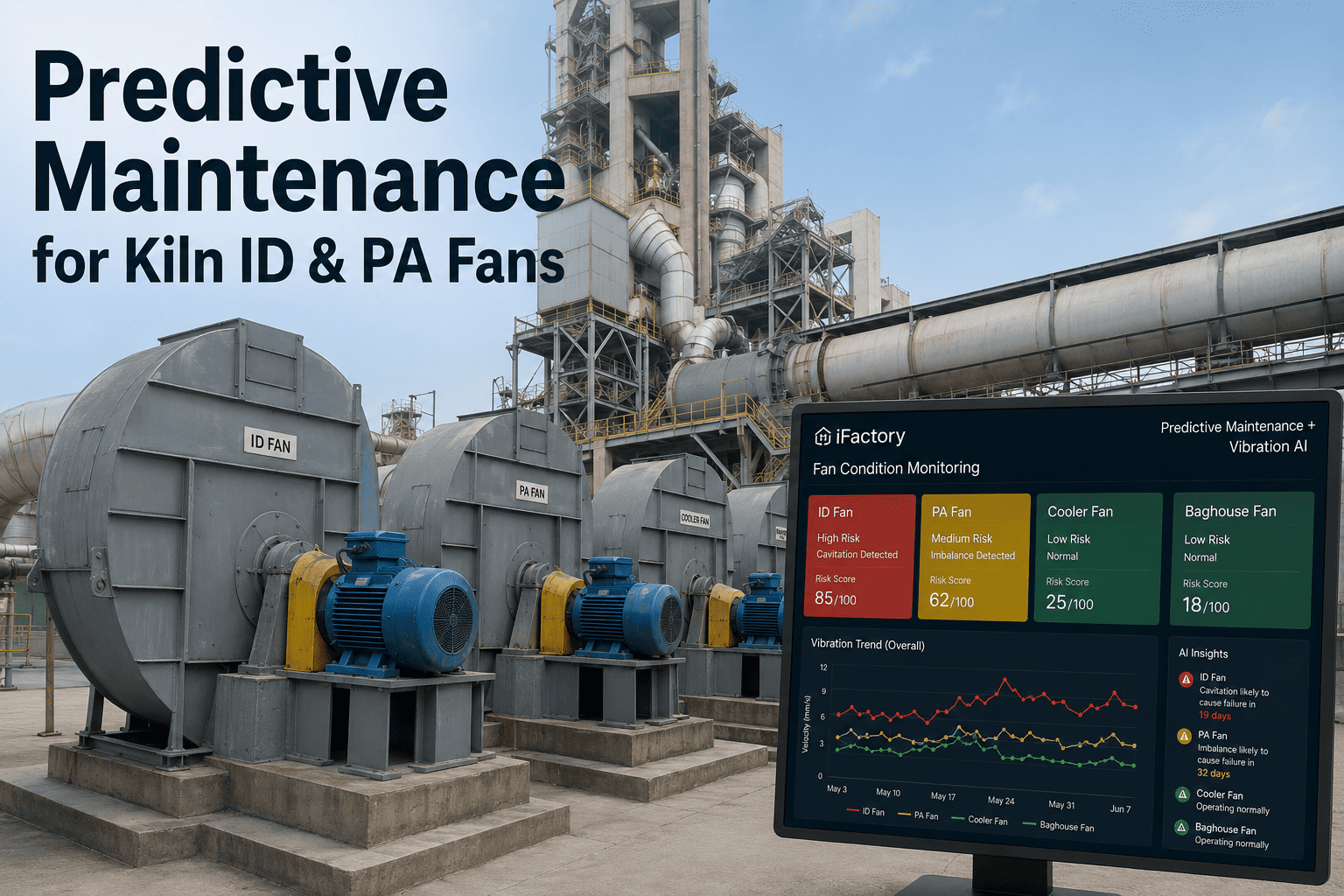
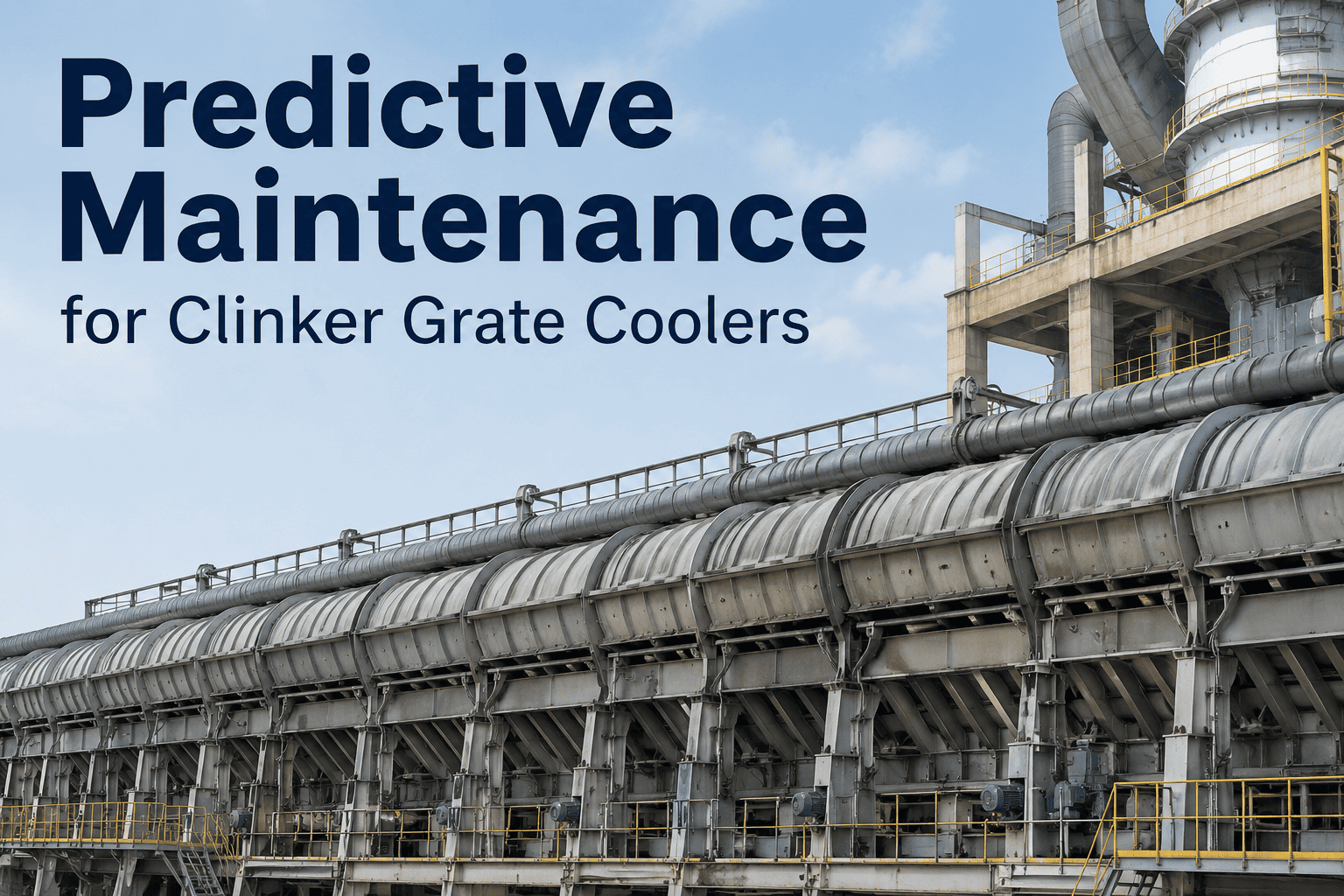
A cement kiln runs at 1,450°C, continuously, and it does not tolerate interruption — starting and stopping the pyroprocessing line is slow, costly, and hard on the refractory, so the whole plant is built around keeping the kiln running. The problem is that the kiln's ability to run depends on a handful of large fans that almost never get the attention the kiln itself does. The induced-draft fan pulls exhaust gas through the kiln and preheater; the primary-air fan feeds combustion air to the burner; the cooler fans quench the clinker; the baghouse fans keep the dust collection and emissions system breathing. Any one of them failing can pull the kiln down, and a single unplanned kiln stop costs on the order of $180,000 a day in lost production — before emergency parts at multiples of list price, overtime, and lost grinding hours. These fans run in the harshest conditions in the plant: hot, abrasive, dust-laden gas that erodes blades, cakes material unevenly onto the impeller, and breaks down bearing grease. And they broadcast their deterioration weeks in advance, in their vibration — if anyone is listening continuously. iFactory's predictive maintenance and vibration AI listens to every kiln-line fan continuously, catching imbalance from buildup, blade wear, bearing faults, and flow disturbances two to four weeks before they force an unplanned pull-out, and turning a would-be kiln stop into a scheduled repair. To see it on your fans, book a demo.
CEMENT PLANT · AI FAN RELIABILITY & VIBRATION
Catch a Kiln Fan Failing Weeks Before It Pulls the Kiln Down.
ID, PA, cooler, and baghouse fans run in the plant's harshest gas stream, and any one failing can stop the kiln — at roughly $180,000 a day. iFactory monitors every kiln-line fan's vibration continuously, detecting imbalance from buildup, blade wear, bearing faults, and flow disturbances two to four weeks ahead, so a developing fault becomes a scheduled repair instead of an unplanned pull-out.
$180K/day
Typical cost of a single unplanned kiln stop
2–4 wks
Warning window from continuous vibration AI
4 fans
ID, PA, cooler, and baghouse — all monitored
90%+
Of developing fan faults caught before a stop
Why a Fan Failure Stops the Whole Kiln
The kiln is the heart of a cement plant, but it can't breathe on its own. The large process fans move the enormous volumes of gas and air that pyroprocessing depends on, and because the kiln runs continuously at extreme temperature, losing a critical fan doesn't just stop one machine — it collapses the process the whole plant is built around. That's what makes fan reliability a production-protection problem rather than a maintenance line item.
The ID Fan Is the Kiln's Lungs
The induced-draft fan draws the huge, continuous volume of exhaust gas through the kiln and preheater — often hundreds of thousands to over a million cubic feet per minute. Without that draft, clinker production stops, kiln temperature collapses, and the entire pyroprocessing line shuts down. No single machine outside the kiln itself carries more of the line's fate.
A Stop Is Slow and Expensive
A kiln running at 1,450°C can't be stopped and restarted quickly or cheaply — the thermal cycle is punishing, and a single unplanned stop costs on the order of $180,000 a day in lost production. The asymmetry is stark: the failing part is a bearing or a blade liner, but the loss it triggers is measured in days of the entire line's output.
Failure Cascades Into Secondary Costs
An unplanned fan failure doesn't stop at lost production — it triggers emergency parts procurement at two to four times standard pricing, overtime premiums, and lost grinding hours that compress finished-cement inventory, sometimes forcing imported clinker to meet commitments. The true cost of a surprise failure runs well beyond the downtime clock.
The Fans Get the Least Attention
The kiln shell and drive are watched closely, but the process fans are often managed on fixed inspection schedules and operator rounds — methods that detect a fault after it produces a visible symptom, not before it produces a stop. The machines most capable of pulling the kiln down are frequently the least continuously monitored.
Vibration analysis is the single most effective predictive technique for rotating equipment in cement plants, catching the large majority of developing fan faults before they cause unplanned shutdowns. The catch is that a monthly handheld reading almost never finds a fault at the early stage where the fix is a scheduled bearing swap — it finds it once it's already advanced. Continuous monitoring is what turns the fans from the plant's blind spot into its most predictable assets.
Four Fans, One Kiln Line to Protect
A cement kiln line runs on more than the ID fan alone — a set of large fans each does a job the process can't continue without, and each fails in its own way. iFactory monitors all of them, because a stop on any one is a stop on the line.
ID FAN
Induced draft · most critical
The induced-draft fan is the kiln's exhaust engine, pulling hot, particulate-laden gas through the kiln and preheater to sustain the draft the process needs. Running at high speed and handling abrasive gas, it's both the most critical fan on the line and one of the most vibration-prone machines in the plant — blade erosion and clinker-dust buildup steadily attack its balance. It's the first asset to instrument and the one where continuous monitoring pays back fastest.
PA FAN
Primary air · combustion
The primary-air fan feeds combustion air to the burner and calciner, so its steady operation is tied directly to flame stability and heat input. A degrading PA fan threatens not just an equipment failure but the combustion conditions the whole thermal process depends on. Monitoring its vibration alongside the ID fan protects the air side of the kiln as closely as the exhaust side.
COOLER FANS
Clinker quench
The clinker cooler fans force air through the grate to quench hot clinker as it leaves the kiln, protecting clinker quality and recovering heat back into the process. Because there are several of them working together, a quiet degradation in one can go unnoticed on rounds until it becomes a trip — exactly the kind of gradual fault continuous vibration monitoring surfaces early across the whole cooler fan group.
BAGHOUSE FANS
Dust and emissions
The baghouse and bag-filter fans keep the dust-collection and emissions system breathing, and their failure carries both a production and a compliance consequence. Handling heavily dust-laden gas, they're prone to buildup and bearing contamination, so monitoring them protects the plant's ability to keep running within its emissions envelope, not just its throughput.
See Your Kiln-Line Fans Monitored Continuously
Bring your ID, PA, cooler, and baghouse fans. iFactory engineers will show how continuous vibration AI detects buildup imbalance, blade wear, bearing faults, and flow disturbances weeks ahead, and how each alert becomes a scheduled work order instead of an unplanned kiln pull-out.
How Cement Fans Actually Fail
Fans in the kiln line don't fail randomly — they fail in a handful of characteristic ways driven by the hot, abrasive, dusty gas they handle. Each mode leaves a distinct signature in the vibration, which is why reading that vibration is how the failures get caught early.
01
Imbalance From Material Buildup
Cement and clinker dust cakes onto the fan blades, and because it builds up unevenly, it throws the impeller out of balance — a high-speed ID fan can accumulate enough particulate to matter within hours. The imbalance shows up as a rising 1× running-speed amplitude, so a growing buildup problem is visible in the vibration long before it shakes the machine apart. It's the most common cement-fan fault and among the clearest to trend.
02
Blade Erosion and Wear
The abrasive, particulate-laden gas steadily erodes the blades and their liners, thinning material unevenly and, in severe cases, loosening a liner section entirely — a detachment at a rotor tip moving hundreds of miles per hour can wreck the housing, shaft, and bearings. Erosion shows as trending 1× and harmonic amplitudes, and a loosening liner drives a sharp vibration rise that gives advance warning before a catastrophic separation.
Bearing Degradation
03
Bearing failure accounts for roughly a third of cement-fan breakdowns, driven by high-temperature grease breakdown and cement dust contaminating the housings. A developing bearing defect generates its own predictable frequency signatures — energy at the bearing's characteristic defect frequencies well before it's audible — so continuous monitoring catches the degradation while the fix is still a planned bearing swap rather than a seized rotor.
Misalignment and Flow Disturbance
04
Thermal growth of the hot ductwork pulls shafts out of alignment, showing as a 2× running-speed component with an axial phase shift, while aerodynamic flow disturbances and instability excite their own vibration patterns. These conditions stress bearings and blades over time, and distinguishing them in the spectrum lets the root cause — not just the symptom — be corrected before it shortens the machine's life.
Each fault type lives at a different frequency, which is the whole reason vibration analysis works: a Fast Fourier Transform converts the raw signal into a frequency spectrum where imbalance, misalignment, and bearing defects each appear in their own place. Read correctly and trended over time, these signatures give two to four weeks of warning — the difference between a scheduled intervention and a kiln pull-out measured in hours of notice.
What the Vibration AI Does
Sensors produce the data, but turning it into weeks of reliable warning takes more than an alarm threshold — it takes a baseline that understands each fan and analytics that recognize a developing fault against the plant's normal process noise. That's the job of the vibration AI.
1
Continuous Sensing on Every Fan
Wireless triaxial vibration and temperature sensors mount non-invasively on the fan bearing housings — magnetic or stud-mounted with no production interruption to install — and stream data continuously rather than once a month. The stethoscope is always on every fan, so a fault that develops between rounds is heard as it happens, not discovered at the next handheld check.
2
Per-Fan Baselines, Not Generic Thresholds
The AI learns each fan's normal vibration signature across its full speed and load range, and calibrates ISO 10816 alert bands to that asset's actual operating profile. Tuning thresholds to the real machine rather than a generic number is what keeps normal process noise from flooding the team with false alerts while still catching the genuine early signs.
3
Fault Classification From the Spectrum
Rather than only flagging that vibration is high, the AI reads the frequency spectrum to classify what's wrong — 1× imbalance from buildup, harmonic trends from blade erosion, bearing defect frequencies, 2× misalignment — so the alert names the fault, not just the symptom. That tells the team what to plan for, turning a warning into an actionable diagnosis.
4
Alert Becomes a Prioritized Work Order
A developing fault routes straight into the maintenance workflow as a work order with a severity and a window — an early inspection alert with a set SLA, or a higher-severity fault escalated into the next planned downtime — rather than a light on a standalone dashboard. The finding lands where the work gets scheduled, closing the loop from signal to fix.
Over time the value compounds: every fault the system catches becomes a labeled signature in the plant's asset-health library, teaching the AI to recognize that pattern even earlier on the next fan. Year one prevents the catastrophic breakdowns; by year three the same monitoring is trimming the fans' energy consumption too, because a balanced, well-aligned fan running clean draws less power.
Weeks of Warning, Not Hours
The entire value of predictive fan monitoring is the size of the warning window it opens. Catching a fault at the vibration stage rather than the failure stage is what converts an emergency into a plan — and the difference is measured in weeks.
EARLY
The Signature Appears
A bearing defect frequency emerges, or the 1× amplitude begins to climb as buildup accumulates — invisible and inaudible on the floor, but clear in the continuous vibration data. This is where a monthly handheld reading sees nothing and where the AI raises the first flag, opening the full warning window.
DEVELOPING
The Trend Confirms
Over days the signature strengthens and trends toward the asset's alert band, and the AI's classification confirms the fault type and its trajectory. The team now has a named, prioritized problem with time in hand — enough to order the right parts at normal prices and slot the work into a planned window.
PLANNED
The Fix Is Scheduled
The repair — a bearing swap, a blade clean or liner replacement, a realignment — is done during planned downtime, coordinated with the kiln-line schedule, before the fault ever reaches the point of forcing a stop. What would have been a pull-out becomes a routine, budgeted intervention.
Read into a maintenance workflow, these signatures deliver days of early warning where manual rounds deliver hours, and plants that act on them convert the large majority of unplanned fan downtime into scheduled work. The dramatic cases make the point: vibration monitoring has caught a loosening fan liner in time to schedule the repair, turning what would have been a violent, machine-wrecking separation into a housing inspection-door replacement.
On-Premise: Your Plant Data Stays In-House
Fan monitoring runs on continuous vibration, temperature, and process data from your kiln line — operational information about how your plant runs and where it's vulnerable — so the AI is built to run on-premise, at the edge, with the reliability a continuous process demands.
Condition Data Stays Local
Vibration signatures, asset-health history, and process data reveal your equipment condition and operating detail, so on-premise and edge processing keeps all of it inside your network and out of any external cloud. Sensitive reliability data about your kiln line never leaves the plant.
Edge Analysis in Real Time
Vibration is high-rate data, and catching a fast-developing fault means analyzing it at the machine rather than shipping every sample to a remote server. Edge processing lets the system detect a rising signature and raise the alert in real time, right where the fan is.
Runs Through Connectivity Gaps
A remote or connectivity-limited plant can't have its fan protection depend on an internet link, so on-premise operation keeps monitoring and alerting running within the plant's own environment regardless of external connectivity — the resilience a 24/7 kiln line requires.
Live in 6 to 12 Weeks
The turnkey model ships a pre-configured, racked-and-ready AI server with the software pre-loaded, so a focused kiln-line fan monitoring scope goes live in 6 to 12 weeks — continuous vibration AI on your critical fans without an open-ended platform build.
Start With the ID Fan, Then Extend
Fan monitoring proves out fastest on the highest-consequence assets, then extends across the kiln line and beyond. The rollout is phased so reliability teams build confidence on demonstrated results, not promises.
1
Instrument the Critical Fans First
Deployment begins with the highest downtime-cost assets — the ID fan and preheater fan train — mounting wireless vibration and temperature sensors non-invasively so there's no production interruption to install. The fans most able to stop the kiln get continuous monitoring first.
2
Baseline Each Asset
The AI establishes each fan's normal signature across its real speed and load cycles and calibrates ISO 10816 thresholds to that profile, eliminating false alerts from ordinary process noise before the monitoring is trusted to drive work.
3
Route Alerts Into the Backlog
Fault classifications are wired to route directly into the maintenance backlog as prioritized work orders with SLAs, not a standalone dashboard, so a detected fault becomes scheduled work — proving the loop from signature to planned repair on the critical fans.
4
Extend Across the Fan Fleet
With results shown on the ID fan, coverage extends to PA, cooler, and baghouse fans and other rotating equipment, and the growing asset-health library sharpens detection across the fleet — making condition-based fan maintenance standard plant-wide.
What Changes in the Plant
AI fan reliability turns the kiln line's most overlooked critical assets into its most predictable ones — every fan monitored continuously, every developing fault named and scheduled, the kiln protected from the surprise pull-out.
01
Unplanned Pull-Outs Become Planned Work
Catching imbalance, wear, and bearing faults weeks ahead converts a would-be kiln stop into a scheduled repair during planned downtime — the single biggest win, turning the fans from the plant's surprise-failure risk into predictable, budgeted maintenance.
02
Every Kiln-Line Fan Covered
ID, PA, cooler, and baghouse fans are all monitored continuously rather than only spot-checked on rounds, so a quiet degradation in any of them surfaces early — closing the blind spots where a single unmonitored fan could still bring the line down.
03
Named Faults, Not Just Alarms
Spectral classification tells the team whether it's buildup imbalance, blade erosion, a bearing defect, or misalignment, so the response is planned and the parts are ordered at normal prices — an actionable diagnosis in place of a late, generic high-vibration trip.
04
Lower Cost and Better Efficiency
Fewer emergency repairs, no premium-priced expedited parts, and cleaner, better-balanced fans that draw less power add up to a large annual saving per plant — reliability and energy efficiency improving together as the monitoring matures.
Frequently Asked Questions
The questions reliability and maintenance engineers ask most often about AI fan monitoring on the kiln line.
We already do monthly vibration rounds on our fans. Why go continuous?
Because the failures that stop the kiln develop faster than a monthly interval can catch. A high-speed ID fan can accumulate enough uneven blade buildup to matter within hours, and a bearing defect or loosening liner can progress from first signature to failure in days to weeks. A monthly handheld reading almost never finds a fault at the early stage where the fix is a scheduled bearing swap — it finds it once it's already advanced, sometimes with only hours of warning left. Continuous monitoring changes the economics of the warning window: the sensor is always on the fan, so the moment a bearing defect frequency emerges or the 1× amplitude starts climbing, the trend begins building and the AI raises a flag while there are still weeks in hand. That's the difference between days-to-weeks of planning time and hours of scramble. Manual rounds also can't easily trend subtle changes over time or classify the fault from the spectrum the way continuous analytics can. Rounds are a reasonable baseline for lower-criticality assets, but for the fans that can pull the kiln down, the gap between monthly snapshots is exactly where the expensive surprises live. To see the warning window on your fans,
book a demo.
How does it tell buildup imbalance apart from a bearing problem?
By where the energy shows up in the frequency spectrum, which is the core of vibration analysis. A Fast Fourier Transform converts the raw vibration signal into a spectrum where different faults appear at different, predictable frequencies. Imbalance — whether from uneven cement-dust buildup on the blades or from blade erosion — shows up primarily as a rise in the 1× running-speed amplitude, because the once-per-revolution heavy spot drives the vibration. A bearing defect is completely different: as the rolling elements pass over a flaw in a race, they generate energy at the bearing's characteristic defect frequencies, which are calculated from its geometry and don't coincide with running speed. Misalignment tends to show as a 2× running-speed component, often with an axial phase shift, and blade erosion adds harmonic content. Because these live in distinct places in the spectrum, the AI can classify what's wrong, not just report that overall vibration is high — so the alert says "buildup imbalance on the ID fan" or "bearing defect developing" rather than a generic high-vibration warning. That specificity is what makes the alert actionable: the team knows whether to plan a blade clean, a bearing swap, or a realignment, and can order the right parts ahead of the planned window.
Will continuous monitoring flood us with false alarms?
Not if the thresholds are set to each fan rather than to a generic number, which is exactly how the AI is designed to work. A cement plant is a noisy environment — fans run across varying speed and load, and process conditions shift — so a single fixed alarm level either sits too low and floods the CMMS with false work orders, or too high and misses the early failure window. The AI avoids that trap by first learning each fan's normal vibration signature across its full speed and load range, then calibrating the ISO 10816 alert bands to that specific asset's actual operating profile. An alert fires when the vibration deviates from what's normal for that machine in that operating state, not when it crosses an arbitrary line, so ordinary process noise doesn't trigger it while a genuine developing fault does. The classification layer helps further: because the system identifies the fault type from the spectrum, an alert comes with a diagnosis and a severity, and lower-severity findings open an inspection work order with an SLA rather than an emergency escalation. This tiering means the team isn't treated to a wall of undifferentiated alarms — they get a prioritized, named set of findings. Getting the balance right is central to the value, because a system that cries wolf gets ignored, and an ignored system catches nothing.
What's the return, given a monitoring system costs money to run?
The return is dominated by avoided kiln stops, and the asymmetry is what makes it compelling. A single unplanned kiln stop runs on the order of $180,000 a day in lost production, and an unplanned failure on a critical fan can take the kiln down — so preventing even a small number of stops a year covers the monitoring cost many times over. Most plants recover the cost of a fan monitoring system within a single avoided failure. On top of the direct downtime, catching a fault early avoids the cascade of secondary costs: emergency parts at two to four times standard pricing, overtime premiums, and lost grinding hours that can force expensive clinker imports to meet commitments — all of which a planned repair avoids. Plants deploying continuous fan analytics report large reductions in unplanned fan downtime, on the order of 70 percent or more, and meaningful annual savings per plant in maintenance and production-loss cost. And there's a compounding efficiency gain that isn't in the headline downtime number: a fan kept clean, balanced, and well-aligned draws less power, so as the program matures it trims the fans' energy consumption too. The projection for your plant depends on your kiln-line fan fleet, stop cost, and current failure rate, which is what a scoping assessment measures — but the core case is simple: the fans can stop the kiln, and the kiln is far too expensive to stop by surprise.
How fast does it deploy, and does our data leave the plant?
Deployment runs in a defined 6-to-12-week window, because the turnkey model ships a pre-configured, racked-and-ready AI server with the software pre-loaded rather than requiring a ground-up build, and the sensors mount non-invasively — magnetic or stud-mounted on the bearing housings — so there's no production interruption to install them. The recommended scope is the highest-consequence fans first, the ID and preheater fan train, so the value proves out on the assets that matter most before extending across the fleet. On data, nothing needs to leave the plant: the system runs on-premise and at the edge, inside your network, because vibration signatures, asset-health history, and process data reveal your equipment condition and how your plant operates. Processing it locally keeps it out of any external cloud. On-premise and edge operation also serves the technical reality that vibration is high-rate data best analyzed at the machine for real-time fault detection, and it keeps monitoring and alerting running within the plant's own environment even where site connectivity is limited or interrupted — important for remote plants and essential for a continuous kiln line that can't have its fan protection depend on an internet link. So you get a fast, non-invasive, bounded deployment and full control of your reliability data at once. Contact
iFactory support to scope your critical fans.
MONITOR EVERY FAN · CATCH THE FAULT EARLY · PROTECT THE KILN
Don't Let a Fan You Aren't Watching Pull the Kiln Down.
Continuous vibration AI on every kiln-line fan — ID, PA, cooler, and baghouse — that detects buildup imbalance, blade wear, bearing faults, and flow disturbances two to four weeks ahead, classifies the fault from the spectrum, and routes it into maintenance as scheduled work before it forces an unplanned pull-out. Per-fan baselines, no false-alarm floods, roughly $180K-a-day stops avoided. On-premise and at the edge, live in 6 to 12 weeks, sensors mounted with no production interruption.