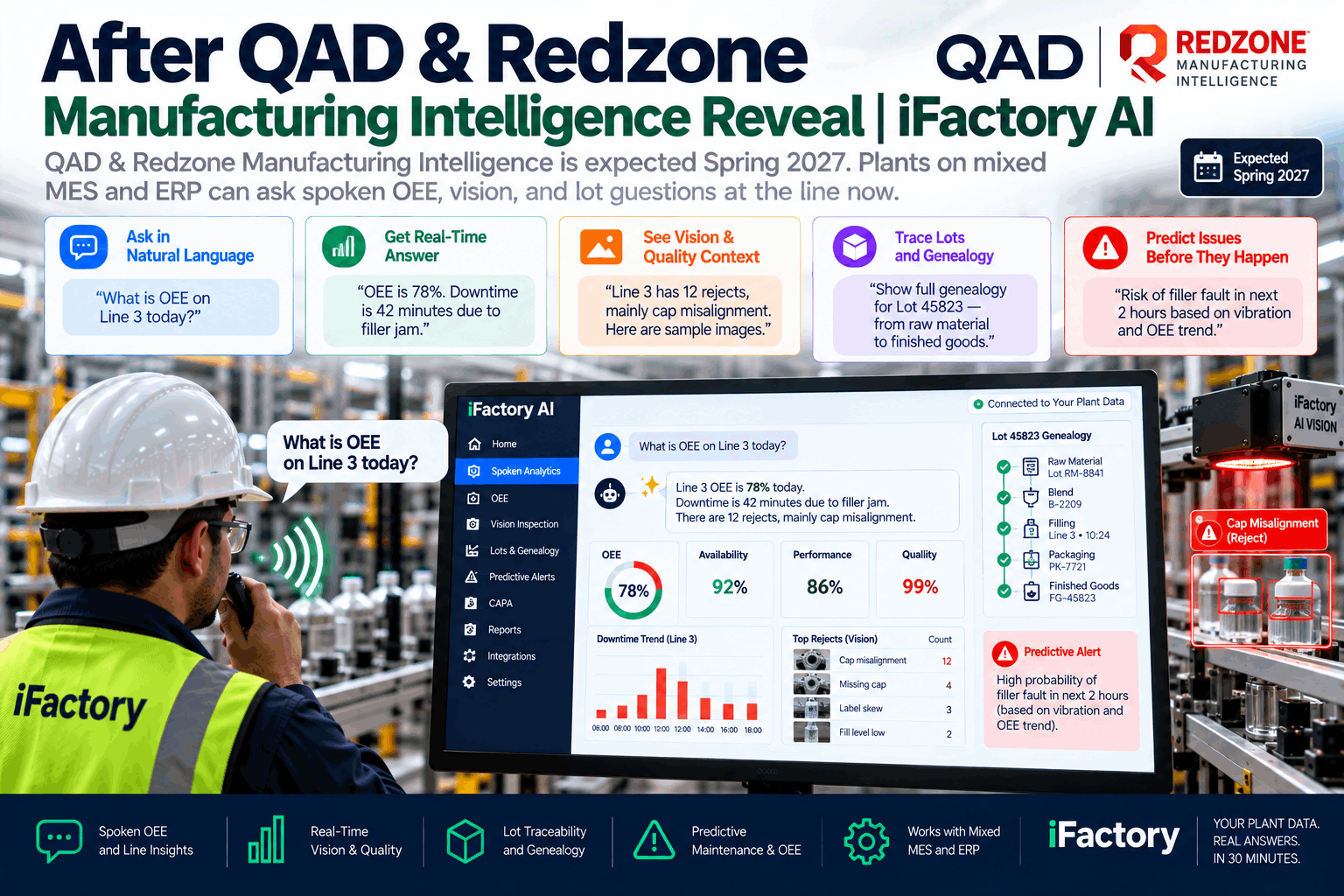
On September 22, 2026, at the Champions of Manufacturing event in Chicago, QAD and Redzone unveiled Manufacturing Intelligence alongside a set of frontline Champions — Line Lead, Ops Manager, Inspector, Kaizen, Yield, Recognition, and Skills. The company says Manufacturing Intelligence is expected in market in Spring 2027. For plant leaders running more than one MES, historian, or ERP, the practical question is what the line lead does with that signal on today shift, well before 2027. iFactory answers plant OEE, vision, and lot-genealogy questions in voice right now — beside whatever systems already run. Book a free 30-minute consulting call to map one line OEE questions to your data.
Agents are moving from the office to the aisle. For mixed-stack plants, spoken OEE, vision, and lot answers do not have to wait for Spring 2027.
At a Glance
What QAD and Redzone Announced, and What Is Still Ahead
Per the QAD press release, Manufacturing Intelligence is an intelligence layer designed to work across Adaptive ERP, Redzone Connected Workforce, Supply Chain, and ChampionAI. QAD also says it is designed to extend beyond its own technology stack, so manufacturers can apply it across heterogeneous environments without first replacing the systems they already have. The same release lists ERP-side additions like Champion Assist and Lynx Champion, which analyzes legacy customizations, plus a Trade Compliance Champion — those serve ERP users and IT teams, a different buyer from the line lead.
A companion release says QAD and Redzone plan to integrate NVIDIA technologies, with initial capabilities using a vision foundation model for quality inspection and a reasoning layer that explains what a detection means for the production order and quality record it touches. Two honest takeaways follow. First, the direction is sound — context from production, quality, and people, in the flow of work. Second, much of it is a roadmap. Manufacturing Intelligence is previewed, not generally available, and plans are plans until they ship.
Why Frontline Agents Matter on the Line
The roles QAD and Redzone chose are telling. A line lead, an inspector, and a yield owner all ask the same kind of question many times a shift — and today those answers usually sit in four or five screens: MES, historian, vision station, SPC tool, and ERP.
- Where did output go since the start of the shift, and which stop cost the most?
- What has the inspection camera flagged in the last hour, and is it the same defect as yesterday?
- Is scrap on this filler drifting, or is it noise?
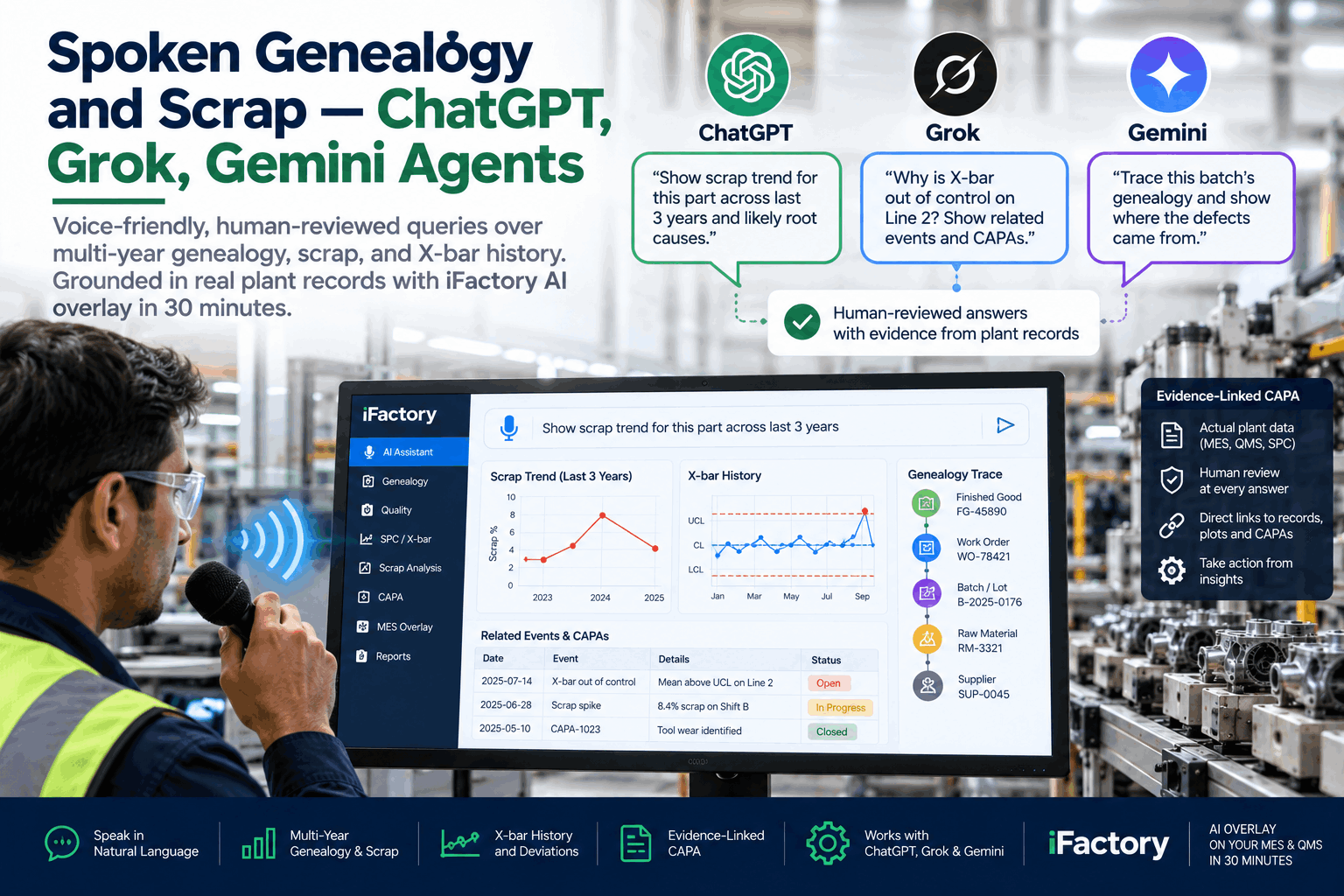
- Which lots ran while the reject rate climbed, and has anyone placed a hold?
- Did the adjustment at 2 PM actually bring the rate down?
- Which line needs help first?
Walking to a terminal, logging in, and building a view takes time a line lead does not have. That is the gap spoken, agentic help is meant to close, and it is why the category keeps moving this way.
The Mixed-Stack Reality
Many plants do not run one vendor stack end to end. Acquisitions leave one site on one ERP and another site on a different one. A plant may run a commercial MES on two lines and spreadsheets on a third. Vision stations often come from the machine builder. An intelligence layer planned for Spring 2027, even one designed to reach beyond its own stack, does not change what a line lead can ask on this week night shift. That is the space iFactory is built for — plants that want spoken answers on OEE, quality, and lots across the systems they already run, with their own people deciding what happens next.
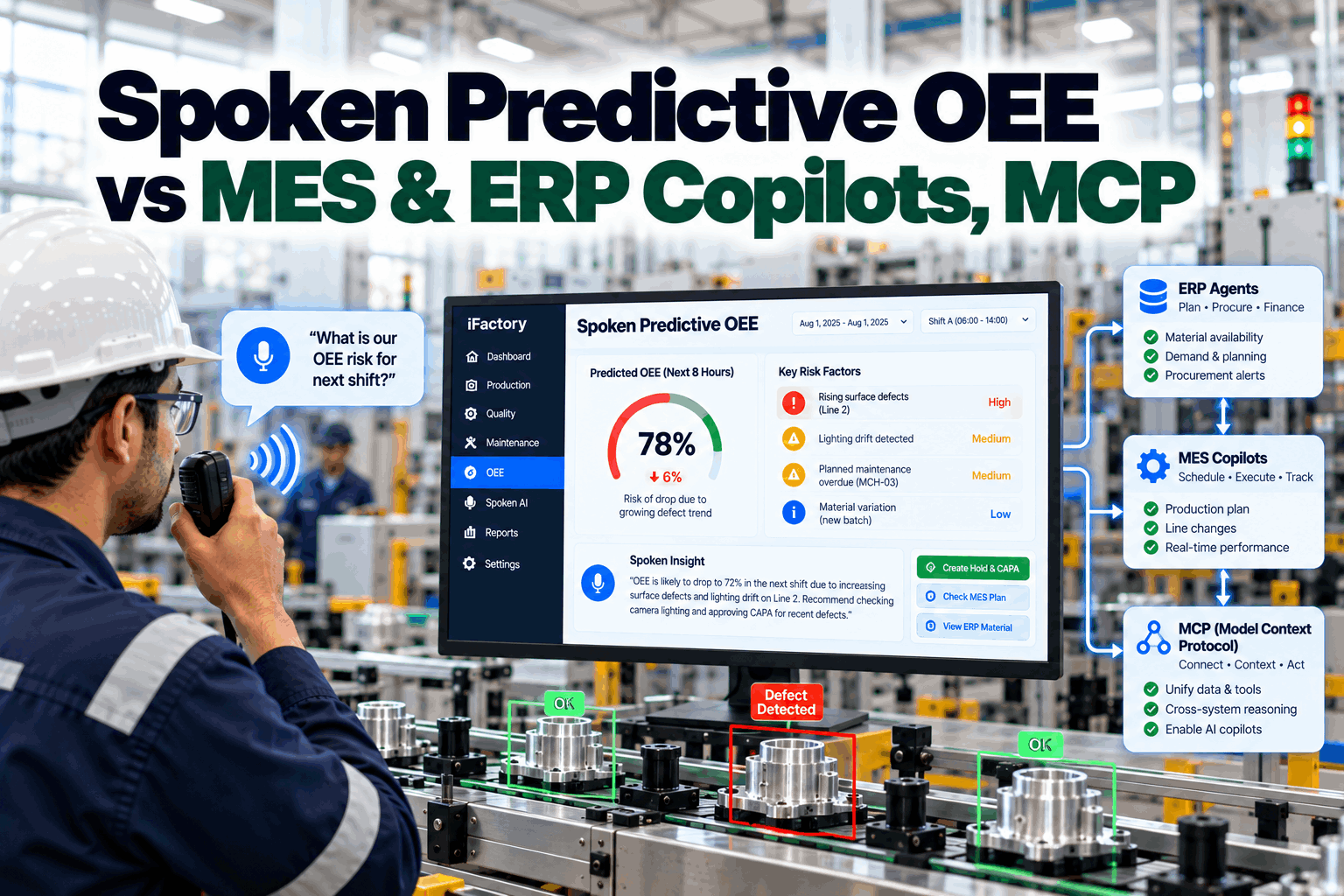
What Spoken Predictive OEE Looks Like With iFactory
The iFactory agent reads your plant data — MES, historian, PLC and SCADA, ERP, QMS, vision system, and batch genealogy — by category and per your confirmed connections. A line lead wearing a headset asks a question and hears a short answer grounded in that data. When the question needs more depth, the agent emails a deep-dive report as a PDF or document. The session carries across channels, so a question started on the headset can continue on a tablet at the line or a desktop in the office.
Where did output go since 6 AM? Breaks down where the output went from your MES and historian data.
What did the camera flag this hour? Tells you what the inspection camera flagged at result level (vision feed scope to confirm).
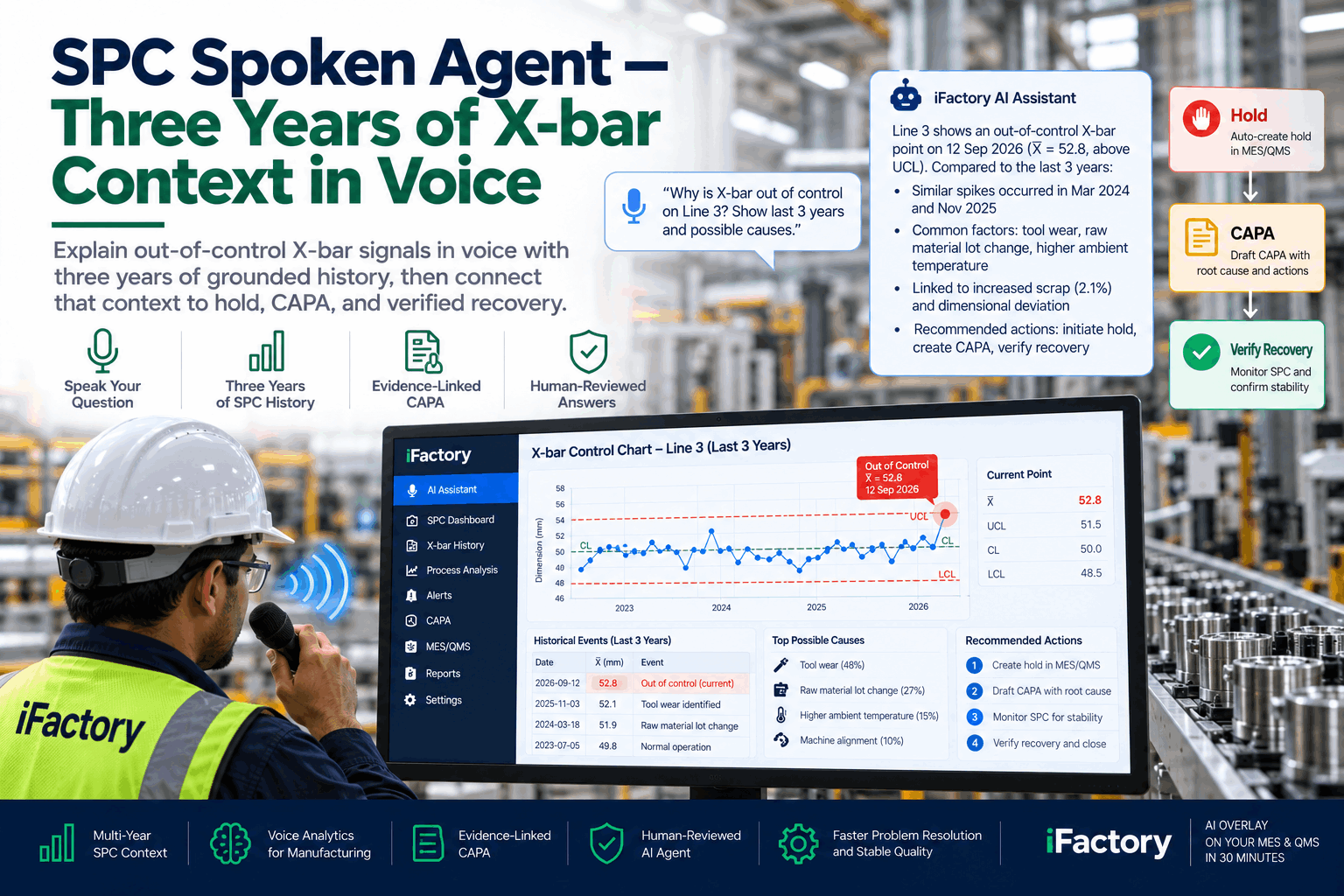
Is scrap on filler 2 drifting? Checks your SPC charts and gives the short version out loud.
Which line needs help first? Compares lines against the plan you share with it.
What keeps coming back? Summarizes repeat stops and defects over the period you ask about (scope to confirm).
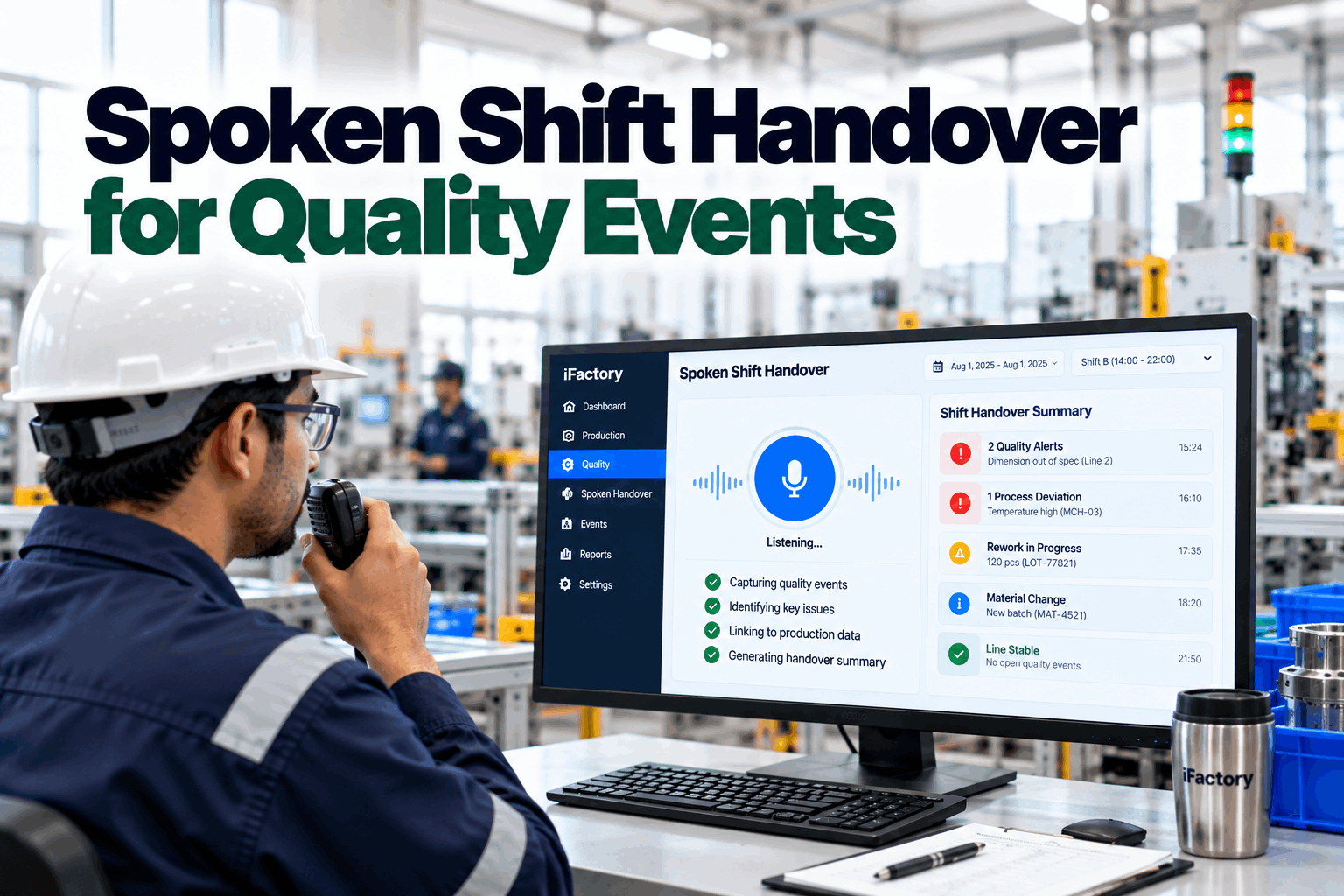
What does the next crew need to know? Summarizes losses, holds, and open items across the shift.
The word predictive here means trend-aware — the agent is designed to point out losses that are building, such as a stop reason that keeps growing or a defect rate that is creeping up, so the team can act before the shift is lost. It reads you those signals when you ask. It does not act on its own. Holds, schedule changes, and corrective actions stay with your people and are entered in your MES or QMS, where the screen stays the record.
Bring one workflow you care about. We walk through the systems it touches, the questions the line lead already asks, and how spoken answers can start beside them.
Templates Built Around Proven Plant Practices
Plants do not need a build-from-scratch project to start. iFactory uses templates built around proven plant practices — an OEE loss breakdown, downtime reason review, SPC review for key characteristics, lot trace after a quality signal, and a shift handover summary. Your team picks the practices that matter, and the agent runs on top of them against your data. Which templates are available for your plant is confirmed during scoping.
How to Evaluate Now Versus Waiting for 2027
Waiting is a reasonable choice for some plants, especially those already standardizing on QAD and Redzone. For plants with mixed systems, a short evaluation helps you decide with facts. Ask any vendor — including iFactory — the same questions.
- What is generally available today, and what is roadmap? Get dates in writing.
- Which of our systems does it read, and how? Categories are a start; your specific MES, historian, and vision stations are what matter.
- Who approves actions? Holds, schedule changes, and work orders should stay with named people.
- Where does the data live, and what leaves the building? Ask for the architecture, not a promise.
- What does our team do? Data access, mapping, reviewing answers, and training crews all take real time — get an honest plan.
A low-risk first step looks like this: one line, read-only, one shift pattern, with the line lead asking the questions they already ask today. Run it beside the current routine, compare the answers, then decide whether to expand.
Where iFactory Runs
iFactory runs at your facility on NVIDIA-based systems — edge-first near the lines, in a server room, or both — with the data backed up to the cloud you pick. There is no one-size-fits-all hardware answer: configurations range from 32 GB to 1 TB and beyond, sized to your lines, cameras, and users with you. Your OT security lead reviews where data lives, what leaves the building, and who holds the keys before each phase.
Frequently Asked Questions
It is an intelligence layer announced on September 22, 2026, designed to work across QAD ERP, connected workforce, supply chain, and ChampionAI and, per the company, beyond its own stack. QAD says it is expected in market in Spring 2027.
QAD announced Line Lead, Ops Manager, Inspector, Kaizen, Yield, Recognition, and Skills agents at the event. Check availability and scope for your plant directly with QAD and Redzone, and separate what is shipping from what is planned.
No. iFactory works beside the systems you run, including plants with more than one MES or ERP. It reads your plant data and answers questions by voice — your people keep making the decisions in the systems of record.
A line lead asks where output went, what the camera flagged, or whether scrap is drifting, and hears a short answer from plant data. Deeper questions produce an emailed report. The agent points out building losses when asked; people decide what to do.
Pick one line and one set of questions, run read-only beside the current routine for a few shifts, and compare. The timeline depends on data access and your team review time, and we scope it with you.
If your plant runs a mix of systems and wants spoken answers on OEE, quality, and lots before 2027, start with one line and one set of questions. No obligation.