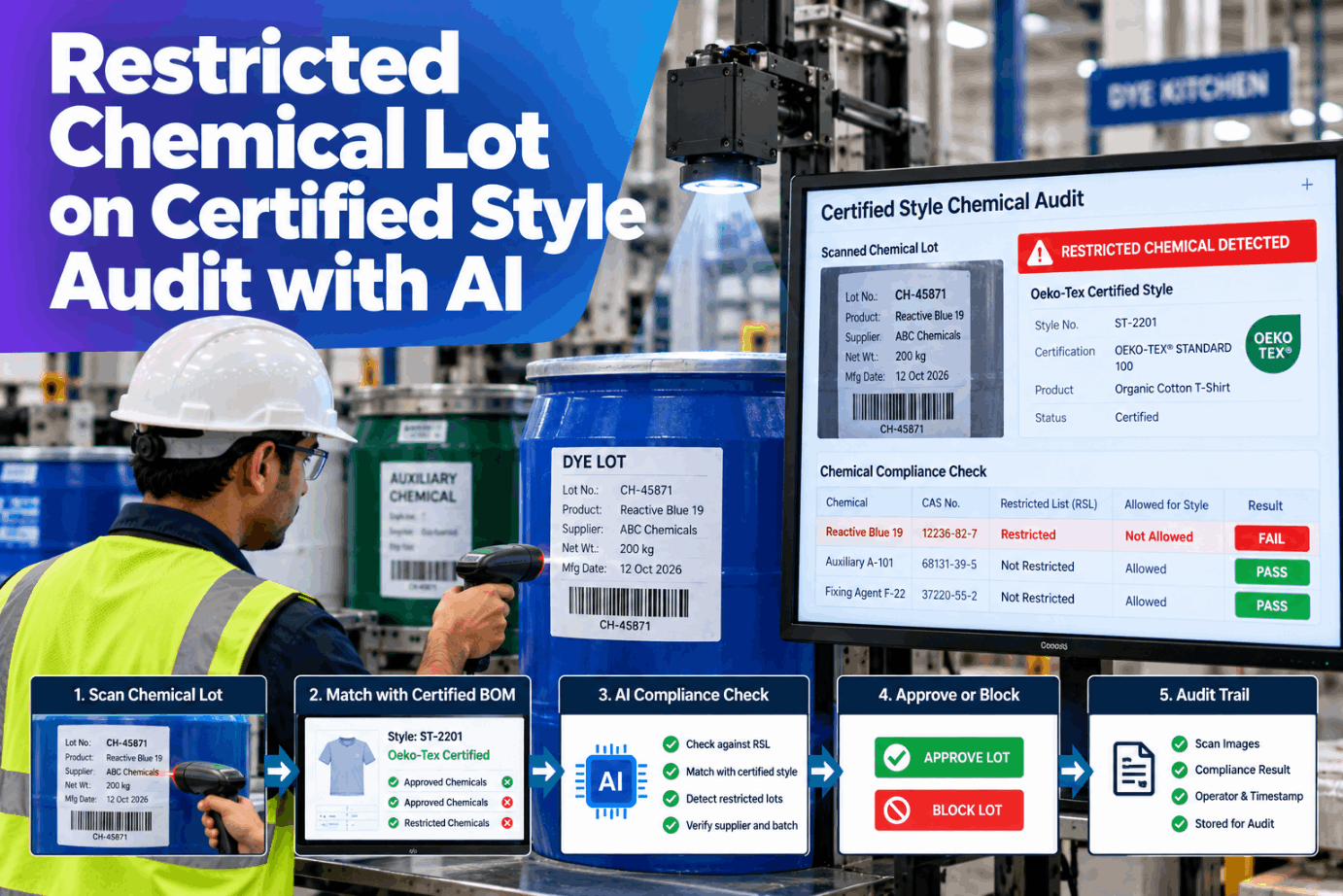
In a dye kitchen, a certified style and a non-certified one can pull from the same rack within the same hour. If a dye or auxiliary lot that isn't on the style's approved list reaches the machine, the fabric may still pass every shade check while the OEKO-TEX certificate no longer reflects what was made. Restricted chemical lot control stops that at the dispense point by reading each container and checking it against the certified style before the scale opens. Watch an off-list lot get stopped in a short dispense control demo.
Stop an Off-List Chemical Lot at the Scale, Not After the Dye Run
iFactory reads every container label and barcode at the dispense station and checks the lot against the approved chemical list for the certified style. If the lot isn't approved, dispense is blocked and the event goes into the audit log.
STANDARD 100 Certifies the Article, ECO PASSPORT Certifies the Chemical
The two labels are easy to confuse, and the difference decides what your dye kitchen must control. OEKO-TEX STANDARD 100 certifies textile articles at every stage from yarn to finished product, tested against a list of more than 1,000 substances. The STANDARD 100 document states that chemicals, auxiliaries and colourants aren't covered by it. Those can be certified under ECO PASSPORT. Compare your own certificates with our chemical compliance team.
- Certifies yarns, fabrics and finished textile articles
- Limit values depend on the article's product class
- Certificate issued for one year, then renewed
- Holder keeps production matching the tested samples
- Certifies chemicals, colourants and auxiliaries
- CAS number screening, lab analysis and self-assessment are mandatory
- On-site visit is optional, at the applicant's request
- Certificate valid for one year
OEKO-TEX publishes new regulations annually. The 2026 set took effect on 1 June 2026 after a transition period, so record which edition each certificate was issued under.
Four Classes, With Tighter Limits the Closer a Textile Sits to Skin
Each certified article falls into one of four product classes, and the limit values follow the class. Class I, for babies and toddlers up to 36 months, has the strictest limits. Build your approved chemical list per style and per class, because a chemical that suits a class IV curtain may not be acceptable on class II bed linen. Review your class split in a style mapping session.
Four Lists Your Dye Kitchen Has to Answer To
Certification limits are only one layer. Many brands also require ZDHC MRSL conformance, which controls substances intentionally used in manufacturing, and an RSL, which limits substances in the finished product. The AFIRM Group's RSL for apparel and footwear is a common base that brands adopt or extend. Each list asks a different question, so the rule layer keeps them apart. Ask our support team how list editions are kept current.
Why a Quiet Chemical Swap Puts a Certified Style at Risk
The certificate covers the article as tested. The STANDARD 100 document asks the holder to inform the institute immediately of changes to materials, mixes, technical procedures or recipes, and treats products made through a different process as uncertified until the institute confirms them. A swap that looks routine to purchasing can become a certification issue on the floor. Confirm the exact wording in your own certificate terms, and see how swaps are flagged in a change control demo.
A Camera Reads the Label, Never the Chemistry
No camera can detect what is inside a drum. A restricted substance looks exactly like a compliant one, and two lots of one product look the same whether or not the supplier reformulated. What vision does well is read the label, barcode, supplier code and lot number at the moment of dispense. The rule layer then checks that lot against the style's approved list, while supplier documents and lab tests cover the chemistry itself. Map this split for your kitchen with our support engineers.
Certification evidence such as ECO PASSPORT, supplier SDS and declarations, MRSL conformance evidence, certificate dates held in the rule layer, and periodic lab tests on chemicals and finished fabric.
Ask the Kitchen Log Which Styles Were Exposed
A chemical compliance manager needs answers by style and by lot, not a pile of dispense slips. iFactory replies in plain language, with the label photo and the rule result behind every reply.
Five Gates Between the Recipe and the Machine
Each gate is a decision point, and a lot that fails any of them never reaches the dye machine. The gates follow the order the kitchen already works in, so operators see one extra check rather than a new process. Plan the gates for your kitchen in a dispense walkthrough.
An Approved Chemical List for Each Certified Style
The rule check is only as good as the list behind it. Keep one list per certified style, owned by chemical compliance and reviewed whenever a certificate is renewed or a supplier changes a product. The fields below are a working example. Our support team can share a blank copy.
Six Reasons a Dispense Gets Blocked
Most blocks are routine and quickly cleared, which is exactly why each one needs a reason code. A clear reason tells the kitchen what to fix and shows the auditor that the control works. Work out your reason codes in a rule design session.
The Record an Auditor Asks to See
An audit question about chemistry usually starts with one batch: what went into it, and how do you know? The evidence log answers with records written at the moment of dispense, each carrying the photo of the label. Talk through your usual audit questions with our support engineers.
Count the Minutes Spent on Manual List Checks
Avoided recalls and protected certificates are real value, but they are hard to size and shouldn't be guessed. The time spent checking paper lists at the scale can be counted. The inputs below are assumed, and the result is arithmetic only. Run it with your own numbers in a short costing session.
Automatic checks don't remove review. Exceptions still go to a person, so use your own block rate to estimate how many of those hours remain.
Dispense Cameras, Rule Engine and AI Server, Shipped Ready
iFactory delivers dispense-lot vision and the certified-style rule check as a single turnkey bundle. A pre-configured NVIDIA AI server ships racked and ready with label and barcode reading models loaded, so label images are processed inside the plant. You rack it, plug in power and Ethernet, and the AI is live. Price it for your kitchens with our support team.
- Pre-configured NVIDIA AI server, racked and ready
- Label cameras at each dispense station
- Reading models for labels, barcodes and lot numbers
- Approved chemical lists per certified style
- Links to the dispensing system and scales
- Block reason codes and an audit evidence log
- Remote monitoring of models and hardware
Approved lists loaded per style, cameras fitted at dispense stations, scale and dispenser links tested.
Reads and rule results logged without blocking while compliance reviews every mismatch.
Dispense blocks enabled, kitchen staff trained and a first audit file produced.
Built for Dye Kitchens That Supply Certified Styles
iFactory keeps the camera on what it can read and leaves chemistry to documents and labs, with one rule check joining them at the scale. Plan a single-kitchen pilot in a planning call.
What Chemical Compliance Managers Ask About Dispense Checks
Only Approved Chemistry Reaches a Certified Style
Read every container at the scale, check it against the certified style's approved list and block anything off-list before it reaches the machine. Delivered turnkey, live in 6 to 12 weeks.