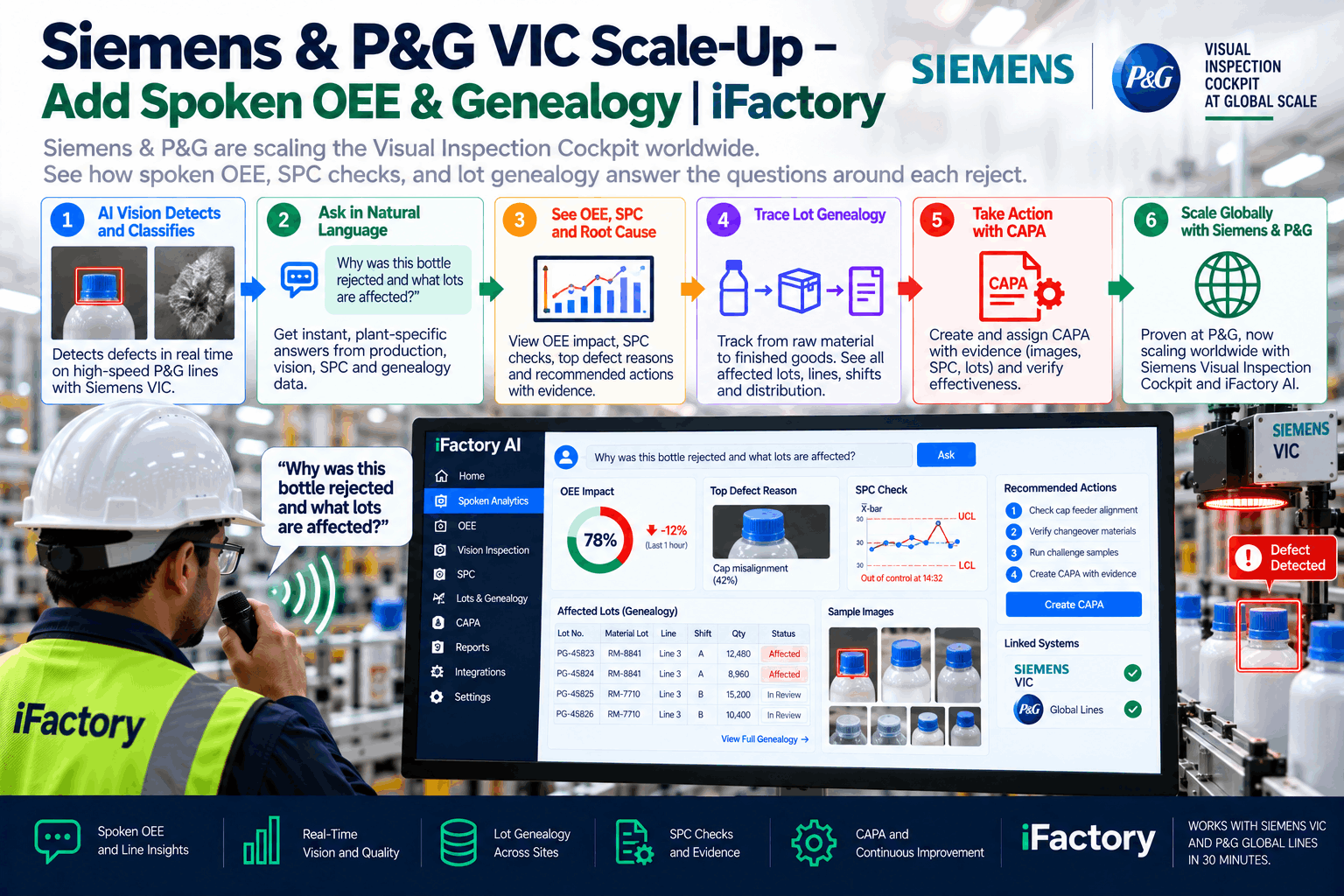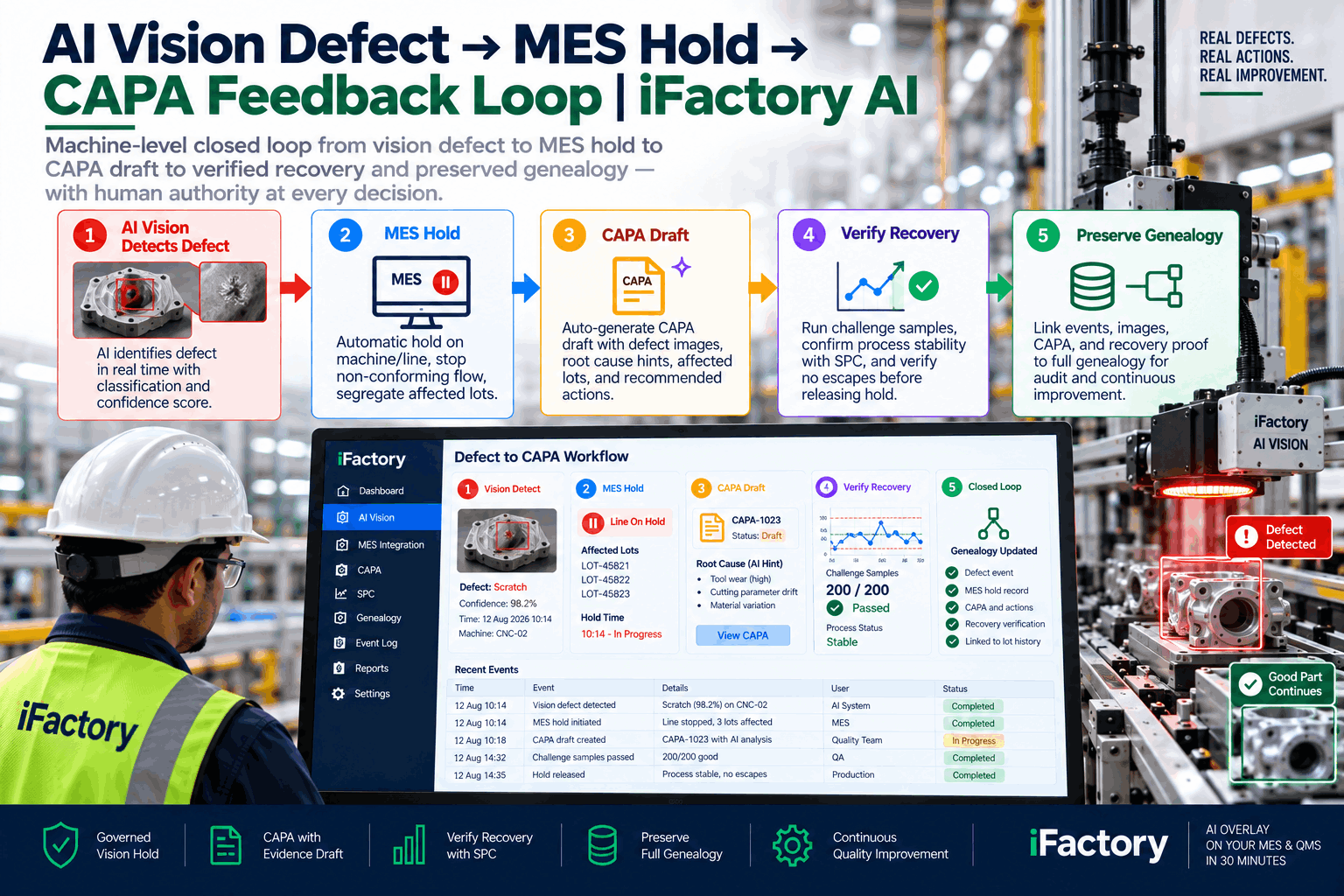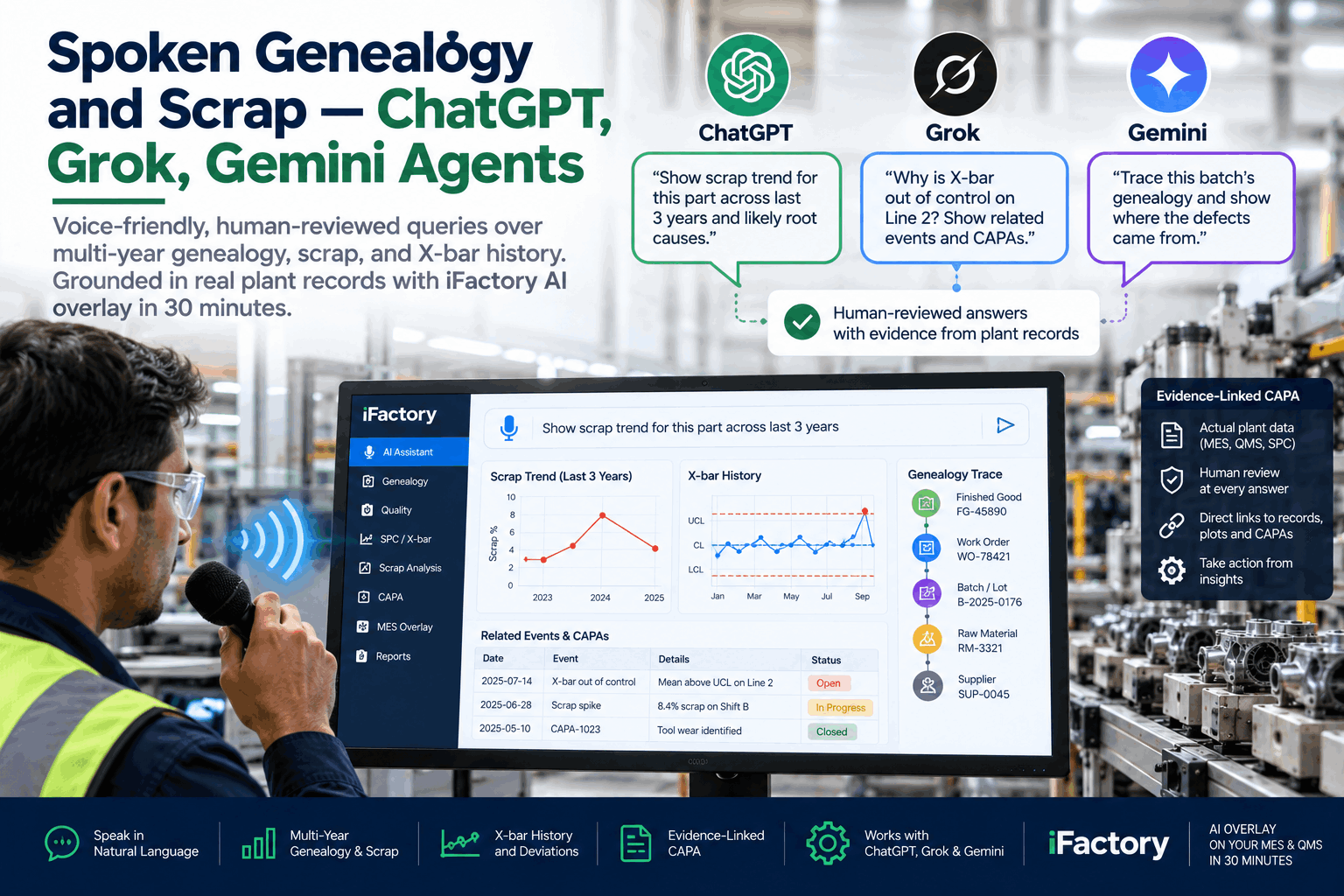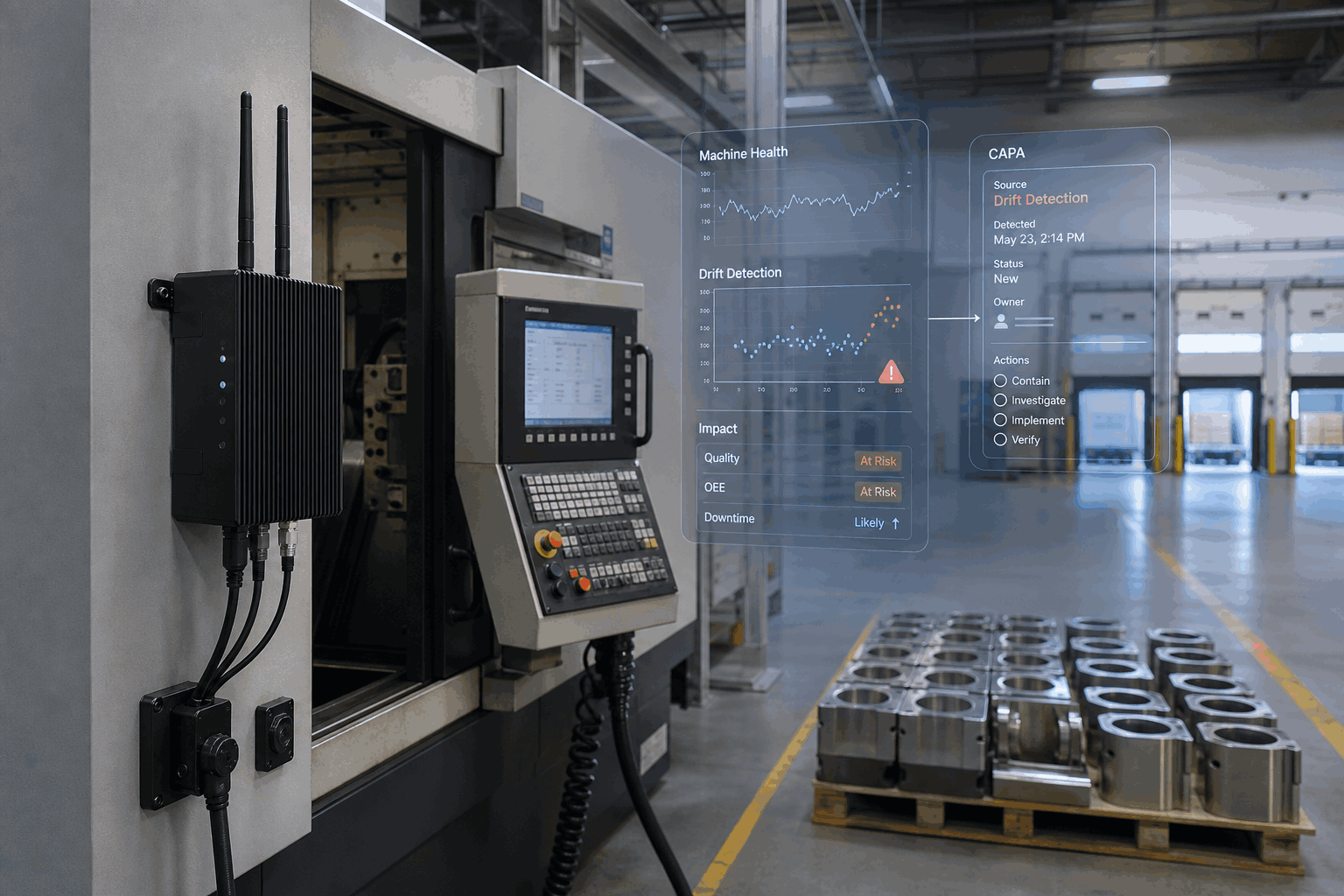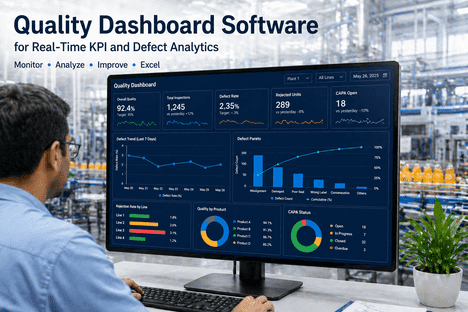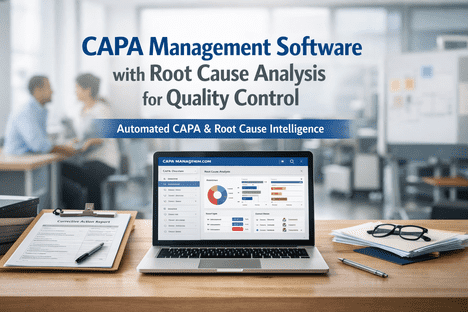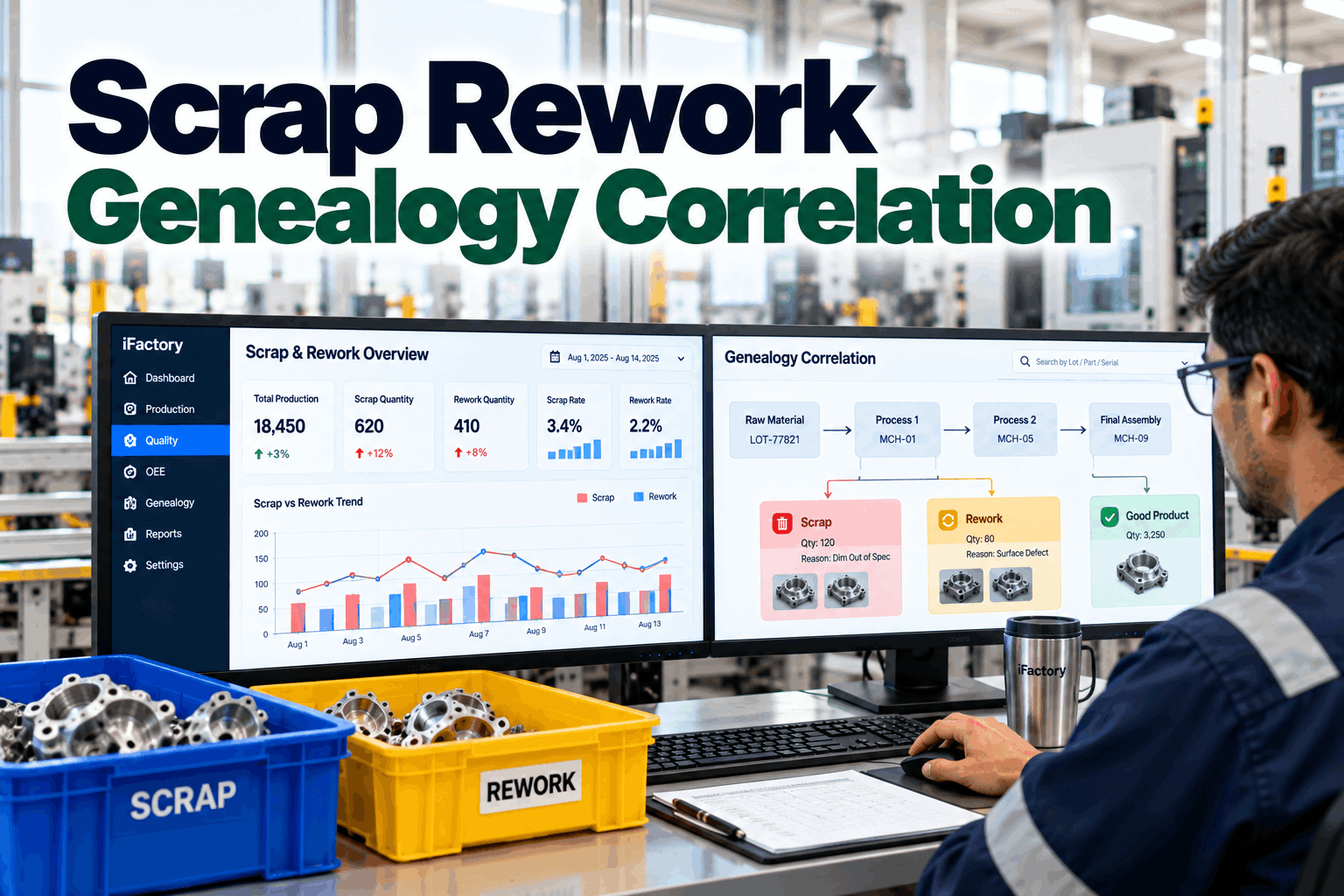
Scrap climbs on a Tuesday, rework doubles on Wednesday, and the plant manager wants to know whether it is the same story or two different ones. Answering that requires more than a Pareto chart. It requires the genealogy trail — which lots, machines, recipes, and shifts appear together across the scrap and rework records. iFactory AI overlays your MES, QMS, historian, and SPC stack so scrap and rework are reviewed together through a shared genealogy correlation view, with human sign-off on the resulting hypothesis before CAPA opens. Book a 30-minute walkthrough of a scrap and rework correlation review.
Two symptoms sharing an upstream lineage is a signal. Two symptoms with no shared lineage is coincidence. Genealogy is what tells them apart.
At a Glance
Why Scrap and Rework Should Be Reviewed Together
In many plants, scrap and rework live in different reports, owned by different teams, reviewed on different rhythms. That separation is convenient administratively and expensive analytically. Scrap and rework are often two symptoms of the same underlying condition. When a supplier lot has an out-of-window property, some downstream units may fail outright and be scrapped, while others may be marginal and diverted to rework. When a machine drifts, some parts may exceed a hard limit while others sit just inside tolerance and can be reworked. When a shift executes a changeover differently, the same recipe may produce a distribution of outcomes across scrap, rework, and good.
Reviewing scrap and rework in isolation risks missing that shared story. When the two are reviewed together with a genealogy lens, the plant can see whether the elevated numbers concentrate on the same lots, machines, recipes, or shifts — the signature of a shared cause worth investigating.
Correlation Dimensions Worth Reviewing First
Do scrap and rework concentrate on the same supplier lot, sub-lot, or upstream WIP branch?
Do both symptoms occur on the same machine, tool, chamber, or cavity during the same production window?
Did a recipe revision or setpoint change precede the elevated numbers on both sides?
Are the same shift patterns, crews, or setup teams overrepresented across scrap and rework?
Is the same defect signature present in both, suggesting an upstream driver rather than two independent issues?
Do the elevated windows overlap in time, or lag each other in a way that hints at process propagation?
What iFactory Delivers
iFactory reviews scrap and rework through one genealogy lens and hands your quality team a hypothesis worth testing.
Both symptoms on one timeline instead of two separate reports.
Defect modes against lots, machines, recipes and shifts, with concentrations highlighted.
Suspected driver, affected population, expected pattern and disconfirming evidence.
Only the genealogy-linked units, for your team to approve.
Ask whether this week's scrap and rework share a cause and hear the evidence.
Past correlation reviews kept so repeat drivers show up in CI planning.
Bring one recent week where scrap and rework both climbed. We walk through lot, machine, recipe, and shift correlation — beside your existing MES, QMS, and SPC.
From Correlation to Testable Hypothesis
A correlation view earns an investigation. It does not conclude one. The next step is to turn the correlation into a testable hypothesis and then let the plant team decide how to test it. That means writing the hypothesis in a specific enough form that the answer can be yes, no, or partially. A vague hypothesis produces a vague CAPA and eventually a repeat event.
A testable hypothesis usually names the suspected driver (a specific lot, machine, or recipe change), the population expected to be affected (which downstream units share the evidence), the expected pattern (concentration in a specific defect mode or shift), and the disconfirming evidence (what would prove the hypothesis wrong). With those four elements in place, the containment scope is deliberate, the CAPA is bounded, and the verification is straightforward.
Closed-Loop Follow-Up After the Correlation Review
Once the hypothesis is confirmed, disconfirmed, or partially supported, the plant team moves through the standard containment and CAPA loop with better inputs. Containment is scoped to the genealogy-linked population rather than the full production window. CAPA is written against the specific driver rather than a generic loss category. Verification runs on the next production window with the same lot, machine, or recipe context, and the results are stored back against the same genealogy record for future reference.
This closed loop is what turns a one-time investigation into a durable improvement. When the next similar signal appears — a scrap spike on a similar lot family, a rework climb on the same machine — the plant already has the prior investigation record, the hypothesis that was tested, the outcome, and the follow-up. Instead of restarting the investigation from scratch, the team can build on what was learned. Over time, the plant develops a body of correlation reviews that shortens the time-to-diagnosis on new events and reduces the risk of missing the same pattern twice. The value is not in any single review — it is in the compounding effect of many reviews that all follow the same discipline of correlate, hypothesize, test, and record.
This is also where the CI cadence benefits. When correlation reviews are recorded in a shared format, the CI lead can spot recurring drivers across time — a supplier lot family that repeatedly correlates with defects, a machine that repeatedly shows up in scrap clusters, a recipe version whose transitions repeatedly produce rework spikes. Those recurring drivers are the natural inputs to the next CI project, and they are visible only because the correlation reviews were done and recorded consistently.
Frequently Asked Questions
Because they are often two symptoms of the same underlying condition. Reviewing them together with a genealogy lens reveals shared lots, machines, recipes, or shifts that a single-symptom view would miss.
Genealogy links downstream units back through their upstream lineage — supplier lot, machine, recipe, shift — so the review can see which of those dimensions concentrate on both scrap and rework.
Correlation earns investigation, not conclusion. A CAPA should be opened against a testable hypothesis reviewed and signed off by the quality team, not against the correlation view alone.
By checking whether unrelated units also show the pattern, by looking for disconfirming evidence, and by preserving human review before any CAPA or containment action.
It organizes evidence from MES, QMS, historian, and SPC into a review-ready summary. The quality team makes every decision that changes containment, CAPA, or release.
That is how scrap and rework become continuous-improvement inputs instead of recurring fire drills. iFactory AI helps assemble the review — your team owns the decision.