Seamer Maintenance for Beverage Cans: Double Seam Checks

By James C on October 22, 2026

seamer-maintenance-beverage-cans-double-seam-checks

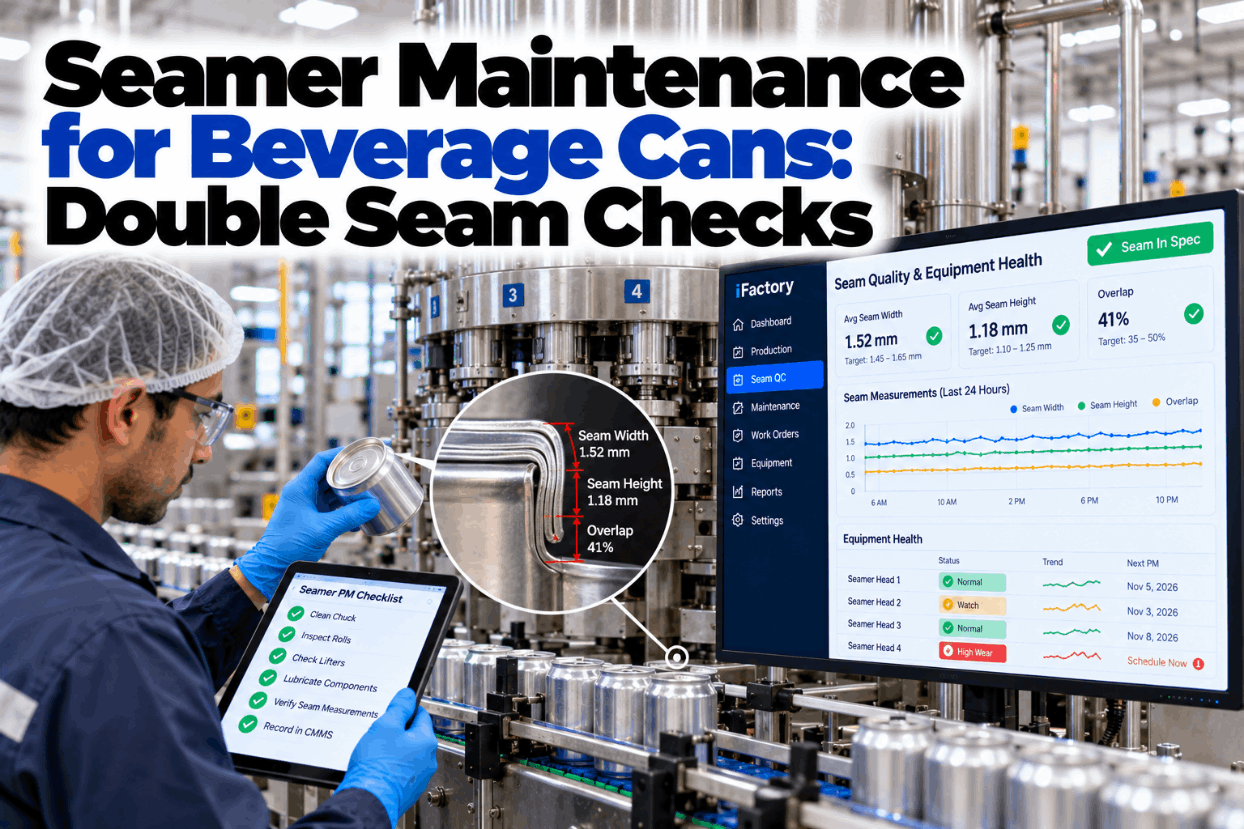
A beverage can is only as good as the five thin layers of metal folded together at its rim. When a seaming roll wears or a chuck loses its edge, the double seam drifts slowly, check by check, until leakers and swollen cans show up in the warehouse. Seamer maintenance for beverage cans works best when every teardown result is tied to the head, roll and chuck that made it. See how per-head seam trends drive roll and chuck changes in a short seamer QC demo.

SEAM QC · PREDICTIVE SEAMER PM

Catch Double Seam Drift Per Head, Then Change the Roll Before It Leaks

iFactory Seam QC takes seam measurements imported from your seam scope or spoken at the bench. It trends every head, links drift to roll and chuck wear, and schedules the change before the seam leaves spec.

Seamer 2 · Head 5 teardown10:40 check
Compared with your can and end supplier spec
Seam thicknessUpper third of spec3rd rise
Countersink depthIn specStable
Body hookIn specStable
TightnessSlight wrinkleWatch
Spoken at the seam bench"Seamer two, head five. Thickness and countersink in spec, slight wrinkle."
iFactory confirmsHead 5 logged. Thickness has risen three checks running. Second op roll check booked for Thursday's planned stop.
DOUBLE SEAM INSPECTION

What Each Seam Measurement Tells You

A double seam interlocks the can body flange with the end curl, then irons them tight against a sealing compound. Every dimension in a teardown says something about the machine that formed it. The seam specification itself comes from your can and end supplier, so use their limits, not generic numbers. Overlap is usually calculated as cover hook plus body hook plus end thickness, minus seam width. Check your spec sheet against these links with our canning support team.

Measurement
What it describes
How it is usually measured
Drift often points to
Seam thickness
Overall thickness of the five folded layers
Seam micrometer or thickness gauge
Second op roll setting or wear
Seam width (length)
Height of the seam along the can wall
Micrometer or seam scope
Roll profile and height setup
Body hook
Body flange turned down inside the seam
Seam scope image or teardown
Base plate pressure, flange
Cover hook
End curl folded up behind the body hook
Teardown with micrometer
First op setting, base plate pressure
Overlap
How far the two hooks lock together
Seam scope or calculated
Short hooks on either side
Countersink depth
Depth from seam top to end panel
Countersink gauge
Chuck wear, lifter pressure
Tightness (wrinkle)
How well the cover hook wrinkle is ironed out
Visual rating on the torn-down hook
Loose or worn second op roll
CAN SEAMER ROLLS AND SEAMER CHUCK

Four Parts at Every Head That Shape the Seam

Each seaming head works in two steps. The first operation roll, with a narrow, deep groove, curls the end around the body flange. The second operation roll, with a shallow, flat profile, irons the hooks tight and presses compound into the gaps. The chuck supports the end from inside, and the lifter or base plate holds the can up against it. Wear on any one of the four shows up in the seam first. Plan PM intervals per part in a seamer PM review.

1
Lifter / base plate Pushes the can up against the chuck at a set pressure Too high: buckling, deep countersink, short cover hook. Too low: risk of deadheads.
2
Seamer chuck Anvil inside the end that the rolls press against Worn lip or damage: loose spots, changing countersink, cut-overs.
3
First operation roll Forms the hooks and sets how they interlock Wrong setting or groove wear: droops, short hooks, low overlap.
4
Second operation roll Irons the seam flat and tight Loose or worn: thick seams and wrinkle. Too tight: sharp seams.
Bearings matter too

A roll with a rough or loose bearing can give a seam that varies around the can. That is why many plants check roll bearings and play at each planned stop, not only the groove profile.

SEAM TEARDOWN SCHEDULE

When to Check the Seam

For low-acid canned foods, 21 CFR 113.60 sets visual seam checks at least every 30 minutes and teardowns at least every 4 hours, plus checks after a jam, an adjustment or a long shutdown. Most carbonated soft drinks and beer fall outside that rule, but many beverage canners use the same rhythm as their benchmark, with every head covered. Agree your own schedule with QA and your can supplier, and ask our support team how it maps into iFactory.

Start-up
Full check, every headAfter the seamer warms up, before releasing product
About every 30 min
Visual seam checkLook and feel for droops, vees, cut-overs and sharp seams
About every 4 h
Teardown or seam saw, per headFull measurement against the supplier spec
After any event
Extra check on affected headsJams, adjustments, roll or chuck changes, new can or end lot
SEAM TEARDOWN VS SEAM SAW

Two Ways to Look Inside the Seam

A manual teardown strips the seam with pliers so hooks can be measured by micrometer and tightness judged by eye. A seam saw cuts a clean cross-section that a seam scope or projector magnifies and measures. Many plants use both: the saw for routine checks, the teardown for tightness and for confirming a suspect result. Some automated systems now measure seams without cutting, but check their claims against your own audits. Compare methods with our seam QC specialists.

MANUAL TEARDOWN
  • Shows tightness and wrinkle directly on the cover hook
  • Needs a skilled hand and careful stripping
  • Results often written on paper, then typed later
  • Slow to cover every head on a high-speed seamer
SEAM SAW + SEAM SCOPE
  • Measures body hook, overlap and thickness from one image
  • More consistent from person to person
  • Images can be stored as evidence
  • Results can be imported straight into iFactory

Seam Results That Feed the PM Plan

iFactory reads seam scope exports or listens to readings spoken at the bench, files them by seamer and head, and spots the slow rise a single check can't show. Roll and chuck changes land on the next planned stop.

Canning line 1 · Packaging lead and iFactory
Packaging leadAny heads I should worry about before the weekend run?
iFactoryHead 5 thickness has risen on five teardowns and its second op roll is past its usual change interval.
Packaging leadStill inside spec?
iFactoryYes, upper third. A roll change is booked for Thursday's stop so it never reaches the limit.
CAN END LEAKS AND VISUAL DEFECTS

Visual Seam Defects and Where to Look First

Visual checks catch the defects that turn into leakers fastest. Some, such as a cut-over or a false seam, call for stopping the seamer and holding product back to the last good check. A false seam may not show at all from the outside, which is one reason teardowns stay essential. Train your crew on these signs with help from our canning support team.

Cut-over
Metal fractured at the inside top of the seamFirst look: chuck, second op roll
False seam
Hooks not locked at all, often hiddenFirst look: flange, first op setting
Droop
Smooth bulge of seam below its normal lineFirst look: body hook, first op, compound
Vee or spur
Sharp V-shaped projection below the seamFirst look: first op roll, end curl
Deadhead
Incomplete seam where the can spun on the chuckFirst look: chuck grease, base plate pressure
Sharp seam
Sharp edge at the seam top, a step toward cut-overFirst look: second op tightness, chuck
SEAMER MAINTENANCE BEVERAGE CANS FOR PLANT MANAGERS

Reading Drift Across Heads, Not One Can at a Time

One teardown inside spec tells you the seam was fine at 10:40. Six teardowns on the same head moving the same way tell you a roll is wearing. The grid below shows how iFactory presents seam thickness by head, with deeper shading for readings closer to the upper spec limit. The values are illustrative. See your own seamer laid out this way in a head trend walkthrough.

Head06:4010:4014:4018:4022:4002:40
H1
H2
H3
H4
H5
H6
Mid specUpper halfUpper thirdNear limit
What the grid shows

Head 5 climbs steadily while its neighbours stay flat. That pattern points to that head's second op roll or bearing, not to can or end supply, which would move every head together.

SEAMER MAINTENANCE BEVERAGE CANS BEST PRACTICES

Habits That Keep Seams Stable

Good seams come from good records as much as good tooling. These habits are common among canners who rarely see seam failures, and none of them needs new hardware. Talk through which ones fit your line with our support team.

01Record every check against seamer, head and time, never just "line 1"
02Log roll, chuck and bearing changes per head so trends reset correctly
03Keep the current supplier spec loaded for each can and end size
04Recheck the affected heads after every jam or adjustment
05Keep chucks clean and grease-free to avoid deadheads
06Store seam scope images with the result as evidence
07Calibrate seam micrometers and gauges on a fixed schedule
08Plan tooling changes for stops, not after a failed check
SEAMER MAINTENANCE BEVERAGE CANS COST AND ROI

A Worksheet for the Value of Earlier Warning

The main cost of a seam problem is product on hold. When a teardown fails, everything packed since the last good check is usually held for review. The arithmetic below uses assumed inputs only, to show how fast that exposure grows. Plug in your own line speed and check interval with our canning team.

Line speed1,000 cans/min, assumed
Time between teardowns240 min, assumed
Cans packed between two checks1,000 × 240 = 240,000 cans
Heads on the seamer12, assumed
Minutes to write up one head by hand3, assumed
Write-up time per teardown round12 × 3 = 36 min

Earlier warning does not remove the hold rule, but a roll changed before drift reaches the limit means far fewer failed checks to begin with. Add your own cost per held can only if your data supports it.

SEAMER MAINTENANCE BEVERAGE CANS IMPLEMENTATION GUIDE

Four Steps From Paper Seam Sheets to Head Trends

Start with one seamer and one can size. The goal of the first month is clean, per-head records, because trend alerts are only as good as the history behind them. Our canning support team can help scope a pilot.

1
Load specsSupplier seam spec per can and end size, plus heads and tooling
2
Connect checksImport seam scope files or speak results at the bench
3
Log toolingRoll, chuck and lifter changes recorded per head
4
Turn on alertsDrift warnings and PM tasks booked onto planned stops
TURNKEY AI DEPLOYMENT

Seam QC, Voice Capture and AI Server in One Package

iFactory delivers Seam QC and Predictive PM as a turnkey system. A pre-configured NVIDIA AI server ships racked and ready, with seam trend models and voice capture loaded, so your seam data stays on site. You rack it, plug in power and Ethernet, and the AI is live. Get a scoped plan for your canning hall in a turnkey planning call.

What's Included
  • Pre-configured NVIDIA AI server, racked and ready
  • Seam scope and gauge data import
  • Voice capture for readings at the seam bench
  • Per-head trend models for every seam measurement
  • Roll, chuck and lifter PM plans linked to drift
  • Supplier spec library per can and end size
  • 24×7 remote monitoring of models and hardware
Live in 6–12 weeks
Wk 1–4
Install and Connect

Server racked, seam scope exports linked, specs and heads loaded.

Wk 5–8
Build History

Checks logged by head, voice terms tuned, tooling history entered.

Wk 9–12
Alerts Go Live

Drift alerts on, PM tasks booked to stops, crews trained.

HOW iFACTORY FITS

Seamer Maintenance Beverage Cans Software Built Around the Head

iFactory treats each seaming head as its own asset, so seam results and tooling history meet in one place. Our support team can show how it fits your QC routine.

1
Imports or hears seam data. Seam scope files load directly, and readings can be spoken at the bench.
2
Trends every head. Each measurement is tracked per head against your supplier spec.
3
Links drift to wear. Seam changes are matched to roll, chuck and lifter history.
4
Books the change early. PM tasks land on planned stops before seams leave spec.
1000+
Industrial clients running iFactory
99.9%
Platform uptime for round-the-clock canning
6-12 wks
From racked server to live seam alerts
FREQUENTLY ASKED QUESTIONS

What Canning Teams Ask About Seamer Maintenance

How often should beverage can double seams be checked?
A common benchmark is a visual check about every 30 minutes and a teardown or seam saw check on each head about every 4 hours, plus checks at start-up and after jams, adjustments or tooling changes. These intervals come from the US rule for low-acid canned foods. Most beverages are outside that rule, so confirm your schedule with QA and your can supplier.
Where do seam specification limits come from?
From your can and end supplier. Limits depend on the can size, end type and metal, so iFactory stores the supplier spec for each combination and compares every result against the right one.
Which part usually causes rising seam thickness?
Rising thickness and a poorer wrinkle rating often point to the second operation roll on that head, through setting, groove wear or a worn bearing. If every head rises together, look at can or end supply first.
Can seam results be spoken instead of typed?
Yes. A QC tech can say the seamer, head and readings at the bench. iFactory repeats them back for confirmation before saving, so gloves and cut cans never meet a keyboard.
Does this replace our seam scope?
No. Your seam saw, scope and gauges still measure the seam. iFactory imports their results, trends them per head and links them to tooling history and PM plans.
How do we start?
Pick one seamer and one can size, load the supplier spec and the head list, then log every check by head for a few weeks. Once the history is clean, switch on drift alerts. Our support team can plan that pilot with you.

Change the Roll on Your Terms, Not After a Leaker

Bring every seam check, every head and every tooling change into one view. iFactory spots drift early and books the fix onto your next planned stop. Delivered turnkey and live in 6 to 12 weeks.

Example seam check record · Seamer 2
Head5 of 12
MethodSeam saw + scope, spoken tightness
ResultIn spec, thickness rising
Linked toolingSecond op roll, bearing
Roll change booked for next planned stop

Share This Story, Choose Your Platform!