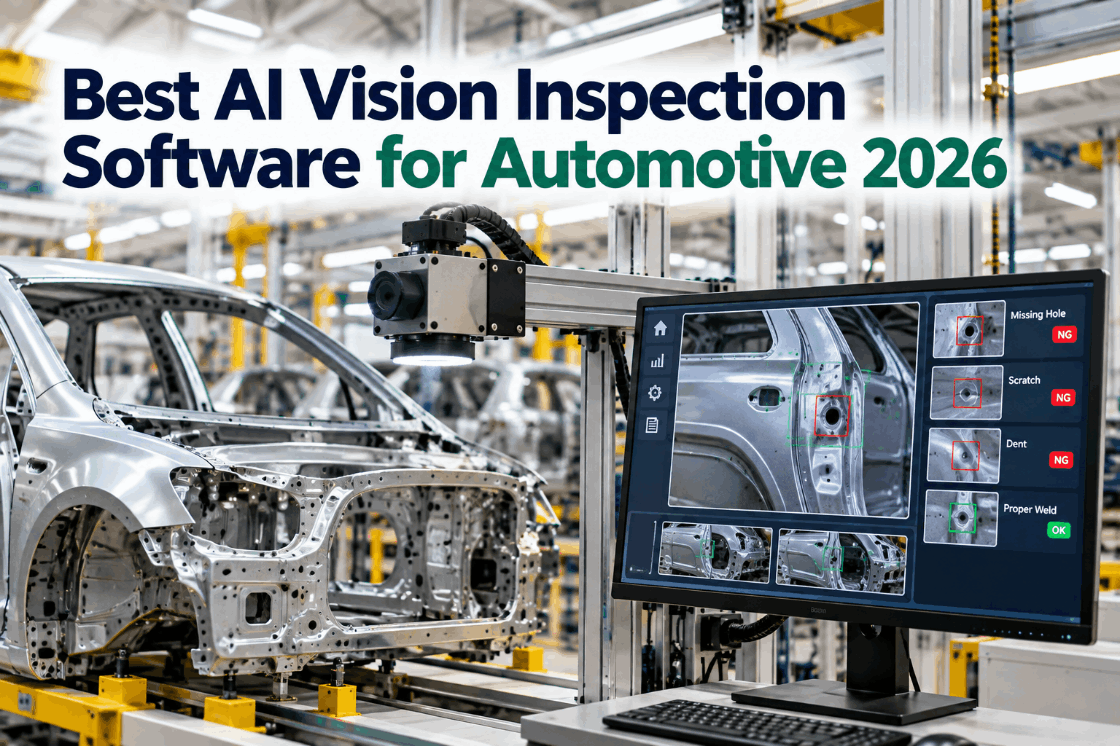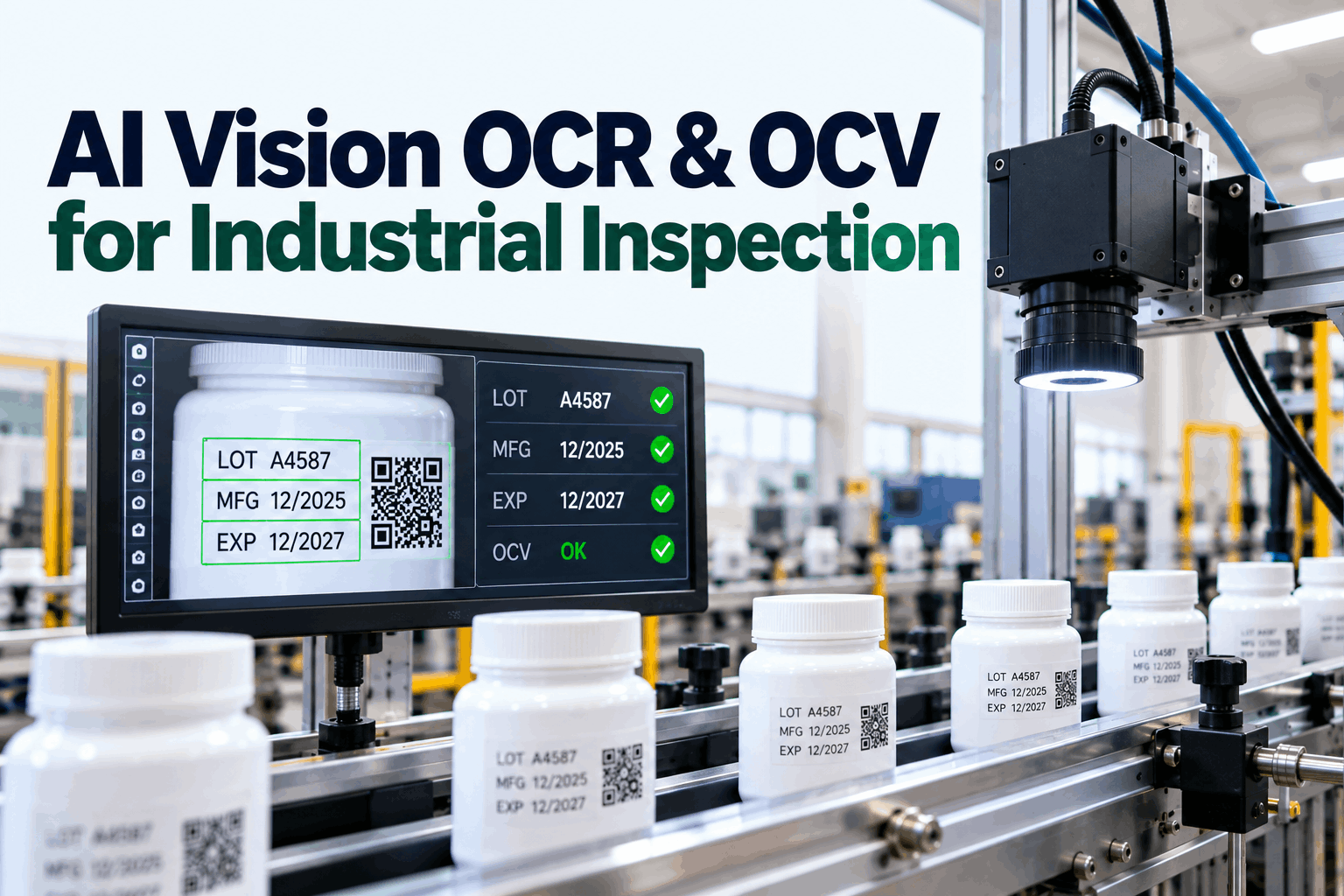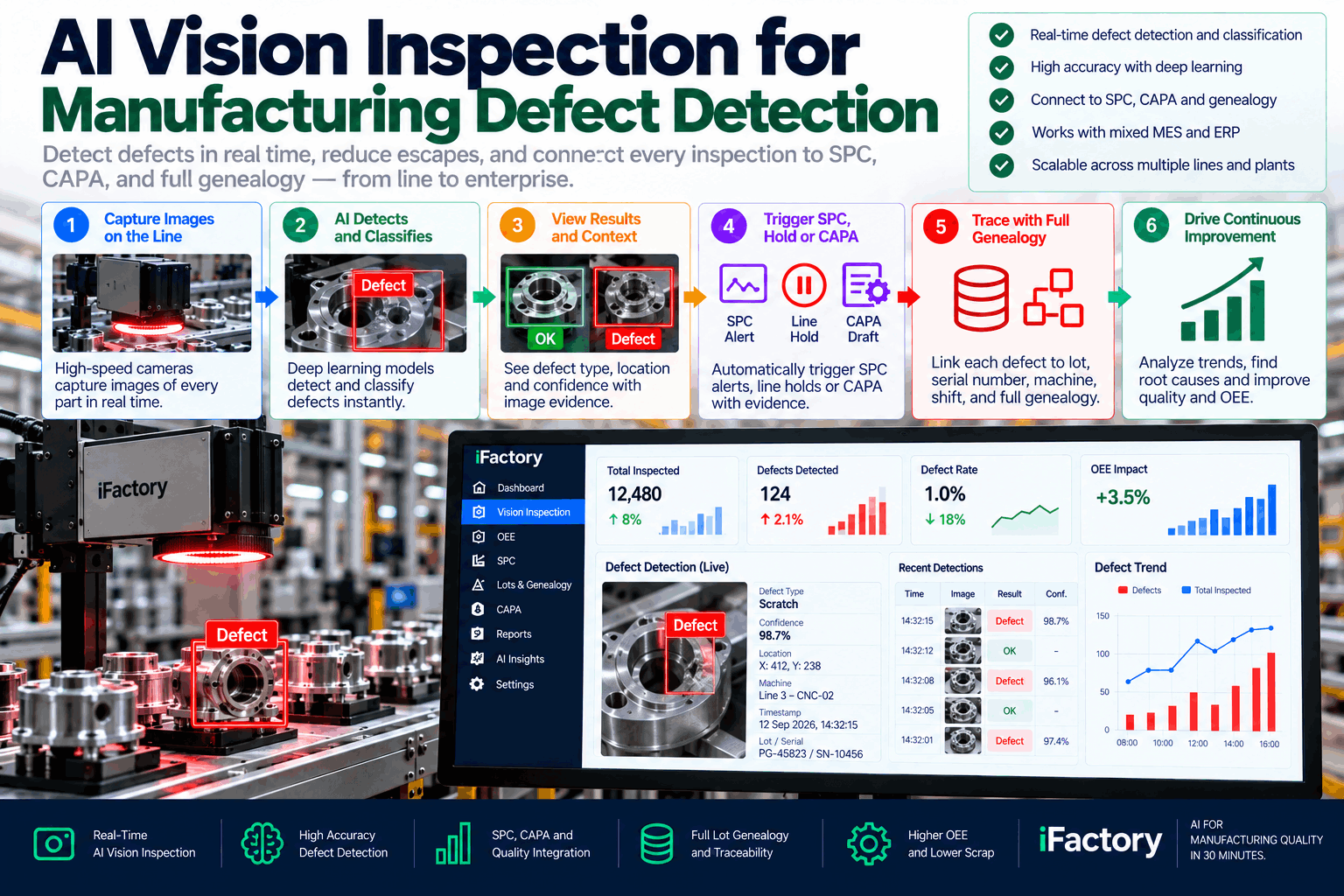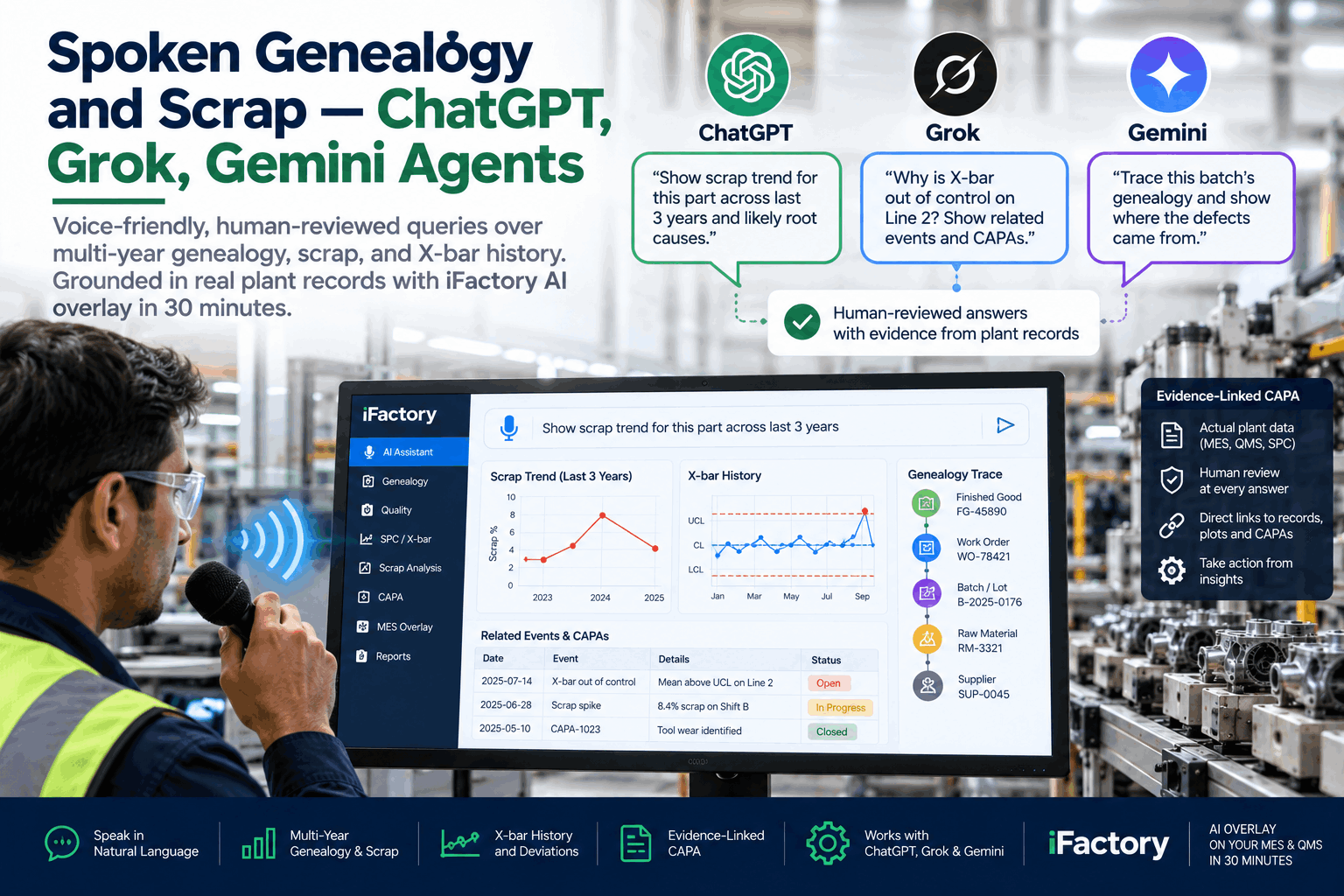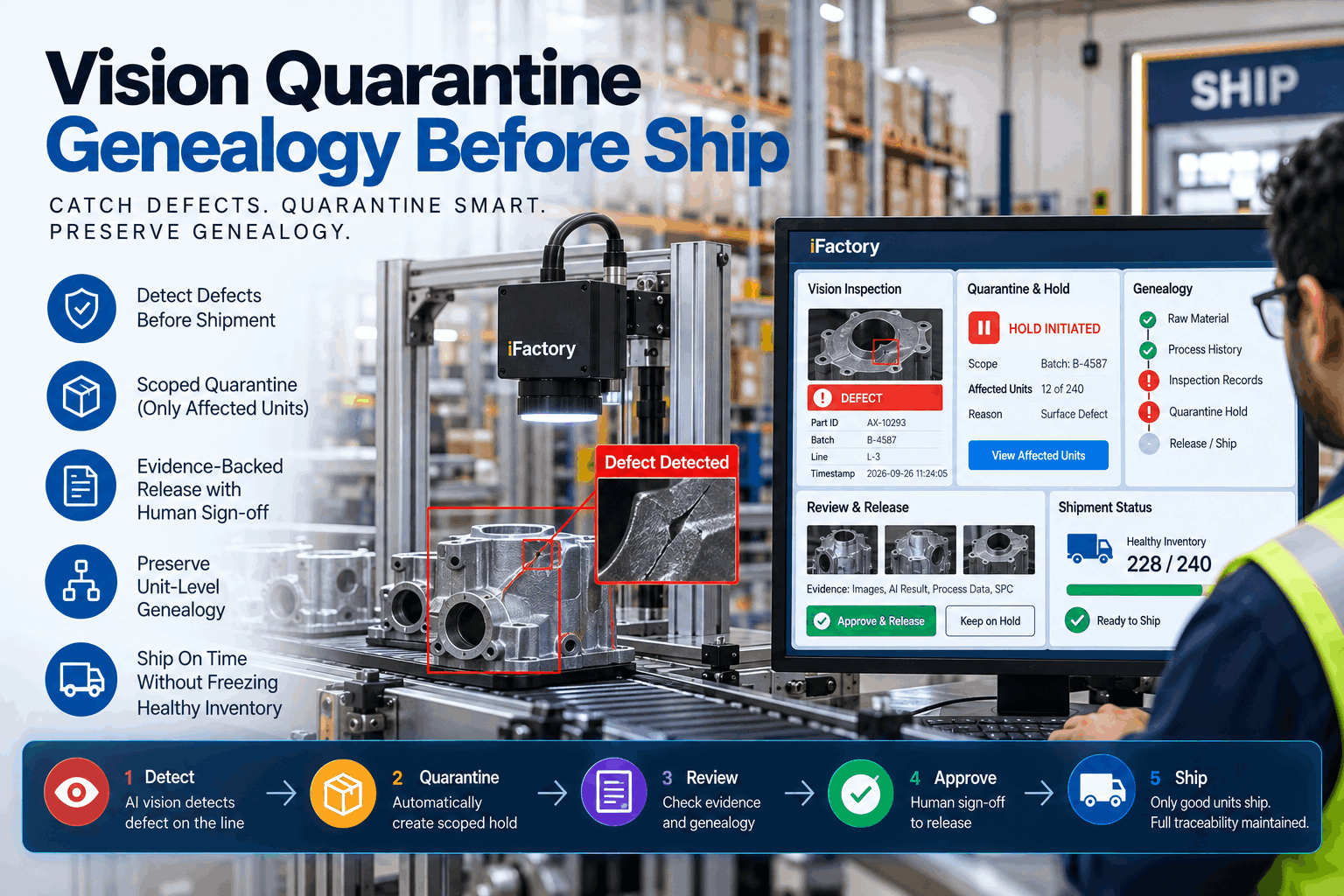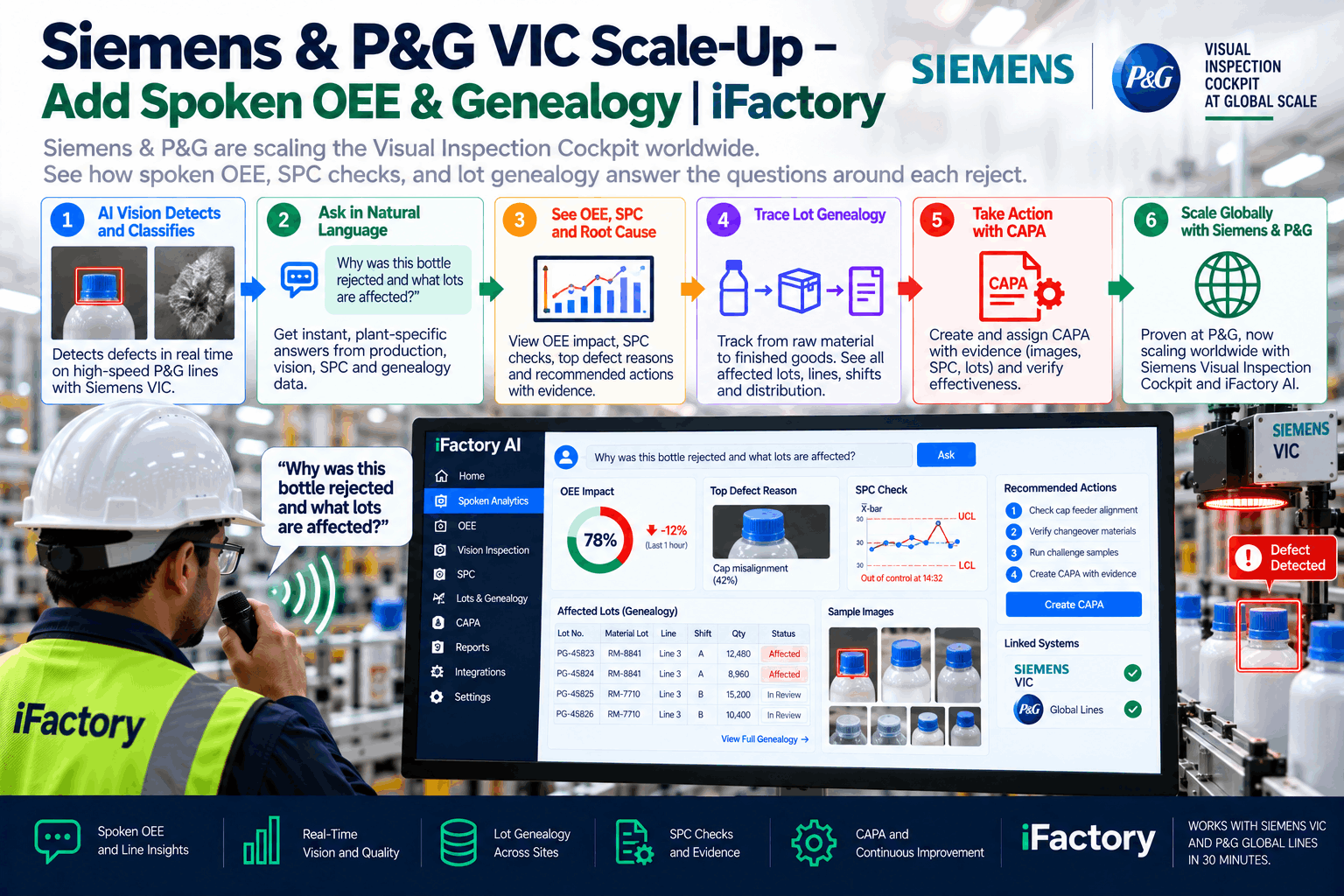
On September 16, 2026, Siemens and Procter and Gamble said they are expanding an AI-based quality inspection solution — the Siemens Visual Inspection Cockpit (VIC) — across P and G manufacturing operations worldwide. The system inspects products in real time at full line speed and can trigger alerts or remove defective units through the line PLC. Siemens and P and G report scrap rates fell by 10 to 20 percent depending on product, and new deployments are commissioned five to ten times faster than traditional bespoke vision systems. Those are Siemens and P and G figures for P and G lines, not a benchmark for yours. Once the camera rejects a unit at line speed, who connects that reject to the shift OEE, the SPC trend, and the lots that ran while the rate climbed? That is where spoken OEE and lot genealogy fit around the inspection island. Book a free 30-minute consulting call to map one vision station rejects to OEE and lots.
The camera decides good or bad at line speed. The questions around the reject — OEE quality loss, SPC drift, affected lots — live outside the camera.
At a Glance
What Siemens and P and G Announced
The release describes VIC as jointly developed. It combines P and G deep-learning models with Siemens Industrial Edge computing platform and industrial PCs with NVIDIA GPUs. A Visual Inspection Engineering Tool lets plant engineers configure, train, and update inspection models directly, without dedicated data science resources. Results are processed close to the equipment and integrated into operations, and quality data is collected over time to spot trends and feed the wider digital manufacturing ecosystem.
Siemens reference material adds that the application combines AI-driven semantic segmentation with classical vision logic, runs at the machine on industrial PCs, and is standardized on Industrial Edge for expansion to more products and sites. Two points stand out for anyone running high-speed consumer goods, food, or packaging lines — the materials in this use case shift, stretch, and wrinkle, which is hard for rule-based vision, and the model updates sit with plant engineers, which is where they belong.
Reading the Vendor Numbers Carefully
The 10 to 20 percent scrap figure and the five to ten times faster commissioning are what Siemens and P and G report for P and G products and infrastructure. They depend on product mix, existing Industrial Edge infrastructure, DevOps processes, and integration patterns that P and G already had in place. They are useful as proof that the category works at scale. They are not a forecast for another plant, and they are not iFactory results. Measure your own baseline before and after any change.
The Inspection Island and the Questions Around It
A camera, an edge PC, and a PLC reject make one decision very well — is this unit good or bad? The questions that follow a rising reject rate live in other systems, and on many lines those answers take a walk to a terminal and four screens.
How much of today quality loss comes from vision rejects, and is it growing faster than yesterday? Lives in MES and historian.
Is the characteristic behind the rejects drifting, or is this a burst of noise? Lives in SPC tool and QMS.
Which material lots, finished lots, and pallets ran while the rate climbed, and do any need a hold? Lives in MES, ERP, and batch genealogy.
Did the adjustment at 2 PM actually bring the rate down? Lives in vision results plus line data.
At line speed, the gap between the reject and the decision is where scrap and quality escapes grow.
Pairing Line-Speed Inspection With Spoken OEE and Lot Genealogy
The iFactory agent reads your plant data — MES, historian, PLC and SCADA, ERP, QMS, vision system, and batch genealogy — by category and per your confirmed connections. Vision inspection results are available to the agent at result level; which parameters flow from a given station is confirmed per plant.
The vision station is doing its job. The agent listens for the signal from that station.
"What is the camera flagging on line 4 since 2 PM?" No walk to a terminal. No login.
How that compares with yesterday and how much of the shift OEE quality loss it explains — spoken back to the line lead.
The agent helps trace the affected lots from genealogy data — material lots, finished lots, pallets.
The hold is entered in the MES or QMS. The agent does not place holds — people do, in the systems of record.
Session continues on the tablet at the line, then the desktop in the office.
Bring one line where the camera decides good or bad at speed. We walk through what a spoken answer looks like the moment the reject rate climbs.
Examples on Food and CPG Packaging Lines
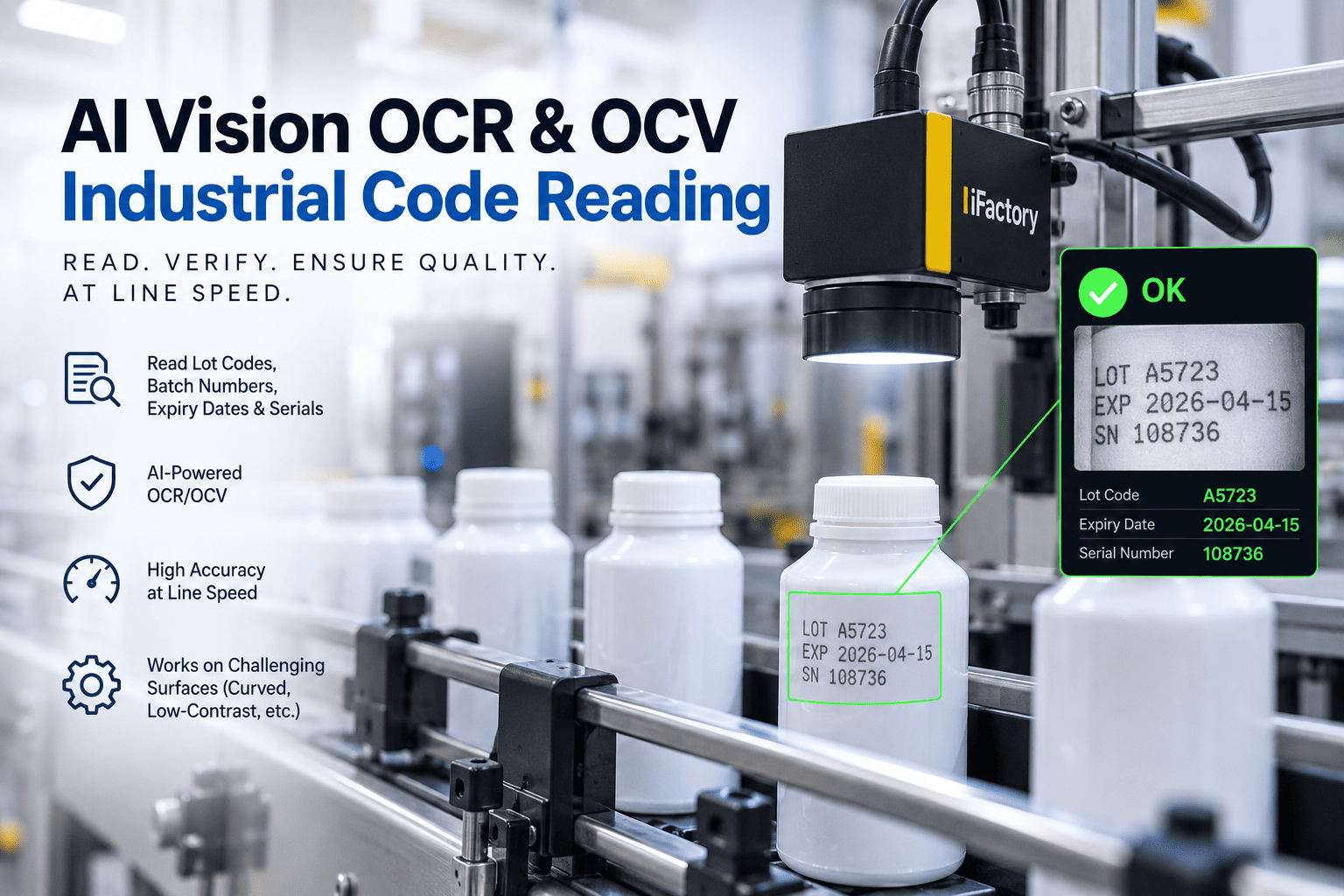
Typical vision-inspected defects on these lines include seal integrity, label placement and code-date legibility, fill level, cap and closure position, and carton damage. Each one has a companion question outside the camera — which film or label lot was running, which filler head or sealing jaw, which shift, and which finished lots went to the warehouse before the fix. Asking those questions by voice at the line, and hearing the answer from plant data, keeps the reject and the decision close together.
Templates Built Around Proven Plant Practices
You do not need a custom project to start. iFactory uses templates built around proven plant practices — a reject Pareto review by shift and lane, an OEE quality-loss breakdown, lot trace after a vision signal, SPC review for the characteristic behind the rejects, and a shift-handover summary. Your team picks what matters, and the agent runs on top. Template availability for your plant is confirmed during scoping.
- Which of our vision stations and systems does it read, and how?
- What is generally available today, and what is roadmap?
- Who approves holds and releases?
- Where does the data live, and what leaves the building?
- What does our team have to do to make it work?
Where iFactory Runs
iFactory runs as its own application at your facility on NVIDIA-based systems — edge-first near the lines, in a server room, or both — with an AI vision processing unit near the cameras where needed. The data is backed up to the cloud you pick. Configurations range from 32 GB to 1 TB and beyond, sized to your lines, cameras, and users with you. Whether it reads results from a specific vision station, including Edge-based ones, is confirmed during scoping. Your OT security lead reviews zones, service accounts, and outbound rules before each phase.
Frequently Asked Questions
VIC is an AI-based inspection application developed by Siemens and P and G that runs on Siemens Industrial Edge with industrial PCs. It inspects products at line speed and can trigger alerts or reject units. Plant engineers update models with an engineering tool.
They are what Siemens and P and G report for P and G lines and depend on product mix and existing infrastructure. Treat them as proof the category scales, not as a forecast for your plant. Measure your own baseline.
No. The vision system decides good or bad at line speed. iFactory works around it — answering questions about OEE, SPC, and affected lots from your plant data, while people decide on holds and fixes.
The agent is designed to read vision system results at result level. Which stations and which parameters are supported for your plant is confirmed during scoping, before any commitment.
Your quality team, in your MES or QMS. The agent helps trace affected lots and reports what it found. It does not place or release holds on its own.
Siemens and P and G show that AI vision now scales across plants. The next move is connecting each reject to OEE, SPC, and lots fast enough to act. Start with one station.