A steam cracker is the largest single energy user in the chemical industry and the starting point for most plastics. Its pyrolysis furnaces crack ethane, propane or naphtha at around 800–850 °C in a fraction of a second, and every furnace is a trade-off between yield, severity and run length. Higher coil outlet temperature raises conversion and changes the product pattern, but it also speeds coking, raises tube metal temperature and shortens the time to the next decoke. Most crackers manage that trade-off with furnace-by-furnace experience and fixed decoke schedules. This guide covers how pyrolysis furnaces work, the variables that control yields, coking and run length, decoke scheduling, coil life and how continuous optimization balances them across a furnace fleet. To see your furnace fleet modeled from plant data, book a short walkthrough.
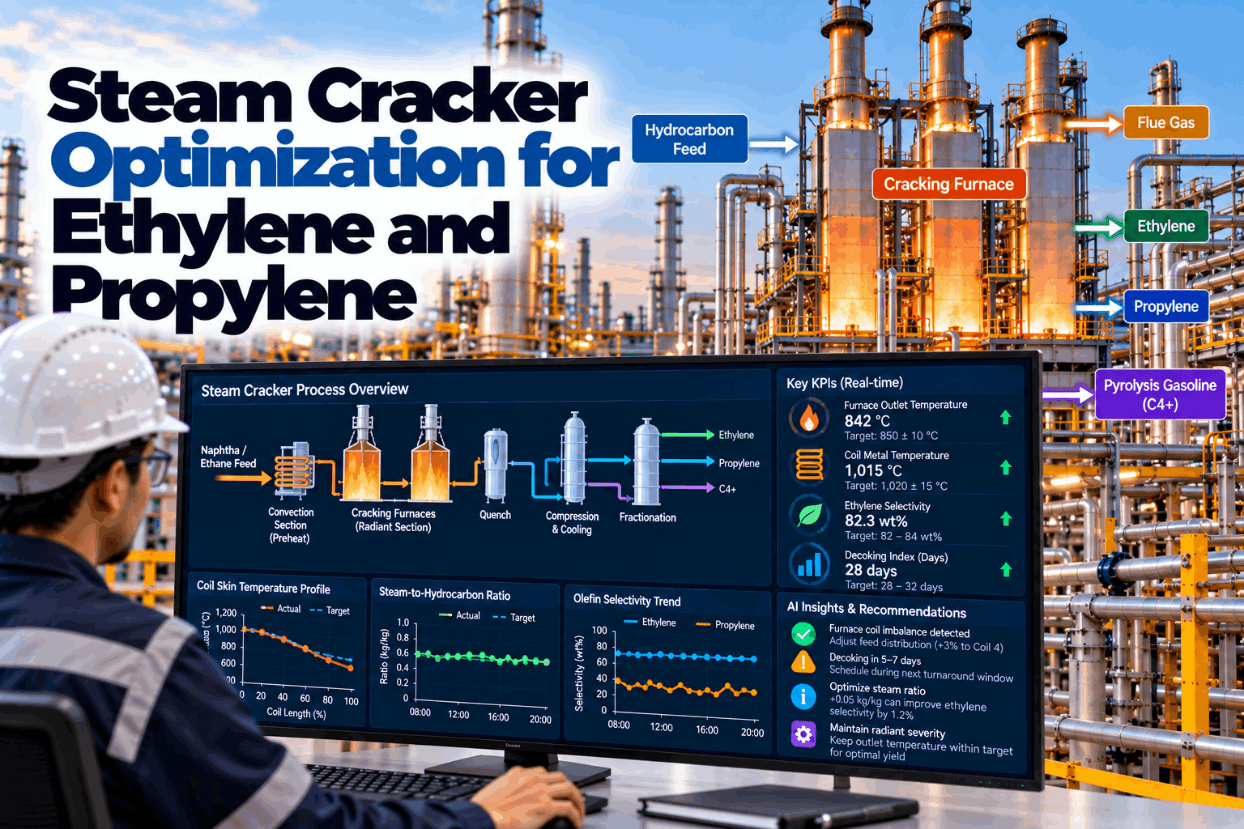
Steam Cracker Optimization for Ethylene and Propylene: Yield, Severity and Run Length in Balance
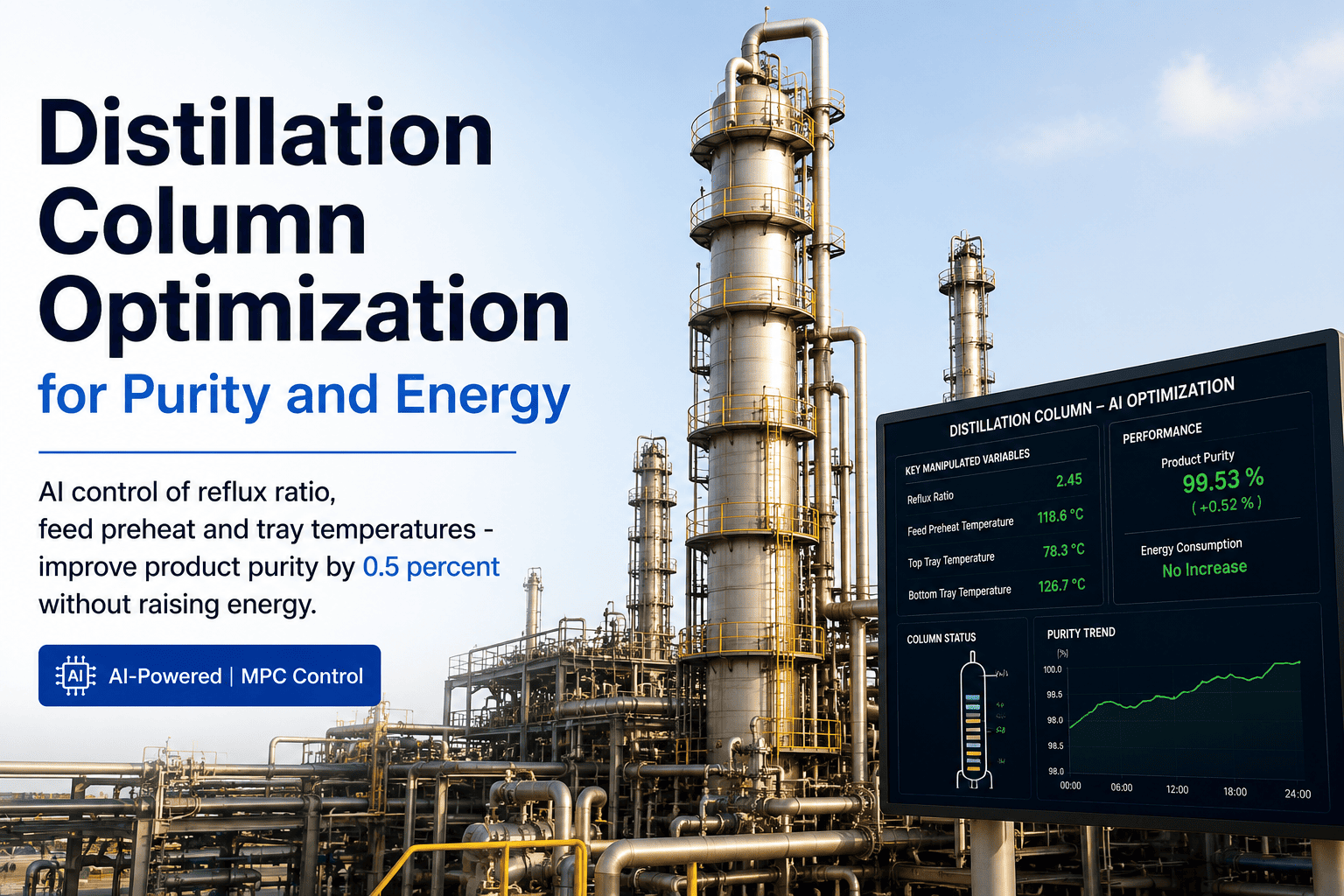
Coil outlet temperature, steam ratio and pass balance tuned furnace by furnace, with tube metal temperature and coking tracked so decokes are planned around value, not the calendar.
Why Cracker Furnaces Rarely Run at Their Best Point
Steam cracking turns ethane, propane, butane or naphtha into ethylene, propylene, butadiene and aromatics. A study by Ren, Patel and Blok in the journal Energy described it as the single most energy-consuming process in the chemical industry, with the pyrolysis section of a naphtha cracker taking about 65% of total process energy. The same work estimated that state-of-the-art naphtha cracking could save about 20% compared with average plants.
Within that energy-heavy process, each furnace is a balancing act. Raising coil outlet temperature increases conversion and ethylene yield but also speeds up coke formation in the radiant coils. Coke raises tube metal temperature and coil pressure loss until one of them reaches its limit and the furnace must be decoked. Too gentle and the plant loses yield; too harsh and it loses run length, availability and coil life.
These trade-offs change all the time. Naphtha cargoes differ, furnaces age at different rates, and the value of ethylene against propylene moves with markets. Fixed severity targets and fixed decoke intervals cannot follow those changes.
Continuous optimization can. We can review your furnace data on a call.
Inside a Pyrolysis Furnace
Every steam cracking furnace follows the same sequence.
Published figures vary between sources, designs and feeds, so these are typical ranges rather than targets. What matters for optimization is that coil outlet temperature, steam ratio and coil pressure together set both the yield pattern and the coking rate.
A calibrated furnace model links those variables for each of your furnaces. See it in a demo.
Feed, Severity and Product Yields
Yield patterns depend first on feed and then on severity.
| Feed | Typical ethylene yield | Other main products | Notes |
|---|---|---|---|
| Ethane | Around 80% in industry descriptions | Hydrogen, methane, small amounts of heavier products | Lowest energy per tonne of high-value chemicals |
| Naphtha | 29–34 wt% | Propylene 13–16 wt%, butadiene 4–5 wt%, aromatics 10–16 wt% | Rich in co-products; yields shift with severity |
| Propane and butane | Between ethane and naphtha | Significant propylene | Flexible feeds in many crackers |
Naphtha yields come from the IEA, DECHEMA and ICCA technology roadmap; the ethane figure is widely quoted by industry sources. For naphtha cracking, severity is often expressed through the propylene-to-ethylene ratio: published examples give about 0.65 at low severity, 0.55 at medium and 0.45 at high severity.
Choosing severity is an economic decision. When propylene is valuable relative to ethylene, lower severity may pay; when ethylene is worth more, higher severity may pay, at the cost of faster coking. A model that predicts yields and coking rate together lets planners see both sides of that decision.
Feed quality changes the answer again. Naphtha with more paraffins cracks to more ethylene; more aromatics bring more fuel oil and coke. Feed analysis linked to the furnace model keeps yield predictions honest from cargo to cargo.
Our engineers can show how your severity choices affect yields and run length together.
Coking, Tube Temperature and Run Length
Coke builds up on the inside of radiant coils throughout the run. It insulates the tube, so burners must fire harder and tube metal temperature rises. The run ends when the first limit is reached.
The most common limit. Industry descriptions note that it rises non-linearly as coke builds, accelerating toward the end of the run.
Coke narrows the coil, raising pressure and lowering yield as hydrocarbon partial pressure rises.
Rising TLE outlet temperature cuts steam generation and can become the binding limit.
Industry sources give typical runs of about 30–60 days for naphtha and 60–90 days for ethane, varying widely with design and severity.
A full steam-air decoke takes roughly one to three days, during which the furnace produces nothing.
Repeated high tube temperatures and decoke cycles shorten coil life, a major maintenance cost.
Pass imbalance is a common hidden cause of short runs. If one pass runs hotter than the others, it cokes faster and reaches its tube temperature limit first, ending the whole furnace’s run early. Balancing pass flows and firing keeps all passes coking at a similar rate.
Predicting the end of run is the key to planning. A model that projects tube metal temperature, pressure and TLE outlet temperature forward shows which limit will bind and when, so decokes can be planned rather than forced.
Run-length prediction is usually the first capability crackers use. We set it up in every rollout.
Planning Decokes Across the Furnace Fleet
A cracker has many furnaces, usually with one or more in decoke or hot standby at any time. Scheduling decokes across the fleet affects total production.
Illustrative. The right choice depends on margins, feed and which other furnaces are due for decoke.
Fleet scheduling avoids two furnaces needing decoke at once, which would cut cracker capacity below what downstream units and contracts need. It also allows planners to place decokes when feed or market conditions make lost production cheapest.
Decoke quality matters too. Industry guidance notes that incomplete decoking leaves residual coke that shortens the next run, so tracking start-of-run tube temperatures and pressures after each decoke shows whether the procedure is working.
Fleet-level planning is where the largest gains often sit. Ask our team how it is modeled.
Furnace Energy and Carbon Emissions
Cracker furnaces burn large amounts of fuel, mostly methane-rich off-gas from the cracker itself.
The IEA puts naphtha cracking at 12–19 GJ per tonne of high-value chemicals and ethane cracking at about 11 GJ/t.
Published estimates give about 1–1.6 tonnes of CO2 per tonne of ethylene, depending on feed.
Flue gas oxygen held at the minimum safe level saves fuel.
Fouled convection coils lose heat recovery and raise stack temperature.
Clean exchangers raise more high-pressure steam from the same cracked gas.
Fewer decokes mean fewer heat-up cycles and less fuel used outside production.
Energy and yield optimization work together. A furnace that runs longer at a balanced severity with clean convection and TLE sections makes more product per unit of fuel, which lowers both cost and carbon per tonne.
Our specialists can benchmark your furnaces against published energy figures.
Fixed Targets Versus Adaptive Furnace Control
The difference between fixed targets and adaptive operation shows in yield, run length and availability.
- Same severity for every feed
- Decoke on a fixed interval
- Pass imbalance found by inspection
- End of run discovered at the limit
- Fleet decokes clash
- Yield and coking traded by experience
- Severity set by feed and market value
- Decoke timed by predicted limits
- Pass temperatures balanced continuously
- End of run projected days ahead
- Fleet decokes planned together
- Yield and coking traded with a model
Recommendations run in advisory mode first, reviewed by furnace engineers and applied by board operators. Closed-loop steps, where wanted, follow the plant’s management of change and existing advanced control layers.
See how recommendations are presented to furnace operators in a session.
Steam Cracker Optimization Checklist
Use this checklist to prepare a furnace fleet for continuous optimization.
Most crackers already collect this data. Combining it is the first step of a furnace review.
What Cracker Optimization Is Worth
Value comes from yield, availability, energy and coil life.
Because crackers are so large, small percentage gains matter. The Ren, Patel and Blok estimate that state-of-the-art naphtha cracking uses about 20% less energy than the average shows the size of the energy gap across the industry; each plant’s own position depends on its design and operation.
A review of a few months of furnace data usually shows where run length and yield are being lost. Book one with our advisors.
How iFactory Delivers Cracker Furnace Optimization
Yields and coking rates calibrated per furnace.
Coil outlet temperature set by feed and product value.
Hot passes identified and rebalanced.
Days to tube, pressure and TLE limits.
Decokes timed across all furnaces.
Fuel and steam per tonne of product.
It runs on premises beside your DCS, historian and existing advanced control. Share a few months of furnace data and we will project your run lengths in a working session.
See When Each Furnace Will Really Need a Decoke
Share furnace, feed and yield data for a few months. We calibrate furnace models, project each run to its first limit and show where pass balance and severity are costing run length.
Pass 3 TMT is rising about 2 °C a day, faster than the other passes. At this rate it reaches the limit in 9 days, a week before the planned decoke.
A Hot Pass Caught Before It Ended the Run
This exchange shows how a cracker operations manager might use iFactory.
iFactory ships as a pre-configured NVIDIA AI server, racked and ready with the steam cracker furnace optimization models loaded. Rack it, plug in power and Ethernet, and the AI is live on your network. Our scope covers data connections across pyrolysis furnaces, quench and utilities, DCS, PLC/SCADA, historian, LIMS and CMMS integration, cabling and network setup, operator and engineer training, and 24×7 remote monitoring. Recommendations run in advisory mode first, and nothing writes to your control system without your management of change approval.
Server installed, DCS and historian links live, historical process, lab and maintenance data loaded.
Models calibrated on your own unit data, then run in advisory mode on one unit with your process engineers reviewing every recommendation.
Rollout to the agreed units under your management of change, operator and engineer training, and 24×7 remote monitoring in place.
Software, server and integration come as one package. For pricing on your site, contact our sales team.
Frequently Asked Questions
It heats feed to around 800–850 °C to break molecules apart. Ren, Patel and Blok described it as the single most energy-consuming process in the chemical industry, with pyrolysis taking about 65% of a naphtha cracker’s process energy.
Naphtha cracking typically gives 29–34 wt% ethylene, 13–16 wt% propylene, 4–5 wt% butadiene and 10–16 wt% aromatics. Ethane cracking gives a much higher ethylene yield, around 80% in industry descriptions.
Whichever limit binds first: tube metal temperature, coil pressure loss or transfer line exchanger fouling, all driven by coke build-up.
Industry sources give about 30–60 days for naphtha and 60–90 days for ethane, with steam-air decokes taking one to three days. Actual runs vary with design and severity.
For naphtha, often by the propylene-to-ethylene ratio: published examples give about 0.65 at low severity, 0.55 at medium and 0.45 at high severity.
A furnace fleet can typically be modeled and in advisory use within a 6–12 week rollout. Plan it with our engineers.
Balance Yield, Severity and Run Length on Every Furnace
iFactory models each furnace, recommends severity and pass balance for today’s feed and plans decokes across the fleet, so more product comes from every run.
Illustrative. Run length ends at whichever limit binds first: tube metal temperature, coil pressure loss or transfer line exchanger fouling.