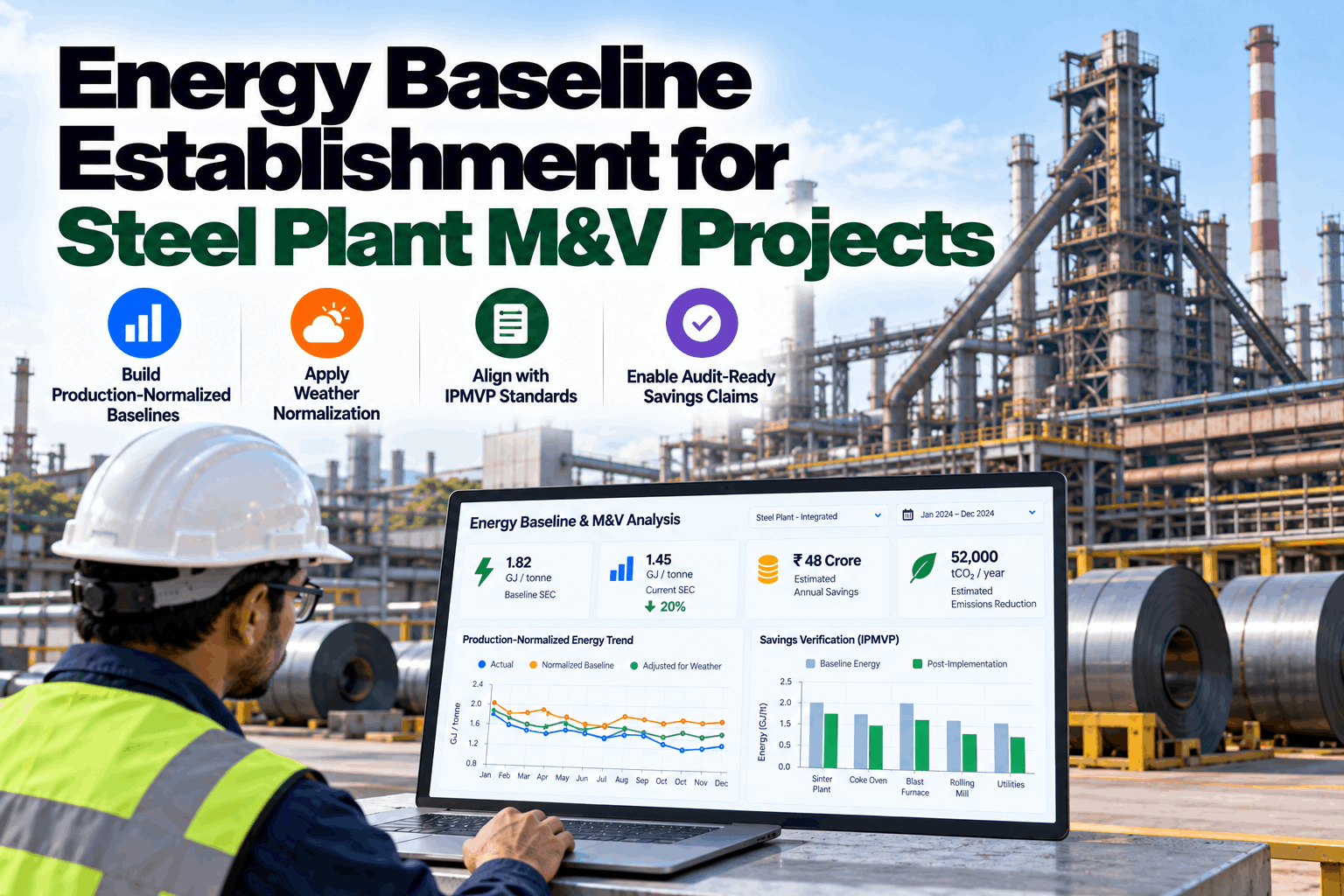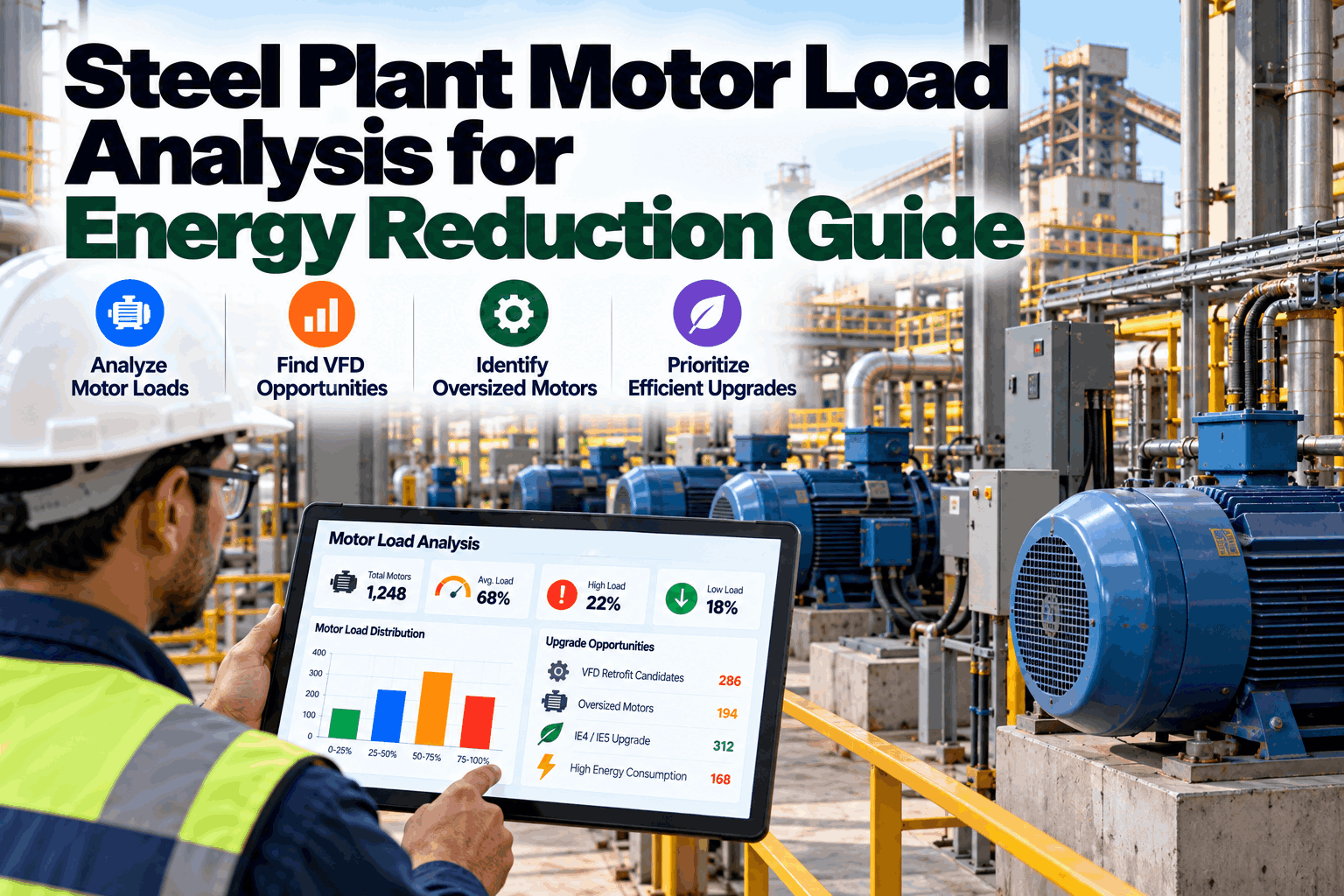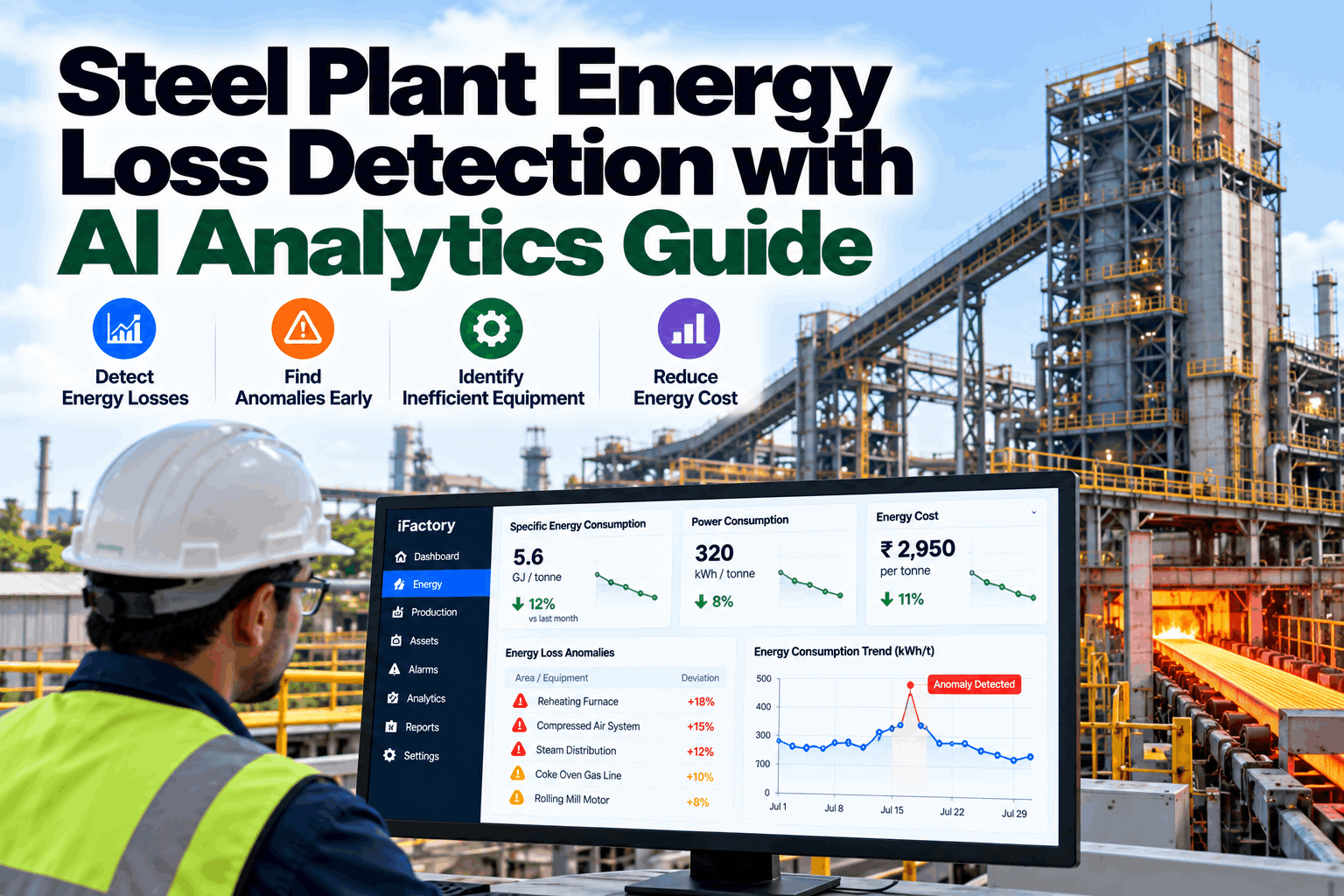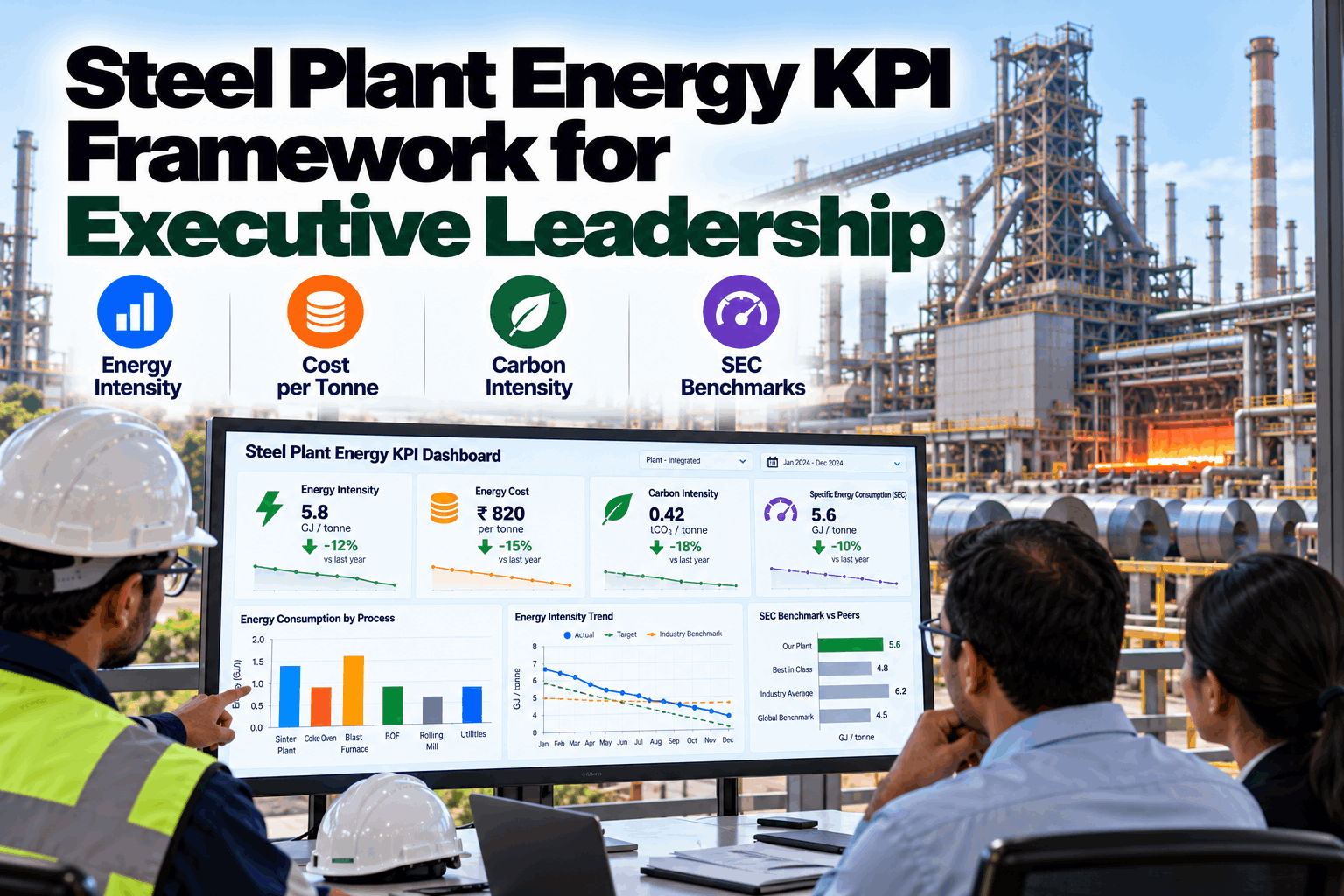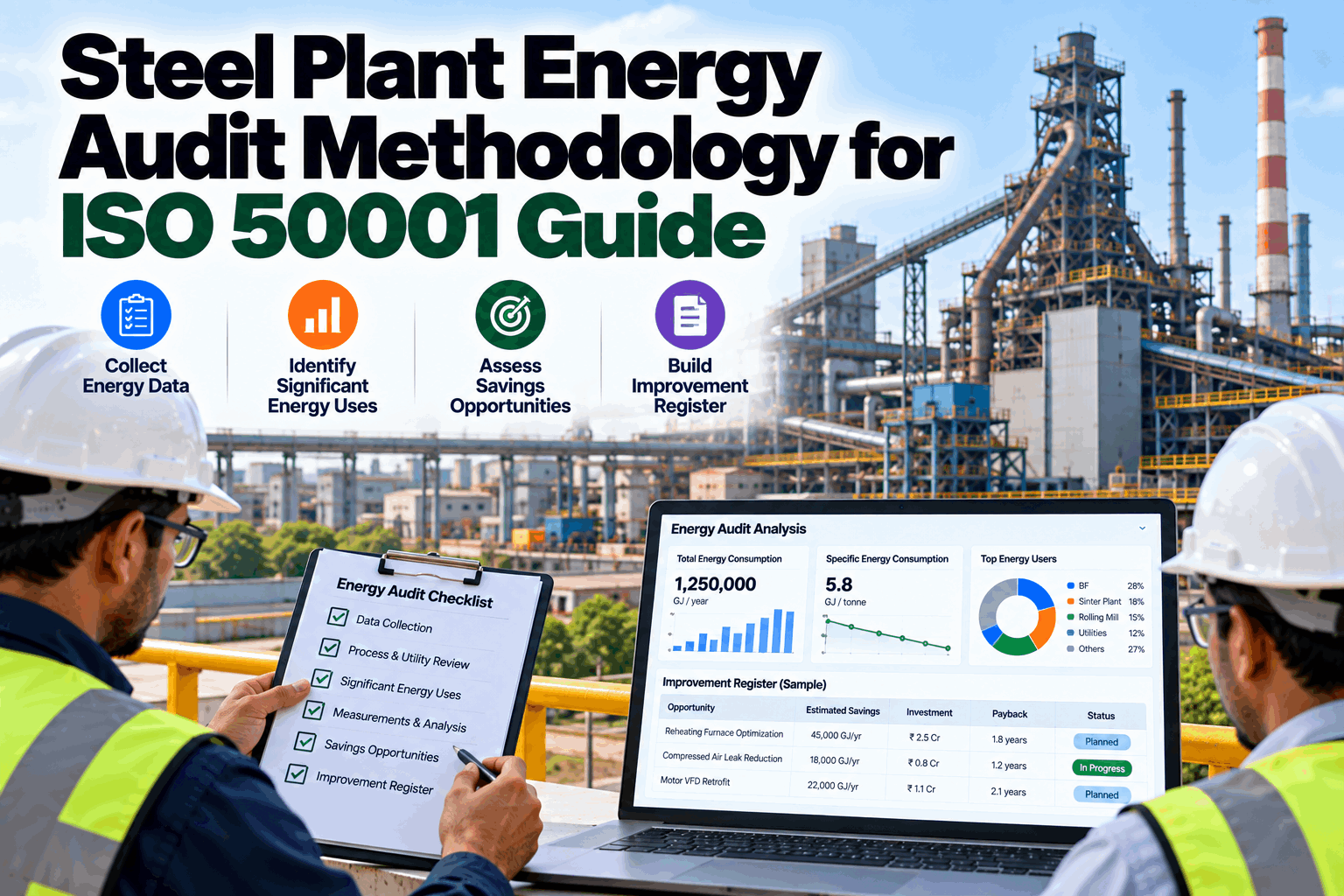
Energy audits are only worth what they change. Too many steel plant audits end as reports full of opportunities that no one owns, with savings that finance never trusts and no way to show later whether performance improved. An audit methodology designed for ISO 50001 fixes that. It collects the right data, identifies significant energy uses with their drivers, and builds an improvement register the plant will actually run, then carries the same evidence through certification. Book a 30-minute audit readiness review using your plant’s data.
Data collection, significant energy uses and an improvement register that passes certification and delivers verified savings.
At a Glance
Why Many Energy Audits Change Nothing
Most steel plants have commissioned energy audits. Many of those reports list dozens of opportunities, and a year later few have been implemented. The reasons are rarely technical. Findings are not tied to owners, savings estimates are not trusted by finance, the audit is a one-off rather than part of a management system, and nobody can later show whether energy performance actually improved.
An audit methodology built for ISO 50001 avoids those traps. It is designed from the start to feed an energy management system: it establishes the energy review, identifies significant energy uses and their relevant variables, sets baselines and indicators, and produces an improvement register the organization will actually work from. The same evidence then carries the plant through certification.
How the Standards Fit Together
The energy management system: energy policy, energy review, significant energy uses, indicators, baselines, action plans and continual improvement in a plan-do-check-act cycle.
General requirements for energy audits, replacing ISO 50002:2014. Part 3 gives guidance for audits of industrial processes, the part most relevant to steel.
How to set energy performance indicators and energy baselines so improvement can be measured fairly.
Principles for measuring and verifying energy performance, so savings from the register can be proven.
The Audit, Step by Step
Agree the sites, units, energy types and period, and how byproduct gases and purchased electricity are counted.
Gather at least 12 months of energy, production and operating data, and list the metering available at each unit.
Reconcile purchased, generated and exported energy so the site balance closes before digging into units.
Rank uses by consumption and improvement potential; confirm their relevant variables and the people who affect them.
Walk each SEU with operators and engineers, and measure where data is missing.
Quantify savings, capex and payback for each opportunity, stacking interacting measures carefully.
Record every opportunity with owner, estimated savings, cost, status and verification method.
Hand over baselines, indicators and the register into the EnMS so the audit becomes the starting point, not the end.
Determining Significant Energy Uses
ISO 50001 defines a significant energy use as one that accounts for substantial energy consumption and/or offers considerable potential for energy performance improvement. In practice most plants rank energy uses on a Pareto chart and set a cut-off, then add smaller uses with unusually large improvement potential. For each SEU the audit records the relevant variables that drive its energy, its current performance and the people whose work affects it.
| Typical steel SEU | Relevant variables | Who affects it |
|---|---|---|
| Reheating furnaces | Throughput, grade mix, hot-charge ratio, delays | Furnace operators, mill scheduling, caster coordination |
| Blast furnace blowers and stoves | Hot metal production, blast volume and temperature | BF operators, energy dispatch |
| Sinter plant fans | Sinter production, bed permeability, strand speed | Sinter operators, maintenance |
| Electric arc furnaces | Tap weight, scrap mix, power-on time | Melt shop operators, scheduling |
| Compressed air | Production hours, leak rate, pressure setpoint | Utilities team, area maintenance |
| Pumps and cooling water | Heat load, ambient conditions, control mode | Utilities and process teams |
Data Collection Checklist
Purchased electricity, natural gas, coal and coke, oxygen and steam, plus byproduct gases generated, used, exported and flared.
Output by unit and product family, grade mix, hot-charge ratio and operating hours for the same periods.
Every meter and historian tag, what it measures, its accuracy and the gaps where sub-metering is needed.
Outages, rebuilds, campaigns and abnormal periods, so baselines can exclude or adjust for them.
The Improvement Register
The register is where most audit value is won or lost. Every opportunity needs an owner, a savings estimate the finance team accepts, a cost, a status and a way to verify the result. Reviewed monthly, it becomes the EnMS action plan.
| ID | Opportunity | SEU | Est. savings | Capex | Owner | Status |
|---|---|---|---|---|---|---|
| EO-01 | Soaking zone O₂ control, furnace 2 | Reheating furnaces | 38,000 GJ/yr | Low | Furnace engineer | In progress |
| EO-02 | Compressed air leak program, mill header | Compressed air | 2,000 MWh/yr | Low | Utilities lead | Verified |
| EO-03 | VFD on sinter waste gas fan | Sinter fans | 1,900 MWh/yr | High | Sinter plant manager | Feasibility |
Illustrative entries. Savings are later verified against production-normalized baselines, which is what lets the register show improvement in energy performance rather than just activity.
Passing Certification and Proving Improvement
ISO 50001 certification involves a stage 1 review of documentation and readiness, then a stage 2 audit of implementation. Certification bodies following ISO 50003 need to see demonstrated improvement in energy performance, not just a well-documented system. Plants that arrive with SEU baselines, indicators, a live register and verified savings from the first projects move through certification far more smoothly.
What iFactory Delivers
12+ months of energy, production and operating data reconciled into a closing site balance.
Pareto ranking with relevant variables and performance for each significant use.
Normalized per ISO 50006 practice, updated automatically.
Owners, savings, capex, status and verification in one place.
Measured against normalized baselines, consistent with ISO 50015 principles.
Baselines, indicators and verified improvement ready for stage 2 and surveillance audits.
Share a year of energy and production data. We reconcile your site balance, rank your SEUs and show what an audit-ready improvement register would look like.
How Deployment Works
Server racked on site, historian, meter and production data connected, and metering gaps listed against the units that matter most.
Baselines and expected-energy models built per unit, then piloted with your energy and process engineers reviewing every finding.
Dashboards, alerts and reports rolled out plant-wide, teams trained, and 24×7 remote monitoring of the system in place.
Frequently Asked Questions
ISO 50001 specifies the energy management system. ISO 50002-1:2025 sets requirements for conducting energy audits, and those audits often provide the energy review that an ISO 50001 system needs.
Published in June 2025, it replaced ISO 50002:2014 as the general requirements for energy audits, and it sits alongside new Part 2 (buildings) and Part 3 (industrial processes) guidance.
Rank energy uses by consumption and improvement potential, set a cut-off, and confirm each SEU’s relevant variables. Reheating furnaces, blast furnace blowers and stoves, sinter fans, EAFs and compressed air are common SEUs.
Each opportunity with its SEU, estimated savings, cost, owner, status and verification method. It is reviewed regularly as the EnMS action plan.
Certification bodies following ISO 50003 look for demonstrated improvement in energy performance, so verified savings against normalized baselines are important evidence.
Companies using more than 10 TJ a year must complete energy audits by October 11, 2026, repeated every four years. Those above 85 TJ need a certified energy management system by October 11, 2027.
iFactory builds the data foundation, SEU analysis and live improvement register your ISO 50001 program needs, then proves the improvement.