Steel Plant Spare Parts Kanban: Two-Bin and Digital Signals

By Josh Brook on November 20, 2026

steel-plant-spare-parts-kanban-two-bin-digital-signals

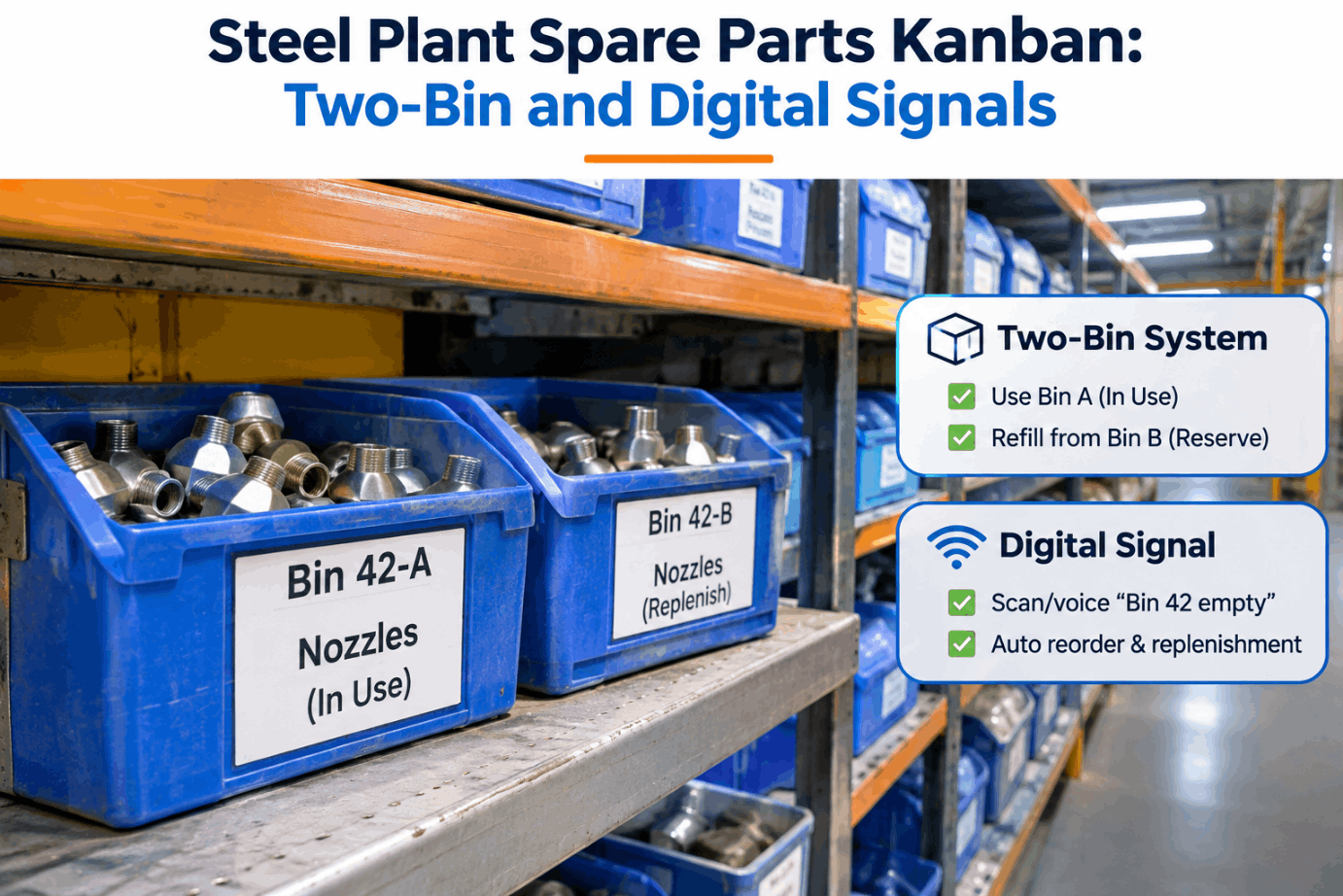
In a steel plant storeroom, the parts that stall a job are rarely the expensive ones. A crew finds no hydraulic filter for the PM, no grinding discs for the roll shop or no nozzle tips for the caster sprays, and someone drives to a distributor mid-shift. A two-bin kanban fixes that for steady-use consumables, and a digital signal stops the empty-bin card going missing on the way to purchasing. Watch the loop run in a bin signal demo.

INVENTORY KANBAN · MAINTENANCE STORES

When the Front Bin Empties, the Reorder Is Already Moving

iFactory Inventory Kanban turns a bin-empty scan or a spoken "bin 42 empty" into a replenishment card. The agent raises the requisition, tracks the supplier's lead time and shows when the bin will be full again, while the back bin keeps the crew working.

Stores aisle B · shelf 3Two-bin
Front bin in use, back bin in reserve · illustrative levels
Bin 40
Spray nozzle tips
Bin 41
Hydraulic filters
Bin 42
Grinding discs
Bin 43
MIG wire 1.2 mm
Bin 42 empty · card sent · ETA 3 days
Front binBack binCard slot
WHICH PARTS BELONG ON KANBAN

Kanban the Consumables, Keep Insurance Spares on Min/Max

Two-bin kanban suits items that are used often, cost little and have a short, steady lead time. It does not suit insurance spares: the motor, gearbox or servo valve you hope never to need. Those are stocked by the consequence of a failure, not by usage, and demand-based formulas tend to recommend zero for them because they have no usage history. They stay on min/max with a criticality review. Sort your own item list with us in a stores review.

Item
Use pattern
Unit cost
Lead time
Method
Caster and descaler spray nozzle tips
Steady, swapped on wear checks
Low
Short
Two-bin kanban
Hydraulic and lube filter elements
Steady, driven by the PM calendar
Low
Short
Two-bin kanban
Grinding and cutting discs
Daily, roll shop and fabrication
Low
Short
Two-bin kanban
Welding wire and electrodes
Steady, repair welding
Low to medium
Short
Two-bin kanban
Gloves, ear plugs, fasteners
Daily, every crew
Very low
Short
Two-bin or vending
Main drive motor, mill gearbox
Rare, failure-driven
High
Long
Min/max + criticality
OEM servo valves, caster segments
Rare or outage-planned
High
Long
Min/max + review
TWO-BIN SYSTEM MECHANICS

Two Bins, One Card, No Counting

The method is old and simple. Two bins hold the same item, one in front of the other. Crews take only from the front bin. When it empties, its card goes to purchasing and the crew moves to the back bin, which carries them through the lead time. When stock arrives, the empty bin is refilled and becomes the new back bin. Nobody counts anything to trigger a reorder. Check your bin set-up with our stores team.

1Pick frontEvery issue comes from the front bin only
2SignalFront bin empties and its card is sent
3SwitchBack bin moves forward and covers the wait
4RefillDelivery refills the empty bin, which goes to the back
Equal bins or a smaller reserve

Most stores use two equal bins. If the back bin is smaller, it must still hold at least the demand over the lead time: a two-week lead time needs at least two weeks of stock in reserve.

SPARE PARTS KANBAN SIZING

Bin Quantity Equals Demand Over the Lead Time, Plus Safety Stock

Each bin must last at least as long as the refill takes, with a margin for a slow week or a late truck. ERP kanban rules use the same idea; Microsoft's Dynamics 365 formulas, for instance, multiply average demand by lead time, add safety stock, divide by pack size and round up. Here is bin 42 with assumed numbers. Size your fastest movers in a sizing session.

Bin quantity=demand × lead time+safety stock
Average use of 125 mm grinding discs (assumed)30 per day
Supplier lead time (assumed)3 days
Demand over the lead time30 × 3 = 90
Safety stock, one day of use (assumed)30
Bin quantity90 + 30 = 120
Rounded up to whole boxes of 25 (assumed)5 boxes = 125
On the shelf, front plus back2 × 125 = 250 discs
SPARE PARTS KANBAN STEEL PLANT TEMPLATE

What Goes on the Kanban Card and Bin Label

A card that says only "discs" gets ignored or ordered wrong. Every card and label carries enough to reorder the item without asking anyone, plus a code to scan. Print the same fields on the bin label and the card so a mismatch is obvious. Ask for a label template from our support desk.

Bin ID42
Part numberGD-125-A60 (illustrative)
DescriptionGrinding disc 125 × 6 mm
LocationAisle B, shelf 3, front
Bin quantity125 (5 boxes of 25)
Supplier and lead timeSupplier B · 3 days
Main usersRoll shop, fabrication
Scan codeQR for bin 42

Say the Bin Number, Hear It Back, Then It Orders

A spoken signal is quick with gloves on, but a misheard digit orders the wrong part. The agent reads back the bin ID and item, waits for "confirm", then raises the requisition and quotes the ETA.

Roll shop · Fitter and iFactory
FitterBin forty-two empty.
iFactoryReading back: bin four-two, grinding discs, 125 millimetre, aisle B shelf 3. Confirm?
FitterConfirm.
iFactoryCard sent. REQ-30418 raised for 125 discs from supplier B, ETA 3 days. The back bin holds 125.
DIGITAL REORDER SIGNALS

Bin-Empty Scan or Voice, Both Ending in One Card

Paper cards work until one falls behind a rack. A digital signal keeps the physical method and removes the walk to purchasing. A scan suits the storeroom counter; voice suits a fitter with gloves on and a part in hand. Either way the card is digital, timestamped and tied to one bin. Try both signals in a signal walkthrough.

Bin-empty scan
  • QR or barcode on the bin label, read by a handheld or phone
  • Bin ID comes from the code, so no digits are misheard
  • Best at the counter and in point-of-use racks
  • Needs a scanner within reach
Voice with read-back
  • "Bin 42 empty", spoken through a headset or handheld
  • Bin ID read back digit by digit, with the item name
  • Nothing is ordered until the fitter says "confirm"
  • Unknown or mismatched bin IDs are rejected, not guessed
One open card per bin

A second "bin 42 empty" while its card is still open does not order again. The agent replies with the open requisition and its ETA, so a busy shift cannot double the order.

REQUISITIONS AND LEAD-TIME TRACKING

Quoted Lead Time Versus the Days It Really Takes

Every bin is sized on a lead time, so a supplier who quotes four days and delivers in six quietly eats the safety stock. The agent raises each requisition through your purchasing rules, then logs the date the refill actually lands. The chart compares quoted and actual averages per supplier. Connect your purchasing records through our integration team.

Average days to refill · illustrativeQuoted Actual
Supplier A · nozzles


5.0 / 5.4
Supplier B · discs


3.0 / 3.1
Supplier C · filters


4.0 / 6.5
Supplier D · wire


2.0 / 2.2
Supplier C runs 6.5 − 4.0 = 2.5 days over quote. The agent proposes a larger filter bin; a stores lead approves or rejects it.
STOREROOM KANBAN LAYOUT

Lay Out the Storeroom So Crews Pick the Right Bin

A kanban only works if people take from the front bin and nobody raids the back. Layout does most of that work. Fast movers go where crews reach them first, reserve bins sit behind, and insurance spares live somewhere else entirely. Walk us through your floor plan in a layout call.

CounterFast movers at waist heightDiscs, gloves and filters nearest the issue window.
Flow racksLoad from the back, pick from the frontSloped racks keep the reserve bin behind and oldest stock first.
Point of useSmall kanbans at the millRoll shop and caster bay racks for the items crews use hourly.
Critical cageInsurance spares apartLocked, on min/max, issued only against a work order.
ReceivingRefill lane by the dockDeliveries checked against the open card before shelving.
LabelsBin ID facing the aisleLarge digits readable from the aisle, QR at hand height.
SPARE PARTS KANBAN STEEL PLANT BEST PRACTICES

Audit the Loop for Stockouts and Overstock

A kanban drifts. Use changes, suppliers slip and someone takes from the back bin. Track every stockout, including requests for parts you do not stock, and look at what is left in the back bin when the refill lands: more than a few days' supply means the bin is too big. Review your first month's results with our stores specialists.

Stockouts on kanban itemsBoth bins empty before the refill. Usually a slow supplier or a demand jump.
Back bin still full at refillOverstock. Shrink the bin quantity at the next review.
Cards past their ETAA supplier or purchasing hold-up, chased before the reserve runs out.
Empty bins with no cardA missed signal. Found on the walk, fixed with training or labels.
Monthly kanban audit
SPARE PARTS KANBAN STEEL PLANT COST AND ROI

Expedites, Walks and Idle Stock, Priced With Assumed Inputs

A consumables kanban pays back through fewer rush orders, less crew time spent hunting for parts and less cash tied up in overfilled shelves. Every input below is assumed. Use your own purchasing and stores data before sharing any figure. Build your version on a short call.

Expedited orders avoided per month (assumed)11
Expedite premium per order (assumed)$140
Expedite saving per year11 × $140 × 12 = $18,480
Parts hunts avoided per month × minutes each (assumed)30 × 40 = 1,200 min = 20 h
Crew time per year at $70 per hour (assumed)20 × 12 × $70 = $16,800
Excess consumables stock cut, $90,000 × 20% (assumed)$18,000 freed once
Carrying cost saved at 20% a year (assumed)$18,000 × 20% = $3,600
Yearly value at those assumptions$18,480 + $16,800 + $3,600 = $38,880
TURNKEY AI DEPLOYMENT

The Kanban Agent Ships on Its Own Server, Ready for Your Bins

iFactory supplies Inventory Kanban and the reorder agent as a single hardware and software bundle, built on a pre-configured NVIDIA AI server that comes racked and ready. The software is pre-loaded, and your first area's bins, cards and suppliers are configured at our end. You rack it, plug in power and Ethernet, and the AI is live. From there our engineers handle cabling, network links, PLC/SCADA integration, operator training and 24×7 remote monitoring. Request a scope from our turnkey team.

What's Included
  • Pre-configured NVIDIA AI server, delivered in its rack
  • Inventory Kanban and reorder agent, pre-loaded
  • Bin labels and QR cards for the first area
  • Site cabling, network links and PLC/SCADA hookup
  • Voice read-back on headsets and handhelds
  • Requisition link to your ERP or CMMS purchasing
  • Stores and crew training, 24×7 remote monitoring
Live in 6–12 weeks
Wk 1–4
Sort and Size

Items split into kanban and min/max, bins sized, labels and cards printed.

Wk 5–8
Run the First Racks

Scan and voice signals live on one area, requisitions checked by the buyer.

Wk 9–12
Extend and Audit

More racks added, lead times tracked, first monthly audit completed.

HOW iFACTORY FITS

A Storeroom Kanban That Sends Its Own Cards

iFactory keeps the physical two-bin method crews already understand and takes the paper, the walking and the guesswork out of the reorder. See it on your own consumables in a 30-minute demo.

1
Hears the empty bin. Scan or voice, with the bin ID read back before anything is ordered.
2
Raises the requisition. Through your purchasing rules, one open card per bin.
3
Tracks the real lead time. Quoted against actual, per supplier, per bin.
4
Keeps critical spares separate. Insurance items stay on min/max and review.
1000+
Industrial clients running on iFactory
99.9%
Uptime for stores that never close
6-12 wks
Racked server to the first bin signal
FREQUENTLY ASKED QUESTIONS

What Stores and Maintenance Leads Ask About Spare Parts Kanban

Should critical spares go on kanban?
No. A two-bin loop needs steady use, and insurance spares such as drive motors, gearboxes and OEM servo valves barely move. They stay on min/max, sized by the cost of being without them and reviewed with your criticality ranking. You can see how the two lists sit side by side on a call.
How big should each bin be?
Big enough to cover demand over the supplier's lead time plus a safety margin, rounded up to whole packs. Re-check it when use or lead time changes, and shrink it if the back bin is still well stocked whenever the refill arrives.
What if someone takes from the back bin first?
The signal comes late and the reserve is already short. Flow racks that load from the back, clear front and back labels and a monthly audit walk keep it rare. Our stores support team can review your rack layout.
How does voice avoid ordering the wrong bin?
Every spoken bin ID is read back digit by digit with the item name, and nothing is ordered until the person says "confirm". Bin IDs that do not exist, or that do not match the area, are rejected. Hear a read-back before you decide.
Does the agent place purchase orders on its own?
It raises requisitions according to the approval rules you set. You might let repeat consumables from agreed suppliers go straight through, and route anything new or above a value limit to a buyer. Re-size proposals always wait for a stores lead.
What is a sensible first step?
Choose one area, such as the roll shop or the caster maintenance bay, and its 30 to 50 fastest-moving consumables. Size the bins, print cards with QR codes and run scan and voice signals for a month before adding racks. To plan that first area, book a kanban scoping call.

Stop Losing Shift Time to a Missing Filter

Two bins on the shelf, a digital card when the front one empties and a requisition that tracks its own lead time. Delivered turnkey, with the first racks signalling within 6 to 12 weeks.


Bin 42 · grinding discs 125 mm · illustrative
SignalVoice, read back, confirmed
RequisitionREQ-30418 for 125 discs
Supplier ETA3 days
Back bin cover125 ÷ 30 a day ≈ 4 days
Refill lands before the back bin runs out

Share This Story, Choose Your Platform!