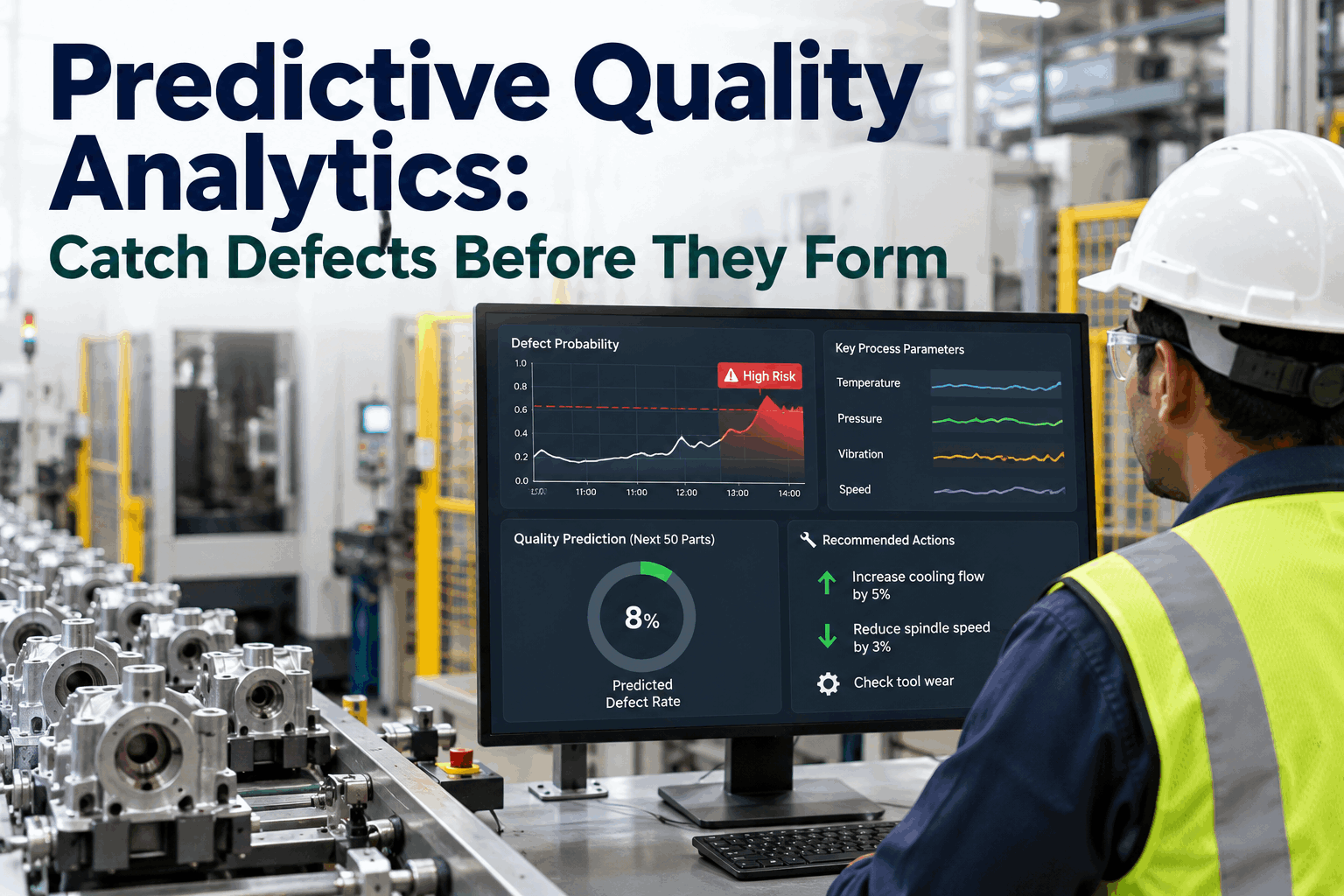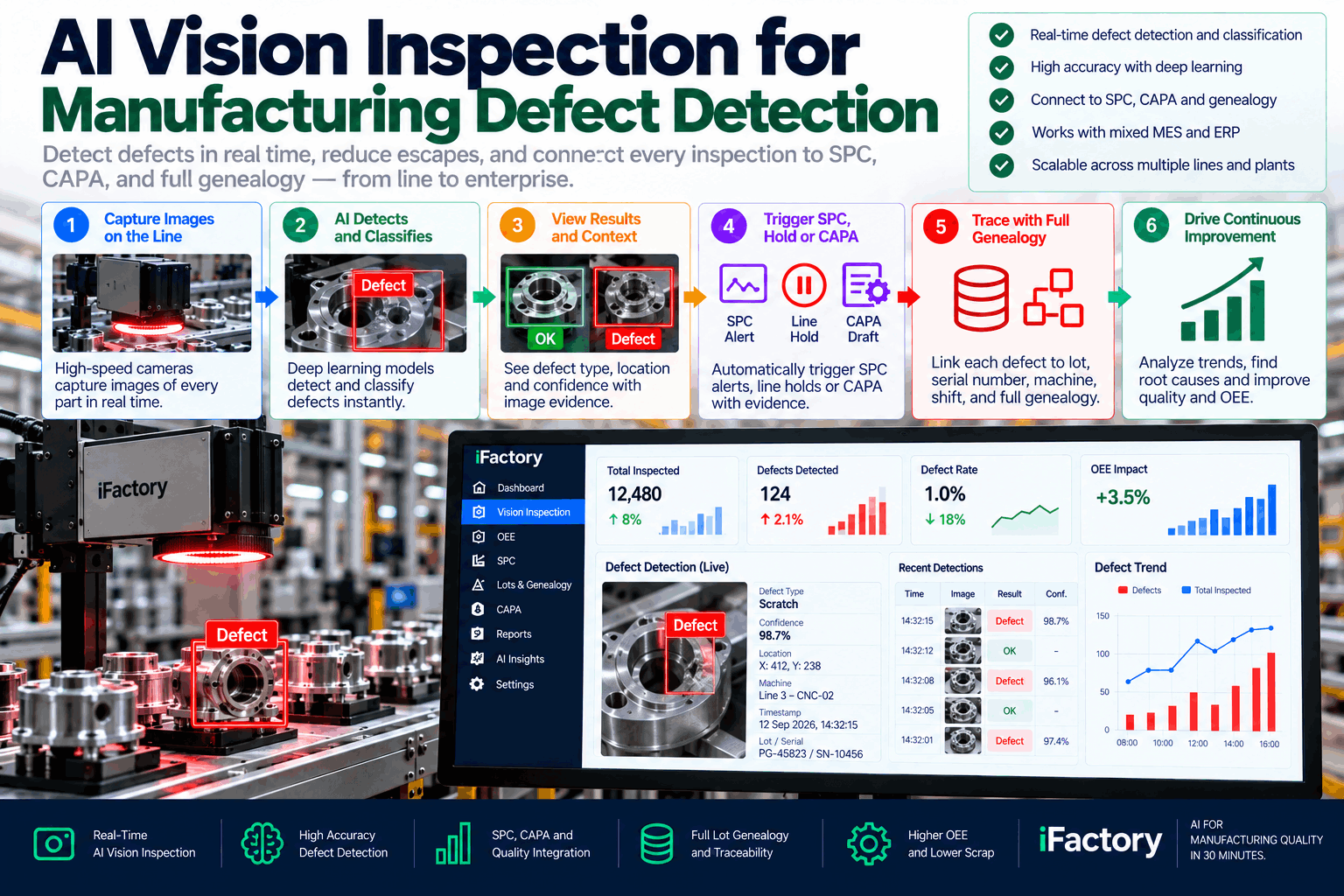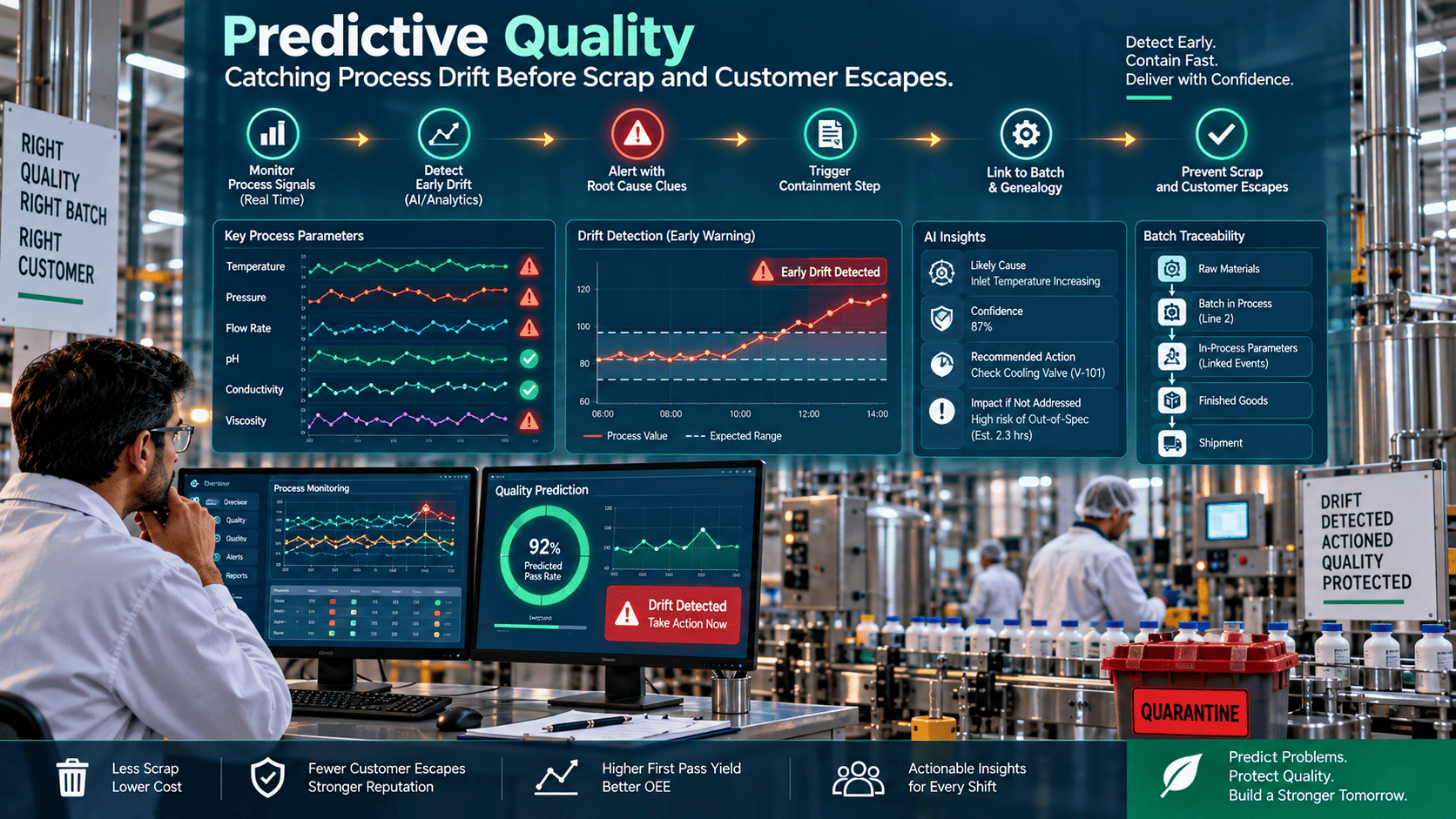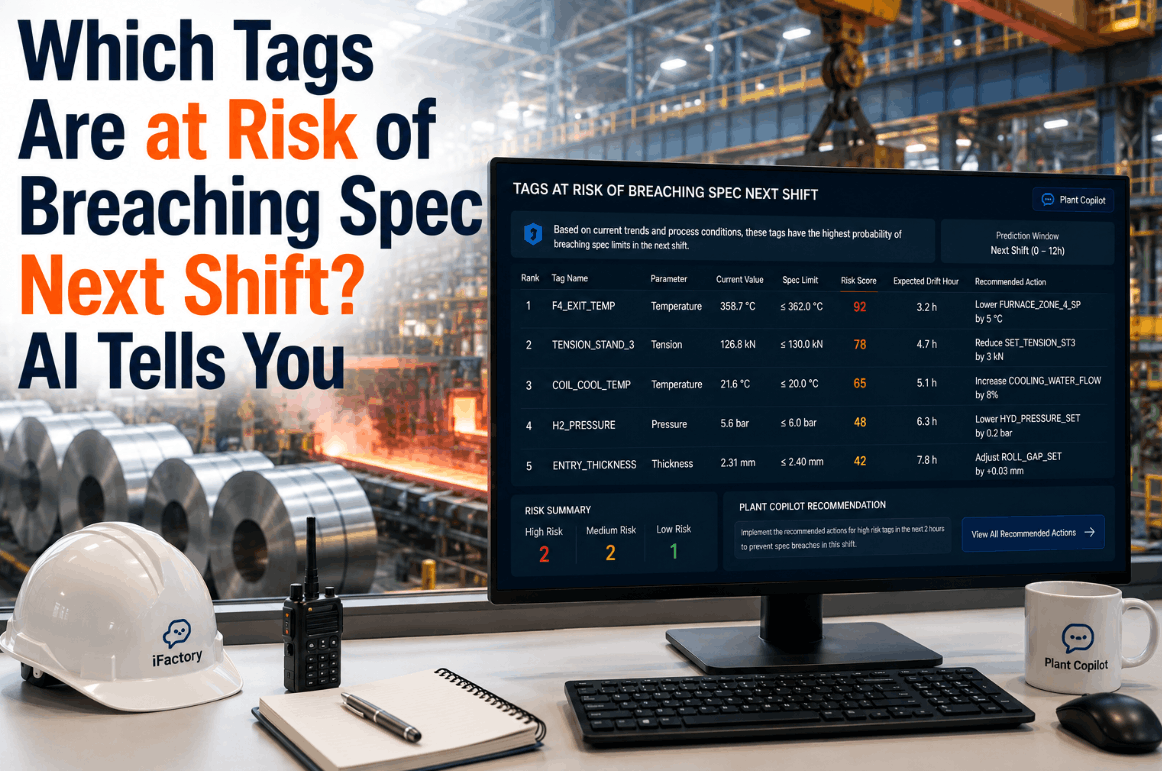
Every production shift carries quality risk that is already visible in your process data — it just hasn't been surfaced yet. Tension tags trending upward. Temperature tags drifting toward their upper control limit. A critical flow ratio running two percent wide of setpoint with a trajectory that clears spec tolerance before the next crew change. The data to answer the question "which tags are going to breach spec in the next eight hours?" exists in your historian right now. What most facilities lack is the AI layer that reads that trajectory, ranks the risk, and tells the shift team — by name, by expected breach hour, and with a specific recipe parameter to correct — before the excursion actually occurs. iFactory's Plant Copilot closes exactly that gap. Quality managers who ask "which tags are at risk this shift?" receive a ranked answer, not a dashboard to navigate.
Stop Discovering Spec Breaches After They Happen
iFactory Plant Copilot answers "which tags are at risk of breaching spec next shift?" with a ranked list, expected drift hours, and the recipe parameter to nudge — before the excursion occurs.
Why Spec Breaches Almost Always Have a Predictable Trajectory — and Why Plants Miss It
Post-shift quality reviews at U.S. manufacturing facilities consistently reveal the same sequence: a tag breached specification at 2:17 AM, the operator noticed at 3:44 AM, and the corrective action was completed at 4:51 AM. The part count between breach and correction went to hold. The root-cause review the next morning shows that the tag had been drifting toward its limit since 11:30 PM — two hours and forty-seven minutes of advance warning that existed in the historian but never reached anyone with authority to act.
The structural problem is that standard SPC systems and SCADA alarm architectures are event-triggered, not trajectory-triggered. They fire when a threshold is crossed. They do not evaluate rate of change, trend direction, or the statistical probability that a tag currently within spec will breach that spec within the next two, four, or eight hours. That trajectory analysis requires an AI model that reads the recent history of every monitored tag, applies a drift projection, and ranks the resulting risk list by expected breach time and correction urgency. Quality managers who Book a Demo with iFactory consistently discover that their process data already contains the signal — what was missing was the system to read it in real time and deliver an actionable risk list at shift handover.
Trajectory-Based Risk Detection
Plant Copilot evaluates the rate and direction of tag drift — not just current value — to identify tags that are within spec now but will breach within the forecast window.
Ranked Risk List at Shift Start
Every shift starts with a prioritized list of at-risk tags ranked by expected breach hour and consequence severity — delivered as a direct Copilot answer, not a dashboard to navigate.
Recommended Recipe Correction
For each at-risk tag, Plant Copilot identifies the specific recipe parameter whose adjustment has the highest historical correlation with returning the tag trajectory to safe range.
Continuous Handover Documentation
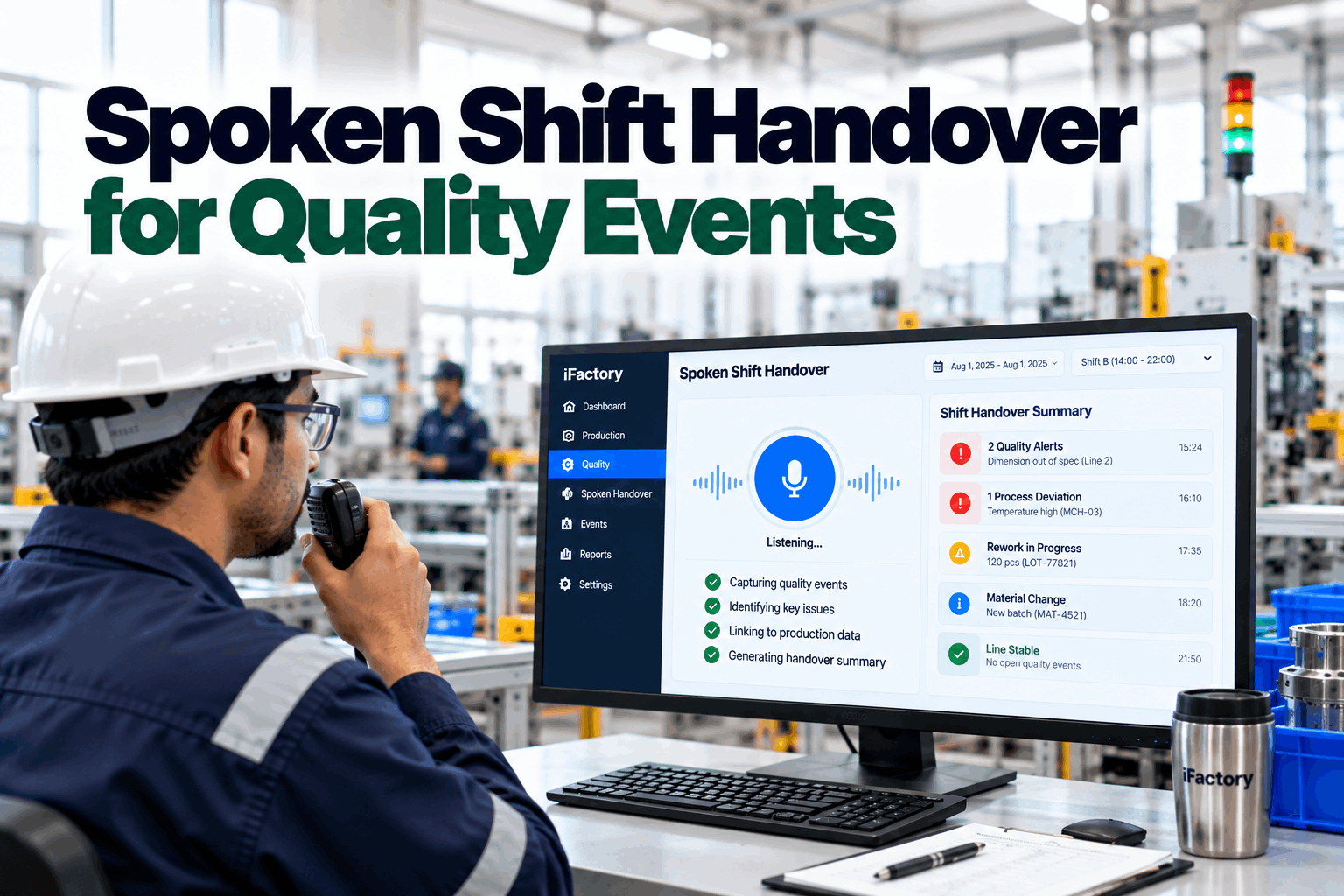
At-risk tag lists are timestamped and logged at every shift handover — creating an auditable record of what risk was visible, what action was recommended, and what was done.
From Tag History to Ranked Risk List: How iFactory Predicts Spec Breaches Before They Occur
The Plant Copilot's spec risk prediction capability is built on four sequential analytical steps — each one transforming raw process data into a progressively more actionable output. Quality managers who have already Book a Demo report that the shift from reactive alarm response to proactive risk list management represents the most operationally significant change in their quality programs in years.
Continuous Tag History Ingestion
Plant Copilot reads the historian for every monitored process tag at configurable intervals — typically every 60 seconds — building a rolling time-series record that captures not just current values but trend velocity and direction over the preceding window.
Drift Velocity and Trajectory Calculation
For each tag, the platform calculates the current deviation from setpoint center, the rate of change over the recent window, and the projected position at T+2, T+4, and T+8 hours using a combination of linear trend extrapolation and process-specific ML models trained on that tag's historical behavior patterns.
Spec Risk Scoring and Ranking
Each tag receives a risk score based on three factors: probability of breaching the specification limit within the forecast window, time remaining before expected breach, and consequence severity for that tag's process position. Tags are ranked by this composite score and flagged by urgency tier — Act Now, Monitor Closely, Watch Next Shift.
Recipe Parameter Recommendation
For each at-risk tag, Plant Copilot identifies the recipe parameter with the highest historical correlation to correcting that tag's trajectory — specifying the recommended adjustment direction and magnitude based on the current deviation and drift rate, not a generic setpoint nudge.
Shift Handover Risk Briefing
At each crew change, Plant Copilot auto-generates the shift risk briefing — a ranked list of at-risk tags with expected breach times, recommended actions, and the operator or supervisor responsible for each. This briefing is delivered directly in the Copilot interface and pushed to the incoming shift team via SMS or email.
How iFactory Classifies and Communicates At-Risk Tags to Shift Teams
Not all tag risk is equal, and a quality shift team cannot treat a tag that is 94% of the way to its limit and trending fast the same way it treats a tag at 78% with a flat trend. iFactory's risk tier framework ensures the right level of urgency is communicated at the right time — eliminating both alarm fatigue from over-alerting and blind spots from under-alerting. Book a Demo to see how the tier logic is configured for your specific process and spec limits.
| Risk Tier | Trigger Condition | Expected Breach Window | Recommended Action | Escalation Path |
|---|---|---|---|---|
| Act Now | Tag at >90% of spec limit, trending toward breach at current velocity | Within 2 hours | Immediate recipe parameter adjustment; confirm correction in 15 minutes | Direct SMS to shift supervisor + quality manager |
| Monitor Closely | Tag at 75–90% of spec limit with positive drift rate over last 60 minutes | 2–4 hours | Review recommended recipe nudge; schedule check-in at T+1 hour | Shift handover briefing flag + dashboard alert |
| Watch Next Shift | Tag at 60–75% of spec limit with sustained directional drift over last 2 hours | 4–8 hours | Log as handover item; recommend incoming shift perform verification check | Included in shift handover risk briefing document |
| Nominal | Tag within spec center ±25%; no sustained directional drift detected | Not at risk this shift | No action required; continue standard monitoring | No escalation; standard dashboard visibility |
The Six Quality Management Gaps That At-Risk Tag Prediction Closes
Most quality programs pursuing spec breach reduction run into the same structural gaps regardless of how much SPC infrastructure they have deployed. Understanding these gaps before a platform deployment helps quality managers set realistic expectations and prioritize the integration work that delivers the fastest return. Quality directors Book a Demo to benchmark their current gaps against iFactory's shift risk architecture.
Standard alarms fire when spec is breached — not before. Trajectory-based prediction identifies the risk while correction is still possible, not after the damage is done.
Incoming shift teams inherit risk from the previous crew without a structured briefing. At-risk tag lists eliminate the knowledge gap at every crew change with a documented, timestamped briefing.
Even when operators see a drifting tag, knowing which recipe parameter to adjust — and by how much — requires experience that varies by shift. Plant Copilot provides the specific nudge, not just the alert.
Flat-threshold alarm systems generate hundreds of alerts per shift, training operators to dismiss them. Consequence-ranked risk tiers deliver 10–20 prioritized actions per shift that operators respond to every time.
Without a documented risk briefing at handover, it is impossible to determine which shift had the data to prevent a breach and chose not to act. Timestamped risk lists create auditable accountability at every shift boundary.
Tags don't drift in isolation — they drift in response to recipe changes, operator actions, and upstream process conditions. Plant Copilot correlates tag risk with the process context that is driving it, not just the measurement itself.
Why Shift Risk Prediction Changes the Entire Quality Management Posture
"In twenty-two years of quality systems work across automotive stamping, precision machining, and food processing, the single most consistent finding I encounter is that the data to prevent a spec breach was available before the breach occurred — and no one acted on it, because no system surfaced it in a way that made action obvious. SPC charts require an engineer to look at them. Historian queries require someone to know what to query. End-of-shift reports capture what already happened. What quality teams need is not more data visibility. They need a system that reads the trajectory of every critical tag, computes the probability of breach within the shift window, and tells the operator — in plain language, at the start of the shift — which three tags need attention today and exactly what to do about each one. When an incoming shift team gets a ranked list that says 'Tag 14: tension ratio expected to breach upper limit at approximately 3:40 AM — recommend reducing nip pressure setpoint by 0.4 bar,' the corrective action that prevents the breach is not a quality engineering decision anymore. It's an operations execution task. That is the organizational transformation that predictive shift risk delivers. It moves quality responsibility from the quality department back to the production floor, where the corrective levers actually live."
The Shift Risk Data Is Already There. iFactory Plant Copilot Reads It Before the Breach Occurs.
The question "which tags are at risk of breaching spec next shift?" has always had an answer inside your historian. The tag that breached at 2 AM was drifting by 11 PM. The tension ratio that produced the out-of-spec parts at the start of the third shift had a visible trajectory from the second. The data was there. What was missing was an AI layer that read that trajectory in real time, ranked the risk by expected breach time and correction urgency, and delivered the answer to the right person at shift handover — before the excursion occurred rather than after.
iFactory Plant Copilot delivers exactly that capability: continuous tag history analysis, drift velocity calculation, consequence-ranked risk tier classification, and specific recipe parameter recommendations — assembled into a shift risk briefing that any operator can act on without an engineering degree. The result is fewer spec breaches, faster correction cycles, and a quality management posture that is genuinely predictive rather than reactively apologetic. The data to prevent your next spec breach is already being generated on your production line. iFactory connects it to the shift team that can act on it.
Ask Plant Copilot Which Tags Are at Risk Before Your Next Shift Starts
iFactory AI reads your tag historian in real time, ranks spec breach probability by shift window, and delivers the corrective recipe recommendation — so your shift team acts before the excursion, not after.
At-Risk Tag Prediction and Shift Quality Intelligence — Questions Answered
Plant Copilot calculates the drift velocity and direction of every monitored tag over a rolling time window, then projects that trajectory against the spec limit to estimate breach probability and expected time to breach — so it identifies risk while the tag is still within specification and correction is still straightforward.
No — iFactory connects to existing OPC-UA, OSIsoft PI, Ignition, and other standard historian platforms via native integration, reading tag history directly without replacing any existing infrastructure. Most deployments are fully connected within 2–4 weeks of go-live. Book a Demo to confirm compatibility with your current historian stack.
The recommendation specifies the parameter name, the recommended adjustment direction, and a suggested magnitude based on the current deviation and historical correction data — not a generic setpoint nudge, but an actionable instruction that an operator can execute without engineering escalation.
Yes — shift handover briefings can be configured to auto-generate at scheduled crew change times and push the at-risk tag list to incoming shift team members via SMS, email, or the Plant Copilot interface, so the risk intelligence reaches the team whether or not anyone actively queries it.
Yes — every confirmed breach event and every confirmed prevention event is logged as a labeled training record for that facility's tag behavior model, progressively improving prediction accuracy and reducing false-positive at-risk flags as the model learns each tag's facility-specific drift patterns.