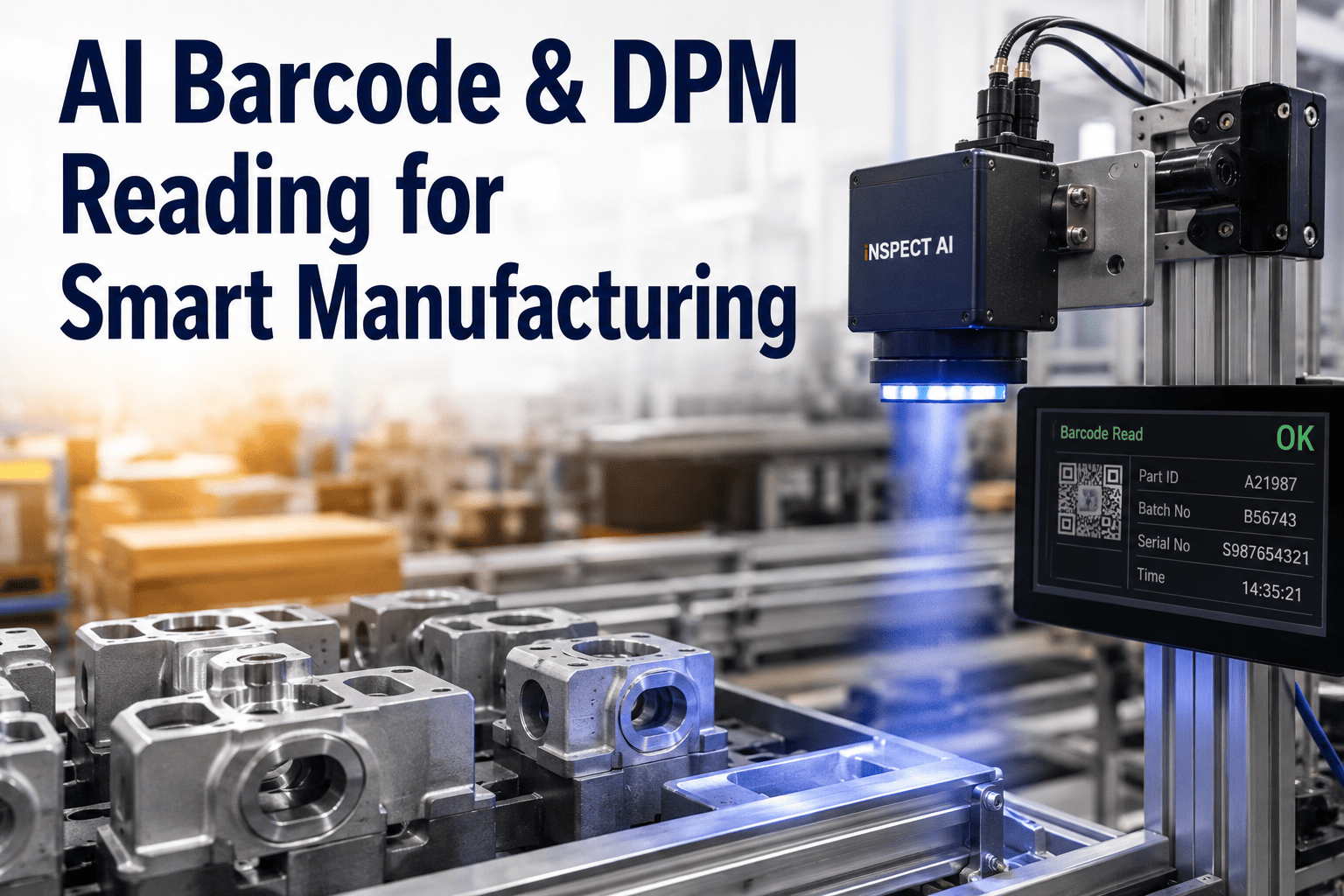
A dot-peened code on a curved, oil-smeared engine housing is one of the hardest things to read reliably in a factory, and it sits at the center of nearly every traceability failure that shows up months later as an unexplained gap in a recall investigation. Direct part marks are supposed to be permanent, but permanent does not mean easy to decode, especially when the mark is small, low-contrast, and moving past a fixed camera at production speed. Most plants still rely on handheld rescans and manual workarounds for exactly the codes that matter most, which is the traceability gap ifactory support was built to close.
Every Code Located and Decoded, Even on Curved and Reflective Parts
1D barcodes, 2D matrix codes, and low-contrast direct part marks read reliably at any pose, with edge GPU inference under 50 milliseconds per part.
Why DPM Codes Break Ordinary Barcode Readers
A printed label barcode is high contrast by design, black ink on white stock, flat, and stationary relative to the reader. A direct part mark is none of those things. Laser etching, dot peening, and chemical etching each create a mark with inherently low contrast against its background, and the automotive, aerospace, and electronics parts they are stamped on are almost never flat. Parts are curved, reflective, and frequently obscured by machining oil or handling residue by the time they reach an inspection station, and any of those conditions alone is enough to defeat a conventional imaging reader tuned for flat, high-contrast labels.
The consequence shows up downstream, not at the reader. A code that fails to scan gets manually keyed, rescanned by hand, or in the worst case, shipped without a confirmed read at all, breaking the digital thread that connects that specific part back to its production order, shift, and raw material batch. When a warranty claim or a field failure investigation needs that link months later, a gap in the read record turns a routine traceability lookup into a much larger liability question.
One Platform Across Every Mark Type on Your Floor
A plant rarely uses just one marking method. Different parts, suppliers, and legacy equipment mean a single production line can carry printed labels, laser-etched codes, and dot-peened marks side by side, and a reading system that only handles one type forces a second manual process to cover the rest.
| Mark Type | Common Application | Typical Challenge |
|---|---|---|
| 1D Barcode (printed) | Cartons, secondary packaging | Damage, smudging, poor print quality |
| 2D Data Matrix (printed or laser) | Electronics, small components | Small cell size, limited real estate |
| Dot Peen DPM | Automotive, metal components | Very low contrast, curved surfaces |
| Laser Etched DPM | Aerospace, medical devices | Reflective background, oil contamination |
| Chemical Etch DPM | Tooling, regulated components | Shallow depth, inconsistent lighting response |
Test Read Rates on Your Actual Parts
Bring the parts your current system struggles with most. We will show read rate and decode time on the exact marks giving your line trouble today.
Read Rate Improvement by Mark Condition
The read rate gap between a generic decoder and an AI-enhanced decoder widens dramatically as mark quality degrades. On a clean, freshly-etched code the difference is marginal. On a worn, oily, or partially obscured mark, the difference determines whether a part gets traced at all.
Curious how your worst-condition parts would score? Talk to our team and bring a sample batch for a live read-rate test.
Where Reliable DPM Reading Changes the Traceability Story
Traceability is only as strong as its weakest read station, and the weakest station is almost always the one handling the hardest mark type on the hardest surface. Automotive, aerospace, and medical device manufacturers carry the most exposure here, since a broken digital thread on a safety-critical component is not a minor inconvenience, it is a compliance and liability event.
Frequently Asked Questions
See Your Hardest Codes Read Reliably
Bring the parts your current reader struggles with most, curved, reflective, or low-contrast, and we will show live read rate and decode time on your own production samples.