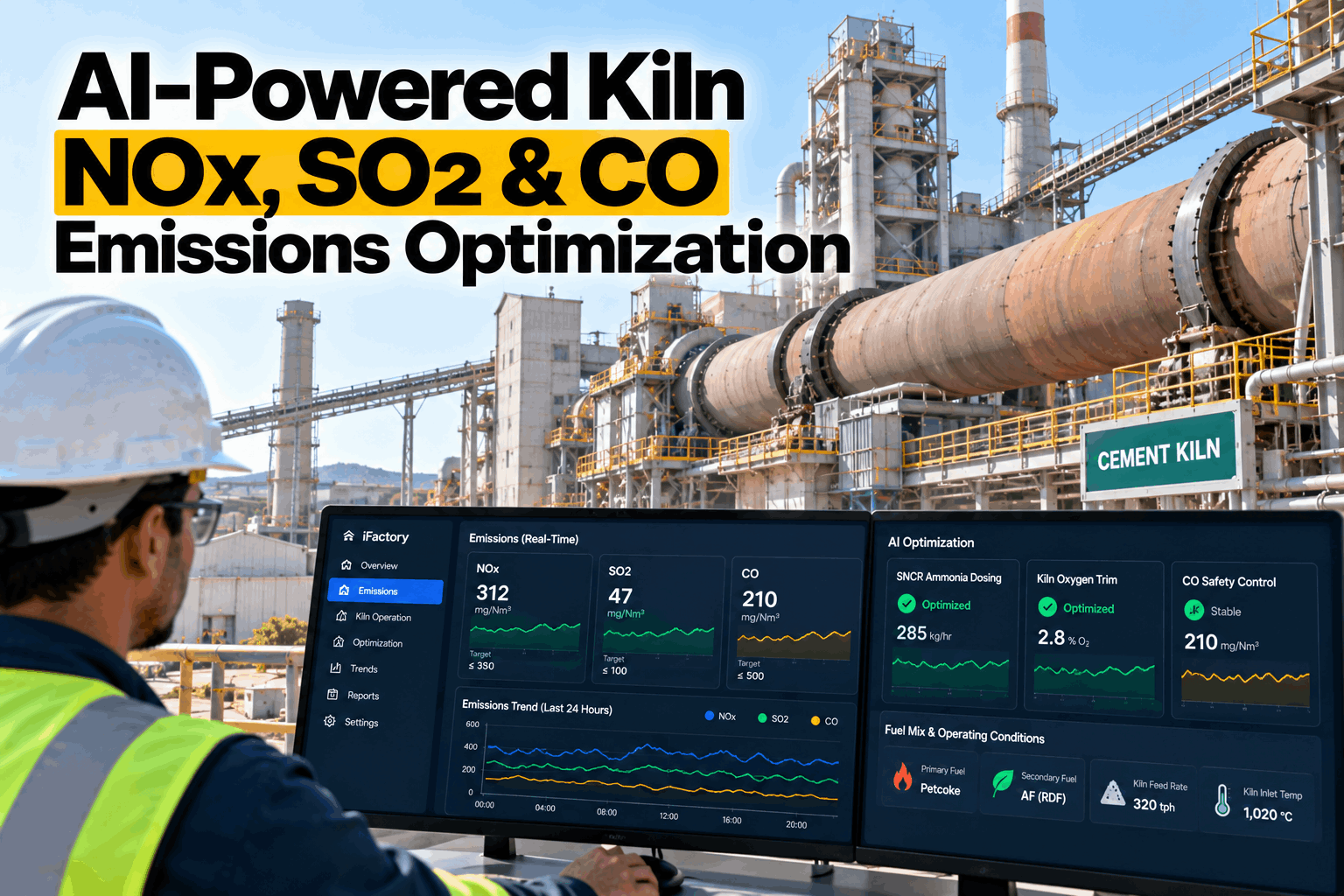
A cement kiln makes three gases that pull in different directions. Add air to burn out CO, and NOx rises. Cut air to hold NOx, and CO spikes with SO2 close behind. Spray extra ammonia to be safe, and it slips out of the stack unused. Most plants cope by keeping wide margins on all three, which costs fuel and reagent every hour. iFactory's AI Optimization and Emissions Analytics watches the three together and tunes ammonia dosing and oxygen to the fuel the kiln is burning right now. To see it on your own kiln data, book an emissions review.
AI Kiln Emissions Optimization: NOx, SO2 and CO Held Together, Not One at a Time
Real-time SNCR ammonia dosing, oxygen trim and early CO warning — tuned to the current fuel mix, and working beside your CEMS, DCS and safety systems.
- Forecasts NOx and CO minutes ahead
- Doses ammonia to the setpoint, not to a margin
- Safety trips stay hard-wired and untouched
- NOx, SO2 and CO are linked. Fixing one alone often worsens another.
- Wide safety margins hide the problem and cost reagent and fuel.
- AI forecasts a few minutes ahead and adjusts dosing and air before the spike.
Three Gases, One Flame
Every move an operator makes for one gas shows up in another.
The link between them is oxygen. Too little, and fuel does not burn out. Too much, and the flame makes more NOx while fuel is spent heating air that does no work. The best running sits in a narrow band between the two. Our support team can help you find where your kiln sits today.
- CO spikes
- SO2 climbs as sulphur stops being captured
- Rings and build-ups form
- Fuel burns out
- NOx stays manageable
- Least fuel per tonne of clinker
- NOx rises
- More ammonia needed to hold the limit
- Fuel wasted heating excess air
Typical kiln-inlet figures for illustration. Your own window is found from your own kiln's data.
- Extra air "to be safe" burns more fuel and makes more NOx to clean up.
- Extra ammonia "to be safe" is paid for twice: once to buy, and again as slip at the stack.
- A low NOx setpoint "to be safe" removes NOx the permit never asked you to remove.
Where Each Gas Is Born
The three gases come from different parts of the kiln line, so no single setting fixes all of them.
That is why watching only the stack is too late. By the time the stack analyser moves, the cause is minutes old and somewhere upstream. To walk through your own kiln line this way, book a working session.
Burning zone
The main flame is hot enough to join nitrogen and oxygen from the air itself. This is thermal NOx, and it follows flame temperature and excess air.
Kiln inlet
The first place gas can be sampled after the kiln. Oxygen, CO and NO here are the earliest warning of what the stack will show.
Calciner
Most of the fuel burns here. Coarse or wet waste-derived fuels give CO; fuel nitrogen gives NOx. SNCR ammonia is injected in this region.
Preheater top
Sulphide minerals and organic matter in the raw meal are driven off as SO2 and CO before they ever reach the flame. This part comes from the quarry, not the burner.
Stack
The CEMS reports what the permit counts. With the raw mill running, some SO2 and ammonia are absorbed on the way; with it stopped, both step up.
What the limits look like
A summary for orientation only. Your own permit and the current national rules govern.
The averaging period matters as much as the number. A daily average forgives a short spike that an hourly one does not, and that changes how much margin a kiln needs to carry.
NOx: Dose Ammonia to the Setpoint, Not to a Margin
SNCR works in a narrow temperature band. Miss it, and you pay for ammonia that does nothing — or leaves through the stack.
In the right band, ammonia turns NOx into plain nitrogen and water. The trouble is that the band moves as fuel, feed and gas flow change, while the stack analyser reports several minutes late. Ask our process specialists how dosing is tuned on a kiln like yours.
- The reaction is slow
- Ammonia passes through unused
- Slip rises at the stack
- NOx becomes nitrogen and water
- Most NOx removed per litre
- Least slip
- Ammonia starts to burn
- Burnt ammonia makes new NOx
- Reagent is wasted twice over
Gas takes time to travel from the calciner to the stack, and the analyser takes time to respond. A controller that waits for the stack reading is always correcting the past. Forecasting closes that gap.
What the AI does differently
It looks ahead
NOx at the stack is forecast a few minutes ahead from kiln-inlet gas, fuel rates and feed. Dosing moves before the analyser does.
It holds the setpoint
Smaller swings mean the setpoint can sit nearer the limit. Every milligram of margin given back is ammonia not bought.
It watches the slip
NOx and ammonia slip are steered together. Where your SNCR has several lance levels, it advises which to use as temperature shifts.
This is an active research field. A 2026 research preprint covering four cement plants on four continents reported forecasting NOx nine minutes ahead and CO six minutes ahead from process data. A supplier of high-efficiency SNCR lances reports ammonia savings of about 30% from better-targeted injection.
What Steadier Dosing Is Worth
One 5,000-tonne-a-day kiln, one year. Holding NOx a little nearer the limit, and getting a little more out of each litre of ammonia, is a six-figure line.
CO and SO2: Oxygen Trim That Follows the Fuel
Waste-derived fuels change by the hour. A fixed oxygen target is right for one fuel and wrong for the next.
iFactory keeps the oxygen target moving with the fuel. It lifts air a little when a difficult fuel arrives, and brings it back when the risk has passed, so the kiln does not sit on a high-oxygen margin all day. To test it against your own fuel mix, book a fuel review.
CO safety stays hard-wired
The CO trip that protects an electrostatic precipitator is a safety function. iFactory never bypasses, delays or replaces it.
What it does is make trips rarer, by warning minutes before CO climbs. EU BAT asks plants to keep total CO-trip downtime under 30 minutes a year.
SO2 in three lines
- Mostly from the quarry. Sulphide in the raw meal leaves at the preheater top.
- Partly from low oxygen. Sulphur the kiln should capture escapes when air is short.
- Changes with the raw mill. Where lime is injected, the dose should follow mill status and raw-meal sulphur.
How It Works With What You Already Have
It reads your analysers and advises your control system. Nothing is ripped out.
Your CEMS stays the instrument of record. Your DCS stays in control of the plant. iFactory sits beside them, starts in advisory mode, and writes setpoints only where you approve it and only inside limits you fix. Our integration team can confirm what your systems expose.
Read
Stack CEMS, the kiln-inlet analyser, fuel rates, feed, temperatures and fan speeds.
Forecast
NOx, CO and SO2 a few minutes ahead, for the fuel mix now in the kiln.
Act
Ammonia flow and oxygen target, as advice first and as setpoints once approved.
Record
Every change with its reason, ready for the shift log and the regulator.
Who sees what
- Kiln operator. The forecast, the advice and the reason, on one screen.
- Process engineer. Ammonia per tonne, oxygen and margin trends by fuel mix.
- Environment manager. Averages against permit, with early notice of a period at risk.
- Plant manager. Reagent and fuel cost per tonne of clinker, month on month.
Advisory first. Closed loop only with your approval, through your DCS, inside your limits.
Turnkey AI: Delivered, Connected and Live in 6–12 Weeks
You do not build this. It arrives ready.
iFactory ships as a pre-configured NVIDIA AI server, racked and ready, with the software pre-loaded. Rack it, plug in power and Ethernet, and the AI is live on your network.
Our team handles cabling, network setup, PLC and SCADA integration, operator training and 24×7 remote monitoring. The server sits inside your own network, and your plant data stays on it. For a scope matched to your kiln line, request a turnkey quote.
Ship, network and data
Server installed. Read-only links to the CEMS, kiln-inlet analyser and DCS. A year of history loaded, with fuel records.
Model training and pilot
Forecasts trained on your kiln and your fuels. Advice runs in shadow beside the operators and is checked against what happened.
Go-live and training
Advisory mode goes live in the control room. Limits and approvals agreed. Training by role, and 24×7 remote monitoring begins.
Frequently Asked Questions
Why can't NOx, SO2 and CO be controlled one at a time?
Because they share the same lever: air. More air cuts CO and helps the kiln hold sulphur, but it raises NOx and fuel use. Less air does the reverse. A change made for one gas moves the others within minutes, so they have to be steered together.
How much ammonia can better SNCR control save?
It depends on how wide your margins are today. The worked example on this page shows 19%. A supplier of high-efficiency injection lances reports about 30% from better targeting. Your own figure comes out of a pilot on your kiln.
Does the AI replace our CEMS or DCS?
No. The CEMS remains the instrument of record for the regulator, and the DCS remains in control. iFactory reads both, forecasts ahead of them and sends advice or approved setpoints through the DCS. If iFactory is switched off, the plant runs exactly as it does today.
Is the CO safety trip affected?
No. Safety trips stay in your hard-wired safety system and are never bypassed or delayed. The aim is fewer trips, by acting on the cause minutes before CO reaches the trip level.
Does it cope with changing waste-derived fuels?
That is where it helps most. Fuel rates and, where measured, moisture and heating value are inputs to the forecast. The oxygen target and ammonia dose follow the fuel in use instead of a fixed worst-case setting.
Does running nearer the limit put compliance at risk?
The setpoint and the margin are yours to fix. Forecasting reduces the swings, so the same safety against the permit average can be kept with a smaller margin. Most plants begin in advisory mode and narrow the margin in steps.
How long does it take to go live?
Six to twelve weeks from delivery. We need a place for the server with power and Ethernet, read access to the CEMS, kiln-inlet analyser and DCS, and about a year of history. A pilot normally covers one kiln line. To check your set-up first, contact our team.
Bring One Month of Kiln and Stack Data
In thirty minutes we show how the three gases move together on your kiln, how much margin you carry and what it costs. You keep the picture whether or not you go further with iFactory.
- 1CEMS data: NOx, SO2, CO, ammonia and oxygen
- 2Kiln-inlet gas analyser trends
- 3Ammonia or urea flow for the same month
- 4Feed rates for each fuel
- 5Permit limits and their averaging periods