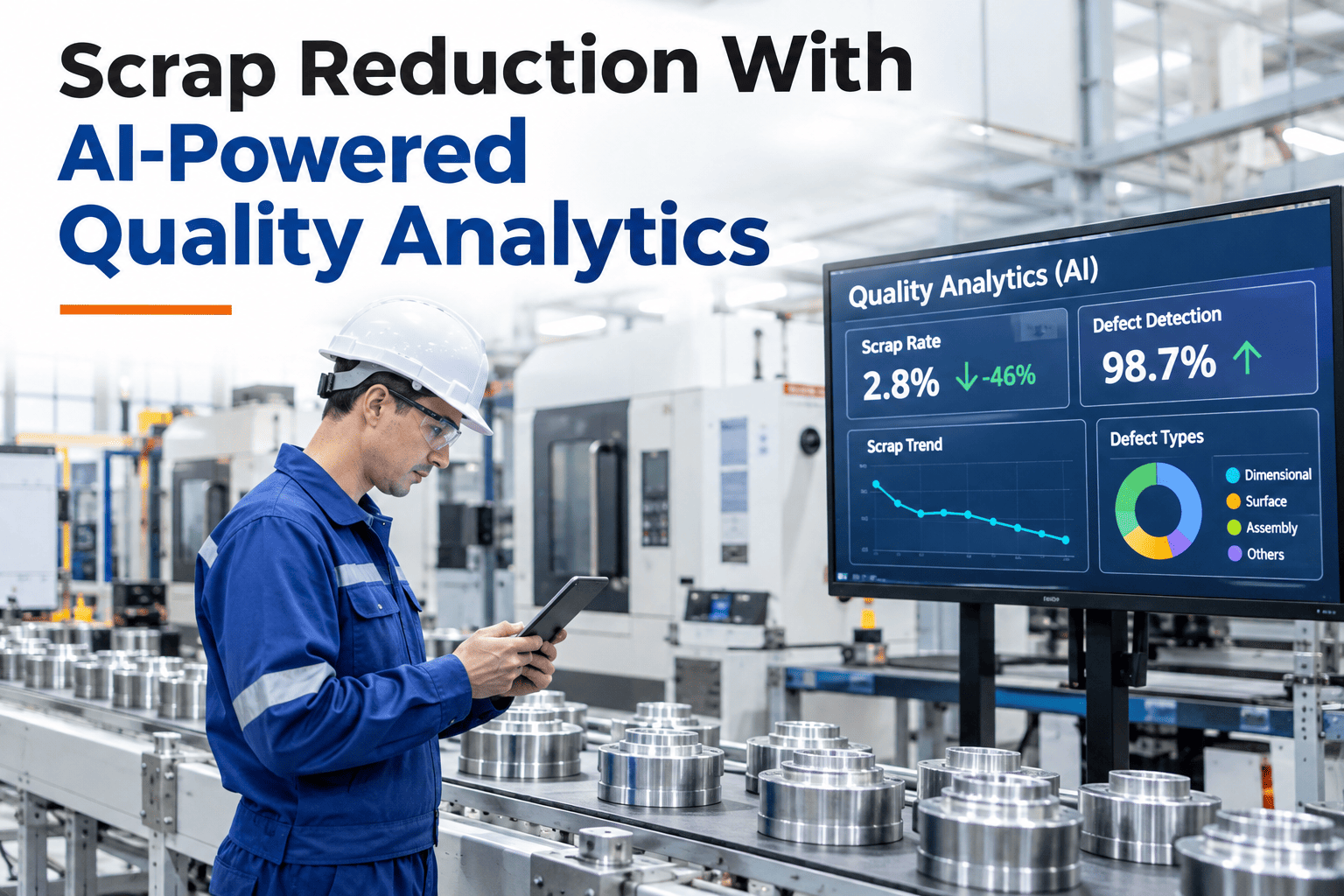
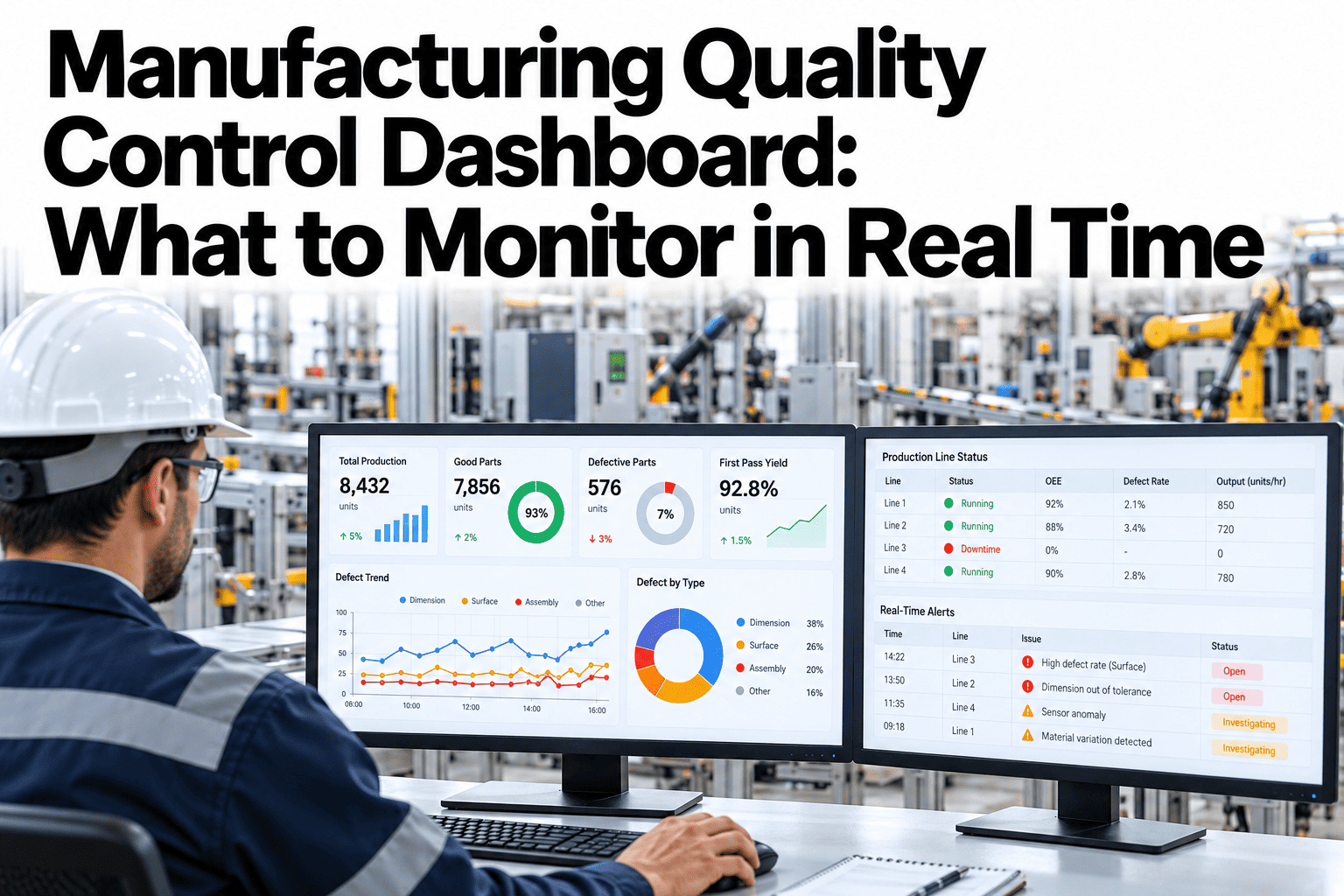
AI-powered quality analytics reduces scrap by linking process conditions, machine states, defect records and production history, so a plant can see why defects form and act before a batch is lost. Most plants still measure scrap at the bin, which counts only the visible part of the loss. The American Society for Quality (ASQ) has long put the cost of poor quality at 15 to 20 percent of sales for many manufacturers. iFactory, an on-premise AI platform for manufacturing, connects these data streams in one place, and teams can watch a scrap driver traced back through their own line data in a short session.
Predictive Quality · Scrap Reduction · 2026
The Scrap in the Bin Is Only the Part You Can See
iFactory AI links process conditions, machine states and defect history so scrap is traced to its cause and stopped earlier in the run.
Visible loss: scrap counted in the bin
Waterline: what most reports stop at
Rework hours and re-inspection
Lost capacity and quality-stop downtime
Engineering time and containment
Warranty claims and returns
Illustrative. ASQ puts total quality costs at 15 to 20 percent of sales for many manufacturers (ASQ, 2026).
The definition
What Is AI-Powered Quality Analytics for Scrap Reduction?
It is the use of machine learning on live process, machine and quality data to find which conditions precede defects, then warn teams while the product can still be saved. It replaces end-of-shift reporting with cause-level insight.
Scrap reporting
Counts what was thrown away
Reviewed after the shift
Cause guessed from memory
Quality analytics
Explains why defects formed
Warns while the run continues
Cause traced to a condition
The cost
How Much Does Scrap Really Cost a Plant?
Far more than its material value. Scrap, rework, re-inspection and lost capacity sit in different budgets, so no single report shows the total.
15–20%
of sales lost to poor quality at many manufacturers (ASQ, 2026)
83%
first-time-through on a line with 2% scrap and 15% rework (TeepTrak, 2026)
Under 5%
of revenue is what most plants believe their cost is (Averroes, 2026)
A line can look healthy on scrap alone while rework quietly consumes labor and energy. Teams who want to see both numbers together can ask our specialists how first-time-through is calculated from existing records.
| Cost Bucket | What It Covers | Typical Line Items |
| Prevention |
Spend to avoid defects |
Training, maintenance, process design |
| Appraisal |
Spend to find defects |
Inspection, testing, calibration |
| Internal failure |
Defects caught in the plant |
Scrap, rework, re-inspection, downgrades |
| External failure |
Defects that reach the customer |
Returns, claims, recalls, lost orders |
Find Where Your Scrap Really Starts
Bring one month of scrap and process records. iFactory AI will show which conditions travel with your defects.
The data chain
How Do Process Conditions, Machine States and Defects Connect?
Each defect has a context: the machine state, the settings, the material lot and the minutes before it formed. Analytics joins these into one record per unit or batch.
1
Process
Temperature, pressure, speed, torque
2
Machine
Run, stop, fault and wear state
3
Defect
Type, position, severity, image
4
History
Lot, shift, product and past runs
When the four layers share a timeline, a pattern such as scrap rising after a temperature drift becomes visible within days. To see this join on live data, review a connected quality record with our team.
Ranking the causes
Which Scrap Causes Does AI Surface First?
The strongest early finds are usually drift and changeover effects, because they repeat. The bars show an illustrative ranking by share of scrap.
Startup and changeover
26%
Material lot variation
20%
Worn tooling or parts
16%
Illustrative split. Your own ranking will differ, and that difference is exactly what the analytics is built to reveal.
A composite scenario
What Does a Saved Batch Look Like?
Picture a line where scrap climbs late in each long run. Analytics finds that a heater zone drifts after about four hours.
Illustrative. The fix was a recalibration prompt at hour three, not new equipment.
The rollout
How Do You Start Reducing Scrap With AI?
1
Pick one costly line
Start where scrap and rework are highest.
2
Connect the four layers
Process, machine, defect and history data.
3
Find the repeating pattern
Rank causes by cost, not by count.
4
Add early warnings
Alert operators while the run is still savable.
5
Prove and repeat
Compare scrap before and after, then expand.
Starting small keeps proof quick. For a realistic first scope, talk with our team about a single-line pilot.
Where iFactory fits
What Does iFactory AI Add to Quality Analytics?
Unified quality record
Process, machine and defect data on one timeline.
Early-warning models
Alerts when conditions match past defect patterns.
Cost-weighted ranking
Causes ordered by scrap and rework cost.
On-premise deployment
Runs on a plant NVIDIA server, live in 6–12 weeks.
Pitfalls
What Mistakes Keep Scrap Reduction Programs From Working?
Most scrap programs stall for the same few reasons. Each one has a practical remedy.
Counting only scrap
Track rework and first-time-through as well, or the true loss stays hidden behind a low scrap number.
Pricing scrap at material cost
Add labor, energy, machine time and disposal, since multi-step parts carry far more cost by the time they are scrapped.
Mixed defect codes
Agree one defect list with written definitions, so two shifts label the same flaw the same way.
Unaligned timestamps
Sync clocks across machines, inspection and ERP, because a defect cannot be linked to a condition without a shared time.
A model with no process test
Confirm each suspected driver with a controlled run before changing standard work.
Fixing these basics often delivers value before any model is trained. To check your own records for them, ask our team to review your defect coding.
Key terms
Which Terms Should Teams Define Before Starting?
A shared vocabulary prevents arguments later. Six terms cover most of the work.
Scrap
Product that cannot be recovered and is discarded.
Rework
Product corrected to meet specification at extra cost.
First-time-through
Share of units that are good with no rework.
COPQ
Cost of poor quality: internal plus external failure costs.
Process drift
A gradual move of a parameter away from its target.
Defect escape
A defect that passes inspection and reaches the next stage or the customer.
Teams can see these terms built into a live reporton their own line data.
Expert review
Using Quality Analytics Responsibly
What holds up
Linking process data to defects is sound practice, and cost-weighted Pareto ranking focuses effort well.
What to verify
That defect labels are consistent, timestamps align across systems and rework is recorded, not only scrap.
What to avoid
Trusting a model that was never checked against fresh production, or acting on correlation without a process test.
Bottom line: fix the data first, then let the model rank causes, and confirm each finding with a controlled run.
Questions
Frequently Asked Questions
How does AI reduce scrap in manufacturing?
AI finds the process and machine conditions that appear before defects, then alerts teams while the run can still be corrected. This cuts scrap at the source instead of counting it afterwards.
See an early-warning example on your data.
What data is needed to start?
Scrap and rework records, machine states, key process parameters and timestamps for a few weeks are usually enough for a first model. Gaps can be handled but should be flagged.
Ask whether your records are usable.
Is rework counted as well as scrap?
It should be. Scrap alone hides the labor, energy and time spent making a unit twice, which is why first-time-through is a useful companion measure.
Walk through a rework tracking setup.
Can it run without sending data to the cloud?
How soon can a plant expect to see results?
Early patterns often appear once a few weeks of connected data exist, but gains depend on the line and defect mix. A limited pilot confirms the result before wider rollout.
Discuss a realistic pilot timeline.
Turn Scrap Data Into Saved Batches
See iFactory AI connect process, machine and defect data on your own line, and rank scrap causes by cost.