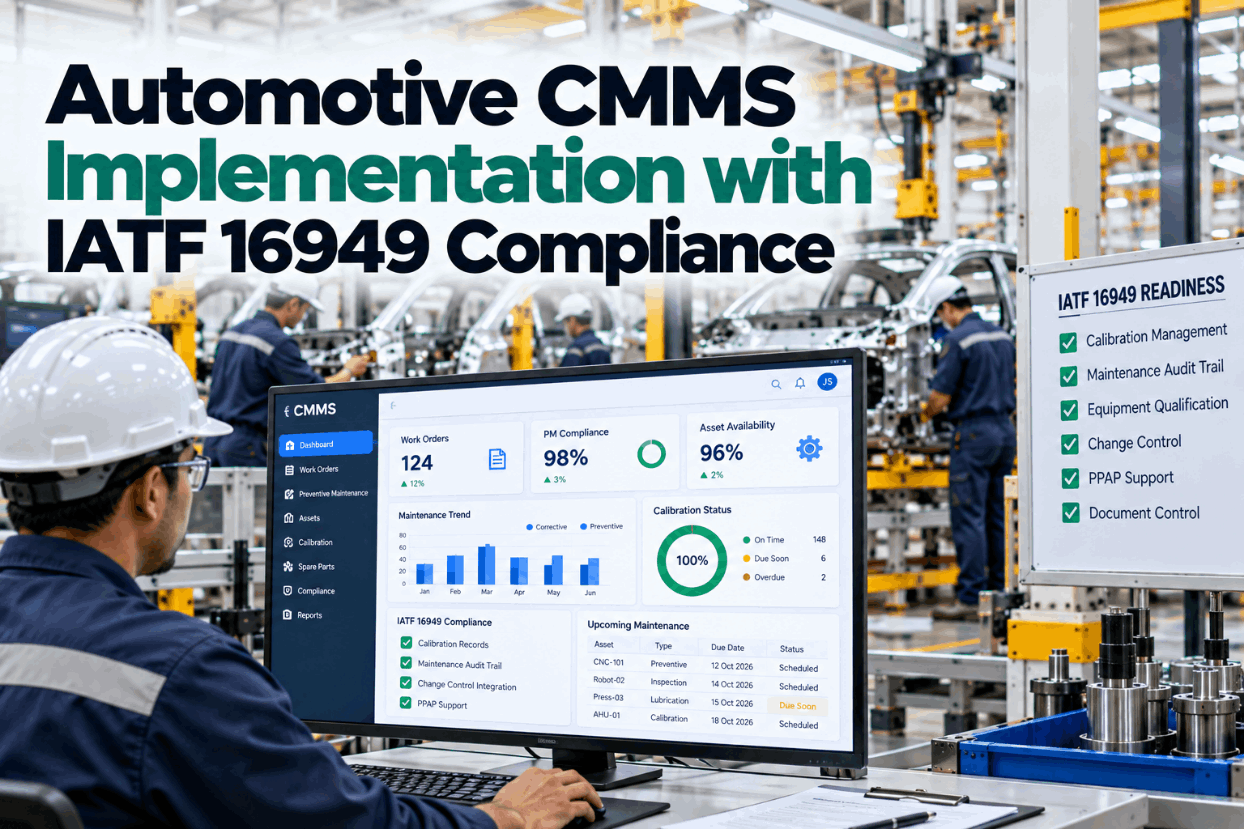
An automotive CMMS has a harder job than a general maintenance system. It has to prove to an IATF 16949 auditor that preventive maintenance was done, gauges were calibrated, tooling was managed and equipment changes were controlled. Rolling one out in a running plant is risky if records are lost or change control is skipped along the way. This guide explains what IATF 16949 expects from maintenance, which records a CMMS must hold and how to implement it in clear steps. To see an IATF-ready CMMS set-up, book a short walkthrough.
Automotive CMMS Implementation With IATF 16949 Compliance: Audit-Ready Maintenance From Day One
Preventive maintenance, calibration, tooling and equipment changes recorded the way IATF auditors expect, without disrupting production or customer approvals.
Clause 8.5.1.5 covers equipment, spare parts, resources, objectives and preventive and predictive methods.
The usual finding is missing proof that planned maintenance was actually done.
Calibration, tooling, contingency plans and change records all need a home.
Start with critical equipment and clean data; add calibration and tooling next.
What Does IATF 16949 Expect From Maintenance?
IATF 16949 requires a documented total productive maintenance system, with objectives that feed management review.
The clause that asks automotive suppliers to develop, implement and maintain a documented TPM system. The points below summarize it; always check the standard itself.
Know which equipment is needed to make conforming product at the required volume.
Replacement parts available; people and facilities for maintenance in place.
Packaging and preservation when stored or moved.
For example OEE, MTBF, MTTR and preventive maintenance compliance.
Regular review of the plan and objectives, with a documented action plan when targets are missed.
Preventive methods, predictive methods where applicable and periodic overhaul.
The objectives are examples, not a fixed list. Auditors accept other measures, such as unplanned downtime, if they are documented and reviewed.
A CMMS is the natural place to hold all of this. We can map your current records to the clause on a call.
Why This Matters to So Many Plants
Almost every automotive supplier site in the world works to this standard.
- Certification is a ticket to trade. Most OEMs require it from direct suppliers.
- Audits come every year. Under the 6th edition Rules, surveillance audits run at 12-month intervals.
- Deadlines are tighter. Evidence for a major nonconformity is now due in 15 days, down from 20.
- Maintenance is always in scope. Auditors visit the shop floor and ask to see maintenance records.
That finding is about missing records, not missing work. See how records are captured at the machine in a demo.
IATF 16949 Clauses a CMMS Must Support
Six parts of the standard land directly on the maintenance team.
| Clause | Subject | What the CMMS should hold |
|---|---|---|
| 8.5.1.5 | Total productive maintenance | Asset list, PM plans, completed work orders, KPIs, review actions |
| 8.5.1.6 | Management of production tooling | Tool identification, status, location, maintenance and repair history |
| 7.1.5.2.1 | Calibration and verification records | Gauge list, due dates, as-received readings, risk assessment |
| 6.1.2.3 | Contingency plans | Plans for key equipment failure, test dates and results |
| 8.5.1.4 | Verification after shutdown | Restart checks after planned or unplanned shutdowns |
| 8.5.6.1 | Control of changes | Equipment and process changes with approvals and validation |
Record retention matters too. Clause 7.5.3.2.1 asks for tooling records, including maintenance, to be kept for as long as the part is active for production and service, plus one calendar year, unless the customer says otherwise.
Our specialists bring a clause-by-clause template to every project.
Calibration and Gauge Records
Calibration is where many CMMS projects stop short, and where auditors look closely.
- Every gauge listed. Unique ID, location, owner and calibration interval.
- As-received readings. The record must show any out-of-specification reading found when the gauge arrived for calibration.
- Risk assessment. If a gauge was out of specification, assess the effect on product measured since its last good check.
- Software version. Where software controls product or process, verify the version is the one specified.
- Due dates enforced. An overdue gauge should be visibly blocked from use.
Out-of-specification readings as received, a risk assessment and software version checks are among the details clause 7.1.5.2.1 expects in the record.
Linking each gauge to the stations where it is used makes the risk assessment quick. We build that link in every rollout.
Tooling, Dies, Molds and Fixtures
Production tooling needs its own records: what it is, who owns it, where it is and what has been done to it.
Stroke or shot counters from the machine make tooling maintenance condition-based. A die is serviced after a set number of hits, not on a calendar date that ignores how much it ran.
Ask our team how counters feed tooling work orders.
Change Control and PPAP: What Maintenance Must Flag
Routine maintenance does not trigger customer approval. Some maintenance events can.
| Event | Possible effect | What to do |
|---|---|---|
| Tooling replaced or refurbished | May need customer notification | Flag for quality review before the tool returns to production |
| Tooling inactive for over a year | May need customer notification | Flag when the tool is recalled from storage |
| Equipment moved or replaced | Change in the production process | Raise a change request; validate before release |
| Primary control device unavailable | Temporary change of process controls | Use the approved alternate method, with time limit and re-verification |
| Shutdown and restart | Verification after shutdown | Run and record restart checks |
These triggers come from PPAP guidance and customer-specific requirements, which differ between OEMs. The CMMS should flag the event; quality decides what the customer needs.
Technician records what was replaced or changed.
System recognizes a change-type event.
Quality checks customer requirements.
Trial run, measurement or approval as needed.
Equipment returns to production with records attached.
A simple flag on the work order prevents changes slipping through unnoticed. See the flow in a session.
Maintenance KPIs for Management Review
IATF 16949 expects maintenance objectives to be measured and reviewed by management.
Illustrative. A CMMS calculates these from work orders with no extra effort.
- MTBF shows how often equipment fails.
- MTTR shows how quickly it is restored.
- PM compliance shows whether the plan is being followed.
- OEE links maintenance to production results.
When a target is missed, the standard expects a documented action plan. Our engineers set up that loop in the system.
How to Implement an Automotive CMMS in Phases
A phased rollout keeps production running and gives auditors a clean story.
Agree which lines, clauses and records are in the first phase. Include quality from the start.
Build the equipment list: plant, area, line, machine, component.
Load preventive tasks with frequency, steps and required evidence.
Link critical spare parts to equipment with minimum stock.
Add gauges and tools with their own schedules and records.
Start on one area, check KPIs, then extend.
Keep old records readable. Retention rules apply to history made before the new system, so archive it in a form that can still be shown to an auditor.
A pilot on one line usually takes a few weeks and shows what the full rollout needs. Discuss it with our advisors.
Common Mistakes in Automotive CMMS Projects
Most problems are about data and ownership, not software.
- Thousands of assets loaded with no hierarchy
- PM tasks copied from manuals, never reviewed
- Technicians close work orders without evidence
- Calibration left in a separate spreadsheet
- Change events not flagged to quality
- KPIs calculated by hand for each audit
- Critical equipment first, clean structure
- PM tasks reviewed with the people who do them
- Photos, readings and sign-off at the machine
- Gauges and tooling in the same system
- Change-type work orders routed to quality
- KPIs ready for every management review
You will often read that most CMMS projects fail. We could not find a named study behind that figure, so we do not repeat it. What is clear is that the projects that struggle share the problems on the left.
A short readiness review shows which of these apply to you.
IATF Audit Readiness Checklist for Maintenance
Use this list before your next surveillance audit.
Most plants are strong on the plan and weak on proof. We can check yours in a working session.
How iFactory Supports IATF-Ready Maintenance
iFactory gives maintenance, calibration and tooling one system, with evidence captured at the machine and KPIs ready for review.
Tasks closed with readings, photos and sign-off.
Gauge schedules, as-received results and risk checks.
Identification, status, counters and history.
Change-type events routed to quality.
OEE, MTBF, MTTR and PM compliance calculated automatically.
Condition data from machines feeding work orders.
It runs on premises and connects to your machines, MES and ERP. Share your asset list and we will structure it in a pilot.
Check Your Maintenance Records Against IATF 16949
Share your asset list, PM plan and calibration records. We map them to the clauses and show where evidence is missing before your next audit.
Calibration is due in 3 days. The tool is assigned to a safety-critical joint on line 2, and no backup tool with valid calibration is reserved.
A Calibration Gap Caught Before the Audit
This is how a maintenance manager might use the system.
iFactory ships as a pre-configured NVIDIA AI server, racked and ready with the maintenance and reliability models loaded. Rack it, plug in power and Ethernet, and the AI is live. Scope covers data connections across press, body, paint, assembly and machining areas, PLC/SCADA, MES, CMMS and ERP integration, cabling and network setup, team training and 24×7 remote monitoring.
Server installed, PLC, MES and CMMS links live, history loaded.
Models tuned on your own lines, then piloted in one area with your team reviewing every output.
Rollout to the agreed lines, team training done, 24×7 remote monitoring in place.
Software, server and integration come as one package. For pricing, contact our sales team.
Frequently Asked Questions
Clause 8.5.1.5 requires a documented total productive maintenance system covering process equipment, spare parts, resources, objectives, review, and preventive, predictive and overhaul methods.
It gives OEE, MTBF, MTTR and preventive maintenance compliance as examples of documented maintenance objectives that feed management review.
It should. Clause 7.1.5.2.1 requires calibration records, including as-received out-of-specification readings and a risk assessment, and keeping them with maintenance records avoids gaps.
Routine maintenance does not. Events such as tooling replacement or refurbishment, tooling inactive for over a year or moved equipment may need customer notification, depending on customer requirements.
For the time the part is active for production and service, plus one calendar year, unless the customer or a regulator specifies otherwise.
A first area is typically live within 6–12 weeks, with further areas added in phases. Plan it with our specialists.
Make Maintenance Audit-Ready Every Day
iFactory holds maintenance, calibration, tooling and change records in one system, with evidence captured at the machine and KPIs ready for review.
Illustrative. Each bar is evidence an IATF auditor can ask for; the lowest one is where to work first.