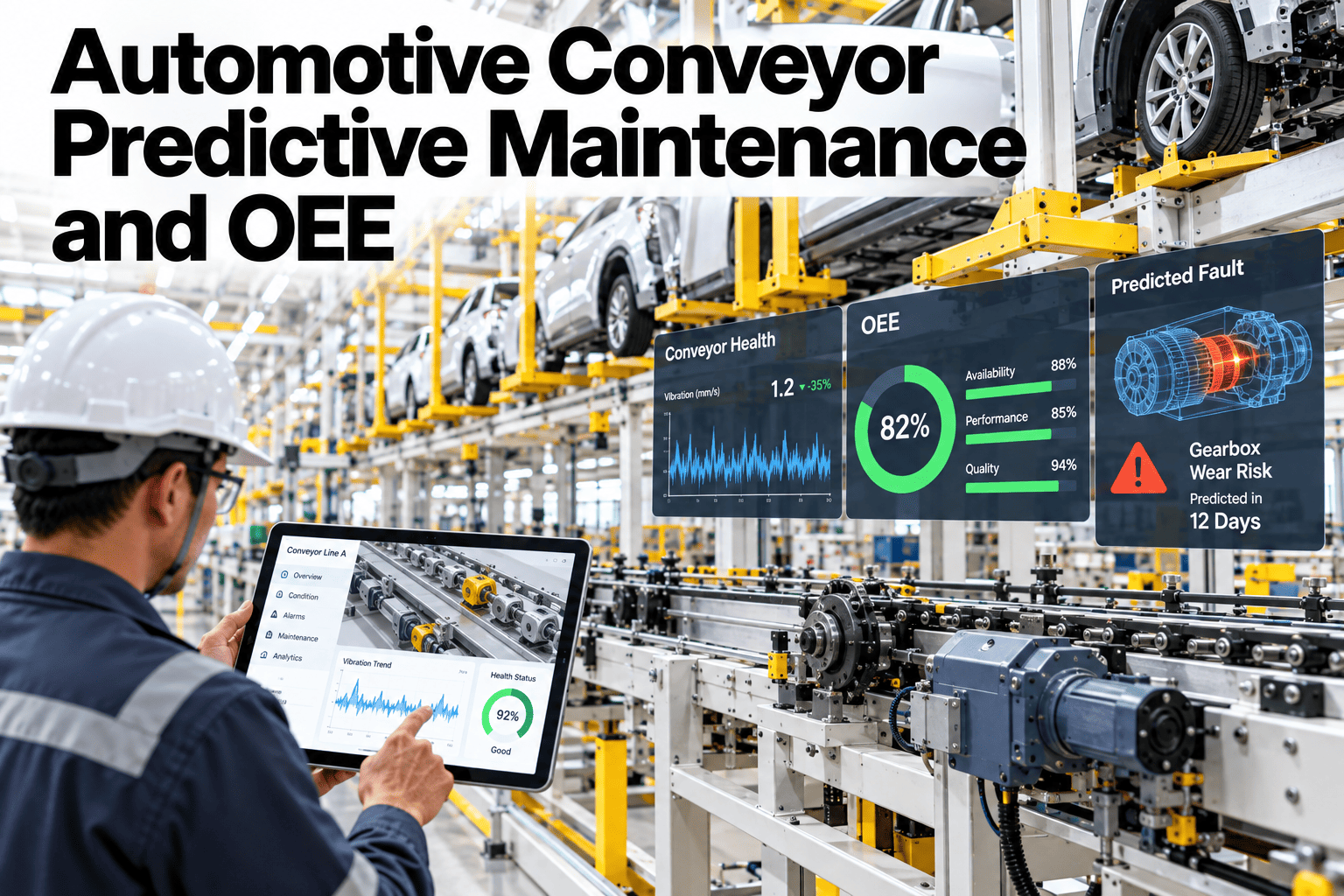
Automotive assembly conveyor downtime is measured in hundreds of thousands of dollars per hour when the full cascade effect across a multi-line plant is counted. But the deeper problem is that most conveyor downtime events are not sudden — they are the endpoint of a deterioration process that was measurable for weeks before the stop. Predictive maintenance that detects this deterioration early converts emergency stoppages into planned maintenance windows, and planned maintenance windows into scheduled events that do not interrupt the production day. The OEE impact is measurable: availability increases, performance recovers, and the maintenance cost per unit falls as emergency labor and expedited parts are replaced by planned interventions. See how iFactory AI improves automotive conveyor OEE at your plant.
Automotive Conveyor Predictive Maintenance and OEE
How predictive maintenance on automotive assembly conveyors translates directly into OEE gains — availability restored, performance recovered, and maintenance cost shifted from reactive to planned.
The Conveyor OEE Connection
Every conveyor failure mode maps to a specific OEE loss category. Understanding this mapping shows why predictive maintenance acts on availability first and performance second.
| Failure Mode | OEE Loss Category | PdM Detection Method | Typical Lead Time |
|---|---|---|---|
| Chain break or jam | Availability — unplanned stop | Chain elongation trend + load spike | 2–6 weeks |
| Motor bearing failure | Availability — unplanned stop | MCSA + vibration fusion | 2–4 weeks |
| Gearbox deterioration | Availability — unplanned stop | Vibration + thermal + load current | 2–5 weeks |
| Chain elongation (pre-break) | Performance — speed reduction | Pitch elongation sensor | 3–8 weeks |
| Drive motor drag (mechanical) | Performance — speed/load | Speed-load correlation | 2–4 weeks |
| Carrier position drift | Quality — station miss or damage | Position accuracy tracking | 3–6 weeks |
How PdM Moves Each OEE Component
PdM does not improve OEE uniformly — it acts strongest on availability, then performance, with quality improvement as a secondary effect. Understanding the sequence helps set realistic targets.
The largest and fastest OEE gain from conveyor PdM. Each prevented emergency stop converts to direct availability improvement. A plant with 18% unplanned downtime that reduces this to 8% gains 10 OEE points from availability alone.
Worn chain running at reduced speed to avoid failure is a performance loss that PdM converts to a planned replacement event — restoring rated speed. Speed-load monitoring also identifies mechanical drag that slows the line without stopping it.
Carrier position drift detected early prevents the station misses and handling damage that produce quality rejects. In precision assembly sections, quality improvement from PdM can exceed the performance gain in dollar value per OEE point.
Measuring the OEE Impact of PdM Investment
A PdM investment on automotive conveyors is justified in OEE terms when the value of the OEE gain — measured in production output recovered — exceeds the platform cost within a defined payback period.
Improve Conveyor OEE With Predictive Maintenance
iFactory AI connects conveyor health monitoring directly to OEE improvement — availability gains from prevented failures, performance recovery from planned chain changes, and quality protection from carrier health tracking. Book a session to see the OEE impact for your line.
Frequently Asked Questions
How quickly does conveyor PdM begin improving OEE after deployment?
Availability improvement begins as soon as the first predicted failure is converted from an unplanned stop to a planned repair — typically within the first eight to twelve weeks as AI models build their baselines and early alerts fire. Performance and quality improvement follows as chain wear tracking and carrier health monitoring mature over subsequent months. Walk through the expected improvement timeline for your conveyor configuration.
Should conveyor OEE be tracked separately from the line OEE that includes assembly stations?
Yes. Conveyor OEE and station OEE have different loss drivers and different improvement levers. Tracking them separately allows conveyor PdM to show its specific contribution to line OEE improvement, rather than being diluted into a combined line metric where the signal is harder to isolate. iFactory AI tracks both levels simultaneously on the same dashboard. Ask how iFactory AI structures conveyor vs. line OEE views.
Can PdM address performance losses as well as availability losses on automotive conveyors?
Yes. Chain elongation that causes operators to reduce line speed to avoid a jam is a performance loss measurable by speed-load monitoring. Restoring rated speed by scheduling chain change-out before the elongation reaches the reduction threshold converts this performance loss into recovered throughput, adding to the availability gain from prevented stops.
What OEE improvement is realistic in the first year of conveyor PdM deployment?
For a plant with baseline conveyor availability losses of 15–20%, an 8–12 OEE point improvement in Year 1 is achievable when PdM monitoring covers the main drive and chain systems. Plants with lower baseline losses have a smaller improvement ceiling but still show clear payback through maintenance cost reduction. The business case should use 8 points as the conservative Year 1 estimate. Build the Year 1 OEE case for your plant in a session.
Does iFactory AI integrate conveyor health data with the existing plant OEE system?
Yes. iFactory AI can export conveyor health event data and availability records to existing OEE tracking systems via API, so the PdM contribution to OEE improvement is visible in the plant's standard reporting rather than in a separate tool. Alternatively, iFactory AI's own OEE dashboard provides a complete view without requiring integration if a separate system is not in place.
Connect Conveyor Health to OEE Improvement
iFactory AI monitors every failure mode that drives conveyor availability, performance, and quality losses — and converts predictions into planned maintenance actions that show up in your OEE numbers. Book a walkthrough to see the connection on your plant's data.