Every multi-plant operator eventually has this argument internally: should maintenance be run from one central team that sets the standard everywhere, or should each plant keep its own crew who knows the equipment and can respond the moment something breaks. Neither answer is universally right, and organizations that pick one extreme and apply it uniformly across every site, regardless of that site's size, criticality, or geography, tend to end up fighting the same friction a few years later. The more useful question is not which model wins, it is which parts of maintenance actually benefit from central control and which parts genuinely need to stay local, and that answer is usually a hybrid rather than a single winner. See how the tradeoffs apply to your own plant network at ifactory support.
Find the Right Balance Between Central Control and Local Response
A data-backed way to decide which maintenance functions belong centralized, which belong at the plant level, and how a hybrid structure with shared visibility keeps both fast and consistent.
What Each Model Actually Optimizes For
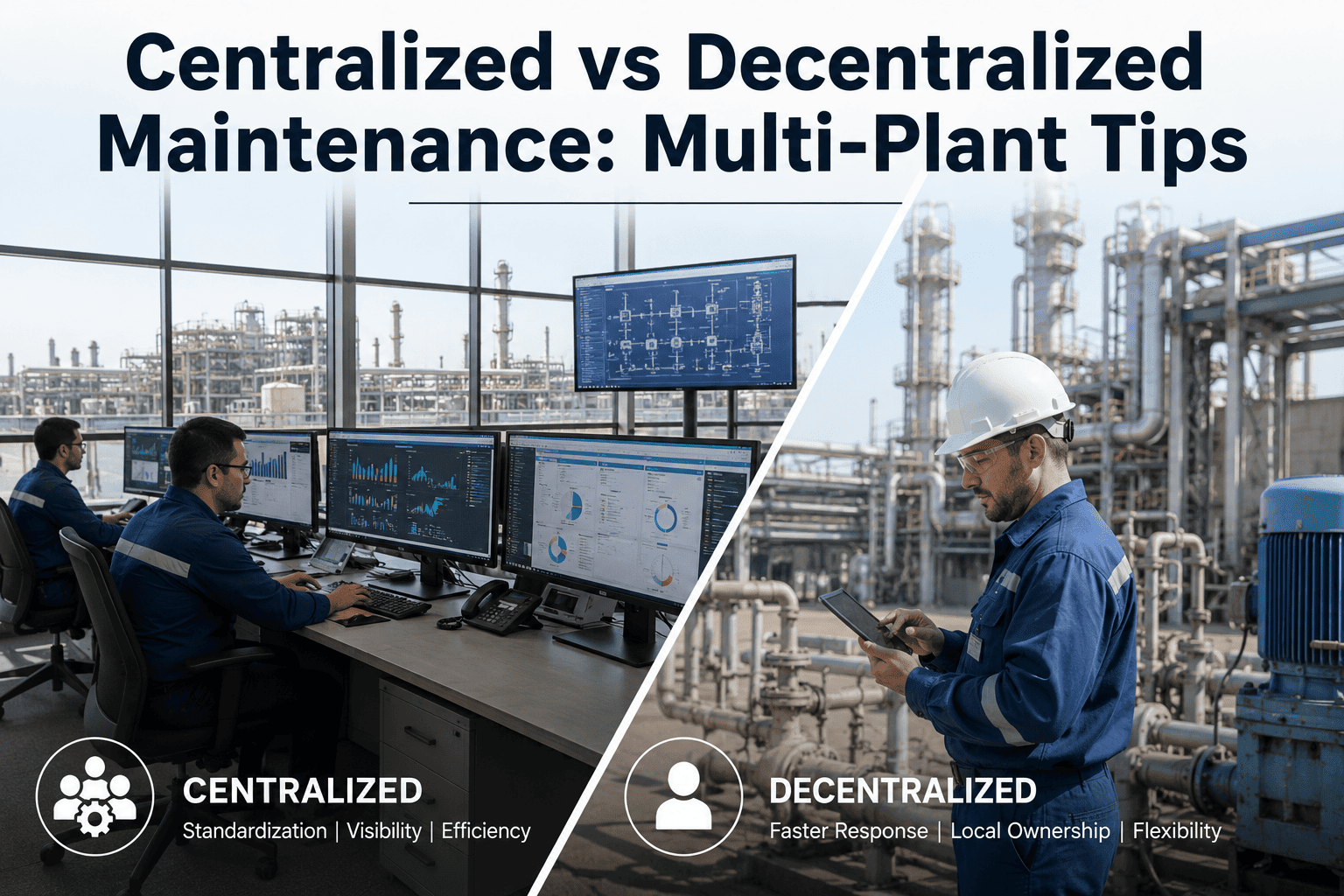
Centralized maintenance coordinates strategy, standards, and often skilled resources from a single headquarters or command center, which tends to produce consistency, tighter cost control, and easier corporate reporting. Decentralized maintenance keeps ownership at each plant, which tends to produce faster response to urgent work and technicians who deeply know their own equipment, but it also produces the inconsistency that makes cross-site comparison and standardized reporting difficult. Neither weakness is fatal on its own, but ignoring it eventually shows up as either slow response in a centralized model or wildly inconsistent numbers in a decentralized one.
Where a Hybrid Model Actually Draws the Line
Most large multi-plant organizations that have run both extremes eventually converge on a hybrid, where a central team owns strategy, standards, and shared specialist resources, while each site keeps a smaller team empowered to respond to urgent, time-sensitive work without waiting on approval from headquarters. The dividing line is not arbitrary, it tends to follow a consistent logic across industries.
| Function | Best Fit | Why |
|---|---|---|
| Maintenance strategy and standards | Central | Consistency matters more than local variation for how work is defined and measured |
| Emergency breakdown response | Local | Minutes matter, and a local technician is already on site |
| Specialist skills (controls, reliability engineering) | Central, shared | Too costly and rare a skill set to duplicate at every plant |
| Preventive maintenance scheduling | Local, centrally tracked | Execution needs site context, but compliance needs central visibility |
| Parts procurement and vendor contracts | Central | Volume purchasing power is lost when each site negotiates separately |
Find Out Which Functions Should Move Central
Bring your current maintenance org structure to the call and we will walk through where a hybrid model would likely fit best.
Why the Structure Debate Is Really a Visibility Problem
A significant part of what makes this decision so difficult is not actually about organizational structure, it is about visibility. A fully decentralized model does not have to sacrifice consistency if every site's work orders, KPIs, and asset history flow into one shared system that a central team can see in real time. Conversely, a centralized model does not have to sacrifice response speed if local technicians retain the authority to act immediately on urgent work without waiting for a ticket to be approved upstream.
That reframes the choice: instead of asking whether to centralize authority, the more productive question is whether to centralize visibility while keeping response authority local. A shared platform that standardizes how every site logs a work order, measures downtime, and reports MTTR removes most of the inconsistency argument for decentralization, without requiring every plant to give up its own crew.
Signs Your Current Structure Is the Wrong Fit
How a Shared Platform Makes the Hybrid Work
Frequently Asked Questions
Design a Maintenance Structure That Gives You Both
Bring your current plant network structure to the call. We will map out which functions belong central, which stay local, and how shared visibility ties it together.