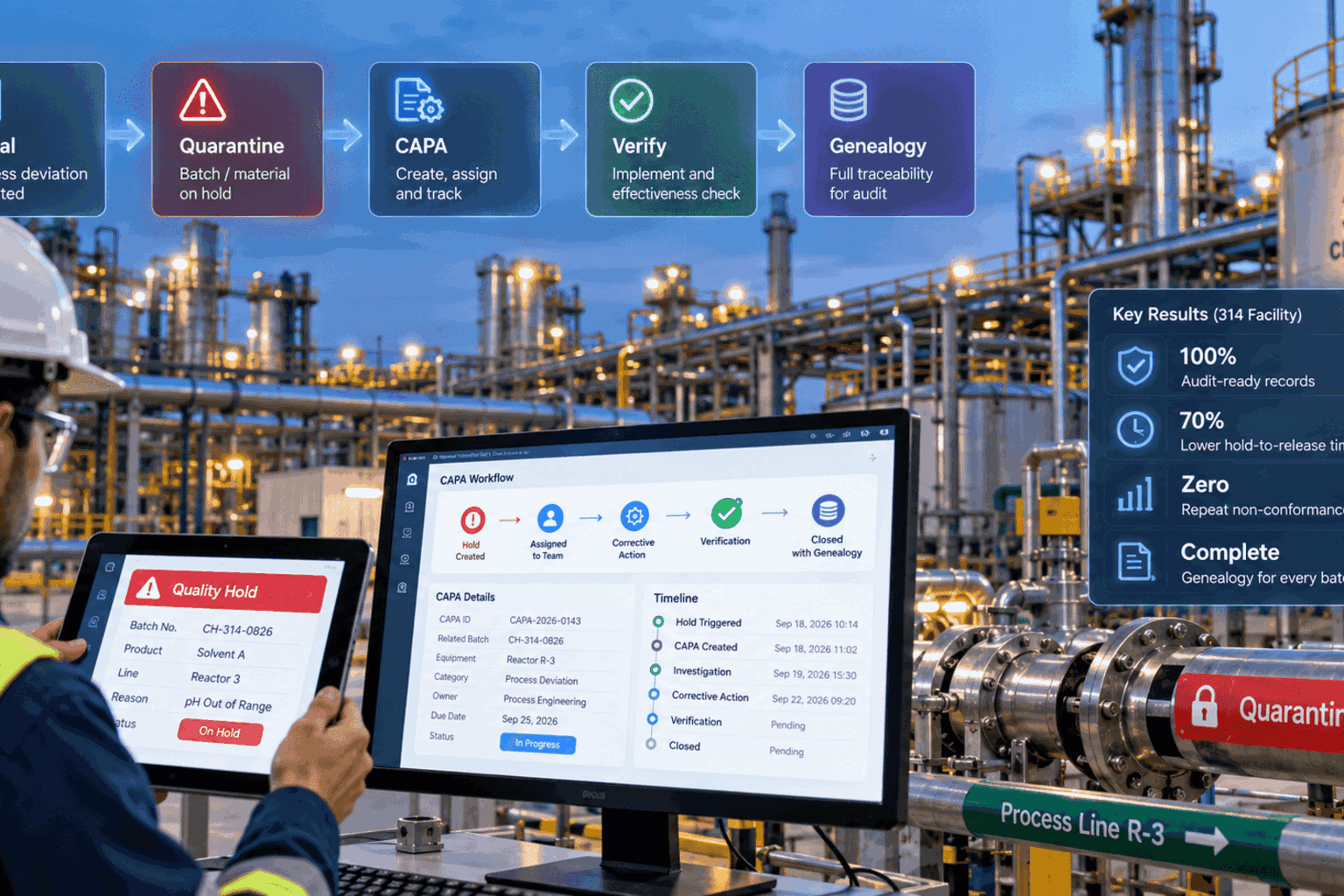
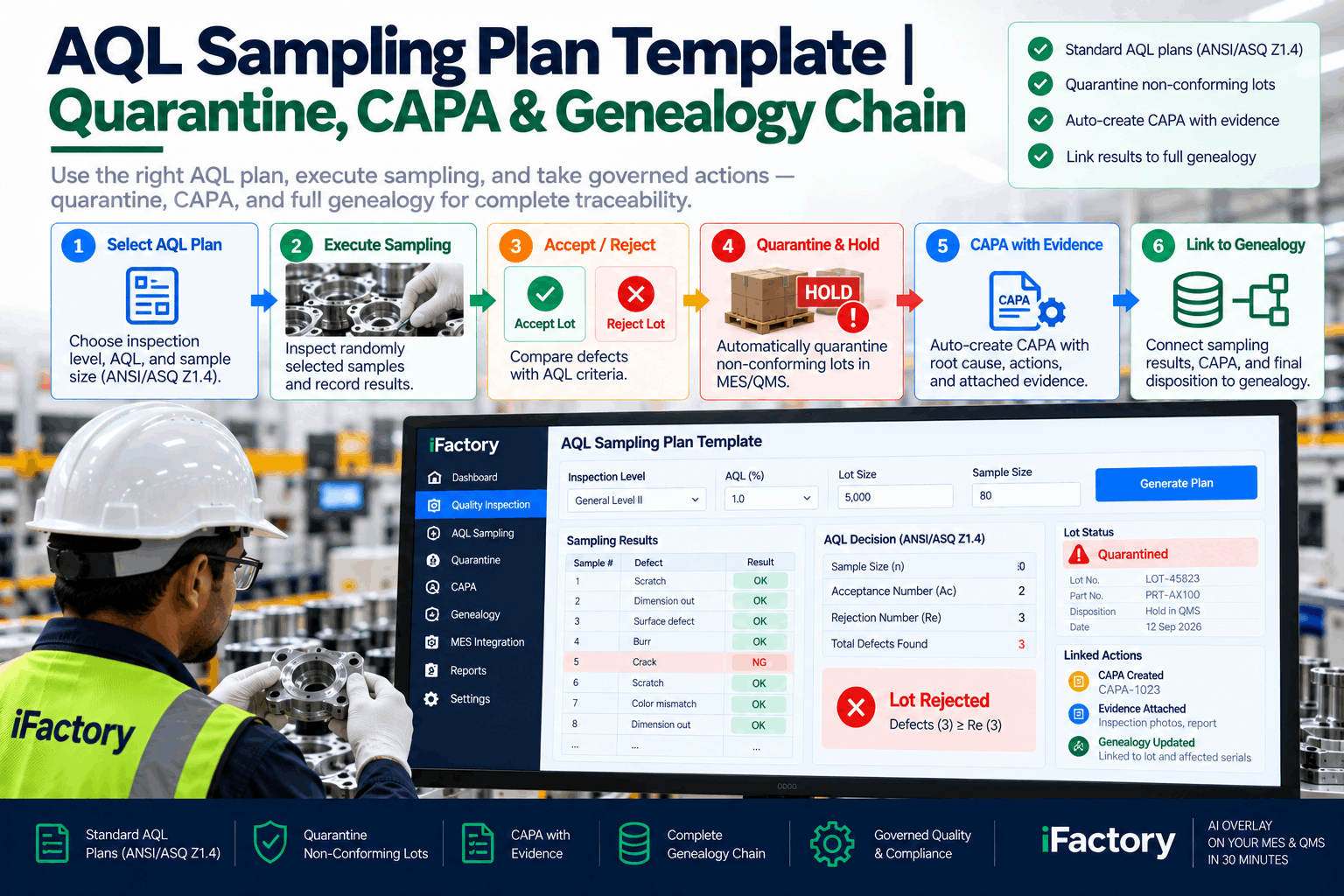
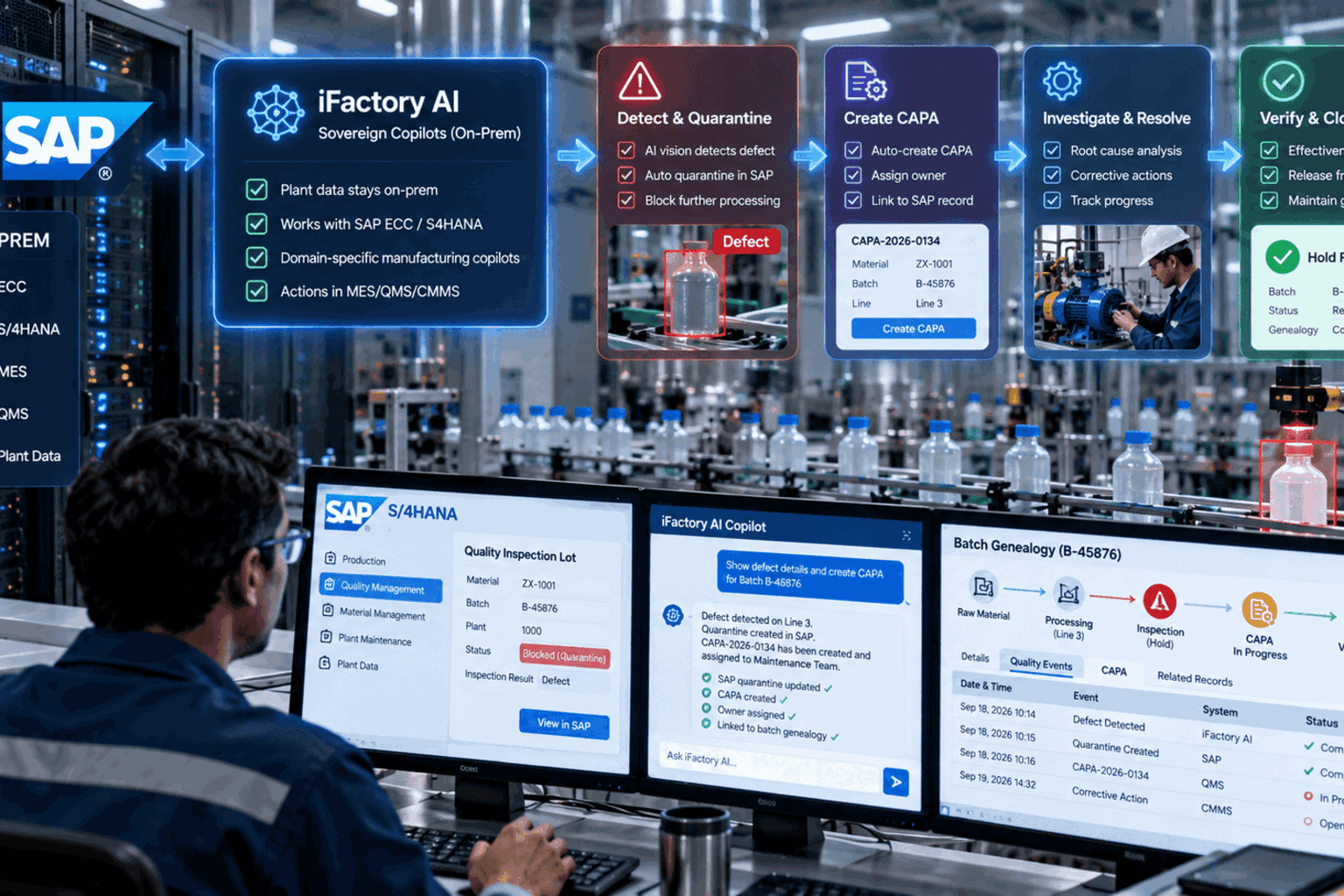
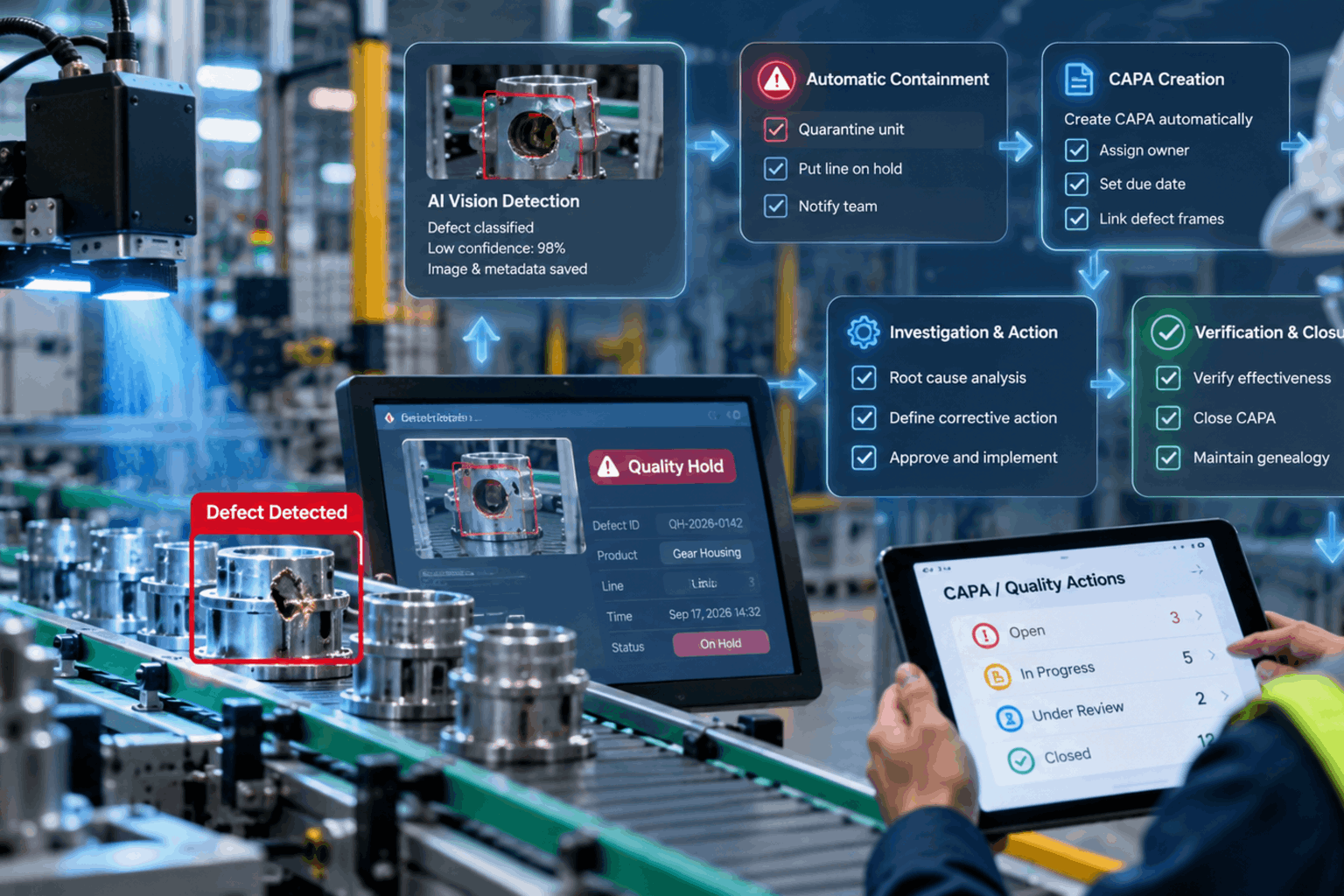
9:14 a.m. on audit morning, a hold-lag alert was still sitting open while operators waited at the line and a QA lead walked fast between the rack and the control room, asking one question nobody wanted to answer: had the suspect lot actually been quarantined yet? The answer mattered because in chemical facility CMMS compliance, a few minutes of delay can turn a manageable signal into a release dispute, and the floor team could feel that clock ticking in real time. The 314 chemical facility did not discover its compliance gap on audit day — it found it earlier, when an inspection signal sat too long before quarantine. If the plant could not prove signal → hold → CAPA → verify → genealogy in one clean sequence, the release decision would be hard to defend. See how a chemical facility closed that gap.
Case Study · 314 Chemical Facility
Holds, CAPA, and Genealogy — Before Audit Day Exposed the Compliance Gap
A chemical facility replaced scattered inspection notes and hold-lag with a closed-loop compliance workflow that stood up on audit day — without ripping out MES, QMS, or existing plant systems.
Before & After — The Operational Shift
The plant was not trying to create more administration. It was trying to reduce uncertainty on the floor. This side-by-side captures how the workflow changed after iFactory AI became the compliance backbone.
Before — Scattered
Signals Landed Everywhere. Ownership Landed Nowhere.
- Inspection findings landed across notes, spreadsheets, and email approvals
- Hold status was easy to lose track of between shifts
- CAPA ownership depended on who happened to be in the room
- Verification evidence lived in a separate thread from the original finding
- Teams had to reconstruct the story when audit questions came up
- Release decisions felt defensible — but were hard to prove under review
After — Closed Loop
One Path From Signal to Release. One Record That Holds Up.
- Every signal enters the same path from detection to disposition
- Suspect items move into quarantine with a visible, enforced state
- CAPA ownership is assigned with due dates and escalation
- Verification is required before release — not an afterthought
- Genealogy stays tied to the original event through closure
- Audit evidence is retrievable in one place, not reconstructed under pressure
At a Glance
Outcome
Scattered inspection signals were converted into a closed-loop compliance workflow before audit pressure exposed the gap.
Core Issue
Hold status, CAPA ownership, verification evidence, and genealogy proof were not always connected fast enough.
iFactory AI Role
Create a controlled path from signal to quarantine, corrective action, verification, and release.
Operational Spine
Signal → Quarantine → CAPA → Verify → Genealogy.
Why It Mattered
Audit teams do not accept “we handled it somewhere” as evidence.
Buyer Takeaway
A CMMS becomes far more valuable when it controls disposition, not just tasks.
Why the 314 Case Mattered
Chemical plants rarely struggle because they cannot detect issues. They struggle because the evidence trail gets scattered across inspection notes, spreadsheets, email approvals, and delayed follow-up. When that happens, a simple abnormality can become a compliance problem: was it quarantined, who owned it, what was corrected, and when was it safe to release? That was the problem in the 314 facility. The team needed more than another dashboard — it needed a system that could enforce the path from signal to disposition and preserve the genealogy behind every decision.
On the floor, this showed up as awkward handoffs. One person saw the issue. Another person knew the hold was supposed to happen. A third person owned the follow-up, but the evidence sat in a separate thread. By the time everyone aligned, the team had already spent time explaining what should have been obvious from the record. In a chemical environment, that is exactly how a hold-lag becomes a compliance problem. See the enforcement pattern in action.
Closed-Loop Control — The Compliance Timeline
The refresh centered on a closed-loop compliance path. iFactory AI helped make each step visible, owned, and traceable. The timeline below walks the sequence from first signal to audit-defensible release.
The Workflow Begins With a Signal
An inspection abnormality, a calibration concern, an operator observation, or another condition that could affect quality, safety, or release. In the 314 facility, the main issue was not detection itself, but what happened after detection.
Why it matters: Good inspection discipline only matters if it leads to controlled action.
Suspect Material Enters a Visible, Enforced Hold State
Once a signal is confirmed, suspect material, equipment, or product needs a clear quarantine state. This is where many plants lose time — a finding in one system and a hold note in another does not reliably stop release.
Why it matters: iFactory AI made quarantine visible and enforceable so items could not quietly advance during investigation.
Ownership, Root Cause, and Corrective Action Are Assigned
Quarantine without corrective action is only a delay. The next step is CAPA ownership: root cause, corrective action, preventive action, due dates, and responsible parties — all tied back to the original signal.
Why it matters: A detection event flows into accountability without losing the context that started it.
The Correction Must Be Proven Before the Item Returns
Verification is where the loop closes. The plant must prove that the correction worked before the item returns to service or release. Proof can come from re-inspection, recalibration, repair signoff, document updates, or acceptance review.
Why it matters: First article-style verification principles apply here: acceptance-based review, not paperwork closure.
The Full Chain Lives in One Record — Ready for Audit
Genealogy is the record that ties everything together: what triggered the event, what was quarantined, what CAPA was opened, what verification was completed, who approved release, and when the item returned to use.
Why it matters: If the plant can show the full chain in one place, it can answer audit questions without reconstructing the story from multiple systems.
Audit-Day Confidence
A CMMS Has Much More Value When It Controls Disposition, Not Just Work Orders
For chemical facility CMMS compliance, that means the system should help the plant prove what happened, when it happened, and who approved the next step — before an auditor asks.
Why Hold-Lag Creates Audit Risk
The danger is not only that an issue exists. The danger is the lag between detection and containment. When that lag is too long, teams are forced to explain why a suspect item was still available, why ownership was unclear, or why release happened before verification was complete. That creates three common risks.
01
Premature Release Risk
A suspect item moves forward before disposition is finalized. In a chemical environment, that can turn a manageable signal into a customer-facing quality event.
02
CAPA Drift Risk
Corrective actions remain open without clear ownership or evidence. The record stays technically open, but the fix is never proven — and recurrence is likely.
03
Genealogy Gap Risk
The facility cannot quickly prove the full chain from signal to release. Under audit review, that gap is where release decisions become hardest to defend.
iFactory AI addresses these risks by making the hold path operational instead of informal. The result is a clearer control point for quarantine, better release governance, and a genealogy trail that is much easier to defend.
What Changed in the 314 Facility Workflow
The refresh was not about adding more paperwork. It was about making the workflow predictable and visible. The plant defined a repeatable sequence — and then made every step enforceable.
1
Inspection findings create a signal
2
Suspect items move into quarantine
3
CAPA is assigned with ownership and due dates
4
Verification is required before closure
5
Release is documented only after verification
6
Genealogy remains tied to the original event
That structure reduced the chance of a finding disappearing into email or sitting unresolved in a spreadsheet. It also gave quality, maintenance, and operations one common path to follow. Book a demo to walk the sequence live.
Why iFactory AI Works Better as a Workflow Backbone Than a Ticket System
The 314 facility did not need another place to log problems. It needed a backbone that could preserve status, ownership, and proof as the event moved across departments. iFactory AI supported that shift by connecting each layer of the compliance record into one live thread.
Inspection events
→
Quarantine status
Quarantine status
→
Affected assets or lots
CAPA ownership
→
Due dates and escalation
Verification steps
→
Closure evidence
Release approval
→
Genealogy records
That matters because chemical compliance is cross-functional. Quality, EHS, maintenance, and operations all touch the event, but none of them should have to rebuild the record later.
Market Context: Edge AI Visual Inspection Is Expanding
There is broader market momentum around AI-enabled inspection. In vendor-reported external coverage, Siemens and P&G Industrial Edge visual inspection news has been presented as a sign that AI inspection is expanding in manufacturing environments. Reported benefits have included faster deployment and more consistent inspection outcomes.
That context is useful, but it is not the main story. The real differentiator for chemical plants is not whether AI exists in the market. It is whether the workflow can enforce quarantine, CAPA, verification, and genealogy with enough discipline to stand up on audit day.
What You Will See in a 30-Minute Demo
The demo focuses on the actual workflow rather than a slide deck. In 30 minutes, you will see how iFactory AI can help a facility close the hold-to-release loop.
Turn an inspection signal into quarantine
Assign CAPA ownership and due dates
Require verification before release
Keep genealogy tied to the original finding
Reduce hold-lag and release confusion
Make audit evidence easier to retrieve
Book the 30-minute walkthrough.
Why This Matters for QA, EHS, and Operations Leaders
For leaders in quality, EHS, and manufacturing systems, the value is straightforward. iFactory AI does not replace existing systems — it connects them into a controlled compliance path that is easier to operate and easier to review.
Faster Containment
When a signal appears, the hold state is enforced — not delayed by handoffs between systems.
Fewer Release Mistakes
Release cannot proceed until verification is complete, so premature release risk is structurally reduced.
Clearer CAPA Ownership
Owner, due date, and escalation are visible in one place, which makes accountability real instead of implied.
Stronger Genealogy
Every step ties back to the original signal, so audit defense does not depend on reconstruction under pressure.
Less Reconstruction Under Pressure
Teams spend less time explaining what happened and more time running the plant.
MES and QMS Stay Intact
The workflow layer connects existing systems instead of replacing them — reducing change management risk.
Frequently Asked Questions
What problem did the 314 chemical facility need to solve?
It needed to turn scattered inspection signals into a closed-loop hold-to-release workflow that could withstand audit review. The gap was not detection — it was the delay between signal and controlled containment.
See the workflow in a live walkthrough.
Why is quarantine discipline so important in chemical compliance?
Because a ticket or note does not reliably stop use or release. A clear quarantine status protects the plant from moving suspect items forward too early — and gives auditors a defensible control point.
See scoped quarantine in action.
How does iFactory AI support CAPA workflows?
iFactory AI helps route findings into ownership, due dates, verification, and closure evidence so corrective action does not drift. Each step is tied back to the original signal so the record stays coherent.
Walk through CAPA routing with our team.
Why is genealogy so important before audit day?
Genealogy proves what happened from the first signal through release. Without it, the plant may struggle to defend decisions under review — and audit findings often trace back to missing chain-of-custody records.
Review a real genealogy trail with our team.
Does iFactory AI replace existing plant systems?
No. iFactory AI is designed to connect inspection, quarantine, CAPA, verification, and release into one operational workflow. MES and QMS remain the systems of record — iFactory AI orchestrates response across them.
See the integration points in a demo.
Before the Next Audit
Convert Scattered Findings Into a Closed-Loop Compliance Workflow — Easier to Control, Easier to Review, Far Harder to Challenge
The 314 chemical facility case shows what happens when signal, quarantine, CAPA, verify, and genealogy are not connected: hold-lag grows, release confidence drops, and audit-day risk rises. iFactory AI closes that gap without replacing your existing plant systems.
Enforced Hold States
CAPA Ownership Visible
Verification Before Release
Genealogy Chain Intact
Audit-Defensible Records