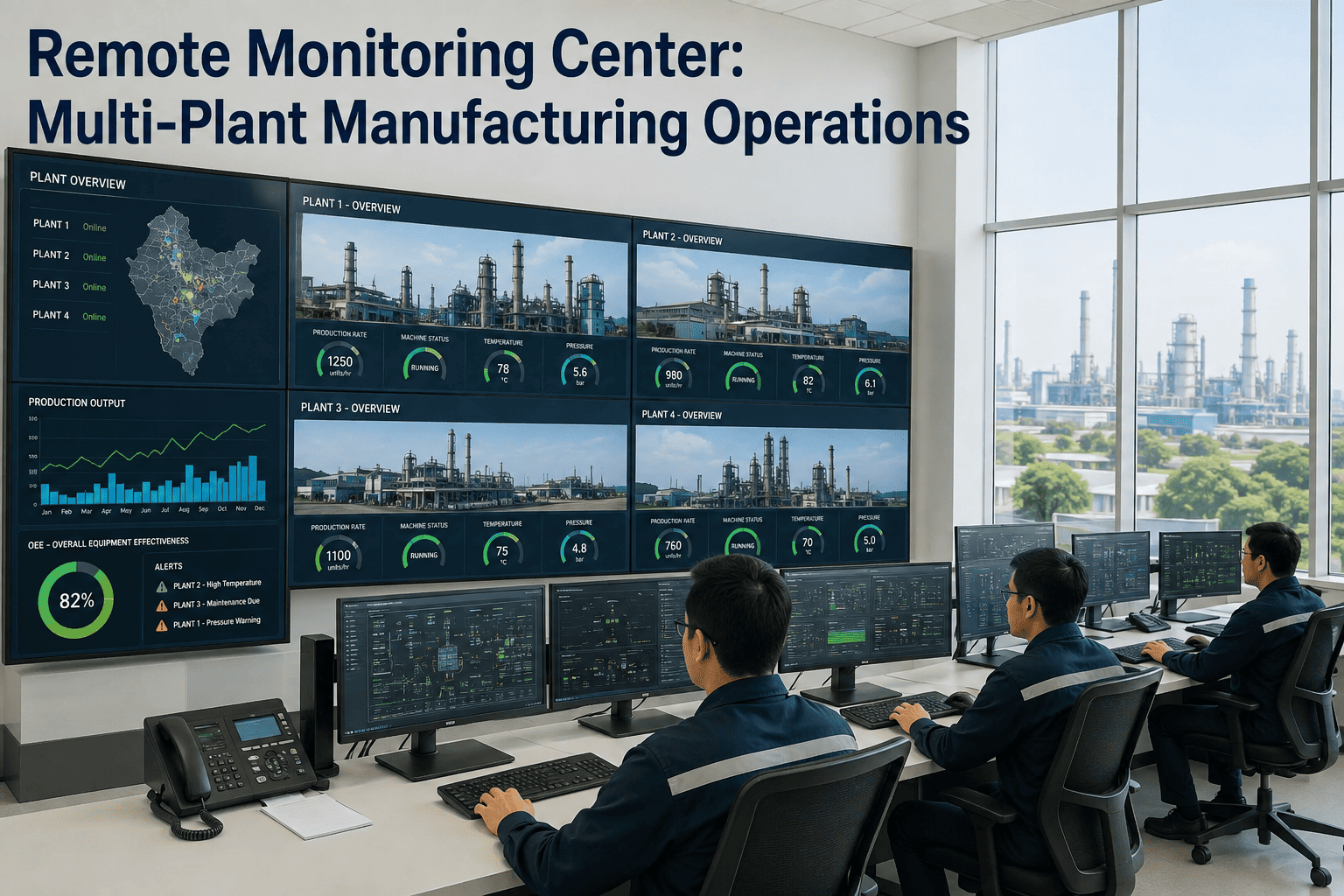
Outsourcing production does not outsource accountability for it. A brand owner whose contract manufacturer ships a bad batch still owns the recall, the retailer conversation and the customer complaint — the CM's process failure becomes the brand's problem the moment it leaves the dock. Production visibility is what closes that gap: a defined set of data to require from every CMO or tolling partner, and a way to verify it remotely instead of trusting a monthly PDF report. You can walk through a CM visibility checklist with our team before your next supplier review.
Outsourced Production Oversight, 2026
Your Name Is on the Box. You Need to See Inside the Plant.
iFactory, an on-premise AI platform for manufacturing execution (MES) and quality control, connects brand owners to the production, quality and downtime data their contract manufacturers generate, without requiring the CM to hand over full system access.
Production Data
Quality Events
Downtime & Changeovers
What it is
What Is Contract Manufacturer Production Visibility?
Production visibility is the set of data a brand owner requires from a contract manufacturer or tolling partner — beyond the finished-goods certificate of analysis — to confirm the process that made the product actually ran the way it was supposed to.
A CoA tells you the output passed a test. It does not tell you whether the line ran at the right speed, whether a changeover was rushed, or whether a quality hold was quietly waived. Those gaps are where most contract-manufacturing surprises live.
The gap
Why "We Trust Our CM" Is Not a Verification Strategy
Monthly, not live
A monthly report cannot flag a problem that started three weeks ago.
Summarized, not raw
A rolled-up summary can hide exactly the variation a brand owner needs to see.
Self-reported
The CM chooses what to include, with no independent verification layer.
No early warning
By the time a trend shows up in a report, the affected batches have already shipped.
The checklist
What to Require From Every Contract Manufacturer
Line-level OEE or run-rate data for the specific line making your product
Quality event log — holds, rejects and deviations, not just final CoA
Changeover and setup records when your SKU shares a line with others
Downtime log with reason codes for any stop during your production run
Batch genealogy linking raw material lots to finished-good lots
Audit trail showing who approved any deviation from the agreed process
How it works
Four Steps to Remote Verification Without Full System Access
Most contract manufacturers will not grant a brand owner direct access to their MES or SCADA systems, and that reluctance is reasonable — they run other customers' products on the same lines. A workable approach shares defined data without sharing the whole system.
1
Agree a defined data export — the specific fields in the checklist above, not a system login.
2
Set the export cadence to match your risk level — daily for critical SKUs, weekly for lower-risk ones.
3
Route the data into your own visibility layer so you are not dependent on the CM's own dashboard.
4
Flag anomalies — a changeover that ran unusually fast, a quality hold that closed unusually quickly — for follow-up with the CM.
Comparison
Monthly CM Reports vs Continuous Production Visibility
| Dimension | Monthly Reports | Continuous Visibility |
|---|
| Update frequency | Once a month, after the fact | Daily or per-batch, as it happens |
| Detail level | Rolled-up summary | Line, batch and event level |
| Early warning | None — issues surface after shipment | Anomalies flagged before the next shipment |
| Verification | Self-reported by the CM | Independent data export, cross-checked |
Expert review
What a Supply Quality Lead Would Check First
Holds up
Requiring process data beyond the CoA is standard supplier-quality practice in regulated and brand-sensitive categories; it is not an unusual ask of a CM.
Watch for
A CM that resists any defined data export at all — that resistance itself is a signal worth investigating before committing more volume.
Do next
Start the data requirement with your highest-risk or highest-volume SKU, since that is where a visibility gap costs the most.
FAQ
What Brand Owners Ask About Contract Manufacturer Visibility
What data should a contract manufacturer provide beyond the CoA?
At minimum, line-level production data, a quality event log, downtime with reason codes, and batch genealogy linking raw materials to finished goods. The CoA confirms the output passed a test; these records confirm the process behind it ran as agreed.
Review this checklist against your current CM.
How do we get this data without full access to the CM's systems?
Most CMs will agree to a defined data export covering specific fields, on an agreed cadence, without granting direct login access to their MES or SCADA.
Ask how a defined export works in practice.
What if our contract manufacturer refuses to share production data?
Reluctance to share any defined data at all is itself worth treating as a risk signal, particularly for high-volume or high-risk SKUs, and is a reasonable topic to raise before the next contract renewal.
How often should visibility data be reviewed?
Match the cadence to risk — critical or high-volume SKUs warrant daily or per-batch review, while lower-risk products can run on a weekly cycle.
Discuss a review cadence for your product mix.
Does this apply to tolling arrangements as well as full contract manufacturing?
Yes — a tolling partner running your raw materials on their equipment carries the same visibility gap as a full CMO relationship, and the same checklist applies.
Walk through tolling-specific requirements with our team.