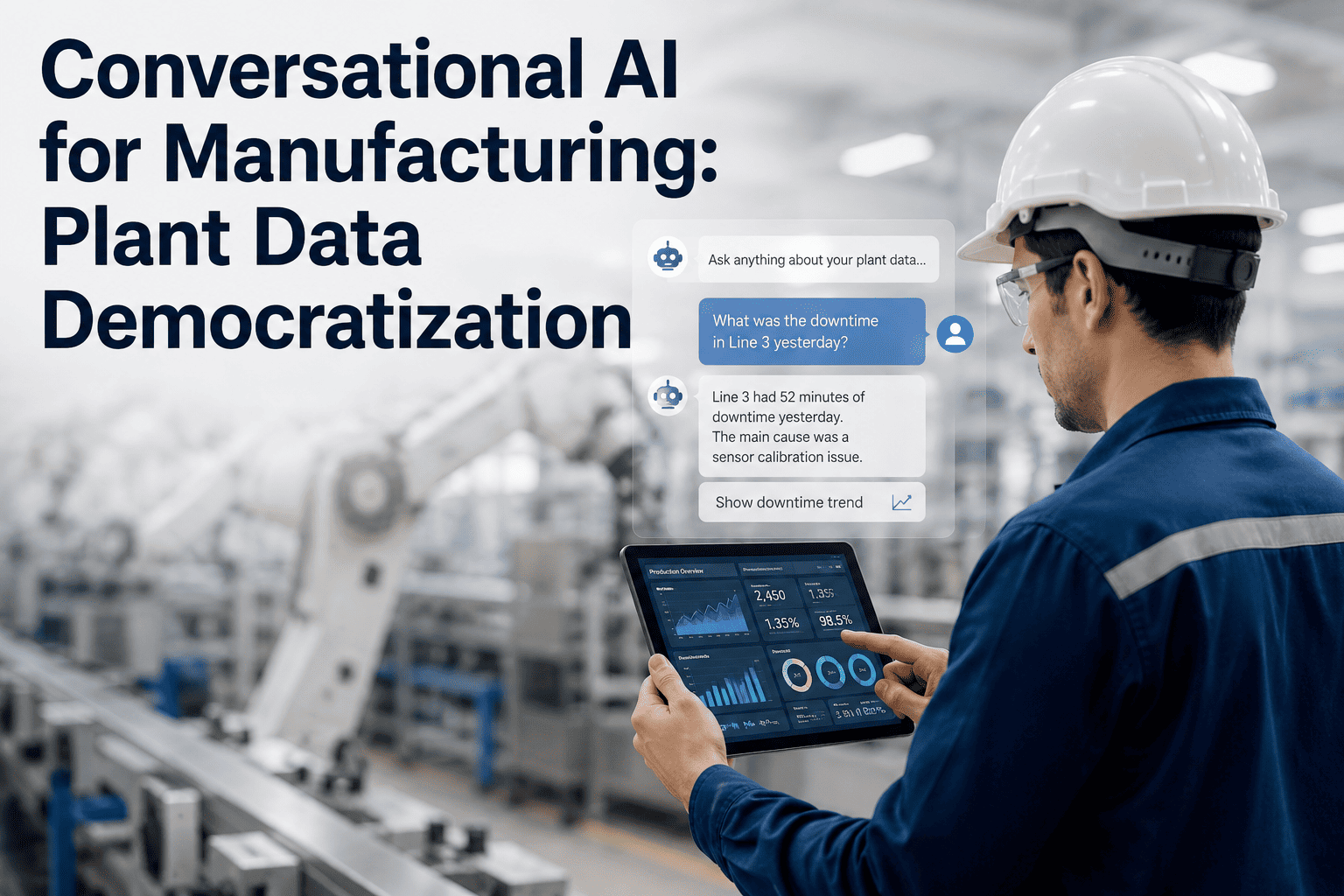
Ask a plant manager how production is trending and they can tell you in seconds. Ask a machine operator the same question and they usually can't, not because they don't care, but because the dashboard was built for someone with a different job title. Most manufacturing software rewards people who already know where to click, what a tag name means, and which report buffer holds the number they need. Conversational AI removes that requirement entirely by letting anyone on the floor simply ask a question in plain language and get a real answer. Manufacturers exploring this shift can Book a Demo to see how iFactory turns plant data into something every role can actually use.
Why Plant Data Stays Locked to a Few People
Most manufacturing data systems were designed around reports, not conversations. A SCADA historian stores millions of tag values, but reading them requires knowing the tag naming convention. An MES tracks every production event, but summarizing a shift requires a saved query someone built months ago. The result is a small group of analysts and engineers who act as translators for everyone else, fielding the same repeated questions — what was yesterday's scrap rate, why did line 3 stop at 2am, which shift ran best this week — because nobody else has a way to ask directly.
What a Conversational Query Actually Does Behind the Scenes
A typed or spoken question looks simple on the surface, but answering it correctly requires several steps happening in sequence. The system has to understand intent, map the language to the correct data source, apply the right time window and filters, and then translate the raw result back into a sentence a person would actually say. Skipping any one of these steps produces an answer that is technically generated but practically wrong — which is why conversational AI in a plant setting needs to be built around manufacturing context, not a generic chatbot layer bolted onto a dashboard.
Chat-Based Queries vs. Voice: Choosing the Right Interface for the Floor
Not every situation on a plant floor favors the same input method. An operator standing at a machine with both hands occupied benefits from voice interaction far more than a typed query, while a supervisor reviewing a shift summary at a desk may prefer typing and reading. Conversational AI systems built for manufacturing need to support both modes natively, because forcing one interface on every role and every context reduces adoption regardless of how accurate the underlying answers are.
| Interface | Best Fit | Limitation |
|---|---|---|
| Voice query | Hands-busy floor situations, quick status checks mid-task | Less suited to detailed multi-part questions or noisy environments |
| Chat-based text | Desk review, shift handover notes, detailed follow-up questions | Slower than voice when both hands are occupied with equipment |
| Mobile chat | Walking the floor between stations, quick reference lookups | Requires a device on hand, which not every role carries |
What Changes When Everyone Can Ask a Question
The value of data democratization is not abstract — it shows up in how quickly small issues get noticed and addressed before they compound. When an operator can ask why a machine's cycle time crept up without waiting for an engineer to notice in a weekly report, the gap between a developing problem and a corrective action shrinks from days to minutes. That shift in who can act on data, not just who can see it, is what actually changes plant performance.
Building Trust in Conversational Answers
Adoption of a conversational AI tool depends entirely on whether people trust the answers it gives them. A single wrong answer early in rollout can undo months of positive experience, which is why manufacturing-grade conversational AI needs transparency built in — showing the data source and time window behind every answer, flagging uncertainty when a question is ambiguous, and making it easy for a person to drill into the underlying numbers rather than accepting a summary blindly. Trust is earned incrementally, and the systems that earn it fastest are the ones that are honest about their own limits.
Frequently Asked Questions: Conversational AI for Manufacturing
Does conversational AI replace the need for dashboards entirely?
Dashboards remain useful for continuous visual monitoring where someone is watching a live trend over an extended period, but conversational AI replaces the far more common use case of a one-off question that doesn't justify building or navigating a dashboard. Most plant data requests are single questions asked once, and forcing every one of them through a dashboard workflow is what created the access bottleneck in the first place. Teams weighing this balance can Book a Demo to see how the two approaches complement each other in practice.
How does the system handle questions that reference data across multiple plant systems?
A well-built conversational layer resolves which underlying systems a question touches and queries them together behind the scenes, so a question like "did the downtime yesterday match the maintenance work order log" pulls from both the historian and the CMMS without the person needing to know either system exists. This cross-system resolution is what separates manufacturing-specific conversational AI from a generic chatbot connected to a single database.
What happens if an operator asks a question the system genuinely cannot answer accurately?
A well-designed system says so directly rather than producing a plausible-sounding but unreliable answer, because a wrong answer delivered confidently is far more damaging to trust than an honest "I don't have reliable data for that." This kind of graceful limitation handling, including clear escalation to a human when appropriate, is part of what should be evaluated before rolling a conversational tool out plant-wide.
Is voice interaction reliable in a loud plant floor environment?
Voice recognition accuracy in industrial noise depends heavily on microphone hardware and the specific acoustic environment, which is why most manufacturing deployments pair voice with a chat fallback rather than relying on voice alone in every area of the plant. Quieter control rooms and offices tend to see strong voice reliability, while high-noise floor areas often favor mobile chat as the primary interface with voice as a convenience option.
How long does it take for a plant team to trust and adopt a conversational AI tool?
Adoption typically follows a pattern where a small group of early users test the tool on low-stakes questions for the first few weeks, and broader trust builds once those users start sharing accurate answers with colleagues informally. Plants that see the fastest adoption usually start with a narrow, well-supported set of question types and expand scope gradually rather than promising the tool can answer anything from day one. Contact iFactory Support for guidance on structuring a phased rollout.