A reprocessed dye lot looks like a quality problem on paper, but it is really a cost problem wearing a quality label: every reprocessed batch burns water, steam and chemicals a second time, while the delivery date that was already tight gets tighter. Dyeing managers tracking right first time percentage often focus on the final shade match without looking upstream at the recipe control and dosing accuracy that actually determine whether that match happens on the first attempt. Getting RFT up is less about catching a bad batch sooner and more about preventing it, through consistent recipe execution and shade data that catches a drift before the batch is finished rather than after. Dyeing teams rethinking their RFT approach can see recipe control and dosing accuracy tracked against RFT live before the next reprocessing cycle eats into the schedule.
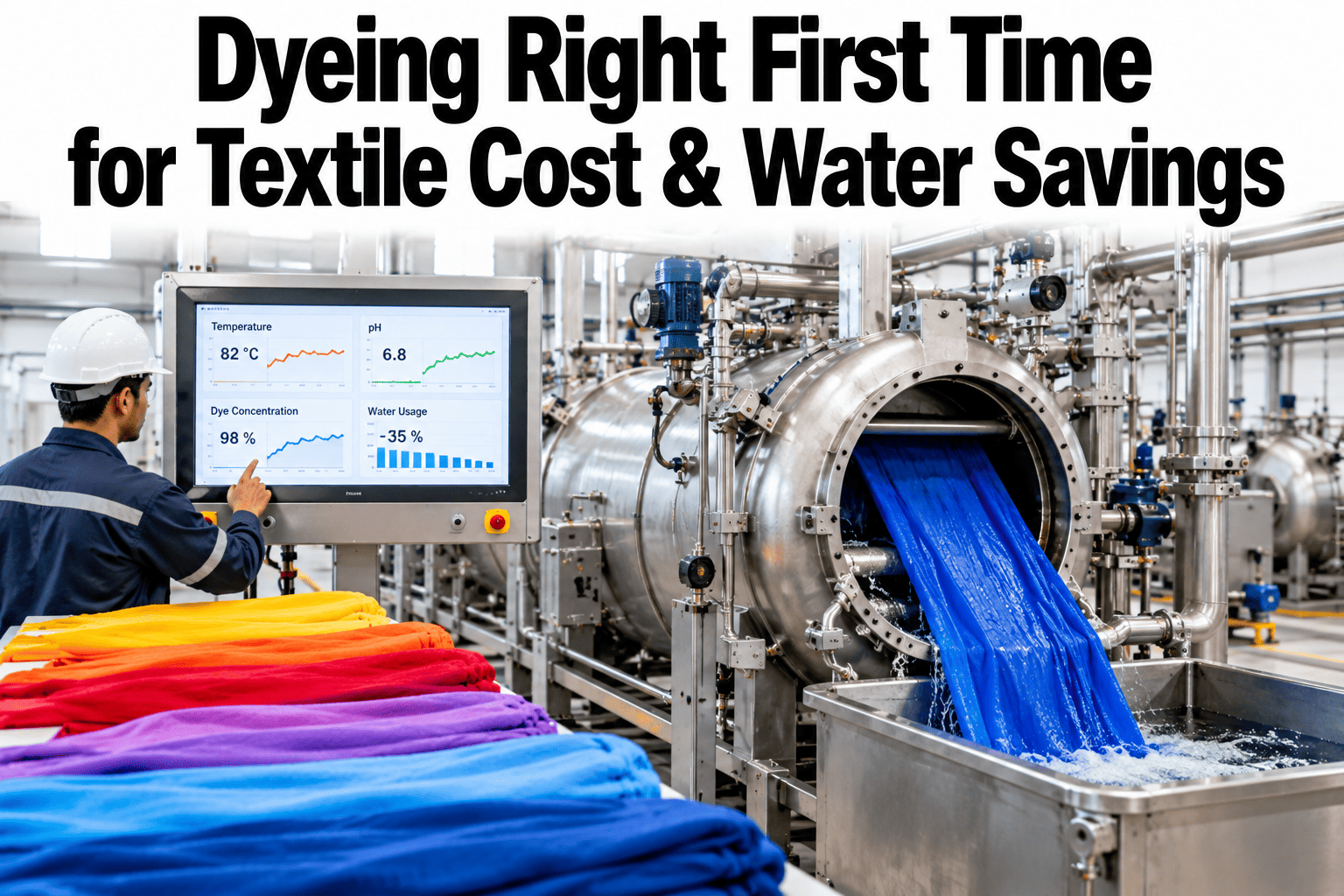
Dyeing Right First Time for Textile Cost & Water Savings
Recipe control, dosing accuracy and shade data working together to prevent the reprocess, not just catch it.
What a Reprocessed Lot Actually Costs
The visible cost of a reprocess is the dye and labor. Three other costs usually go uncounted.
A full reprocess consumes the same water and steam load as the original run, a second time.
Dye and auxiliary chemicals are repurchased and reapplied, not recovered from the failed lot.
A reprocess cycle eats into schedule buffer that was often already tight before the failure.
Counting all three costs, not just the dye, is what makes the case for investing in prevention over correction.
What Actually Drives RFT Up
RFT improves at the point where the batch is still running, not after it has already failed inspection.
| Driver | What It Controls |
|---|---|
| Recipe control | Consistent temperature, pH and dosing sequence against the written recipe |
| Dosing accuracy | Correct chemical quantity and timing at each stage of the cycle |
| Shade matching data | In-process shade comparison against the approved standard, not just a final check |
See What's Actually Driving Your Reprocess Rate
Book a 30-minute session and bring your recent reprocess log. iFactory AI will show which driver is behind most of your failed lots.
What iFactory AI Supports
RFT is tracked alongside the specific drivers behind it, not reported as a single trailing percentage.
Live Recipe Compliance
Temperature, pH and dosing are checked against the recipe as the batch runs.
In-Process Shade Comparison
Shade data is compared against standard before the batch finishes, not only at final inspection.
Reprocess Cost Tracking
Water, steam, chemical and schedule cost are tracked together for every reprocessed lot.
Driver-Level RFT Trends
RFT is broken down by root driver, showing exactly where to focus improvement effort.
iFactory AI connects to existing dyeing machine and lab data. Scope covers recipe tracking setup, shade comparison, team training and ongoing support.
Expert Review
Dyehouses chasing RFT often invest in better final inspection first, when the bigger gain usually sits upstream in recipe execution. Catching a drift mid-cycle costs a correction; catching it at final inspection costs a full reprocess.
Counting water and steam cost alongside dye cost changes how the investment case for prevention gets received by finance. The dye line item alone rarely justifies the spend; the full cost stack almost always does.
Frequently Asked Questions
What counts as a reprocessed lot for RFT calculation purposes?
Any lot that requires a repeat dyeing, correction or re-dye cycle to meet the approved shade standard typically counts, though definitions can vary slightly by dyehouse. Keeping this definition consistent is what makes the RFT trend meaningful over time. Confirm your own RFT definition in a working session.
How early in the cycle can a shade drift actually be caught?
In-process shade comparison can often flag a meaningful deviation partway through the cycle, well before the batch completes, giving the operator a chance to adjust rather than discovering the failure only at final inspection. Ask support about in-process shade check timing.
Does this require new equipment on the dyeing machine?
Many machines already have temperature and dosing sensors that can be connected to, and shade comparison can use existing lab spectrophotometer data where available. Request a review of your current equipment.
Can RFT be tracked separately by fabric type or colorway?
Yes, RFT and its driver breakdown can be filtered by fabric type, colorway or recipe, since some combinations are inherently harder to match than others and deserve their own benchmark. Contact support about segmenting your RFT reporting.
How long before we see a measurable RFT improvement?
Most dyehouses see a measurable improvement within eight to twelve weeks of starting, once recipe compliance and in-process shade tracking identify the specific driver behind most reprocesses. Book a session to estimate your own timeline.
Prevent the Reprocess, Don't Just Catch It
iFactory AI tracks recipe control, dosing and shade data together to lift RFT. Book a walkthrough on your own dyehouse data.