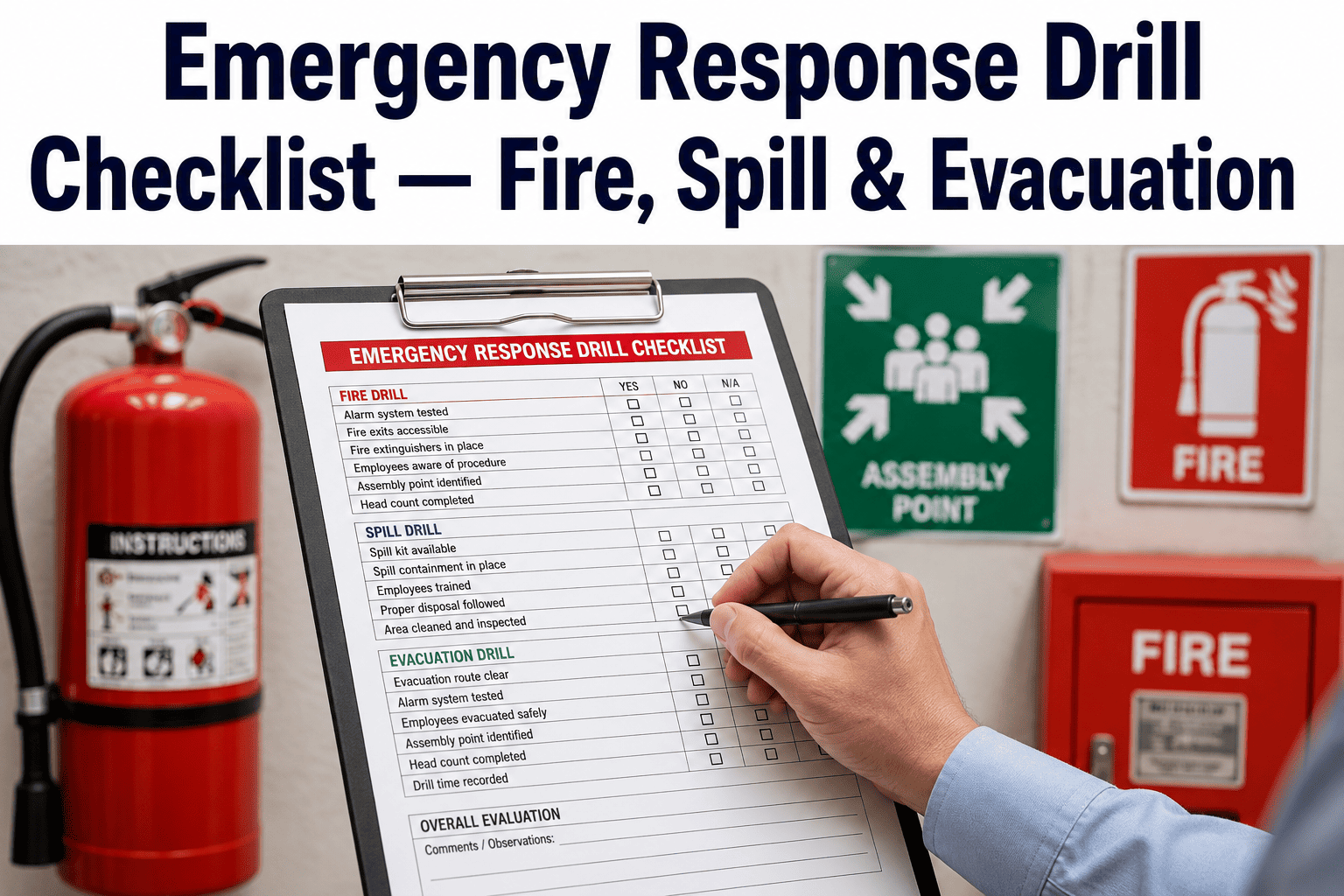
A fire drill that nobody times and nobody scores teaches almost nothing about how a plant would actually respond to a real emergency. Evacuation drills, spill containment drills, and fire drills are only useful when the exact evacuation time, the head count accuracy, and the gaps in response are documented well enough to drive real improvement before the next one. A digital emergency response drill checklist captures all of that in the moment, turning a routine compliance exercise into a genuine readiness check. Safety teams who want drills that actually improve response can book a demo to see how it works.
EMERGENCY RESPONSE DRILLS · FIRE, SPILL, EVACUATION · 2026
Drills That Are Timed, Scored, and Actually Improve Response
Digital checklists that capture evacuation time, head count accuracy, and spill containment performance for every fire, spill, and evacuation drill, with improvement actions tracked to completion.
Why Untimed Drills Give a False Sense of Readiness
Most plants run drills because a regulation or insurance requirement says they must, and the record of that drill often amounts to a sign-in sheet and a checkbox saying it happened. Nobody notes that the evacuation actually took eleven minutes instead of the assumed five, or that the head count at the assembly point was off by two people for several critical minutes before anyone noticed. Without that level of detail captured in the moment, a plant can run drills every quarter for years and still have no real evidence of whether its response time is improving or quietly getting worse.
A digital drill checklist forces that detail to be captured while it is happening rather than reconstructed from memory afterward, timing each phase of the drill automatically and prompting evaluators to log specific gaps as they observe them on the floor.
FD
Fire drills timed from alarm activation to full evacuation and assembly confirmation
SD
Spill drills scored on containment speed, correct PPE use, and cleanup verification
EV
Evacuation head counts cross-checked against badge or roster data in real time
TIMED, SCORED DRILLS
Turn Compliance Drills Into Real Readiness Data
See how automatic timing and structured scoring reveal gaps a sign-in sheet never would.
What Gets Measured During Each Drill Type
| Drill Type | Key Metric | Common Gap Found |
|---|---|---|
| Fire Drill | Alarm-to-assembly time | Blocked exit route |
| Spill Drill | Time to full containment | PPE not readily accessible |
| Evacuation Drill | Head count accuracy | Visitor log not accounted for |
Running a Drill in Four Phases
1
Trigger the Scenario
The drill begins with a defined trigger, and the app starts timing automatically from that moment.
2
Observers Score in Real Time
Evaluators log specific gaps and delays as they happen, not from memory during a debrief afterward.
3
Confirm the Count
Assembly point head counts are cross-checked digitally against who was on site at drill start.
4
Assign Improvement Actions
Every gap identified becomes a tracked action with an owner instead of a line item in a forgotten report.
What Safety Coordinators Are Saying
Our first timed drill was a wake-up call, evacuation took almost twice as long as we assumed and two contractors were unaccounted for at the assembly point. Having that data in front of leadership made getting budget for a second exit route a much easier conversation.
Safety Coordinator, Chemical Processing Facility
Frequently Asked Questions
How is drill timing captured without disrupting the drill itself?
Timing starts automatically from a defined trigger point, such as alarm activation, and evaluators positioned at the assembly point or containment area log arrival and completion on a tablet or phone as it happens, which requires no more effort than an evaluator would already be putting into observing the drill. The advantage over a manual stopwatch and clipboard approach is that the data is timestamped precisely and cannot be estimated or rounded afterward, which is where a lot of the inaccuracy in traditional drill records comes from.
Can this handle head counts for a large site with contractors and visitors?
Yes, the head count feature is designed to cross-reference against whoever was checked in on site at the time the drill started, including employees, contractors, and visitors logged through a badge or sign-in system, which is exactly the group that is hardest to account for manually since visitor logs often live in a completely separate system from the employee roster. This is frequently where real gaps get found, since a manual count at the assembly point rarely catches a missing contractor who was working in a remote area of the site.
What happens to the gaps identified after a drill ends?
Each gap logged during the drill, such as a blocked exit or an inaccessible spill kit, becomes a tracked corrective action with an assigned owner and due date, and it remains visible on a dashboard until closed with evidence rather than disappearing into a static post-drill report that nobody revisits before the next drill happens.
How often should each type of drill be run?
Frequency requirements vary by regulation, industry, and site risk profile, so exact schedules should be confirmed against applicable local requirements, but many facilities run fire evacuation drills at least twice a year and spill response drills at a frequency tied to the hazard level of materials on site. Teams can review a suggested cadence appropriate to their facility type through support.
Can drill data be shared with auditors or insurers directly?
Drill records including timing data, scoring, identified gaps, and closure evidence for corrective actions can be exported or shared in a format suitable for an auditor or insurance review, giving a documented improvement trend rather than a stack of sign-in sheets. Safety leaders can book a demo to see what a typical drill history report looks like.
EMERGENCY RESPONSE DRILLS
Make Every Drill Prove Your Plant Is Actually Ready
Replace sign-in sheets with timed, scored drill data that drives real improvement.