Most ERP go-live problems that show up in week one were visible in the data months earlier. A duplicate vendor record, an unreconciled trial balance, a BOM that didn't survive the field mapping, none of these appear overnight at cutover. They were sitting in the legacy system the whole time, waiting for a migration plan that treated data readiness as a real workstream instead of a line item in the final weeks. ERP program managers building their cutover plan can book a session with iFactory AI to see how the platform automates cleansing, mapping validation and mock cutover reconciliation ahead of go-live.
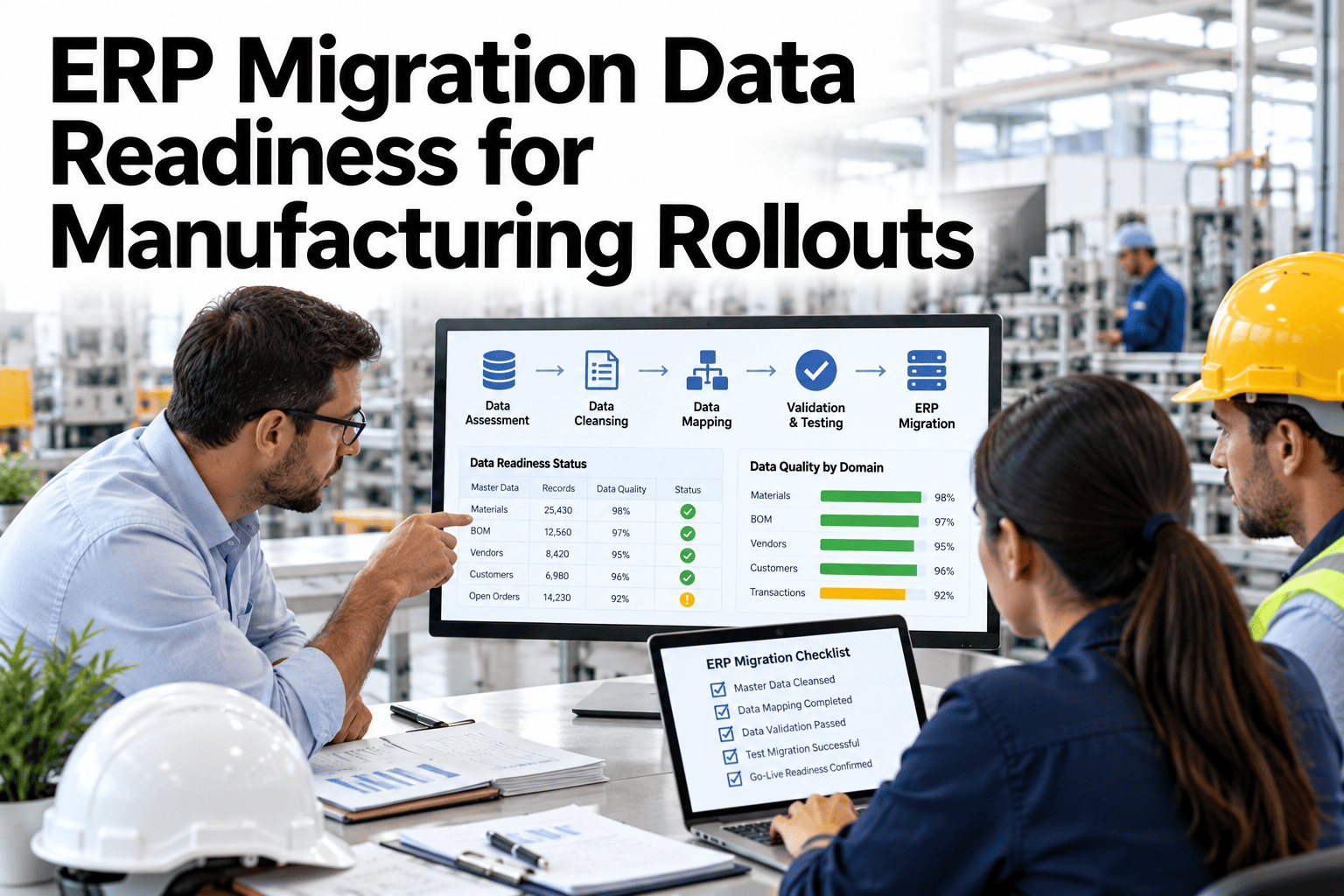
ERP Migration Data Readiness for Manufacturing Rollouts
Go-live problems are usually data problems that were visible months earlier. Cleanse, map and test your migration before cutover, not during it.
Why Data Readiness Gets Squeezed Into the Last 10 Percent
On most ERP rollout timelines, data migration is scoped like a technical task that happens near the end: extract, transform, load, done. In practice, data migration consumes roughly 30 to 40 percent of total project effort once cleansing, mapping, validation and reconciliation are counted honestly. Projects that budget it as a line item rather than a workstream are the ones that discover problems during the final mock cutover, when there is no time left to fix them.
Master data assumed clean
Legacy systems accumulate duplicate, stale and incompatible records for years. Industry data suggests 30 to 60 percent of legacy master records can carry some form of quality issue. These surface for the first time at the first mock load, far later than they should.
IT-only mapping decisions
Field mapping done without business input captures the technical shape of the data but misses what it means operationally. A unit-of-measure conversion that's technically correct can still be operationally wrong if nobody asked production what the field actually drives.
Generic tools on non-generic data
Standard migration tooling handles a majority of straightforward fields well, but custom fields, multi-level BOMs and multi-currency ledgers typically need purpose-built scripts for a meaningful share of records that off-the-shelf templates can't touch.
No reconciliation strategy
Counting rows migrated is not the same as confirming the business numbers tie out. A trial balance variance that exceeds a small fraction of a percent of total GL balance should be treated as a hold condition, not a rounding note.
Single mock cutover
One rehearsal leaves no window to find a defect, fix it, and retest before the real cutover. Programmes that run only one mock are making their first full-scale discovery of migration problems during the actual go-live weekend.
No rollback plan
Without documented abort criteria and a rehearsed rollback path, a go/no-go decision at 2am on cutover weekend becomes a political argument instead of a pre-agreed technical judgment call.
None of these causes are exotic. They are well-documented failure patterns that repeat across manufacturing ERP rollouts because data readiness is treated as a checkbox rather than a staged programme with its own gates. Teams scoping their own migration risk can book a readiness assessment with iFactory AI.
What a Failed Data Migration Actually Costs
The cost of poor data readiness is not hypothetical. Two well-documented manufacturing and retail ERP failures show how far the consequences travel when data problems aren't caught before go-live.
Inaccurate product data at scale
A large retail ERP migration loaded tens of thousands of product records with inaccurate data across roughly 50 data elements per product. The data was accurate a fraction of the time it needed to be. Inventory levels, pricing and replenishment all ran on numbers the system believed but the warehouse couldn't act on. The operational breakdown that followed contributed to the company's insolvency within roughly 18 months of go-live.
Vendor master and invoice processing collapse
A major utility's ERP migration left thousands of vendor invoices unprocessable after go-live because vendor master data and transaction mapping weren't reconciled before cutover. The monthly close process stretched from roughly 4 working days to over 40. The programme's total cost grew to several multiples of its original budget before the company settled with its systems integrator.
Both cases trace back to the same root failure: data that looked migrated because the rows loaded, but was never actually validated against what the business needed it to be. A readiness programme exists to catch exactly this gap before it reaches production. Teams that want to stress-test their own migration plan against these failure patterns can contact iFactory support for a risk review.
The Four-Stage Readiness Framework
Data readiness is not one activity, it is four distinct stages that each need their own owner, timeline and exit criteria before the programme moves to the next stage.
Assess and cleanse
Profile every master data domain, customers, suppliers, products, chart of accounts, BOMs and routings, to find duplicates, stale records and incomplete fields. Where duplicate or quality-flagged records exceed roughly 15 percent of a domain, that domain needs a dedicated cleansing sprint before mapping begins, not a quick fix during it.
Map with business ownership
Every field mapping needs a named business owner who signs off on what the field means operationally, not just a technical source-to-target pairing from IT. Custom fields, unit conversions and currency handling get flagged early rather than discovered at the first load.
Mock cutover and reconcile
Run the full extraction, transformation, load and reconciliation sequence at least twice before the real cutover, with defined gate criteria at each pass. Reconciliation means tying trial balances, subledgers and open transaction counts, not just confirming row counts match.
Go/no-go and rollback readiness
A documented go/no-go checklist with pre-agreed abort criteria, plus a rehearsed rollback procedure, turns the cutover decision into a technical judgment made against known thresholds rather than a pressured call made under deadline stress.
Each stage has a clear exit gate, and no programme should move to the next stage until the current one's criteria are met. iFactory AI tracks readiness status across all four stages in a single dashboard, so the programme manager can see exactly which domain or mapping is blocking the next gate. Teams building their readiness framework can book a framework walkthrough with iFactory AI.
Track Readiness Across Every Gate
iFactory AI automates master data profiling, mapping validation and mock cutover reconciliation so your go/no-go decision is backed by data, not deadline pressure.
Master Data Cleansing: Domain by Domain
Not every master data domain carries the same risk or needs the same cleansing effort. Manufacturing ERP migrations should prioritize domains by how far their errors travel once the system goes live.
| Domain | Common quality issue | Downstream impact | Cleansing priority |
|---|---|---|---|
| Chart of accounts | Inconsistent account structures across entities | Financial consolidation and reporting errors | Critical, cleanse first |
| Customer and vendor master | Duplicates from multiple legacy source systems | Receivables, payables, and relationship reporting distortion | Critical, cleanse first |
| BOM and routing | Stale revisions, orphaned components | Production orders release against the wrong structure | High, cleanse before mapping |
| Product and SKU master | Inconsistent units of measure, incomplete attributes | Planning, costing and fulfilment errors | High, cleanse before mapping |
| Open transactions | Incomplete capture of in-flight orders | Orders fall through the cutover gap entirely | Critical, validate at mock cutover |
| Historical records | Over-scoped history inflating volume | Extended migration runtime, longer cutover window | Low, archive candidates if inactive 24+ months |
Chart of accounts and customer/vendor master data should be cleansed first because every other domain's financial reporting depends on them being correct. Historical records, by contrast, are usually the easiest to defer: if a record hasn't been touched in two years or more, it is often a stronger candidate for archive than for full migration. iFactory AI profiles every domain automatically and ranks cleansing priority by downstream dependency, not just by data volume. Programme teams building a domain-by-domain plan can book a data profiling session.
Mock Cutover: What to Test and How Many Rehearsals
A mock cutover is a full rehearsal of the actual cutover sequence, extraction, transformation, loading, validation and reconciliation, run against production-representative data well before the real event. It is where theoretical mapping decisions meet actual data and either hold up or fall apart.
Technical validation
File structures, field mappings, interface sequencing and load results. This confirms the pipeline moves data correctly from source to target without silently dropping or truncating fields.
Financial reconciliation
General ledger balances, customer and vendor balances, open transactions and tax information, tied between source and target. A trial balance variance above a small fraction of total GL balance is a hold condition, not a note for later.
Integration behavior
Every connected system, MES, warehouse management, procurement, banking, is tested for authentication, field mapping and error handling against the new ERP structure, not the legacy one it was originally built against.
Business workflow sign-off
Finance and operational users confirm that reports, approval flows and transaction processes behave correctly against the migrated data, not just that the data technically loaded.
Most well-run programmes schedule at least three mock cutovers, with each successive rehearsal expected to come in close to the duration of the prior one and with zero unresolved critical defects before the next rehearsal or the real cutover proceeds. A single mock cutover leaves no time to find and fix a defect before the live event becomes the first real test. iFactory AI runs automated reconciliation checks after every mock cutover and flags any variance against the defined gate criteria immediately, rather than waiting for a manual review days later. Programme managers scheduling their mock cutover sequence can book a mock cutover planning session with iFactory AI.
Go/No-Go: Making the Cutover Decision Defensible
The go/no-go decision at the end of the final mock cutover should never be a judgment call made under deadline pressure. It should be a checklist evaluated against criteria the programme agreed on weeks earlier, when nobody had a stake in rushing the answer.
All critical-domain cleansing complete
Chart of accounts, customer/vendor master and BOM/routing domains have passed their quality thresholds with no open critical exceptions.
Final mock cutover reconciled clean
Trial balance, subledger and open transaction reconciliation all land within the pre-agreed variance threshold, with zero open severity-1 defects.
Integrations tested against live interface partners
Every connected system has confirmed successful inbound and outbound transaction tests against the new ERP, not just the migration team's internal test harness.
Rollback plan rehearsed, not just documented
The rollback procedure has been run at least once in a test environment, with a known time budget, typically measured in hours rather than assumed to be instantaneous.
Business sign-off from every affected function
Finance, operations, procurement and any plant floor system owner have confirmed their workflows behave correctly against migrated data in the final mock.
If more than a couple of these items are vague, deferred, or depend on a "we'll fix it after go-live" answer, the programme should escalate the cutover date rather than proceed on hope. iFactory AI tracks each of these criteria as a live gate status, so the go/no-go meeting reviews data that has already been validated rather than discovering gaps in the room. Programme managers preparing their go/no-go framework can book a session to build the checklist around their specific rollout.
Frequently Asked Questions
How early should data readiness work start relative to go-live?
Data readiness should start as its own workstream from the moment the ERP programme kicks off, not after functional configuration is underway. For a typical manufacturing rollout, profiling and cleansing usually needs 10 to 16 weeks of runway before the first mock cutover, with the full sequence of mock cutovers completing well ahead of the planned go-live date. Book a demo to map a readiness timeline against your go-live date, or contact support for a quick scoping conversation first.
How many mock cutovers are actually necessary?
Most well-run manufacturing ERP programmes run at least three mock cutovers. The first surfaces the bulk of mapping and data quality defects, the second confirms the fixes held and finds remaining edge cases, and the third is close to a dress rehearsal with the full data volume and integration set. A single mock cutover leaves no time to fix anything before the real event. Book a session to plan your mock cutover sequence.
What reconciliation variance should trigger a hold at the go/no-go decision?
A trial balance variance above a small fraction of a percent of total general ledger balance is a common hold threshold, though the exact number should be set by finance based on materiality for your organization. Row counts matching is not sufficient; the business numbers have to tie out independently. Book a demo to see automated reconciliation checks running against your chart of accounts, or contact support to discuss your specific GL structure.
How do we decide which historical records to migrate versus archive?
Records that haven't been accessed or transacted against in roughly 24 months are strong archive candidates rather than full migration targets. Migrating a decade or more of history inflates data volume, extends mock cutover runtime, and adds cleansing burden for records almost nobody will query in the new system. Book a session to scope your historical data strategy.
Can iFactory AI integrate with our existing migration tooling and ERP platform?
Yes. The turnkey NVIDIA AI server connects to existing ETL and migration tools as a validation and reconciliation layer rather than replacing the migration tooling your integrator is already using. It adds automated profiling, gate tracking and reconciliation checks on top of the pipeline you've already built. Contact support to check compatibility with your current migration stack, or book a scoping call to map the integration.
Make Your Go-Live Decision With Confidence
iFactory AI tracks master data cleansing, mapping sign-off and mock cutover reconciliation against clear gate criteria, so your go/no-go call is backed by data.