
Every missed inspection is a silent countdown to failure. Across manufacturing facilities worldwide, the gap between scheduled preventive maintenance and actual completion rates creates a hidden risk landscape that surfaces only when equipment fails, safety incidents occur, or auditors arrive. According to industry research, 58% of facilities spend less than half their time on scheduled maintenance, while 67% of manufacturers still rely on reactive maintenance—waiting for equipment to break before taking action.
The consequences extend far beyond operational disruption. From October 2023 to September 2024, OSHA documented more than 16,000 violations in the manufacturing sector alone, resulting in penalties exceeding $70 million. Many of these citations trace directly back to missed inspections: machine guards that weren't verified, lockout/tagout procedures that weren't followed, respiratory protection that wasn't tested. Each violation represents not just a regulatory failure, but a workplace where someone could have been injured because a scheduled safety check didn't happen.
How Missed Maintenance Compounds Into Costly Failures
This guide examines how missed inspections and PM schedule failures silently increase operational risk, the true cost of inspection non-compliance, and proven strategies for achieving world-class PM compliance rates. Whether you're a plant manager struggling with maintenance backlogs or a safety director preparing for your next audit, understanding the inspection gap is the first step toward closing it.
The PM Compliance Gap: Where Factories Fall Short
World-class maintenance organizations achieve PM compliance rates of 90% or higher—meaning nine out of ten scheduled preventive maintenance tasks are completed on time. Yet the reality across most manufacturing facilities falls significantly short of this benchmark. Industry data reveals that facilities operating between 40-90% PM compliance are functional but exposed to elevated risk, while those below 40% face near-certain equipment reliability problems and compliance failures.
PM Compliance Benchmark Scale
Where does your facility stand against industry standards?
The compliance gap stems from systemic challenges that compound over time. The average age of industrial fixed assets has reached 24 years—the oldest in nearly 70 years—meaning maintenance teams are managing equipment that requires more attention than ever while facing labor shortages and budget constraints. When 50% of maintenance costs are estimated to be "waste" and 30% of preventive maintenance is performed too frequently while critical tasks get skipped, the problem isn't doing more maintenance—it's doing the right maintenance at the right time.
Top 5 Reasons for PM Non-Compliance
The Real Cost of Missed Factory Inspections
Missed inspections create a cascading risk profile that manifests in multiple ways: unplanned equipment failures, safety incidents, regulatory citations, and quality defects. The financial impact is staggering. Unplanned downtime costs the average manufacturing facility $260,000 per hour, with automotive plants facing losses of $2.3 million per hour. Fortune 500 companies collectively lose $1.4 trillion annually to unplanned downtime, representing 11% of total revenues.
The True Cost of Missed Inspections
But financial losses represent only part of the picture. Safety incidents tied to equipment failures carry human costs that cannot be calculated in dollars. OSHA estimates that workers operating machinery suffer 18,000 amputations, lacerations, crushing injuries, and abrasions annually in the manufacturing sector alone. Many of these injuries trace back to missed inspections: machine guards that weren't verified, safety interlocks that weren't tested, or protective equipment that wasn't maintained.
Top OSHA Violations Linked to Inspection Failures
OSHA's annual Top 10 violations list serves as a roadmap of where inspections fail most frequently. In FY 2024, the same categories appeared yet again—many of them directly tied to inadequate inspection and maintenance protocols. Lockout/Tagout, powered industrial trucks, machine guarding, and respiratory protection all require regular inspection schedules that, when missed, create immediate compliance exposure and safety risks.
Manufacturing OSHA Violations Requiring Regular Inspections
The connection between inspection protocols and OSHA compliance is direct and measurable. Lockout/Tagout violations—which can result in 120 fatalities and 50,000 injuries annually when procedures aren't followed—often stem from failure to conduct required annual procedure reviews. Powered industrial truck citations frequently involve inadequate pre-shift inspections. In each case, a functioning inspection management system with proper scheduling and verification would have prevented the citation.
Equipment Failure: The Maintenance Connection
The link between missed inspections and equipment failure is documented across thousands of incidents. The top causes of unplanned equipment downtime tell the story: aging equipment (34%), mechanical failure (20%), operational error (11%), and lack of time for maintenance (9%). When maintenance teams don't have time for scheduled inspections, they're not identifying the early warning signs that prevent catastrophic failures.
Top Causes of Unplanned Equipment Downtime
The pattern is consistent across industries: missed lubrication schedules lead to bearing failures, skipped calibration checks result in quality defects, overlooked vibration readings precede motor burnouts, and deferred filter replacements cause contamination failures. Research shows that proper condition monitoring can detect potential failures 30 days in advance—but only if inspections actually happen.
The Impact of Regular Inspections on Equipment Reliability
Without Regular Inspections
- 48.5% more unplanned downtime
- 63.2% more quality defects
- 4-5x higher repair costs
- 20-40% shorter equipment life
With PM and Inspection Programs
- 25-40% reduction in downtime
- 87.3% fewer defects
- 12-18% lower maintenance costs
- 2-4 years equipment life extension
Building a World-Class Inspection Management System
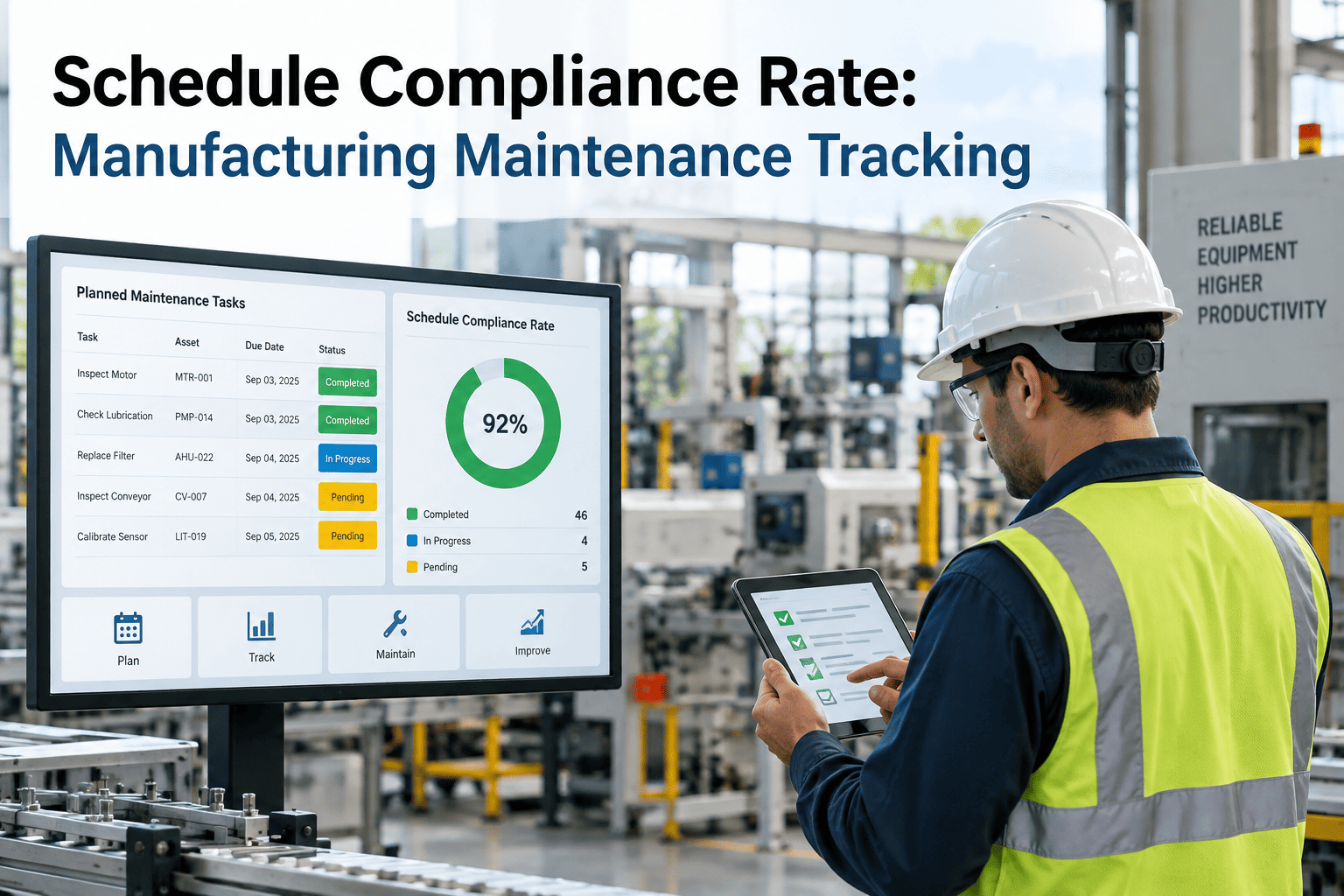
Achieving 90%+ PM compliance requires more than good intentions—it demands systematic changes to how inspections are scheduled, assigned, tracked, and verified. Organizations that successfully close the compliance gap share common characteristics: centralized scheduling through CMMS platforms, mobile-enabled technicians who can complete checklists in real-time, automated escalation for overdue tasks, and management visibility into compliance metrics.
6 Components of World-Class Inspection Management
Centralized Scheduling
CMMS-driven PM schedules with automated work order generation based on time, meter, or condition triggers
35% scheduling improvementMobile Execution
Technicians complete digital checklists on smartphones with photo capture and real-time data sync
50% faster inspectionsAutomated Escalation
Overdue inspections trigger supervisor alerts and automatic reprioritization based on criticality
Zero tasks fall through cracksReal-Time Analytics
Dashboards showing PM compliance rates, overdue tasks, and trends by asset, area, or technician
Data-driven decisionsAuto Work Orders
Failed inspection items automatically generate corrective work orders with priority assignment
Immediate issue responseComplete Audit Trail
Full documentation of who performed what inspection, when, with findings—ready for auditors
Instant compliance evidenceThe technology exists to transform inspection management from a paper-based burden into a streamlined digital workflow. Modern CMMS platforms offer features specifically designed to address inspection compliance: customizable checklist templates, QR code scanning for asset identification, GPS verification of technician location, and integration with IoT sensors for condition-based triggering.
Proven Results from Digital Inspection Management
Ready to Close Your Inspection Compliance Gap?
iFactory's integrated inspection management system provides the scheduling automation, mobile execution tools, and real-time analytics you need to achieve world-class PM compliance. Stop letting missed inspections silently increase your operational risk.
Frequently Asked Questions
What is PM compliance and why does it matter for manufacturing?
PM (Preventive Maintenance) compliance measures the percentage of scheduled preventive maintenance tasks completed on time within a defined period. It's calculated by dividing completed PMs by scheduled PMs and multiplying by 100. PM compliance matters because it directly correlates with equipment reliability, safety performance, and regulatory compliance. World-class organizations target 90%+ PM compliance, particularly for critical equipment. Facilities with low PM compliance experience more unplanned downtime, higher repair costs, increased safety incidents, and greater exposure to regulatory citations during audits.
What is considered world-class PM compliance in manufacturing?
World-class PM compliance is generally considered to be 90% or higher, meaning at least 9 out of every 10 scheduled preventive maintenance tasks are completed on time. For critical equipment and safety-related inspections, organizations should aim for 100% compliance. Facilities operating between 85-90% are considered "good," 70-85% is "functional," 40-70% indicates elevated risk, and below 40% represents critical risk where equipment failures become nearly inevitable.
How much does missed maintenance cost manufacturing facilities?
The costs of missed maintenance are substantial. Unplanned downtime costs an average of $260,000 per hour across manufacturing, with automotive plants facing up to $2.3 million per hour. Fortune 500 companies lose approximately $1.4 trillion annually to unplanned downtime (11% of revenues). Beyond downtime, missed inspections lead to OSHA violations ($16,131-$161,323 per citation), workplace injuries averaging $50,000-75,000 in productivity losses per incident, quality defects causing 25-40% higher defect rates, and reactive repairs costing 4-5x more than planned maintenance.
What are the most common OSHA violations related to factory inspections?
The most common inspection-related OSHA violations in manufacturing include: Lockout/Tagout (1910.147) requiring annual procedure inspections; Powered Industrial Trucks (1910.178) requiring daily pre-operation inspections; Respiratory Protection (1910.134) requiring inspection before and after each use; Machine Guarding (1910.212) requiring regular verification of guards and safety devices; and Hazard Communication (1910.1200) requiring regular audits of chemical labeling. In FY 2024, manufacturing sector violations exceeded 16,000 with penalties over $70 million.
How can a CMMS improve inspection compliance rates?
A Computerized Maintenance Management System (CMMS) improves inspection compliance through: automated scheduling that creates work orders based on time, meter, or condition triggers; mobile execution allowing technicians to complete digital checklists with photo capture; automated escalation alerting supervisors to overdue tasks; centralized documentation providing instant audit trail access; and analytics dashboards tracking compliance metrics. Research shows CMMS implementation improves PM scheduling efficiency by 35%, and technicians using mobile devices complete inspections 50% faster.
What is the ROI of preventive maintenance programs?
Preventive maintenance programs deliver significant ROI. According to the US Department of Energy, predictive maintenance can deliver a 10x return on investment. Industry research shows PM programs reduce maintenance costs by 12-18% compared to reactive approaches, with every $1 spent on PM saving $5 in future repairs. Organizations implementing structured PM programs report 400% average ROI. Additional benefits include 25-40% downtime reduction, 70-75% decrease in breakdowns, and 2-4 year equipment life extension.
Close the Gap Before It Closes On You
Every inspection on your PM schedule exists for a reason. Each task represents lessons learned from equipment failures, safety incidents, or compliance violations. When you skip an inspection, you're reopening the door to the problems that inspection was designed to prevent.
The path to world-class PM compliance is well-documented and achievable. Organizations that invest in centralized scheduling, mobile execution, automated escalation, and real-time analytics consistently achieve 90%+ compliance rates while reducing both downtime and total maintenance costs. Start with visibility—measure your current PM compliance rate, identify which critical inspections are being missed and why, then build the systems to ensure those inspections happen every time, on time, fully documented.


.png)

.png)