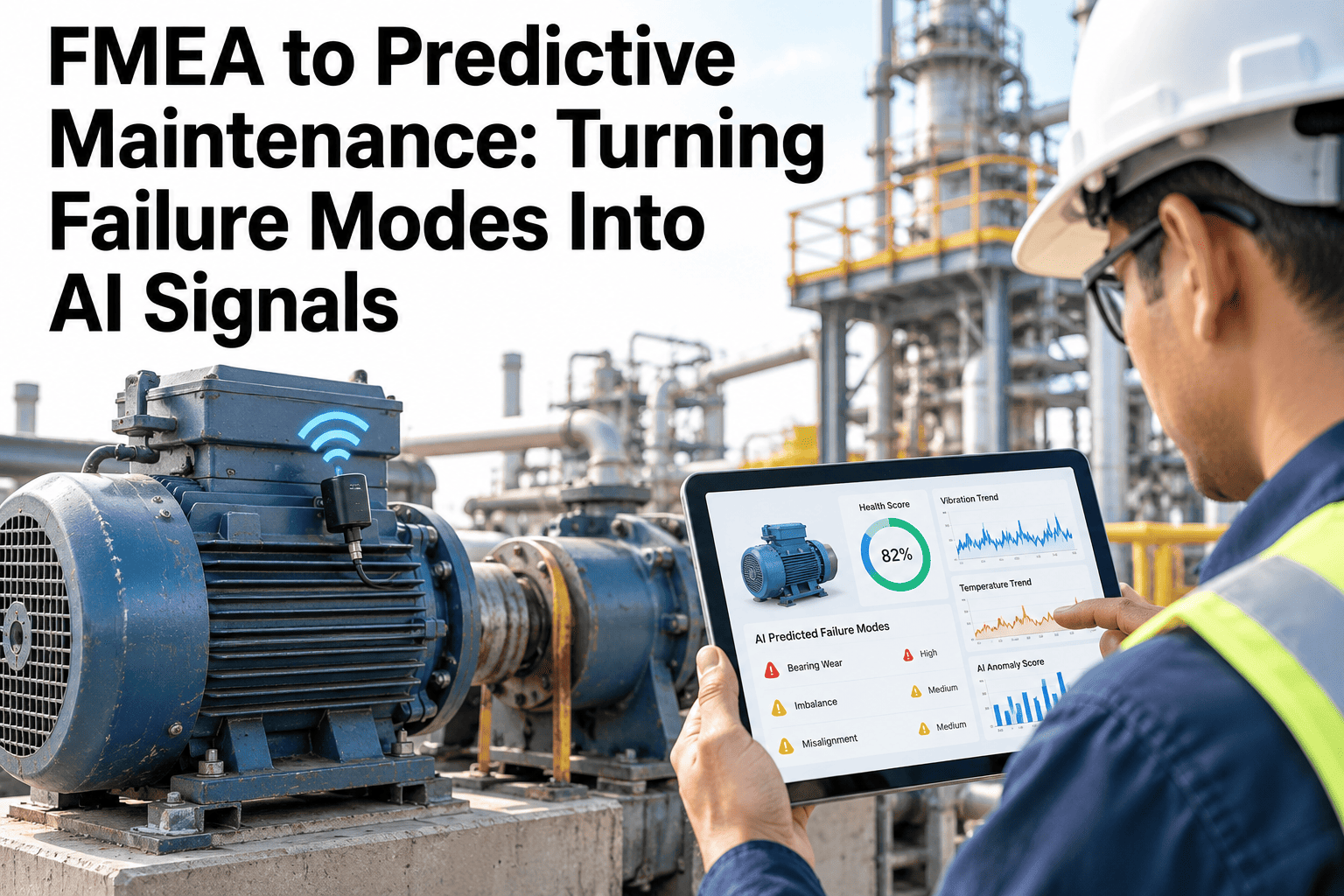
Most plants already have an FMEA sitting in a binder or a spreadsheet, carefully documenting every failure mode, its severity, occurrence and detection rating, and the resulting risk priority number. What almost nobody does is connect that document to the predictive maintenance program actually running on the floor, which means two teams independently rediscover the same failure modes: one on paper during a risk review, the other months later when a sensor finally flags the same pattern in production. Turning FMEA entries into AI monitoring signals closes that gap, using the failure modes already identified and prioritized to decide which sensors and models actually get built first. Reliability and maintenance teams rethinking this connection can see FMEA failure modes mapped directly to live predictive maintenance signals before the next reliability review.
FMEA to Predictive Maintenance: Turning Failure Modes Into AI Signals
The failure modes already identified and risk-ranked on paper become the priority list for what gets monitored first.
Why FMEA and Predictive Maintenance Stay Disconnected
The two programs usually run in parallel without ever informing each other.
Reliability engineering owns the FMEA while a separate team builds predictive models independently.
An FMEA reviewed once a year rarely feeds into which sensors get prioritized day to day.
A high-risk failure mode gets rediscovered by a model months after it was already flagged on paper.
Connecting the two means the highest-RPN failure modes become the first candidates for a monitoring signal, not an afterthought.
From Failure Mode to Monitoring Signal
Turning an FMEA entry into an active signal follows a consistent sequence.
Rank Your Own FMEA by What's Actually Monitorable
Book a 30-minute session and bring your current FMEA. iFactory AI will show which high-risk failure modes already have a measurable signal.
What Changes When FMEA Drives Monitoring Priority
The difference shows up in which assets get monitoring attention first.
| Factor | Without FMEA Link | With FMEA Link |
|---|---|---|
| Monitoring priority | Based on available data or recent incidents | Based on documented risk priority number |
| Detection rating | Stays static after the FMEA is written | Updates as monitoring signals go live |
| Team alignment | Reliability and predictive maintenance work separately | One shared priority list drives both |
What iFactory AI Supports
The platform connects FMEA risk data directly to the monitoring models it builds.
FMEA Import and Ranking
Existing FMEA data is imported and ranked by risk priority number automatically.
Signal Feasibility Check
Each high-risk failure mode is checked against available sensor data for a measurable signal.
Model Build and Deployment
Monitoring models are built for the highest-priority, feasible failure modes first.
Detection Rating Feedback
The FMEA's detection rating updates automatically as live monitoring comes online.
iFactory AI connects FMEA data to live predictive maintenance signals. Scope covers FMEA import, signal feasibility review, model build and training.
Expert Review
Plants sitting on a well-built FMEA already have a prioritized list of where predictive maintenance would deliver the most value. The gap is almost never a lack of risk analysis, it is that nobody connected the analysis to the monitoring program's build sequence.
Updating the detection rating once a signal goes live is the step most teams skip, and it is the one that keeps the FMEA accurate over time. An FMEA that never reflects new monitoring capability quietly drifts out of date with the actual state of the plant.
Frequently Asked Questions
What format does our existing FMEA need to be in to import it?
A standard spreadsheet or exported FMEA format with failure modes, severity, occurrence and detection ratings is typically sufficient to import and begin ranking, without needing to restructure the document first. Bring your current FMEA to a working session.
What happens to failure modes that have no measurable signal available?
These are flagged as not currently monitorable with existing sensors, which can inform a decision to add instrumentation if the risk priority is high enough to justify it, or to rely on other mitigation in the meantime. Ask support about instrumentation gap analysis.
Does this require rewriting our existing FMEA format?
No, the existing FMEA structure and ratings are used as they are; the process adds a signal feasibility layer and a connection to monitoring, rather than requiring the underlying risk analysis to be redone. Request an FMEA compatibility check.
How often should the FMEA be re-ranked as monitoring expands?
An annual review is typical, consistent with standard FMEA review cadence, though a major process change or a new failure event may prompt an earlier update to the ranking and monitoring priority list. Contact support to set a review cadence for your program.
How long before the first monitoring signals from this process are live?
Most teams have the first set of high-priority, feasible signals live within six to nine weeks, starting with failure modes that already have usable sensor data available. Book a session to estimate your own timeline.
Let Your FMEA Drive What Gets Monitored First
iFactory AI connects documented failure modes to live predictive maintenance signals. Book a walkthrough on your own FMEA.