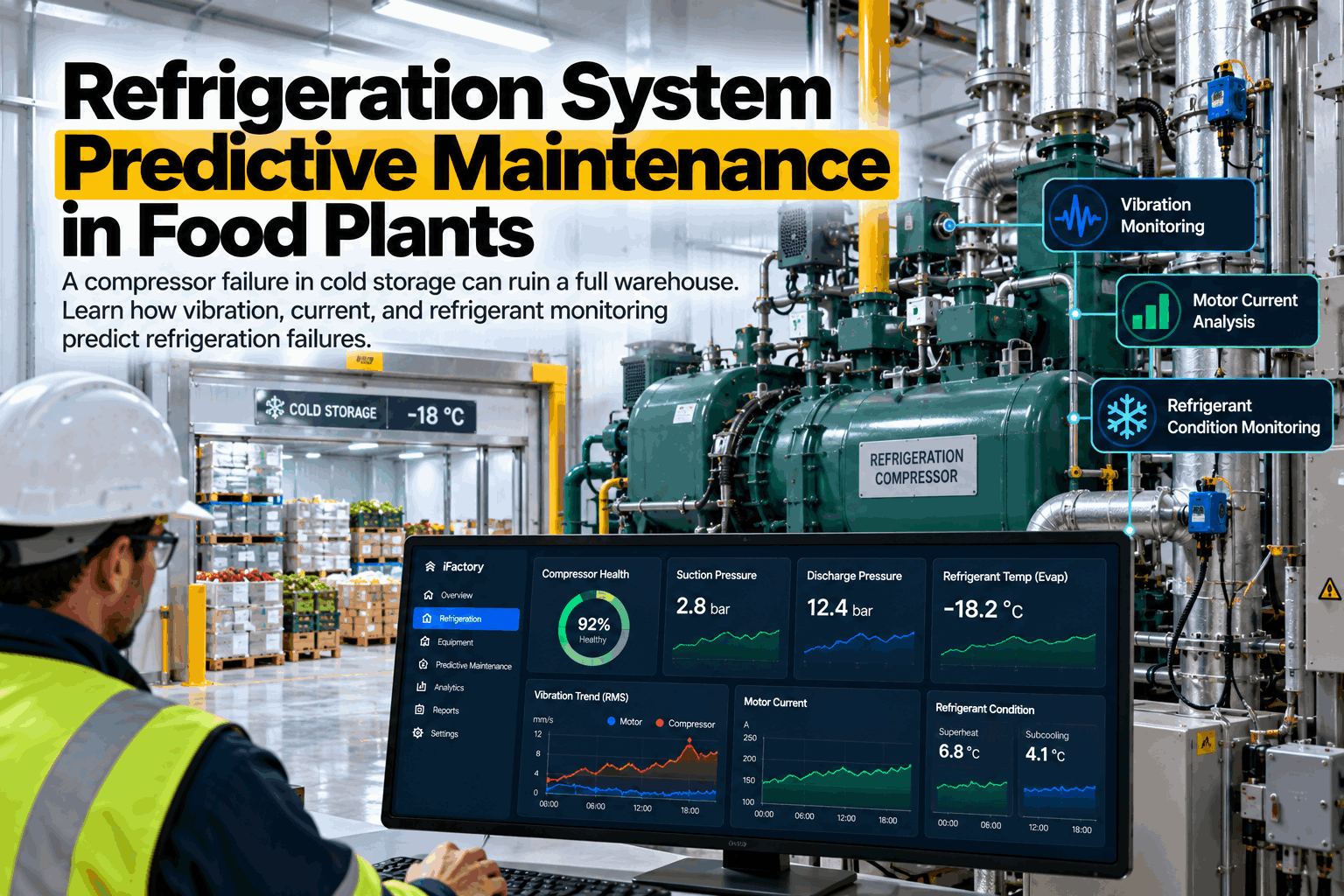
In a food plant, the refrigeration system is the one utility that cannot be late. A line can stop for an hour and catch up. A chilled room that warms for an hour may not get its product back. Yet compressors, condensers and evaporators rarely fail without notice: a bearing roughens, a current creeps, a pressure drifts, usually for days or weeks first. Predictive maintenance is the habit of reading those signs while there is still time to act. This guide explains the three signals that matter — vibration, motor current and refrigerant readings — and how iFactory puts them to work. To see them on your own plant, book a refrigeration review.
Refrigeration Predictive Maintenance for Food Plants: Hear the Compressor Before It Fails
Vibration, motor current and refrigerant readings show a compressor, condenser or evaporator going wrong days or weeks ahead — in time to protect the product in the room.
- Works on ammonia and Freon systems
- Tells a machine fault from a system fault
- Turns each warning into a planned job
What predicts a refrigeration failure?
What a Refrigeration Failure Really Costs
The compressor is cheap next to what it keeps cold.
A rebuilt compressor is a known cost. The product in the room, the production that stops and the safety risk of a refrigerant release are the larger numbers. How bad it gets depends on how long the failure goes unseen. Refrigeration is also the biggest power user on most cold sites: in one studied cold store it took more than 70% of all electricity. Our support team can help you work out your own exposure.
What is at stake
- Product. Chilled food above 41°F is on a clock.
- Production. Blast freezers and process chillers stop the line at once.
- Safety. A failed seal or valve on an ammonia system is a release.
- Energy. A struggling system uses more power for weeks before it fails.
How much time you have
- Chilled rooms. The margin is a few degrees. Hours, not days.
- Frozen stores. A full, closed store holds its cold longer.
- Process cooling. No margin. The line waits for the plant.
All three shrink at peak load, with doors open, or when nobody knows until morning.
One compressor failure does not ruin a warehouse by itself. It does when there is no standby, when it happens on the hottest day, or when the alarm reaches nobody. Predictive maintenance removes the surprise, so the failure never meets those conditions.
Three Signals That Give Warning
Vibration tells you about the machine. Current tells you about the load. Refrigerant readings tell you about the system.
None of the three sees everything, which is why they are read together. A fault that shows in one and not the others is a clue in its own right. To see which signals your plant already has, book a working session.
Vibration
Sensors on compressor and motor bearings.
Catches: bearing wear, misalignment, looseness and rotor contact, often weeks ahead.
Misses: system faults such as a fouled condenser or a low charge.
Motor current
Measured at the starter or drive.
Catches: motor faults, overload, and extra work caused by high head pressure.
Misses: early bearing wear, which vibration sees sooner.
Refrigerant readings
Pressures, temperatures, levels and leak detectors.
Catches: condenser fouling, air in the system, low charge, failed defrost and oil cooling trouble.
Misses: wear inside the compressor, until it is advanced.
Reading them together
Compressor makers also recommend regular oil analysis. A lab sample shows wear metals, water and contamination that no sensor reads directly. iFactory logs the results beside the live trends so both tell one story.
Follow the Loop: What Fails and What Shows It
Refrigerant travels in a circle. A fault at one point shows up as a symptom at another.
That is what makes refrigeration hard to troubleshoot from a single gauge. High discharge pressure may be a condenser problem, air in the system or an overcharge. Reading several signals together narrows it down. Ask our refrigeration specialists how the patterns are told apart.
Published figures from trade and research sources. Your own plant will differ; the direction will not.
This is why the energy bill is an early warning too. A condenser that is fouling costs money every hour, long before it trips a compressor on high pressure.
One Compressor Failure, Two Bills
The same worn bearing can end as a planned job at a quiet moment, or as an emergency at the worst one. The difference is whether anyone saw it coming.
Ammonia and Freon Plants: Same Signals, Different Rules
The physics is the same. What a leak means, and what the law asks of you, is not.
Most large food plants and cold stores run on ammonia. Smaller rooms, chillers and packaged units often run on HFC refrigerants, commonly called Freon. Predictive maintenance reads the same three signals on both, but the priorities differ. To check which rules touch your site, book a compliance call.
A leak is a safety event first
- Large screw or piston compressors, usually in one engine room.
- OSHA's process safety rule applies at 10,000 lb of ammonia or more.
- That rule requires a mechanical integrity programme: inspect, test, record.
- IIAR 6 sets the minimum inspection, testing and maintenance tasks.
- Trend data and work orders support that record. They do not replace it.
A leak is a cost and a compliance count
- Racks, chillers and packaged units, often spread around the site.
- From 1 January 2026, a US rule covers systems holding 15 lb or more.
- Leak-rate triggers: 30% a year for process refrigeration, 20% for commercial.
- A leak over the trigger must be repaired within 30 days in most cases.
- Systems of 1,500 lb or more need automatic leak detection.
Process chillers and glycol loops follow the same logic. One more reading helps there: the gap between refrigerant temperature and water or glycol temperature at each heat exchanger. A gap that widens over the weeks means the surfaces are fouling.
A short summary of US rules for orientation. Requirements vary by country and by site; check what applies to you.
From Alert to Planned Job
A warning is only useful if it names the fault, says how fast it is moving and lands on someone's schedule.
iFactory learns what normal looks like for each machine at each load and outdoor condition, then flags the change. It does not touch your refrigeration controls or safety cut-outs; it reads, explains and advises. Alerts are few by design: a trend has to hold before it is raised, so technicians are not chasing noise. Our integration team can confirm what your control system already records.
Watch
Vibration, current and refrigerant readings, every few seconds, from every machine.
Compare
Each reading is set against what is normal for today's load and weather.
Explain
Signals are read together to name the likely fault and where it sits in the loop.
Schedule
A work order is drafted with urgency, parts and the next quiet window.
Where to begin
Machines with no standby
If one compressor carries a room alone, it comes first.
Rooms holding chilled product
The smallest temperature margin deserves the earliest warning.
Machines with a history
Anything that has failed before, or is close to overhaul hours.
Who sees what
- Refrigeration technician. Each machine's trends, and what has changed since last week.
- Maintenance planner. Jobs ranked by urgency, matched to standby capacity.
- Food safety lead. Rooms at risk, before a temperature limit is reached.
- Plant manager. Energy per ton of cooling, and what drift is costing.
iFactory advises. Controls, cut-outs and ammonia detection stay exactly as they are.
Turnkey AI: Delivered, Connected and Live in 6–12 Weeks
You do not build this. It arrives ready.
iFactory ships as a pre-configured NVIDIA AI server, racked and ready, with the software pre-loaded. Rack it, plug in power and Ethernet, and the AI is live on your network.
Our team handles cabling, network setup, PLC and SCADA integration, operator training and 24×7 remote monitoring. The server sits inside your own network, and your plant data stays on it. For a scope matched to your plant, request a turnkey quote.
Ship, network and data
Server installed. Vibration and current sensors fitted. Pressures, temperatures and room readings taken from the refrigeration controls.
Model training and pilot
Normal behaviour learned for each compressor, condenser and room. First findings checked in the engine room with your technicians.
Go-live and training
Live health view and work orders. Training for technicians, planners and food safety. 24×7 remote monitoring begins.
Frequently Asked Questions
Can one compressor failure really ruin a whole warehouse?
It can, but not by itself. The loss happens when there is no standby capacity, the failure comes at peak load, or it goes unnoticed for hours. Chilled rooms have the least margin. Seeing the fault coming lets you repair it at a time of your choosing.
What does vibration monitoring detect on a refrigeration compressor?
Mainly mechanical wear: bearings, misalignment between compressor and motor, looseness and rotor contact. These usually build over weeks. Vibration does not see system problems such as a fouled condenser, which is why it is paired with other signals.
Why monitor motor current as well?
Current shows how hard the compressor is working. If it rises while the cooling load has not, something is making the job harder — often high head pressure. It also shows electrical faults in the motor that vibration does not. On drive-fed compressors, the drive's own current and speed readings are used.
Which refrigerant readings matter most?
Suction and discharge pressure and temperature, oil pressure and temperature, liquid level and leak detector readings. Compared with outdoor conditions and load, they reveal condenser fouling, air in the system, low charge and defrost problems.
Does it work for both ammonia and Freon systems?
Yes. The same three signals apply to both. What changes is the equipment, the normal pressures and the rules around leaks. Each machine is learned on its own data, so mixed sites are covered in one view. Process chillers, glycol loops and blast freezers are handled the same way.
Does this replace our PSM programme or leak inspections?
No. Required inspections, tests and records stay in place. Continuous monitoring fills the gaps between them and gives you better evidence of equipment condition. Whether any reading counts toward a legal requirement is for you and your regulator to decide.
How long does it take to go live?
Six to twelve weeks from delivery. We need a place for the server with power and Ethernet, access to the engine room and the refrigeration controls, and your equipment list. A pilot normally covers one engine room. To check your set-up first, contact our team.
Bring Your Equipment List and a Month of Engine-Room Logs
In thirty minutes we mark which of the three signals each machine already has, where the gaps are and which rooms carry the most risk. No preparation is needed. You keep the notes whether or not you go further with iFactory.
- 1List of compressors, condensers and evaporators
- 2Refrigerant type and charge for each system
- 3A month of engine-room logs or control trends
- 4Maintenance and failure history
- 5Room temperature records