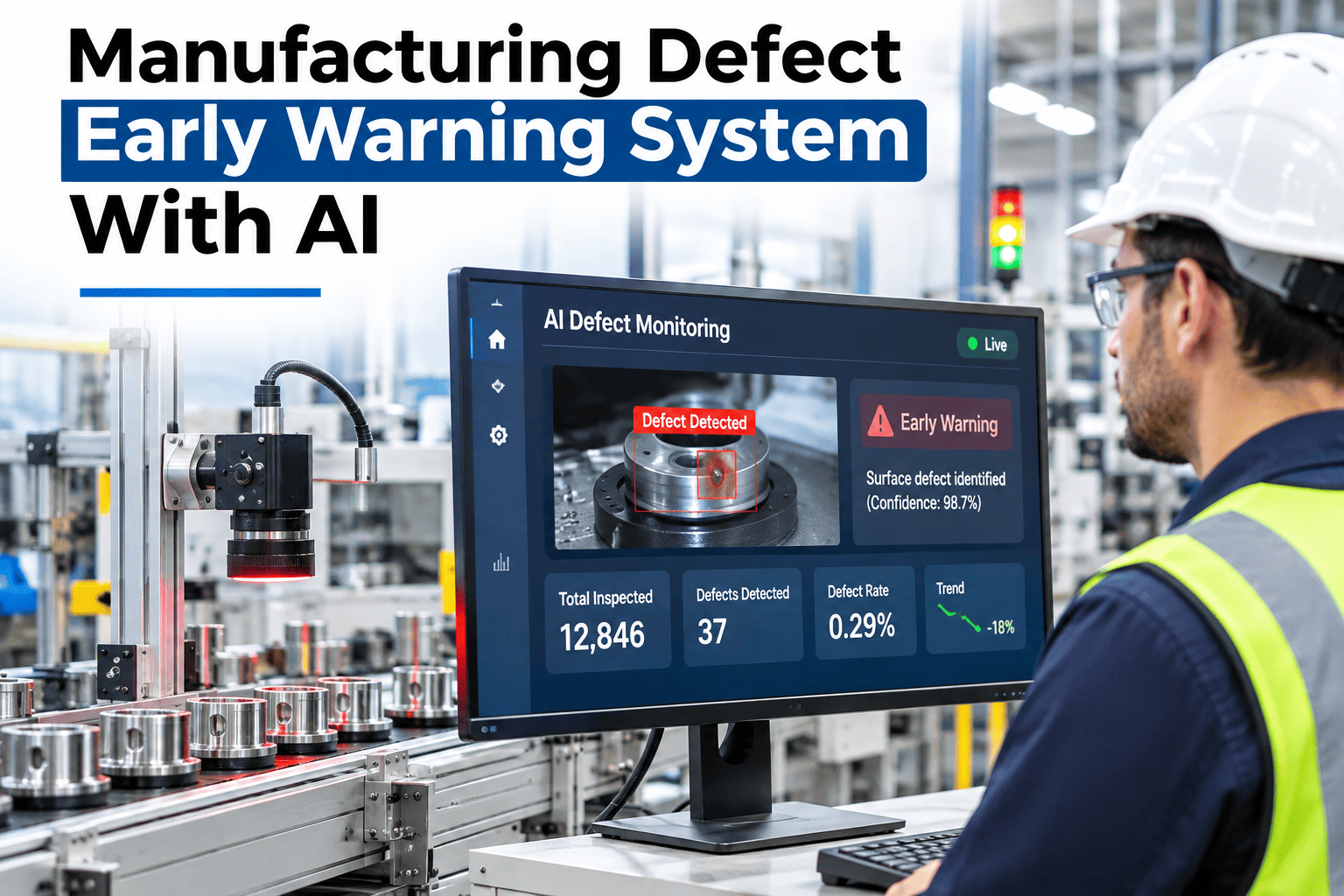
A manufacturing defect early warning system uses AI to spot process drift and rising defect risk while a batch is still running, so teams can correct the cause before large quantities need scrap, rework or containment. The gain comes from lead time: a warning ten minutes before a defect forms is worth far more than a perfect report an hour after. The American Society for Quality (ASQ) puts quality costs at 15 to 20 percent of sales for many manufacturers, and most of that cost grows with every unit made after the drift begins. iFactory, an on-premise AI platform for smart manufacturing, watches process signals for exactly this pattern, and teams can watch a drift warning fire on a replay of their own line data in a short session.
Predictive Quality · Defect Early Warning
Catch the Drift While the Product Is Still Good
iFactory AI flags the slow slide toward a defect so the fix happens before the batch is lost.
Defect limit
In controlEarly warning windowDefects form
Illustrative parameter drift. The middle columns are the window where action is cheap.
The idea
How Does a Defect Early Warning System Work?
It learns what normal looks like for each product and machine, then flags when live signals move away from normal in a pattern that has led to defects before. The alert reaches the operator while the run continues.
Sense
Live process and machine signals
Compare
Against learned normal behavior
Score
Defect risk for this batch
Alert
Operator acts with a suggested cause
The score matters more than any single reading, because defects usually follow combinations of small shifts. To see risk scoring on real signals, ask our specialists how a batch risk score is built.
Why timing matters
How Much Does Earlier Detection Save?
Every unit made after drift starts is at risk, so the loss grows with time. Earlier warning shrinks the quantity that needs containment.
15–20%
of sales go to quality costs at many manufacturers (ASQ, 2026)
60%
is the median plant OEE, with world-class near 85% (TeepTrak, 2026)
10x
visible scrap cost is a common estimate of total failure cost (Fabrico, 2026)
Illustrative bars show relative units exposed, not measured results.
See a Warning Arrive Before the Defect
Bring one known quality incident. iFactory AI will replay it and show when a warning could have fired.
The zones
What Are the Signs of Process Drift?
Drift is a steady move away from target that stays inside limits at first. It is quiet, which is why people miss it.
Green: in control
Signals sit near target with normal noise.
Amber: drifting
Trend, rising variation or two parameters moving together.
Red: defect risk
Pattern matches past defect events. Act now.
Common drift sources include heating or cooling lag, tool wear, material lot changes and sensor offset. To map these for your process, review likely drift sources with our team.
Signal types
Which Signals Give the Earliest Warning?
| Signal | What Changes First | Typical Lead Time | Defects It Often Precedes |
|---|
| Temperature profile | Slow offset or lag | Minutes to hours | Bonding, warping, incomplete cure |
| Vibration and sound | Rising amplitude or new frequency | Hours to days | Surface marks, dimension error |
| Motor current and torque | Higher load for the same output | Hours | Fill errors, tool wear defects |
| Vision statistics | Subtle rise in minor flaws | Minutes | Visible defects at larger scale |
Lead times vary by process. Treat the ranges as starting points, then measure your own.
Trust
How Do You Balance Missed Defects and False Alarms?
Every warning system trades sensitivity against noise. Set it too tight and operators ignore it. Set it too loose and defects slip through.
Too sensitive
Many false alarms
Alerts get ignored
Tuned by review
Thresholds set per product
Alerts trusted and acted on
Too loose
Defects appear first
Warning adds little
Weekly review of each alert, marked useful or not, steadily improves the balance. For a tuning plan, talk with support about threshold review routines.
From alert to action
What Should Happen After a Warning Fires?
1
Operator sees the alert with the likely cause and the parameter involved.
2
A quick check confirms the cause, such as a heater zone or a worn guide.
3
The adjustment is made and the signal is watched until it returns to normal.
4
Units made during the warning window are flagged for a targeted check, not a full hold.
5
The outcome is logged, so the model learns whether the warning was right.
Targeted containment is the quiet saving here: only the units made inside the window are checked, not the whole batch. iFactory is delivered on an on-premise NVIDIA server, live in 6–12 weeks, with training and 24×7 remote monitoring.
PitfallsWhat Mistakes Reduce the Value of Early Warning?
A good model can still disappoint if the surrounding habits are weak. Five mistakes are common.
Training on poorly timed defect labels
Record when each defect formed, not only when it was found, or the model learns the wrong lead time.
Alerts with no owner
Assign each alert tier to a named role with a target response time.
One threshold for every product
Tune limits per product and recipe, since normal behavior differs between them.
No feedback on alerts
Mark each alert useful or not, so thresholds and models keep improving.
Removing inspection too soon
Keep checks in place until the warning record proves itself over many runs.
These habits cost little and protect the whole program. To plan them for your line, ask support about an alert ownership plan.
Key termsWhich Terms Matter for Early Warning?
Six terms describe how warnings work and how they are judged.
Process drift
A gradual move of a parameter away from its target.
Lead time
The gap between a warning and the defect it predicts.
False alarm
A warning that was followed by no defect.
Defect risk score
A number estimating the chance of defects in the current run.
Containment
Limiting the product that needs checking after a problem.
Multivariate monitoring
Watching several signals together instead of one at a time.
To see these terms on a live example, review a defect risk score with our specialists.
Expert review
Using Early Warning Responsibly
Holds up
Multivariate drift detection is well established, and earlier action limits the quantity at risk.
Verify
That past defects are labeled with accurate times, since the model learns from them.
Avoid
Switching off inspection too early. Warnings reduce defects but do not replace checks.
Questions
Frequently Asked Questions
What is a defect early warning system?
It is software that compares live process signals with learned normal behavior and flags defect risk before defects appear. Teams can then adjust the process while product is still good.
See a warning on replayed line data.
How much history does the AI need?
A few weeks of signals plus accurately timed defect records is a common starting point, though rare defects need longer. More labeled events improve warnings over time.
Ask whether your history is enough.
Will it flood operators with false alarms?
Not if thresholds are tuned per product and reviewed weekly. Alerts are tiered so that only real risk interrupts work.
Plan alert tuning for your line in a short call.
Does it replace end-of-line inspection?
No. It reduces how many defects form, while inspection still confirms what leaves the plant. Together they give earlier prevention and reliable detection.
Discuss how both fit your quality plan.
Act Earlier, Contain Less, Scrap Less
Book a session to see iFactory AI score defect risk on your own process signals.