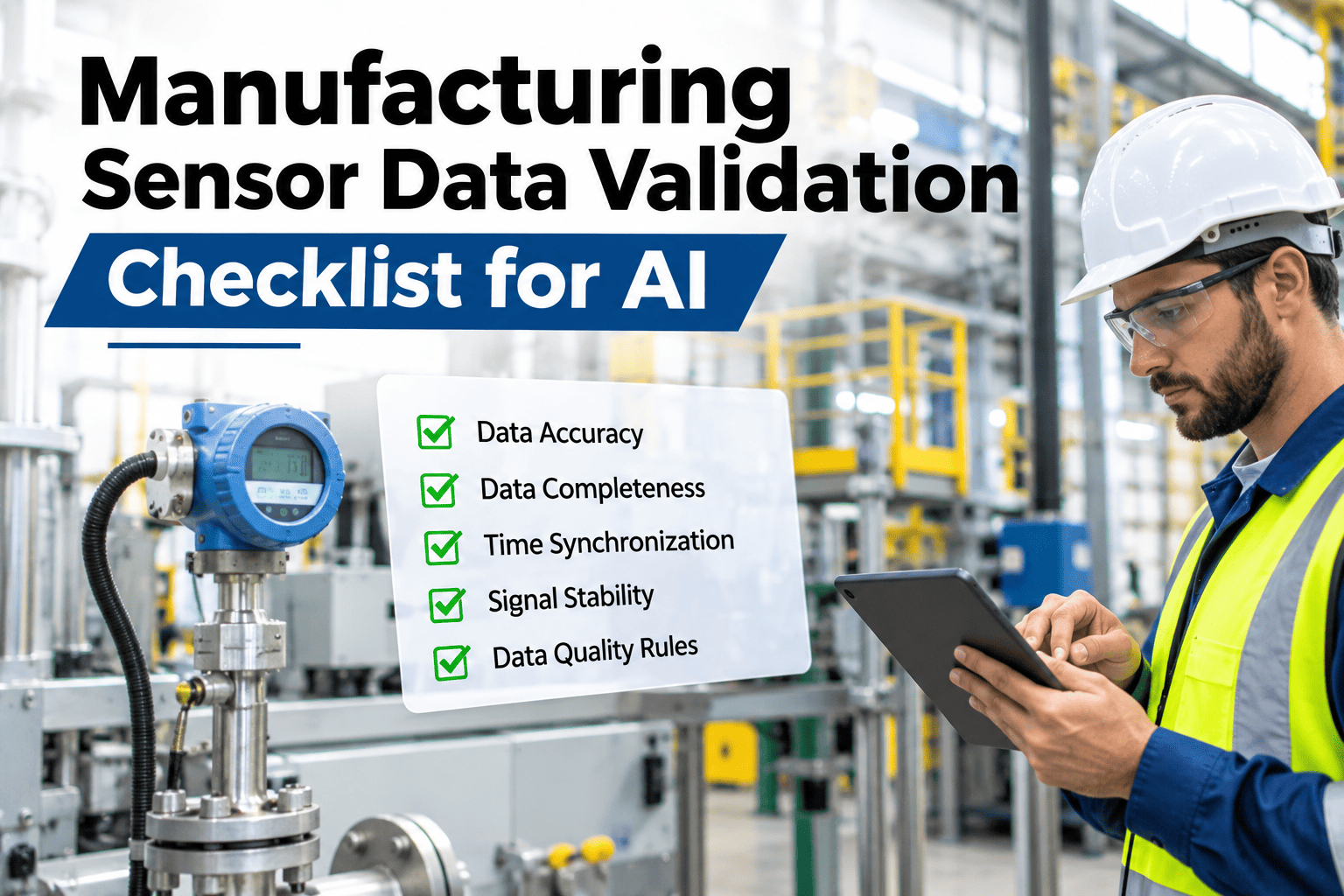
Before a single model gets trained, sensor data needs to pass its own inspection — coverage, sampling rate, timestamps, units, missing data, outliers, calibration, and asset relationships all need to check out, because any AI project built on top of ungoverned sensor data inherits every one of those problems. iFactory, an on-premise AI platform built around data validation, runs this check before model development begins. Teams preparing their own sensor data for an AI project can discuss their plant data and use case with our team.
Sensor Data Validation Checklist · Industrial AI, 2026
Eight Checks Before Any Sensor Data Is Ready to Train a Model
iFactory AI validates coverage, sampling rate, timestamps, units, missing data, outliers, calibration, and asset relationships before model development starts.
Sensor coverage matches what the use case actually needs
Sampling rate is fast enough for the fault or event being detected
Timestamps are synchronized across every connected system
Units are consistent and documented for every tag
Missing data is identified and its pattern understood
Outliers are flagged and investigated, not silently dropped
Calibration status is known for every sensor in scope
Every reading is linked to the correct asset and context
Coverage and sampling rate
Does the Data Even Have What the Model Needs to See?
A model trying to detect a fault that develops over milliseconds can't be trained on data sampled once a minute — the signal simply isn't in the data at that resolution, no matter how good the model is. Coverage and sampling rate are the first checks precisely because no amount of downstream data cleaning can fix a gap this fundamental.
Timestamps, units, and missing data
Three Checks That Quietly Corrupt a Dataset
| Check | What goes wrong if skipped |
|---|
| Timestamp synchronization | Clock drift between systems misaligns cause and effect in the training data |
| Unit consistency | A mix of Celsius and Fahrenheit, or metric and imperial, silently corrupts any model trained across both |
| Missing data pattern | Treating a sensor outage the same as a genuine zero reading teaches a model the wrong thing |
Outliers and calibration
Not Every Outlier Is Noise, and Not Every Sensor Reads True
Real anomaly
A genuine process event the model should actually learn to detect.
Sensor fault
A spike or dropout caused by the sensor itself, which should be flagged, not learned as a pattern.
Calibration drift
A sensor reading consistently off by a small, growing margin until it's recalibrated.
See What Your Current Sensor Data Would Pass or Fail
Share a sample of your sensor data, and iFactory AI will walk through this checklist against it before you invest in model development.
Asset relationships
The Last Check Is Often the One That Makes the Data Useful at All
A perfectly clean temperature reading is only useful once it's clearly linked to which machine, which component, and which production context produced it. Without that asset relationship, even flawless data can only answer generic questions — the specific, actionable insight a plant actually wants comes from knowing exactly which asset a reading belongs to.
Running the validation
Four Steps to Validate a Dataset Before Model Development
1
Inventory the sensors
List every sensor in scope with its type, location, and sampling rate.
2
Run the eight checks
Validate coverage, timestamps, units, missing data, outliers, and calibration systematically.
3
Document the gaps
Any failed check becomes a known limitation, not a silent assumption the model inherits.
4
Decide: fix, flag, or scope out
Each gap gets a deliberate decision rather than being ignored until the model underperforms.
Expert review
What a Data Engineer Checks First
Sensor validation earns its place when every gap is documented as a known limitation rather than silently inherited by whatever model gets built on top of it.
Verdict
Strong when outliers are investigated individually rather than dropped automatically as noise.
Watch for
Unit inconsistency across sensors from different vendors or installation eras — an easy check to skip and a costly one to discover late.
Do next
Run this eight-point checklist against the dataset for your next planned AI project before any model development work begins.
Frequently asked questions
What Teams Ask About Sensor Data Validation
How do we know if our sampling rate is fast enough for a given use case?
The sampling rate needs to be faster than the timescale of the fault or event being detected — a slow-developing wear trend needs far less frequent sampling than a fast electrical fault, so the right rate depends on what you're trying to catch.
Discuss sampling rate requirements for your use case.
What's the difference between a real anomaly and a sensor fault?
A real anomaly reflects an actual process or mechanical event; a sensor fault is a spike or dropout caused by the measuring device itself — distinguishing them usually requires cross-checking against adjacent sensors or known process conditions.
Ask support how to distinguish these in your data.
How often should sensor calibration status be checked?
This depends on the sensor type and its calibration schedule, but the validation check itself is about knowing the current calibration status for every sensor in scope before trusting its readings for model training.
Discuss calibration tracking for your sensors.
Can missing data be filled in rather than flagged?
It can, depending on the pattern and the use case, but the validation step is about understanding why the data is missing first — a sensor outage and a genuine zero reading need different handling, and conflating them teaches a model the wrong lesson.
Ask support about handling missing data correctly.
Does this checklist apply to historical data as well as new sensor feeds?
Yes — historical data intended for model training should go through the same validation, since old data often has more undocumented quirks, unit changes, or sensor replacements than people assume.
Talk through validating your historical dataset.
Validate before you train, not after you fail
Run Your Sensor Data Through This Checklist First
Book a session with iFactory AI to validate your sensor data before your next AI project begins.