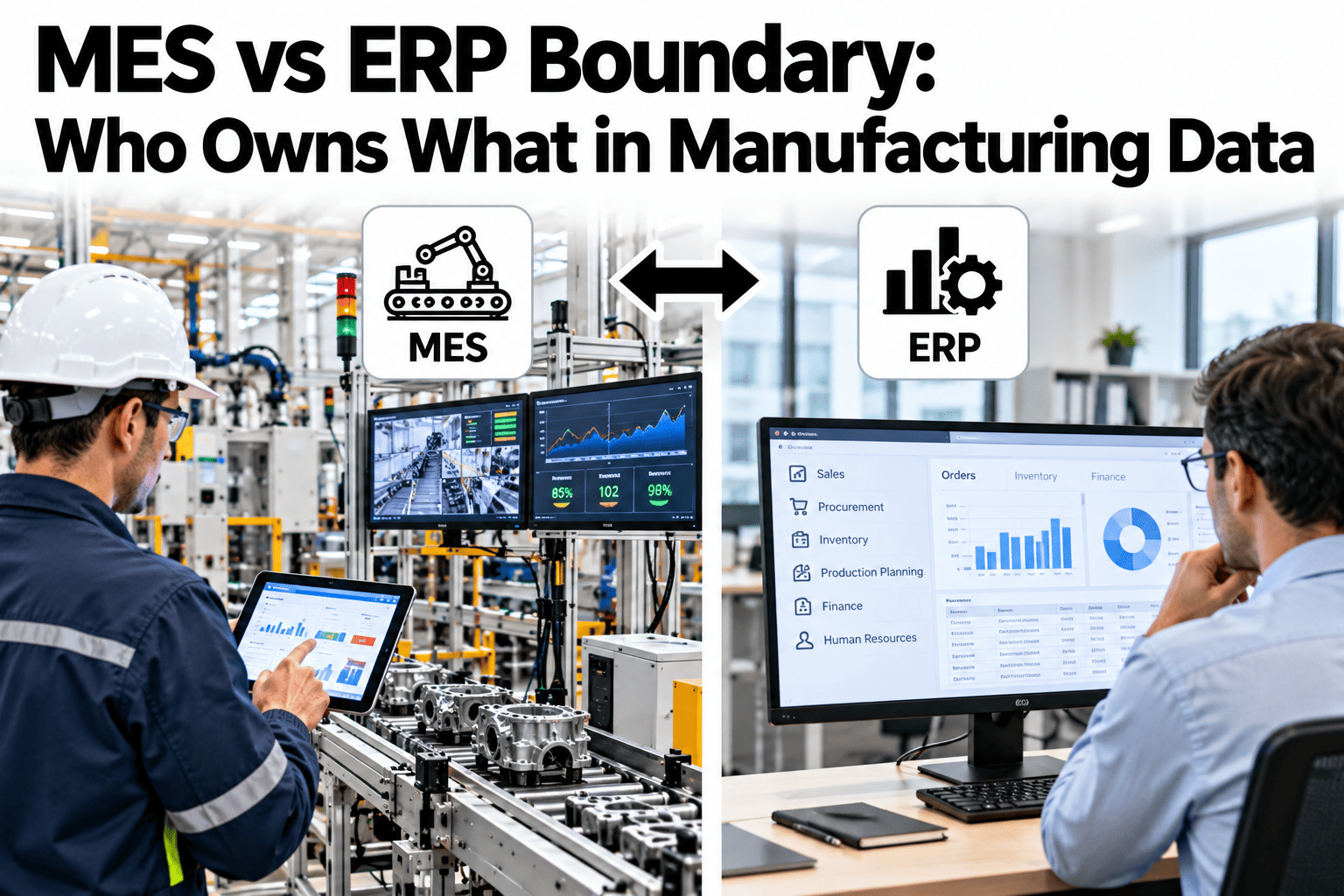
Ask an MES vendor and an ERP vendor who owns the production order and both will have a confident answer, and the two answers will not match. Without a boundary drawn once and enforced everywhere after, a plant ends up maintaining two versions of the same truth: a production order that exists in both systems, updated independently, drifting apart the moment someone edits one without the other. The ISA-95 integration levels give a reasonable starting framework, but the real work is translating that framework into a specific decision for a specific plant about which system is the system of record for which data, and making sure every integration respects that decision rather than quietly duplicating entry. Manufacturing IT managers untangling this overlap can see a clean MES-ERP boundary mapped against their own systems before the next data discrepancy gets escalated.
MES vs ERP Boundary: Who Owns What in Manufacturing Data
A boundary drawn once and enforced everywhere, so the plant stops maintaining two versions of the same truth.
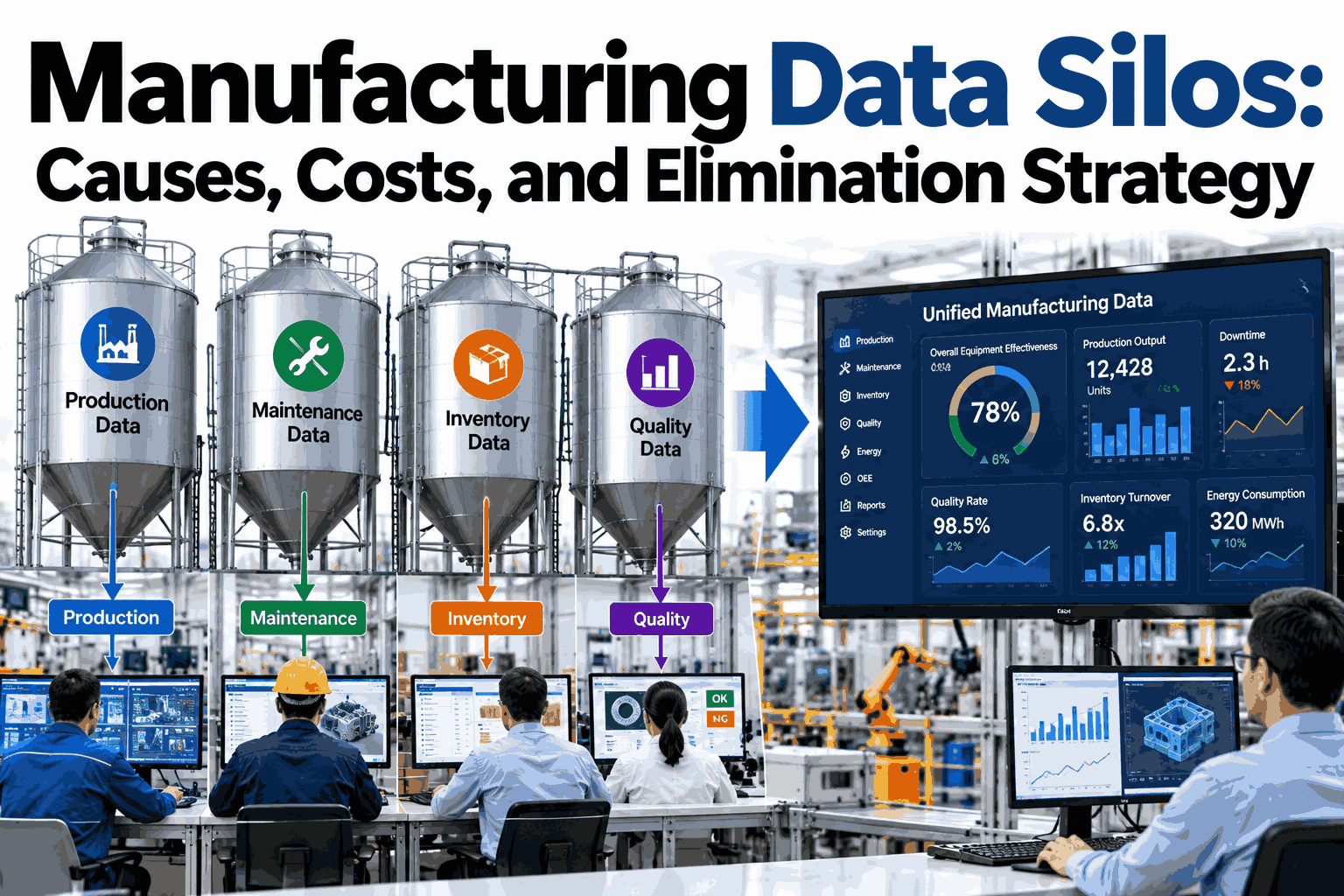
Why Two Versions of Truth Keep Happening
Without an enforced boundary, the same data ends up maintained in two places that drift apart.
Operators or planners enter the same information into both systems, independently.
An edit in one system without a matching update in the other creates a growing discrepancy.
When the two systems disagree, nobody has a clear answer for which one is correct.
A boundary drawn once, with integration enforcing it, is what stops this drift from recurring.
A Practical Starting Boundary
Based on ISA-95 integration levels, this split works as a reasonable default for most plants.
| Data Category | System of Record | Why |
|---|---|---|
| Production order creation | ERP | Tied to business planning and financial scheduling |
| Work order execution status | MES | Real-time, floor-level data the ERP update cycle cannot match |
| Material consumption | MES, reported to ERP | Captured at the point of use, reconciled against ERP inventory |
| Finished goods inventory | ERP | Tied to financial and fulfillment processes |
Map This Boundary Against Your Own MES and ERP
Book a 30-minute session and bring your current systems. iFactory AI will help draw a clear boundary and identify where duplication is happening.
What iFactory AI Supports
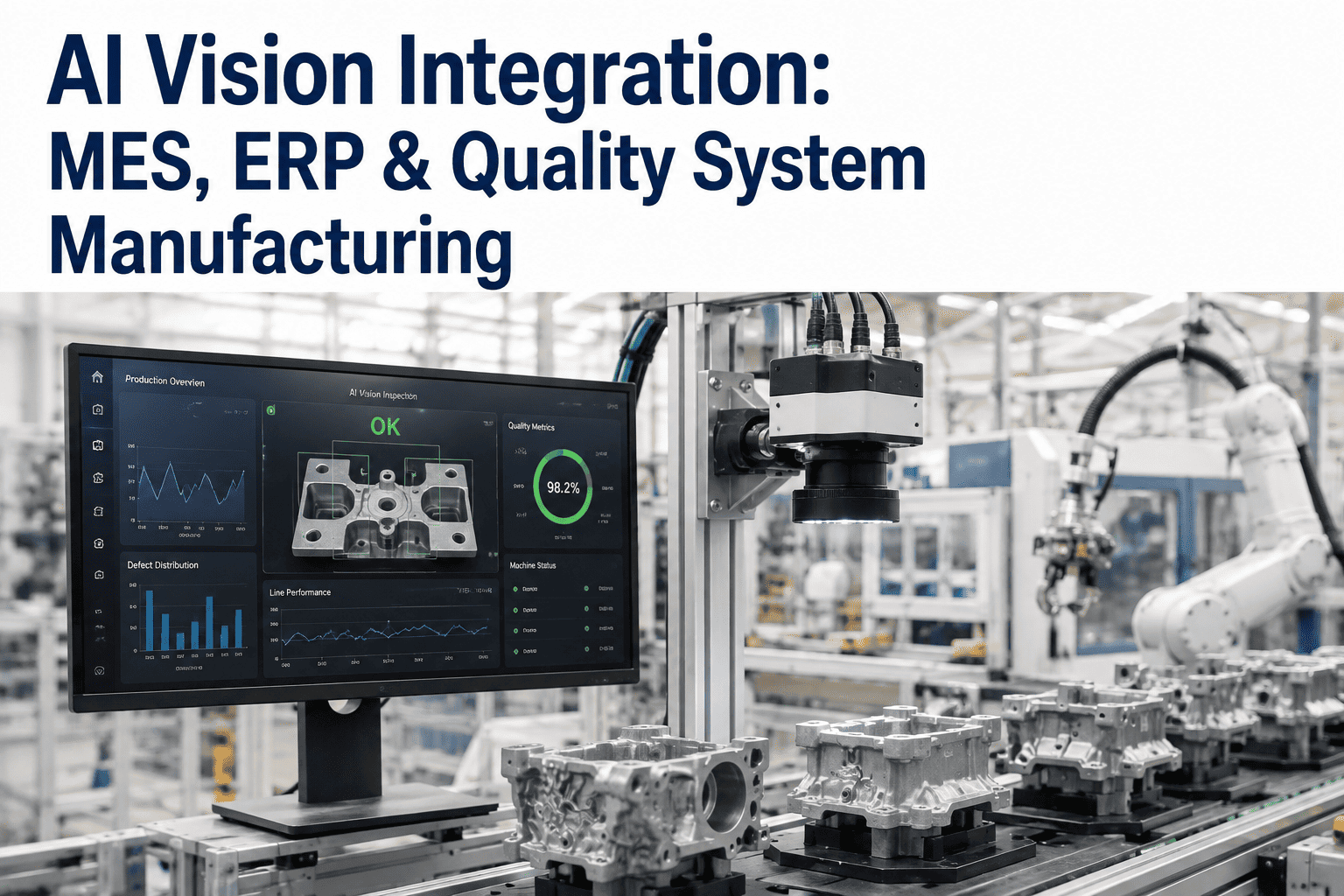
The platform integrates with both systems while respecting a defined boundary, rather than duplicating data entry.
ISA-95 Aligned Integration
Data flows between MES and ERP follow the integration levels, not ad hoc connections.
Single System of Record Per Category
Each data category has one enforced owner, eliminating duplicate maintenance.
Real-Time Reconciliation
Floor-level execution data reconciles automatically against ERP records.
Discrepancy Alerts
A mismatch between systems is flagged immediately, not discovered weeks later.
iFactory AI maps and enforces a data ownership boundary between existing MES and ERP systems. Scope covers boundary definition, integration build and validation.
Expert Review
Most boundary disputes we see are not actually about whether ISA-95 gives a clear answer; it usually does. The real friction is organizational, between whoever owns the ERP relationship and whoever owns the MES relationship, each defending their system's scope rather than deferring to the framework.
Material consumption is the category that trips up the most plants, since it genuinely needs both systems: captured at the point of use on the floor, reconciled against planning and inventory in the ERP. Getting that specific handoff right resolves a disproportionate share of the drift we see elsewhere.
Frequently Asked Questions
Does this boundary apply the same way to every plant?
The ISA-95 framework provides a reasonable starting default, but the specific boundary should be adjusted for a plant's own systems, processes and how mature its MES deployment already is. Discuss your own plant's specifics in a working session.
What happens to historical data that was duplicated before the boundary was enforced?
Historical discrepancies are typically reconciled during the integration build, with the enforced system of record becoming the accepted source going forward rather than attempting to perfectly resolve every past conflict. Ask support about handling historical discrepancies.
How is a discrepancy actually caught once the boundary is enforced?
Reconciliation checks compare the designated system of record against any secondary reference automatically, flagging a mismatch for review rather than letting it sit undetected. Request a reconciliation example.
Does this work with our specific MES and ERP vendors?
The approach applies to common MES and ERP platform combinations, connecting through their standard integration interfaces rather than requiring either system to be replaced. Contact support about your specific vendor combination.
How long before the boundary is fully enforced across our systems?
Most plants have the boundary defined and integration enforcing it within seven to ten weeks, depending on how many data categories need reconciliation and how many existing integrations need to be reworked. Book a session to estimate your own timeline.
Draw the Boundary Once, Stop Maintaining Two Versions of Truth
iFactory AI enforces a clear MES-ERP data ownership boundary across your systems. Book a walkthrough on your own setup.