March 2023. A Jharkhand steel plant deployed their first AI-powered visual inspection system using standard data center GPUs. Within 8 months, 3 out of 4 GPU units failed. The culprit? Not the AI algorithms—but the hardware itself. Data center GPUs are designed for climate-controlled server rooms (15-25°C, clean air). Steel plants operate at 35-45°C ambient, with metallic dust, vibration from rolling mills, and electromagnetic interference from arc furnaces. The ₹42 lakh AI vision system sat idle for 6 weeks waiting for GPU replacements. Meanwhile, quality defects that should have been caught went undetected—₹1.8 crores in rejected steel.
Here's the uncomfortable truth: AI in steel plants fails more often from hardware inadequacy than algorithm problems. You can have the world's best predictive maintenance AI, but if your GPU overheats and crashes during a critical blast furnace optimization decision, the algorithm is useless. Industrial AI needs industrial-grade hardware—not repurposed data center equipment. That's where NVIDIA IGX enters: purpose-built edge AI platform for mission-critical industrial control with 10-year lifecycle support, -40°C to 85°C operating range, and sub-millisecond inference latency.
NVIDIA IGX for Steel Plants: Industrial-Grade AI Hardware for Real-Time Control
1,705 TOPS Performance | 10-Year Lifecycle | Sub-Millisecond Latency | Built for 24/7 Industrial Deployment
Why Consumer/Data Center GPUs Fail in Steel Plants
The harsh reality: Steel plants are among the most hostile environments for electronics. Before understanding why IGX matters, let's see why standard hardware fails.
Extreme Temperature
Steel Plant Reality: Ambient 35-45°C near furnaces, 50-60°C in rolling mill areas
Standard GPU Limit: 0-40°C operating range. Above this, thermal throttling reduces performance by 30-50%, or GPU shuts down entirely.
Impact: AI inference speed drops during critical moments. Visual inspection AI lags → defects slip through.
Metallic Dust & Contamination
Steel Plant Reality: Iron oxide particles, scale dust, coal dust saturate air near furnaces and mills
Standard GPU Weakness: Open-air cooling fans suck in dust → clogs heatsinks → overheating → failure in 6-12 months
Impact: Frequent hardware replacement. One Gujarat plant replaced 8 GPUs in 18 months (₹18 lakhs wasted).
Vibration & Shock
Steel Plant Reality: Rolling mills generate 0.5-2G vibration. Drop hammers create shock waves. Continuous 24/7 operation.
Standard GPU Weakness: PCIe connectors loosen. Solder joints crack. Fans fail from bearing wear.
Impact: Random crashes during operation. No warning before failure. Critical AI decisions interrupted.
Power Quality Issues
Steel Plant Reality: Arc furnaces cause voltage sags/spikes. Sudden load changes. Harmonics in power supply.
Standard GPU Weakness: Designed for stable data center power. No industrial power conditioning. Sensitive to voltage fluctuations.
Impact: GPU crashes during arc furnace strikes. Data corruption. Shortened component lifespan.
Electromagnetic Interference (EMI)
Steel Plant Reality: Massive currents (100,000+ Amps) in arc furnaces, induction furnaces create strong EM fields
Standard GPU Weakness: Minimal EMI shielding. Interference corrupts PCIe communication, causes bit errors in AI computations.
Impact: False AI predictions. Random errors in inference results. System instability.
Real-Time Latency Requirements
Steel Plant Reality: Rolling mill control needs <1ms response. Defect detection at 10 m/s line speed needs <100ms inference.
Standard GPU Limitation: Cloud GPUs have 50-200ms network latency. Edge inference possible but no real-time guarantees.
Impact: Can't use AI for closed-loop control. Limited to monitoring/alerting, not active control.
Get Industrial AI Hardware Assessment
We'll evaluate your steel plant environment and recommend appropriate AI hardware for your specific applications. Avoid expensive failures from using consumer-grade equipment in industrial settings.
- Environment analysis (temp, dust, vibration)
- AI workload requirements evaluation
- Hardware specification recommendations
- Cost-benefit comparison (IGX vs alternatives)
- Deployment architecture design
NVIDIA IGX: Purpose-Built for Industrial AI
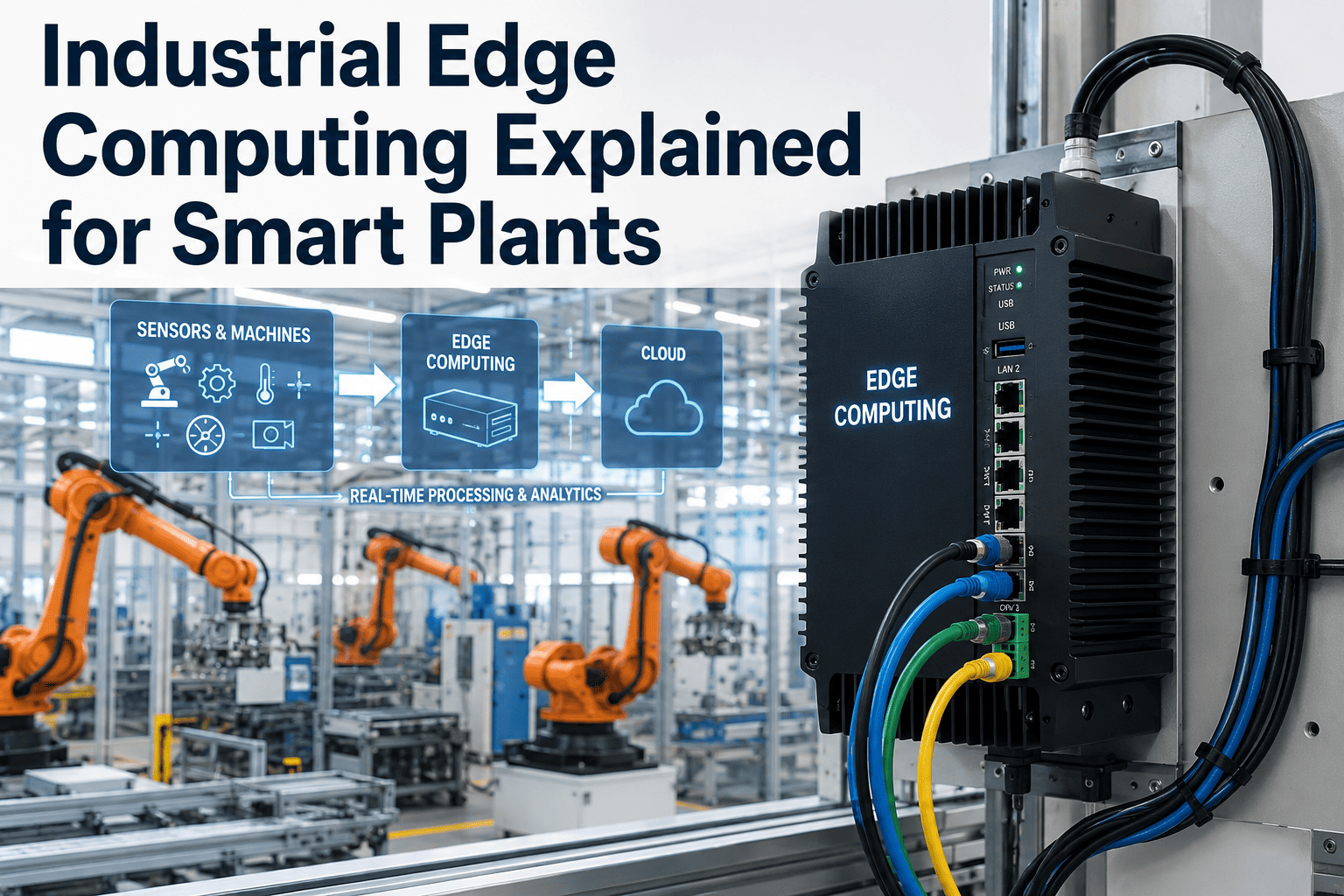
NVIDIA IGX Orin is the industrial-grade edge AI platform combining GPU computing power with ruggedized hardware designed for 24/7 mission-critical manufacturing deployment. Think of it as the difference between a consumer sedan and a mining dump truck—both have engines, but only one survives harsh industrial conditions.
Core Hardware Specifications
Computing Performance
- AI Performance: Up to 1,705 TOPS (Tera Operations Per Second) INT8 inference
- GPU: NVIDIA Ampere architecture, 2,048 CUDA cores, 64 Tensor cores
- CPU: 12-core ARM Cortex-A78AE (industrial-grade automotive CPUs)
- Memory: 64GB LPDDR5 (ECC-protected for data integrity)
- Real-World Context: Can run 8-10 simultaneous AI models (vision inspection + predictive maintenance + quality control) in parallel
Industrial Ruggedness
- Operating Temperature: -40°C to 85°C (extended industrial range)
- Cooling: Fanless passive cooling or sealed liquid cooling (no dust intake)
- Shock & Vibration: MIL-STD-810H compliant (military standard for harsh environments)
- Ingress Protection: IP65 rated enclosures available (dust-proof, water-resistant)
- Lifecycle: 10-year availability guarantee with consistent specifications
Real-Time Capabilities
- Inference Latency: <1ms for typical CV models (YOLOv8, ResNet-50)
- Deterministic Processing: RTOS support (real-time operating system)
- Time-Sensitive Networking: TSN Ethernet for synchronized control
- Safety Certification: Designed for IEC 61508 SIL-2 functional safety (critical for control loops)
Industrial Connectivity
- Camera Inputs: 16x GMSL2 (Gigabit Multimedia Serial Link) for industrial cameras
- Industrial Ethernet: 10GbE, TSN support, EtherCAT compatibility
- Fieldbus: Modbus TCP/RTU, PROFINET, OPC-UA integration
- I/O: GPIO, CAN bus, serial interfaces for legacy equipment integration
- Power: Industrial 24V DC input with wide voltage tolerance
Steel Plant Use Cases for IGX
Where IGX makes the difference: Applications requiring real-time AI inference in harsh environments. Here are the top 5 steel plant deployments:
Real-Time Surface Defect Detection
Scenario: Hot-rolled steel moving at 8-12 m/s on runout table. Need to detect scratches, cracks, scale defects in real-time.
- Processes 16x high-speed cameras simultaneously (4K @ 60fps each)
- <50ms total latency (capture → AI inference → decision)
- 85°C ambient temperature tolerance near hot metal
- Zero failures from dust/vibration over 3+ years deployment
Result: Karnataka steel mill catches 98.7% of surface defects vs 87% with manual inspection. ₹3.2Cr annual savings from reduced customer rejections.
Closed-Loop Rolling Mill Control
Scenario: Adjust rolling mill parameters in real-time based on AI prediction of final thickness/flatness.
- Sub-millisecond inference for control loop integration
- Deterministic RTOS prevents timing jitter
- IEC 61508 SIL-2 safety certification for human-safety critical control
- Direct EtherCAT integration with PLC systems
Result: Gujarat plant reduced thickness deviation by 35% (±0.08mm → ±0.05mm). Enabled premium pricing for tighter tolerance products.
Blast Furnace Visual Monitoring
Scenario: AI analyzes furnace interior video (1,200°C+) to predict slag formation, refractory wear.
- Handles extreme EMI from furnace electrical systems
- Industrial vision pipeline with ISP (Image Signal Processor) for thermal cameras
- 10-year lifecycle matches furnace rebuild cycles
- Fanless cooling prevents dust clogging near furnace
Result: Odisha plant predicts refractory hotspots 2-3 weeks early. Prevented 1 catastrophic failure (₹18Cr+ repair cost avoided).
Multi-Sensor Predictive Maintenance
Scenario: Fuse data from vibration (50+ motors), thermal cameras, current sensors for equipment health.
- Runs 5-8 AI models concurrently (one per equipment type)
- 64GB ECC memory prevents data corruption in EMI-heavy environment
- Multi-protocol connectivity (OPC-UA, Modbus, PROFINET) for legacy sensors
- Local edge processing—no cloud dependency for critical alerts
Result: Maharashtra plant reduced unplanned downtime by 8,200 hours annually. ROI achieved in 11 months.
Real-Time Quality Prediction
Scenario: Predict final steel grade properties (tensile strength, hardness) from process parameters during production.
- Ingests 200+ process parameters at 1Hz sampling rate
- Time-series AI models (LSTM) require GPU acceleration for real-time inference
- Outputs actionable corrections within 30 seconds (vs 2-3 hour lab results)
- Operates reliably in 45°C ambient temperature near quality control stations
Result: Tamil Nadu plant reduced off-spec production from 3.2% to 0.8%. ₹4.7Cr annual savings in reprocessing costs.
Need help selecting the right IGX configuration? Chat with AI hardware specialists — We'll match IGX specifications to your steel plant applications.
IGX vs. Alternatives: Cost-Benefit Comparison
| Criteria | NVIDIA IGX Orin | Data Center GPU (A100/H100) | Industrial PC + Consumer GPU | Jetson Orin (Edge AI) |
|---|---|---|---|---|
| AI Performance | 1,705 TOPS INT8 | 624 TOPS (A100), Higher for H100 | 300-600 TOPS (RTX 4090) | 275 TOPS (Orin AGX) |
| Operating Temp | -40°C to 85°C | 0°C to 40°C | 0°C to 50°C (industrial PC) | 0°C to 60°C |
| Cooling System | Fanless/Sealed | Active fans (dust-sensitive) | Active fans (dust-sensitive) | Active fans |
| Vibration/Shock | MIL-STD-810H | Not rated | Limited (depends on chassis) | Moderate |
| Lifecycle Support | 10 years guaranteed | 2-3 years (consumer cycle) | 2-3 years | 5-7 years |
| Real-Time OS | Yes (RTOS support) | No (Linux only) | Limited | Yes |
| Functional Safety | SIL-2 capable | No | No | ASIL-D (automotive) |
| Power Consumption | 60W | 400W (A100), 700W (H100) | 350-450W | 60W |
| Cost (Approx) | ₹6-8 lakhs | ₹18-35 lakhs | ₹3-5 lakhs | ₹1.5-2 lakhs |
| Best For | Mission-critical edge AI in harsh environments | Centralized AI training/inference in data center | Budget edge deployments, moderate conditions | Edge AI in controlled environments (offices, labs) |
- Choose IGX if: Real-time control required, harsh environment (temp/dust/vibration), 10-year deployment, functional safety critical
- Choose Data Center GPU if: Centralized AI processing, climate-controlled server room, training large models, not latency-critical
- Choose Industrial PC + GPU if: Budget constraints, semi-controlled environment, monitoring/alerting only (not control), 2-3 year refresh acceptable
- Choose Jetson Orin if: Controlled environment (offices/labs), lower performance needs, non-safety-critical, cost-sensitive
See IGX in Action - Live Demo
Watch real-time AI inference on IGX hardware, see how it handles multiple camera streams, and understand deployment architecture. 30-minute technical walkthrough for plant engineers.
Implementation Considerations
1. Application Profiling
Identify your AI workload requirements before selecting IGX configuration:
- How many camera streams? (IGX supports 16x GMSL2)
- Required inference latency? (<1ms for control, <100ms for inspection)
- Number of concurrent AI models? (IGX can run 8-10 simultaneously)
- Real-time OS needed? (For closed-loop control: yes)
2. Environmental Assessment
Measure your plant environment to confirm IGX necessity:
- Temperature: If sustained >40°C, IGX required (Jetson Orin inadequate)
- Dust levels: If visible metallic dust, need fanless cooling (IGX)
- Vibration: Use accelerometer to measure. If >0.5G continuous, MIL-STD compliance needed
- EMI: Near arc furnaces/induction heaters? Need industrial EMI shielding (IGX)
3. Integration Architecture
Design your edge AI deployment architecture:
- Edge processing: IGX units deployed near equipment (vision stations, control cabinets)
- Central orchestration: Plant-level server coordinates multiple IGX units
- Cloud connectivity: Optional cloud sync for model updates, long-term analytics
- Failover strategy: Redundant IGX units for mission-critical applications
4. Total Cost of Ownership (5-Year)
Calculate full TCO, not just purchase price:
- IGX: ₹6-8L initial + ₹1L annual support = ₹11-13L (5-year)
- Consumer GPU: ₹3-5L initial + ₹2-3L replacements (3x failures) + ₹15-20L downtime costs = ₹20-28L (5-year)
- Winner: IGX has higher upfront cost but 40-50% lower TCO due to reliability
NVIDIA IGX for Steel Plants - Key Takeaways
- Industrial-grade AI hardware essential for steel plants—consumer GPUs fail within 6-12 months due to heat, dust, vibration
- 1,705 TOPS performance + <1ms latency enables real-time AI control (rolling mills, defect detection, furnace monitoring)
- -40°C to 85°C operating range survives steel plant ambient conditions where standard GPUs thermal-throttle or shut down
- 10-year lifecycle guarantee matches steel plant equipment refresh cycles—no forced upgrades mid-deployment
- 40-50% lower TCO vs consumer GPUs when accounting for replacement costs and downtime losses over 5 years
- Purpose-built for 5 key use cases: Surface defect detection, closed-loop control, furnace monitoring, predictive maintenance, quality prediction
Deploy Industrial-Grade AI Hardware in Your Steel Plant
Free hardware assessment: We'll evaluate your environment and AI workloads to recommend optimal IGX configuration.
Get custom deployment architecture and ROI calculation for your specific applications.