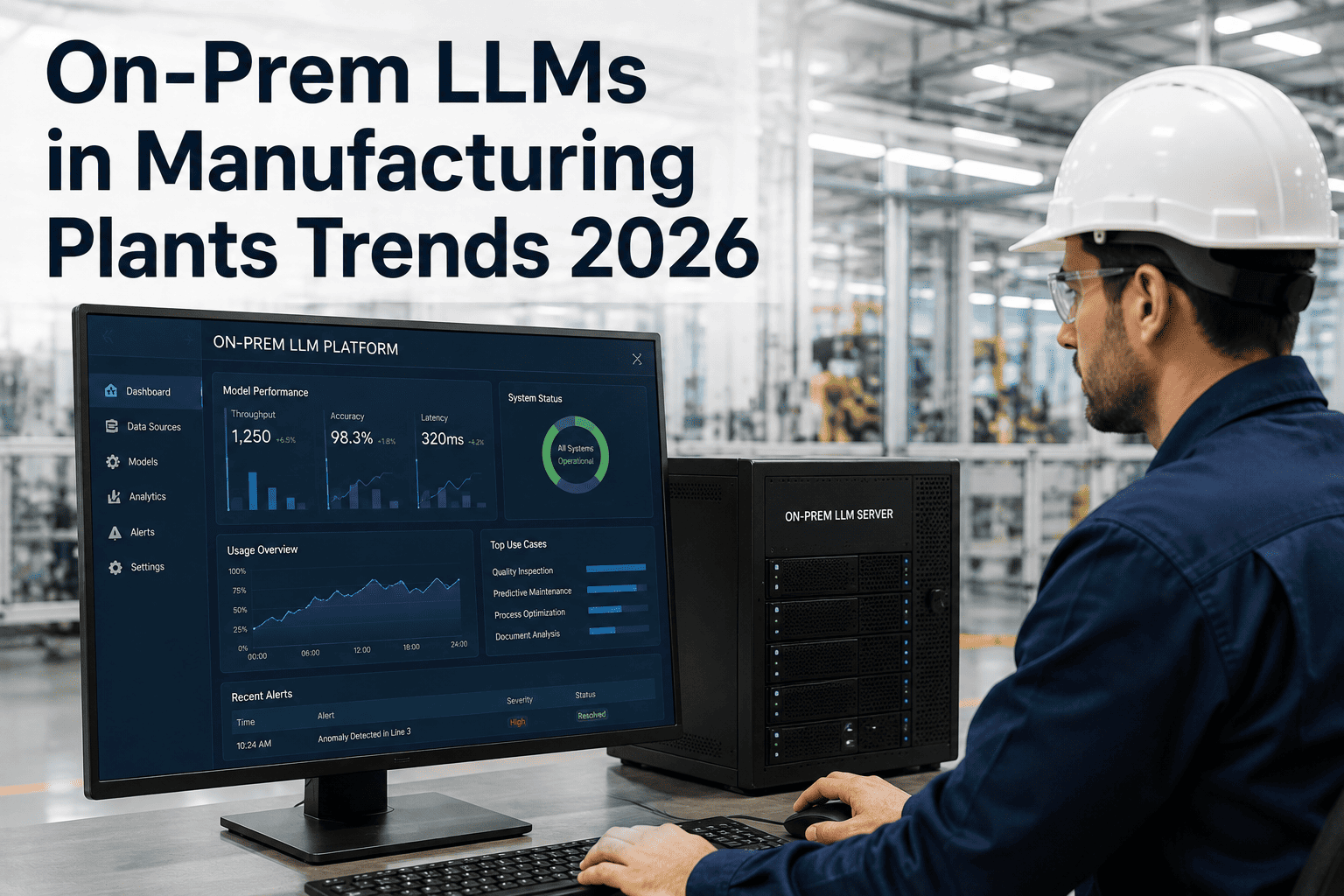
Every plant CIO now has the same conversation on their calendar at least once a quarter: someone in engineering wants to connect a generative AI assistant to process recipes, SPC data, or PLC configuration files, and legal wants to know exactly where that data goes before anyone says yes. That single question, not model capability, has become the real bottleneck standing between manufacturers and useful AI on the plant floor, and it is why on-premise language models have moved from a niche security preference to the default architecture in 2026. The teams already working through this shift with ifactory support are finding the hardware and deployment barriers are far lower than they expected.
Sovereign Language AI Is Now the Default, Not the Exception
A sourced look at why on-premise LLM inference overtook cloud APIs on the plant floor, what changed to make it affordable, and what leaders should plan for next.
The Number That Explains the Shift
Enterprise AI inference performed on-premises or at the edge has climbed to roughly 55 percent, up from just 12 percent three years ago, a 4.6x increase that industry analysts did not expect to happen this quickly. Manufacturing has been one of the sharpest movers within that broader trend, for a reason that is specific to the sector, the data an LLM would need to be useful on a plant floor, process recipes, SPC datasets, PLC configurations, MES production records, and maintenance history, is exactly the data most legal and security teams are least willing to send to a third-party cloud endpoint.
This is not a compliance formality, it is a competitive intelligence question. Process knowledge and equipment-specific calibration history took years to build, and treating it the same as generic corporate email when deciding where it can be sent is a governance gap most manufacturing organizations are now closing deliberately rather than by accident.
Why the Cloud Round Trip Fails the Plant Floor Specifically
| Requirement | Cloud-Hosted LLM | On-Premise LLM |
|---|---|---|
| Process data leaves the facility | Yes, to a third-party endpoint | No, stays inside the facility network |
| Typical response latency | Roughly 1.5 seconds round trip | Under 40 milliseconds locally |
| Cost per million tokens at volume | Premium API pricing, ongoing | Up to 18x cheaper on owned hardware |
| Works during a network outage | No, requires internet connectivity | Yes, fully functional air-gapped |
| Regulatory and IP exposure | Third-party data governance question | Fully auditable on owned infrastructure |
See a Local Plant Copilot Running on Your Own Data
Bring a sample of your maintenance documentation or process recipes. We will show a fully local assistant answering questions against it, with zero data leaving the building.
What a Hybrid Architecture Actually Looks Like
Very few manufacturers are running a single monolithic model for every task. The pattern that has emerged as the practical standard uses a compact local model, typically in the 7B to 13B parameter range, for anything touching sensitive internal data, and reserves external cloud APIs only for complex reasoning tasks that do not involve proprietary process information. This hybrid approach captures most of the cost and latency benefit of local inference while still allowing access to frontier-scale reasoning capability for the narrow set of tasks that genuinely need it.
Sizing the Hardware for a Single-Plant Deployment
The barrier most executives still picture, racks of expensive GPU servers, no longer matches deployment reality for a typical single-plant rollout. Model size, concurrent user count, and whether fine-tuning is required determine the right hardware tier, and most plants land in the smallest tier by a wide margin.
The Regulatory Backdrop Making This Urgent, Not Optional
Data sovereignty on the plant floor is increasingly a legal requirement, not just a best practice. The EU Cyber Resilience Act's operational phase, beginning in September 2026, requires manufacturers to report actively exploited vulnerabilities within 24 hours, and by December 2027 every connected product placed on the EU market must meet full cybersecurity requirements. NIS2 has separately brought manufacturing explicitly into scope as an essential entity category, with incident reporting deadlines and personal liability for management on cybersecurity failures. Any AI deployment sending plant floor data outside the facility now has to be evaluated against this expanding regulatory surface, which is accelerating the shift toward architectures that keep data inside the building by design rather than by policy alone.
Frequently Asked Questions
Deploy a Local AI Assistant That Never Sends Data Outside Your Plant
Bring a sample of your process documentation or maintenance history and we will show a fully local assistant running against it, with a clear picture of the hardware tier your plant actually needs.