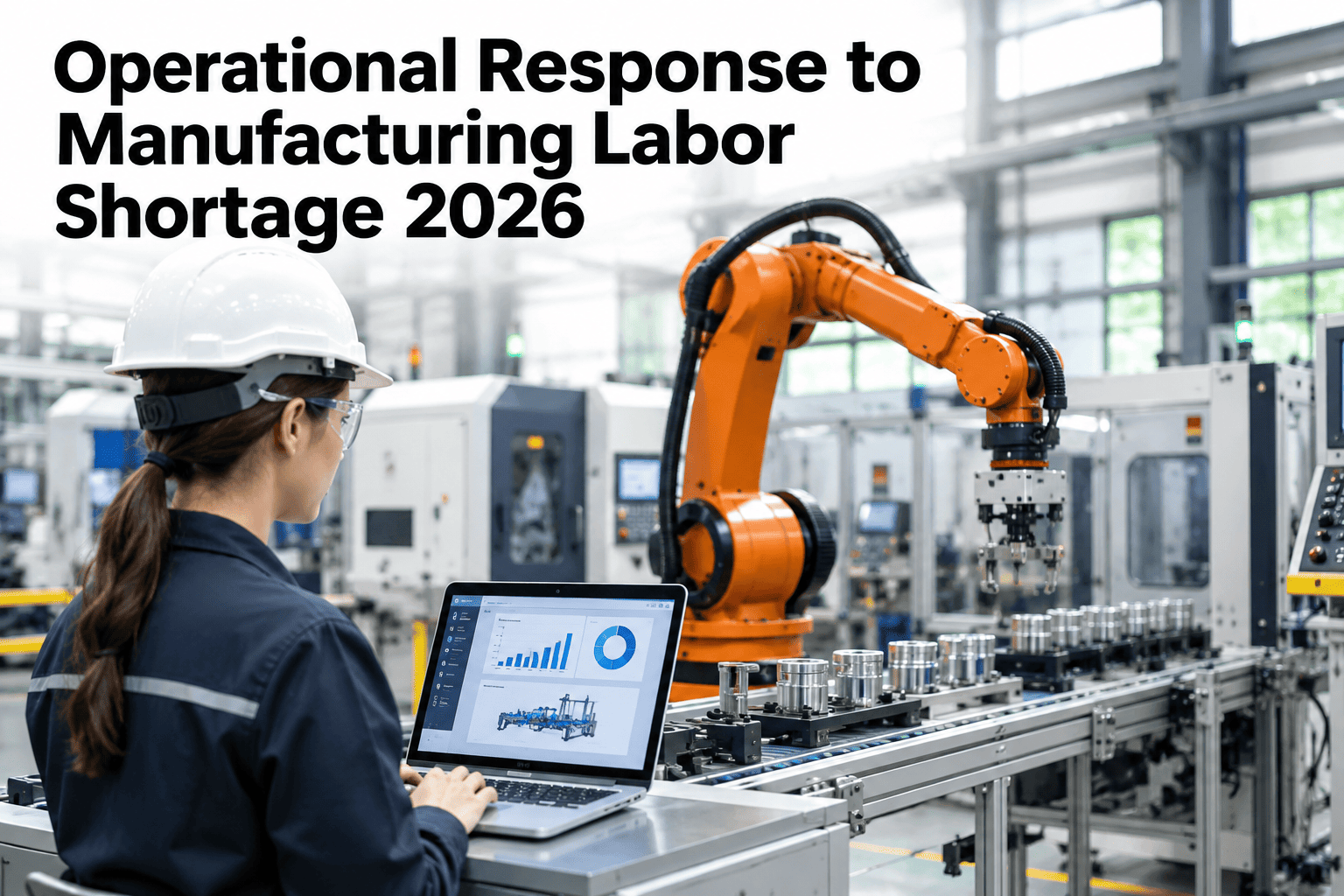
Operational Response to Manufacturing Labor Shortage 2026

By James Smith on November 3, 2026

operational-response-manufacturing-labor-shortage-2026

Hiring harder has stopped working for most plants. U.S. manufacturers reported 522,000 open jobs in August 2026, up from 416,000 a year earlier, and 79% of manufacturing leaders now call the skilled labor shortage their top challenge heading into the new year (Bureau of Labor Statistics JOLTS, 2026; CADDi 2026 Manufacturing Outlook Study). The operational response that actually works is not a bigger recruiting budget — it is task redesign, automation triage and protecting the output you already have. You can map your own labor gap against these three levers on a short call with our team.

Manufacturing Workforce, 2026

Stop Fighting the Labor Market. Redesign the Work Instead.

iFactory, an on-premise AI platform for manufacturing execution (MES) and workforce support, helps plant managers triage which tasks need a trained operator, which need automation, and which can be cross-trained — so output holds even as headcount stays tight.

522K
Open manufacturing jobs, Aug 2026 (BLS JOLTS)
79%
Leaders citing skilled labor as top 2026 challenge (CADDi)
90%
Say manufacturing roles are most affected by the gap (industry survey, 2026)
What it is

What Does an Operational Response to the Labor Shortage Actually Mean?

An operational response treats the labor shortage as a capacity-allocation problem rather than a hiring problem alone. Instead of asking "how do we find more people," a plant manager asks three narrower questions: which tasks genuinely require a skilled, trained operator; which can be redesigned or automated out of the skill requirement; and which can be covered by cross-training an existing operator for a few extra hours a week.

This reframes the shortage from a single crisis into three separate, solvable problems — and each one has a different owner and a different timeline, which is why plants that treat it as "one big hiring push" tend to stay stuck.
Why hiring alone fails

Why the Gap Is Structural, Not Cyclical

Retirement wave
A large share of the experienced workforce is approaching retirement, taking institutional knowledge with it.
Skills mismatch
Open roles increasingly require digital and automation skills that the available applicant pool does not yet have.
Applicant gap
Some roles go unfilled not from lack of skill but from a genuine shortage of applicants in the local labor market.
Turnover churn
High separation rates mean plants are often rehiring and retraining for the same seat repeatedly.
Lever one

Task Redesign: Separate the Skill From the Task

Many tasks bundle a skilled judgment call with a routine motion that does not actually need that skill. Redesigning the task splits the two apart, so the scarce skill is spent only where it is needed.

1
Map each role's tasks and flag which ones require judgment versus which are repeatable motion.
2
Reassign the repeatable portion to a lower-skill role, a shared pool, or a digital work instruction that guides a newer hire through it.
3
Keep the judgment-heavy portion with the experienced operator, freeing their time for the decisions only they can make.

Find the Tasks You're Over-Skilling

Share your current role and task breakdown for one department and see where skill requirements can be redesigned down.

Book a Task Redesign Review Ask About Work Instructions
Lever two

Automation Triage: Decide What Actually Deserves It

Not every open seat should be automated, and chasing the wrong one wastes capital that a smaller fix would have solved. Automation triage ranks open or chronically understaffed roles by two factors together, not separately.

FactorLow priority for automationHigh priority for automation
Task variabilityHigh — changes constantly, hard to automateLow — repeatable, well-defined motion
Vacancy durationShort, usually filled within weeksChronic, repeatedly unfilled for months
Safety or quality risk if understaffedLowHigh — errors compound fast
Lever three

Protecting Output While the Gap Closes

Redesign and automation both take time to implement, and a plant cannot simply stop producing in the meantime. Protecting current output means making the existing workforce more flexible, not just more efficient.

Cross-training the same five operators across adjacent stations buys more short-term resilience than a single new hire, because it removes the single point of failure that one absence or departure used to create.
Expert review

What an Operations Director Would Check First

Holds up
Splitting judgment tasks from routine motion is standard industrial engineering practice, not a new idea — the labor shortage just raises its urgency.
Watch for
Automation chosen by which role is loudest to fill, rather than by vacancy duration and risk — that is the same mistake as chasing the loudest machine on a line.
Do next
Start cross-training on the single role whose absence causes the most disruption, since that is where resilience pays off fastest.
FAQ

What Plant Managers Ask About the Labor Shortage Response

Is the manufacturing labor shortage a skills gap or an applicant gap?
Usually both at once. A skills gap means available candidates cannot yet do the work; an applicant gap means too few people are applying at all. Most plants need a response that addresses both, not just one. Review which gap affects you most with our team.
How do we decide which tasks to automate first?
Rank open or chronically understaffed roles by task variability, how long the vacancy has stayed open, and the safety or quality risk of running understaffed — not by which role is complained about most. Ask about automation triage for your lines.
What is a realistic cross-training target for a small team?
Start with the single role whose absence causes the most disruption and cross-train two or three nearby operators on it first, rather than trying to cross-train the whole team on everything at once. Discuss a cross-training plan for your department.
Does task redesign require new software?
Not necessarily — the first pass is a mapping exercise. Digital work instructions and MES tools help once the redesign is defined, by guiding a newer or cross-trained operator through the reassigned task reliably.
How long until an operational response shows results?
Cross-training can reduce single-point-of-failure risk within weeks; task redesign and automation typically take a quarter or more to plan and implement, depending on scope. Discuss a realistic timeline for your plant.

Build Your Three-Lever Response to the Labor Shortage

Book a session with iFactory AI to map task redesign, automation triage and cross-training against your own open roles and current output.

Book a Workforce Strategy Session Reach Our Support Team


Share This Story, Choose Your Platform!