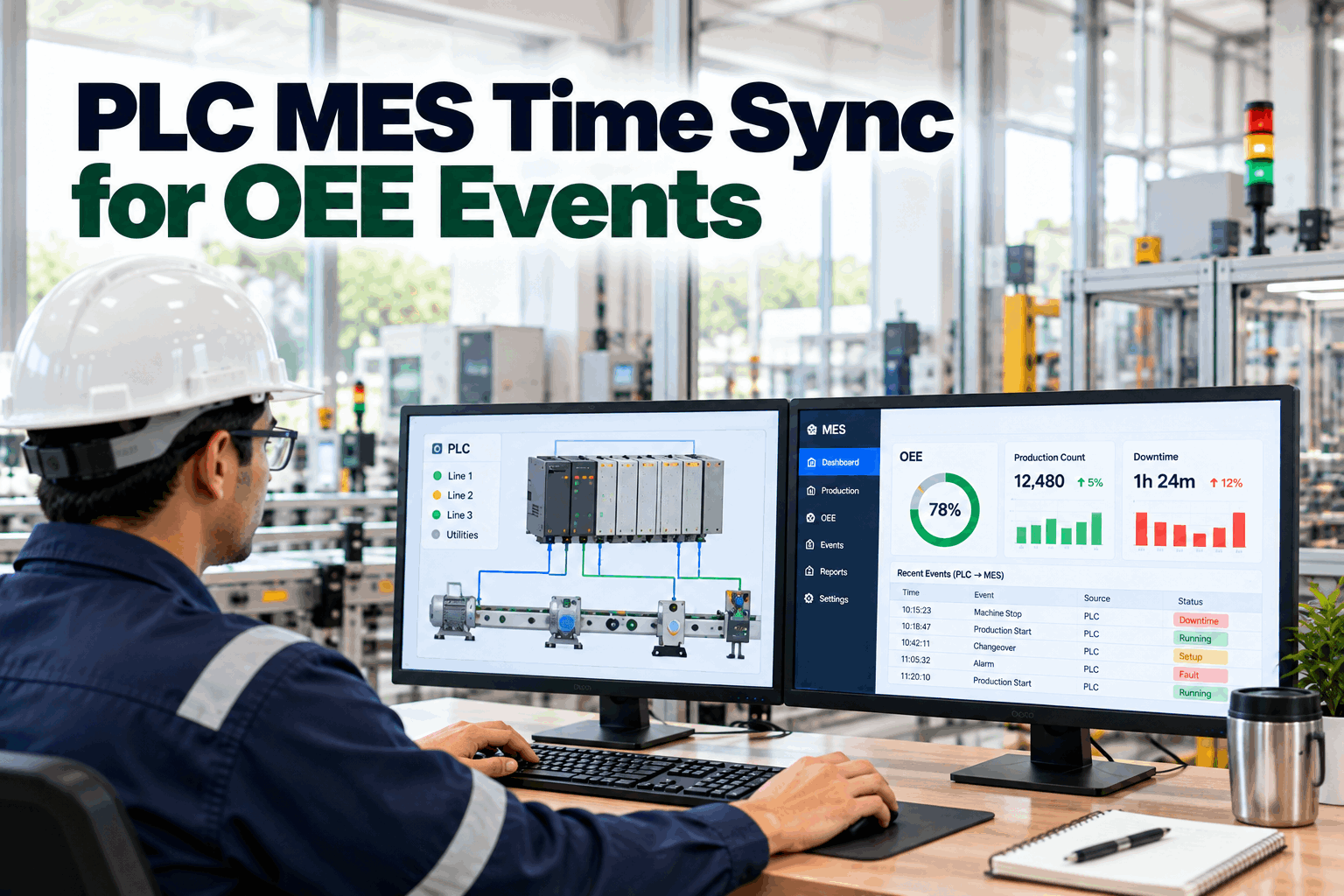
A sensor event and the MES stop disagree by seconds, and suddenly the loss bucket changes. On a real line, the issue is not just bad time sync — it is a missing contract for how PLC and MES events become defensible OEE records. iFactory AI overlays your MES, QMS, historian, and SPC stack with an event-alignment layer that reconciles PLC, MES, and historian timestamps, applies ownership and tolerance rules, and preserves raw evidence for audit — so the final OEE bucket stays traceable and human-reviewed. Book a 30-minute walkthrough of one stop event reconciled across three clocks.
PLC MES time sync is a contract problem, not only a network clock problem. Defensible OEE needs shared clocks, stable IDs, state ownership, and tolerance rules.
At a Glance
Why Seconds Matter in OEE
In OEE, a few seconds can shift a stop across a shift boundary, reclassify a micro-stop as downtime, or move an event into a different reason bucket. That is why teams often discover that two systems can both be right and still produce conflicting analytics. The PLC may see the physical state change first. The MES may receive the stop later, after buffering, network latency, or a scan delay. The historian may record tag transition time based on its own ingest cycle. If each system is treated as an independent source of truth, the result is disagreement instead of traceability.
The practical answer is not to hope the clocks match perfectly. The answer is to define an event contract that says what each system owns, which timestamp is canonical for each event class, how to reconcile small differences, and how to preserve the raw evidence for audit. That is the basis for defensible OEE.
Event Contract Fields Every Record Should Carry
Asset identifier tied to the line, cell, or work center hierarchy.
Classification of what happened and the state code that produced it.
Which system generated the event — PLC, MES, historian, or operator.
Both retained so drift can be measured and adjusted for review.
For ordering and cross-system matching across records.
Production context tied to the event for genealogy lookup.
Where relevant, the operator or crew associated with the event.
Whether the record was matched, adjusted, disputed, or reviewed.
What iFactory Delivers
iFactory adds a reconciliation layer between PLC, historian and MES events so every OEE record carries its own evidence trail.
Fields, ownership and tolerance rules defined with your controls and MES teams.
PLC, historian and MES events matched within the agreed tolerance window.
Clock drift between systems tracked so it is caught before it moves an OEE bucket.
Out-of-order, missing or conflicting events held for human review, not overwritten.
Raw and adjusted timestamps kept with reviewer and reason on every override.
No changes to your PLC logic or MES configuration.
Bring one recent stop where the three timestamps disagreed. We walk through the reconciliation rules, ownership resolution, and audit trail — beside your existing MES.
Ownership Pattern That Actually Works
A defensible model does not require every system to own everything. It works better when ownership is explicit.
Machine state transitions, micro-stops, cycle completion, and sensor-derived stop detection.
Order context, production intent, downtime reason assignment, and business state.
Time-series capture and tag transition history for corroboration.
Reviewed reason-code confirmation when required by policy.
Traceability across systems, dispute handling, and the audit trail.
Reconciliation Rules That Keep OEE Defensible
The point of reconciliation is not to force disagreeing systems into a single timestamp. It is to record what each system saw, apply a documented rule for choosing the canonical time, and preserve every raw record for later review. A defensible rule set typically covers the tolerance window inside which two systems are considered to be describing the same event, the priority order that decides which timestamp becomes canonical when systems disagree by more than the tolerance, the handling of missing events when one system did not receive the record at all, the treatment of out-of-order events where a later timestamp arrives before an earlier one due to buffering, the flagging of disputed events for human review before they roll into a shift KPI, and the audit fields that preserve reviewer identity and rationale on any override.
When these rules are documented and applied consistently, the OEE record becomes something the team can defend in an audit rather than something they have to explain away. And because the raw records are preserved, a future review — whether for a customer complaint, a regulatory inquiry, or an internal CAPA — can rebuild the event chain without depending on memory or on a single system's version of the truth. The reconciliation layer becomes part of the plant data culture, not a one-time cleanup exercise.
Frequently Asked Questions
Use a defined tolerance window, retain raw timestamps, and apply ownership rules so the overlay can match the records without overwriting the original evidence.
Usually the PLC owns the physical state transition, while the MES owns the business context. The historian provides corroboration, not necessarily ownership.
That depends on line speed, shift rules, and event sensitivity. The important part is to define a documented tolerance and review process rather than assuming drift is harmless.
Equipment ID, event type, state code, source system, source timestamp, received timestamp, sequence number, correlation ID, order or batch ID, and reconciliation status.
Preserve the raw record, mark the event as disputed or incomplete, and require human review before finalizing the OEE classification.
Clocks, identifiers, states, and ownership rules that let PLC and MES timestamps reconcile inside an auditable analytics overlay. For teams ready to see the workflow in practice, the fastest next step is one real stop event end to end.