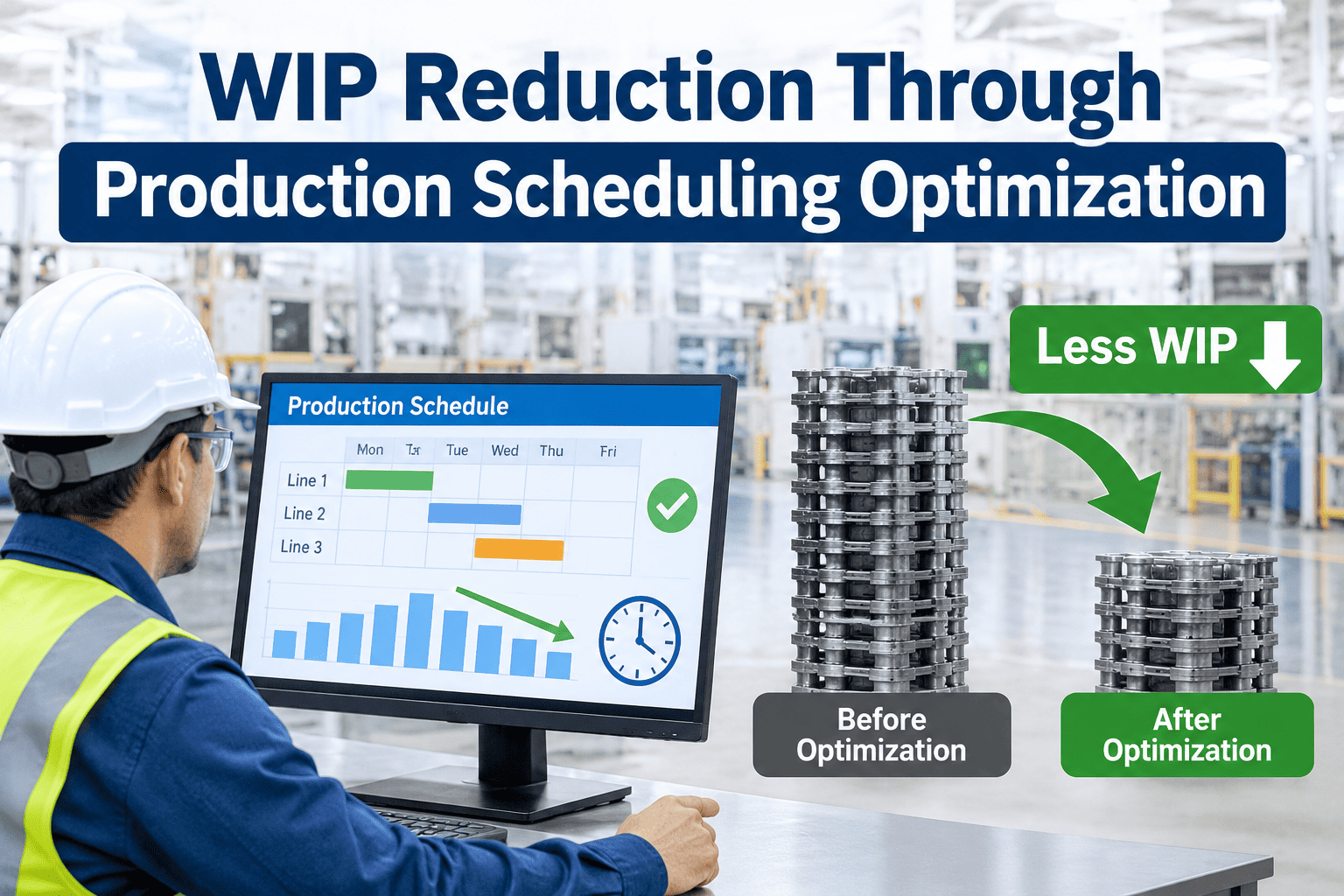
Work-in-progress keeps climbing on plenty of floors where every machine still looks busy, because WIP never builds evenly — it stacks at the one station releasing work faster than the next one can absorb it. Scheduling that is built around that specific point, instead of an across-the-board release cut, is what actually shortens lead time and makes delivery commitments something a plant can keep. iFactory, an on-premise AI platform for production scheduling, MES, and OEE analytics, turns that point into a measured, live signal rather than a guess from last quarter's routing sheet. Walk through your own schedule with the team.
Your Utilization Report Can Say 85% And Still Hide Weeks Of WIP
A scorecard built from live station data separates "busy" from "the actual constraint" — and that difference is what a WIP-reduction schedule has to get right.
WIP, Throughput, and Lead Time Are One Equation, Not Three Separate Problems
Little's Law states it directly: work-in-process equals throughput multiplied by lead time, which rearranges to lead time equals WIP divided by throughput (Fabrico, 2026). Hold throughput steady and cutting WIP in half cuts lead time in half — it is arithmetic, not a lean slogan, and it is the reason a scheduling change can move lead time without touching a single machine's speed.
A documented automotive-cell case shows the stakes: at a fixed bottleneck throughput of 40 units per hour, releasing 80 units of WIP yields a 2-hour lead time, while releasing 200 units "to keep everyone busy" stretches that to 5 hours — same output, more than double the wait (jjandradellc, 2026). The release decision set the lead time, not the machine.
A Work Center Can Be Busy Without Being The Bottleneck
A busy station can still carry idle time between jobs; a true bottleneck has none relative to the demand placed on it. Mistaking the two is how a plant ends up tightening the wrong station's schedule while WIP keeps building somewhere else entirely.
| Signal | Busy, not constrained | Actual bottleneck |
|---|---|---|
| Utilization reading | High, with recoverable gaps | At or above 100% of available capacity |
| Queue in front of it | Stable or shrinking | Growing week over week |
| Effect of speeding it up | Little to no change in plant output | Plant output moves directly with it |
Bottleneck-Aware Scheduling vs. An Across-The-Board WIP Cap
Both approaches reduce inventory on paper, but a blanket cap treats every work center identically and risks starving the one station that actually sets plant throughput. A schedule built around the constraint protects that station's queue specifically while leaving deliberate slack everywhere else — exactly what Theory of Constraints means by releasing work on a "rope" tied to the constraint's drumbeat rather than flooding every upstream station with all it can produce (Umbrex, 2026).
Find Out Which Station Is Actually Setting Your Lead Time
Share your current routing and recent throughput data, and the team will show where releases are outrunning the real constraint today.
The Constraint Moves — Most Schedules Don't Move With It
A schedule tuned once around today's bottleneck degrades the moment that bottleneck shifts, and it will shift: a changeover-heavy week, a tooling swap, or a maintenance event on the current constraint machine routinely hands the limiting role to a different station. Theory of Constraints' own Five Focusing Steps call for continuously monitoring for new constraints, because improving today's bottleneck predictably creates tomorrow's at the next-slowest station (uen Pressbooks, 2026).
What Has To Be True Before A WIP-Reduction Schedule Will Hold
- The constraint is identified from this week's data — not a routing sheet from last quarter.
- The buffer in front of it matches real variability — not a flat, round-number guess.
- WIP isn't a reliability hedge in disguise — operators who distrust an upstream machine will keep building a private buffer regardless of what the schedule says, since it's insurance against a stoppage they've seen before.
Skip that third condition and a scheduling fix tends to erode within weeks as the informal buffering quietly creeps back in, no matter how well the release logic was designed.
Turning The Constraint Into A Measured Signal, Not An Assumption
iFactory pulls station-level cycle events, downtime, and changeover data from the shop floor into one live view, paired with OEE analytics, so the constraint is a number updated from this week's production rather than a time-and-motion study from months ago. Scheduling logic then releases work at the rate the constraint can actually absorb.
- Release rate at upstream stations ties to the constraint's current throughput, not its rated capacity.
- A shift in which station is slowest surfaces from live data within the same week, not the next formal study.
- Buffer in front of the constraint is sized from measured upstream variability, not a flat safety margin.
- Planners see queue depth by station, so a growing pile is visible before it becomes a missed ship date.
Because the platform runs on-premise, this view is built from the plant's own machine and MES signals without routing production data off-site — a standing requirement for plants that can't put shop-floor telemetry on an external cloud.
What A Scheduling Lead Should Check First
Questions Planners Ask About WIP And Scheduling
See Where Your Own Schedule Is Outrunning Its Constraint
Book a session with the iFactory team to map your plant's actual bottleneck and what a constraint-aware schedule would release differently this week.