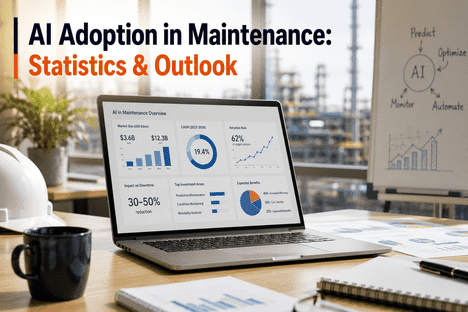
The maintenance landscape is undergoing one of its most significant transformations since the introduction of computerized maintenance management systems (CMMS). Artificial intelligence is no longer a future-facing concept for industrial operations — it is an active deployment priority across manufacturing, energy, oil and gas, and critical infrastructure. More than two-thirds of maintenance teams are expected to adopt AI by the end of 2026, and the global AI-driven predictive maintenance market is projected to grow from $1.18 billion in 2026 to over $2 billion by 2030. For maintenance leaders evaluating their operational strategy, the question is no longer whether AI adoption is necessary, but which capabilities deliver the fastest, most measurable returns. This page collects the most important statistics and trends shaping AI adoption in maintenance today — and what the data means for facilities that are still operating on reactive or calendar-based models. Book a Demo to see how iFactory's AI vision and predictive maintenance platform maps to your specific operational requirements.
See AI-Powered Maintenance in Action Across Your Facility
iFactory delivers AI vision monitoring, predictive maintenance, and real-time IoT analytics in one unified platform — purpose-built for industrial operations.
Where AI Adoption in Maintenance Stands Right Now
The 2026 maintenance data presents a nuanced picture: adoption intent is outpacing actual implementation, but the gap is closing faster than most analysts projected. 32% of maintenance teams have now fully or partially implemented an AI solution across their maintenance processes, with an additional 26% currently piloting or actively evaluating options. At the same time, 65% of maintenance teams expect to adopt AI within the next 12 months. These figures represent a decisive inflection point — the majority of industrial facilities are no longer asking whether AI belongs in maintenance. They are working through the practical barriers that have slowed deployment.
The three most cited barriers to AI adoption are budget constraints at 25%, lack of internal expertise at 24%, and cybersecurity concerns at 22%. Importantly, facilities that already face severe downtime pressure are more than twice as likely to be early AI adopters — 40% of high-downtime operations have fully implemented AI versus just 18% among low-downtime peers. This asymmetry reflects a consistent pattern: the pain of reactive maintenance drives faster adoption decisions, while facilities still operating in acceptable loss ranges tend to delay until competitive pressure forces the issue.
The Maintenance Strategy Gap: Why Most Facilities Are Still Reactive
Despite AI adoption momentum, the majority of maintenance operations remain anchored to strategies that consistently underperform. Preventive maintenance is still the most widely used approach, with 71% of professionals reporting its use. Calendar-based maintenance, however, misses 60–70% of actual equipment degradation patterns because failure timelines rarely align with scheduled inspection intervals. Only 27% of teams report using predictive maintenance as of 2025, a slight decrease from 30% in 2024, suggesting that while interest is high, practical deployment remains constrained by data infrastructure gaps.
The cost profile of remaining reactive is increasingly difficult to justify. The average large manufacturing plant loses $253 million per year due to unplanned downtime, and the per-hour cost of unplanned equipment downtime roughly doubled between 2019 and 2024. Meanwhile, 31% of maintenance and operations managers reported that downtime costs increased again in 2025. The data consistently points to the same conclusion: facilities still operating on calendar-based schedules are carrying a structural cost disadvantage that compounds with each production cycle. AI-powered condition monitoring and computer vision inspection close this gap by surfacing degradation signals weeks before mechanical failure occurs — enabling planned interventions at standard maintenance rates rather than emergency response costs.
Calendar-Based Maintenance Misses Most Failures
58% of facilities spend less than half their working time on scheduled maintenance, and fewer than 35% spend a majority on preventive tasks. Calendar schedules cannot adapt to the actual condition of equipment in real time — leading to both over-maintenance on healthy assets and missed failures on degrading ones. AI-powered condition monitoring replaces the fixed schedule with a continuous, data-driven picture of actual asset health.
Data Silos Prevent Cross-Asset Decisions
Maintenance teams operating with disconnected SCADA, CMMS, and inspection data systems spend 40–60% of their working time consolidating information before analysis can begin. This delay is not just an efficiency problem — it is a decision quality problem. By the time data is assembled and reviewed, the window for a low-cost intervention is often closed. A unified AI platform that integrates sensor data, work orders, and visual inspection results enables real-time decisions at a fraction of the labor overhead.
Manual Inspection Cannot Scale with Asset Complexity
As facility asset counts grow and regulatory inspection requirements expand, manual inspection workflows hit hard capacity limits. AI vision systems — including computer vision cameras deployed across pipelines, processing equipment, and structural assets — can perform continuous visual monitoring at a fraction of the cost of manual rounds, while detecting corrosion, leaks, and anomalies that fall between scheduled inspection intervals. The global industrial machine vision market reflects this demand, growing from $17.47 billion in 2026 to a projected $33.4 billion by 2034.
AI Vision and IIoT: The Technology Layer Accelerating Predictive Maintenance
Two technology categories are reshaping the practical deployment of AI in maintenance: IIoT sensor networks and AI vision cameras. As of 2026, 35% of maintenance professionals report using sensors and IIoT devices extensively, with an additional 41% currently testing or considering deployment. This broad testing activity signals that the sensor infrastructure required for AI-powered condition monitoring is reaching mainstream adoption across industrial operations. The data these sensors produce — vibration signatures, thermal patterns, acoustic emissions, pressure curves — is the raw material that AI models use to detect degradation weeks before it becomes a failure.
AI vision cameras extend this monitoring capability to the visual dimension. Computer vision systems deployed at equipment locations can detect surface corrosion, structural cracks, seal degradation, leak formation, and safety anomalies continuously — without requiring personnel in the field. The global AI camera market is projected to grow from $14.1 billion in 2026 to $38.7 billion by 2034, driven substantially by industrial applications in quality control, predictive maintenance, and process monitoring. iFactory's AI Vision Monitoring module deploys computer vision across facility infrastructure, detecting leaks, corrosion, and equipment anomalies faster and more consistently than manual inspection cycles. Explore iFactory's AI Vision Camera capabilities to see how computer vision integrates with predictive maintenance workflows.
35% Extensive IIoT Deployment — 41% Testing
More than a third of maintenance professionals report extensive use of sensors and IIoT devices, with an additional 41% currently testing or considering deployment. This represents the majority of industrial facilities actively building the data infrastructure required for AI-powered condition monitoring.
Continuous Visual Inspection Without Personnel
AI vision cameras deployed on industrial infrastructure perform continuous monitoring for corrosion, leaks, structural anomalies, and equipment degradation — detecting issues between scheduled inspection cycles that manual rounds consistently miss. Anomalies are detected in hours rather than weeks.
90%+ Accuracy for AI-Based Visual Inspection
Supervised machine learning models for industrial defect detection achieve F1-scores above 90% in peer-reviewed studies — outperforming manual inspection in both consistency and speed. AI vision systems also eliminate inspector fatigue and coverage gaps that accumulate in large facilities.
25% Reduction in Unplanned Downtime
AI-based predictive maintenance reduces unplanned downtime by an average of 25% across studied industrial systems, with leading deployments achieving 30–50% reductions through condition-based maintenance that replaces reactive call-outs with planned interventions.
Up to 25% Reduction in Maintenance Spend
Predictive maintenance can reduce overall maintenance costs by up to 25% while simultaneously increasing equipment uptime by 10–20%. These gains come from eliminating unnecessary preventive work on healthy assets and from avoiding the premium costs associated with emergency repairs.
Top Use Case: Preventing Knowledge Loss
39% of maintenance leaders identify knowledge capture and sharing as the most valuable AI use case in maintenance — ahead of even direct failure prevention. AI platforms that encode equipment behavior, failure histories, and work order patterns create institutional knowledge that survives workforce transitions.
iFactory's AI Vision Monitoring module deploys computer vision across pipelines, wellhead equipment, and processing infrastructure — detecting leaks, corrosion, and structural anomalies faster than any manual inspection schedule can match. Book a Demo to see a live AI vision deployment on real industrial asset data.
How AI Is Reshaping CMMS and Work Order Management in Industry 4.0
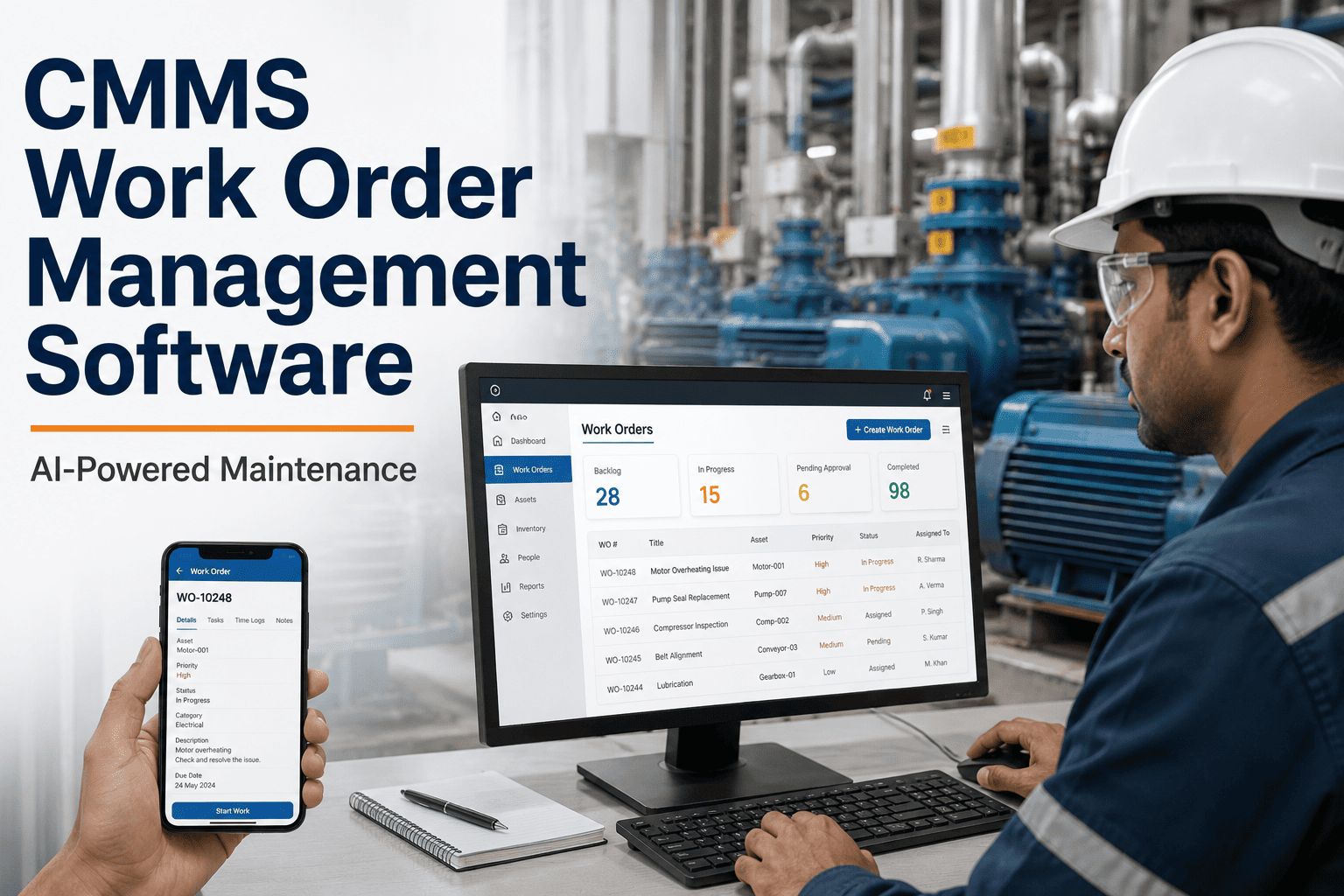
The integration of AI with computerized maintenance management systems (CMMS) represents one of the highest-leverage applications of machine learning in industrial operations. Traditional CMMS platforms are records systems — they document what happened and when. AI-enhanced maintenance platforms transform the CMMS function from a historical archive into a forward-looking decision engine, predicting which assets are approaching failure, automatically generating condition-based work orders, and routing tasks to the right technicians based on skill certification and current workload.
Industry 4.0 frameworks accelerate this transformation by connecting CMMS data with IIoT sensor streams, digital twin simulations, and AI vision outputs into a single operational intelligence layer. The result is a maintenance operation where work orders are generated by asset condition rather than calendar date, where parts procurement is triggered weeks before the repair is needed rather than hours after the breakdown, and where every maintenance decision is informed by the full operational context of the asset. iFactory's Workforce Analytics module connects crew competency data to work order management and digital twin systems so that compliance gaps and skill mismatches are surfaced at assignment time — before the technician reaches the asset. Book a Demo to see how iFactory integrates with your existing CMMS and work order workflows.
Sensor & Vision Data Collection
IIoT sensors and AI vision cameras continuously collect vibration, thermal, pressure, and visual data from every monitored asset — feeding a unified AI analytics layer in real time.
AI Anomaly Detection
Pre-trained machine learning models analyze incoming data streams and identify degradation signatures 3–4 weeks before mechanical failure — triggering condition-based alerts rather than fixed-interval reminders.
Automated Work Order Generation
Condition alerts automatically generate prioritized work orders in the CMMS, pre-populated with asset history, failure mode context, and recommended parts — eliminating manual data entry and reducing response lag.
Continuous Model Refinement
Each completed work order and confirmed failure event feeds back into the AI model, continuously improving prediction accuracy and reducing false alert rates as facility-specific failure patterns accumulate.
AI Adoption Outlook: What the Statistics Mean for Maintenance Leaders in 2026
The 2026 maintenance data tells a story with a clear directional conclusion. The facilities investing in AI-powered maintenance now — specifically those combining IIoT sensor networks with AI vision monitoring and condition-based work order management — are building a structural cost advantage that compounds over time. Each month of operational data refines failure prediction accuracy. Each condition-based intervention avoided compounds into reduced emergency labor, avoided expedited parts procurement, and preserved production output. The cost disadvantage of remaining on calendar-based maintenance grows with every production cycle.
The barriers to adoption are real but solvable. Budget constraints, skill gaps, and cybersecurity concerns are manageable when the platform chosen integrates with existing SCADA and CMMS infrastructure rather than requiring replacement, deploys in weeks rather than months, and keeps operational technology data inside the facility's security perimeter. iFactory is designed to remove each of these barriers — connecting to existing infrastructure via OPC-UA, MQTT, and REST APIs, activating pre-trained AI models from day one, and maintaining SOC 2 Type II and ISO 27001 certifications with optional air-gapped deployment for critical operational technology environments.
The shift from preventive to predictive maintenance is no longer a technology question — it is a financial discipline question. The data is unambiguous: AI-powered condition monitoring reduces unplanned downtime, cuts maintenance costs, and extends asset life. The facilities that will face the most pressure in the next 24 months are not those without AI — they are the ones that started evaluating and never committed to a deployment. Budget constraints are a real barrier, but the cost of a single avoided emergency shutdown typically exceeds the annual cost of the platform that prevented it.
AI vision monitoring represents one of the most underutilized maintenance capabilities available today. Computer vision systems deployed on industrial infrastructure do not replace inspectors — they extend inspection coverage to every hour of every day, across every monitored asset simultaneously. The combination of continuous visual monitoring with IIoT sensor data and AI failure models creates a maintenance intelligence layer that no manual inspection schedule can replicate, regardless of how many technicians are deployed. For facilities with aging infrastructure or high-consequence failure risks, AI vision is not optional — it is the risk management layer that traditional maintenance approaches cannot provide. Book a Demo to see iFactory's AI vision capabilities in a live deployment.
The knowledge capture use case for AI in maintenance is consistently underappreciated in procurement conversations. 39% of maintenance leaders identify it as the most valuable AI application — ahead of direct failure prevention. Facilities with experienced maintenance technicians approaching retirement are carrying significant knowledge risk: failure patterns, equipment quirks, and informal inspection judgments built over decades that exist nowhere in a CMMS. AI platforms that encode this knowledge into failure models and work order intelligence create institutional memory that survives workforce transitions and scales to any number of assets.
What AI-Powered Maintenance Delivers: Documented Results
The statistics below reflect documented outcomes from AI-powered maintenance deployments — not projected benchmarks. They represent what facilities have actually achieved by moving from calendar-based and reactive maintenance to condition-based, AI-driven operational models.
Ready to Move Your Maintenance Operation from Reactive to Predictive?
iFactory delivers AI vision monitoring, IIoT analytics, predictive maintenance, and digital twin simulation in one unified platform. First sensors operational in 4 weeks — no SCADA replacement required.