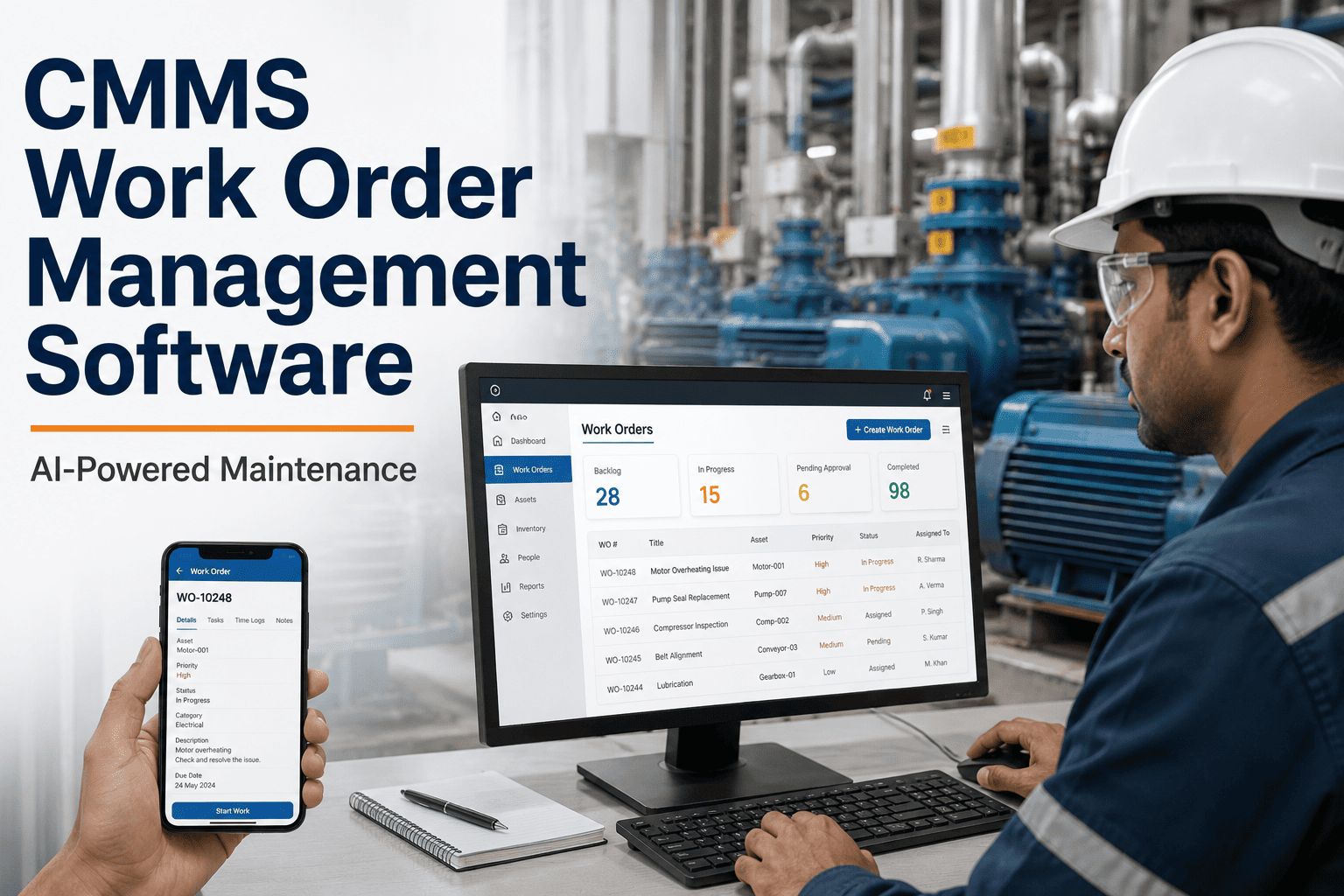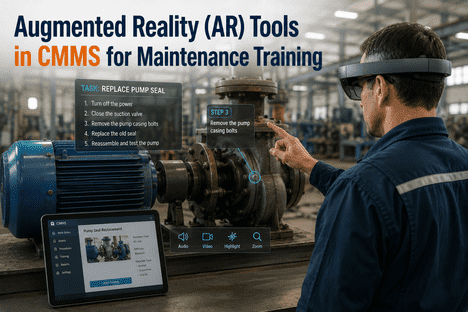
Augmented Reality (AR) Tools in CMMS for Maintenance Training are redefining how industrial facilities develop, deploy, and retain maintenance expertise. In 2026, the combination of AR-guided work instructions, real-time IoT sensor data, and AI-powered predictive models has moved from pilot projects into full-scale operational deployment across upstream energy, manufacturing, and process industries. Facilities that integrate AR with their Computerized Maintenance Management System (CMMS) are reporting 32% faster repair completion, a 40% reduction in procedural errors, and new technician onboarding times cut by as much as 28%. The shift from paper binders and static manuals to live AR overlays is no longer a technology question — it is a competitive operations decision that directly impacts asset uptime, maintenance cost, and workforce readiness. iFactory's AI Vision Monitoring module sits at the center of this transformation, connecting computer vision, digital twin simulation, and CMMS work order management into a single operational intelligence layer that guides technicians through every step of every maintenance task.
AI Vision and AR-Powered Maintenance Training — Built for Industrial Operations
iFactory connects augmented reality guidance, real-time IoT sensor data, and predictive maintenance intelligence into a unified CMMS platform that reduces downtime, accelerates technician competency, and eliminates manual inspection gaps.
How Augmented Reality Works Inside a CMMS Platform
Augmented Reality in a CMMS environment means overlaying digital work instructions, live asset health data, and step-by-step repair guidance directly onto the physical equipment a technician is working on — delivered through smart glasses, tablets, or smartphones. Unlike static PDF manuals, AR-guided maintenance pulls the active work order, asset failure history, and real-time IoT sensor readings from the CMMS and presents them at the exact moment and location where the technician needs them. This removes the information gap that causes the majority of maintenance errors: technicians working from memory, outdated printed procedures, or incomplete verbal handovers.
When AR integrates with an AI-powered CMMS like iFactory, the capability extends further. Computer vision on the asset detects visual anomalies — corrosion, misalignment, fluid leaks — and feeds those findings directly into the work order alongside sensor-derived predictive alerts. The technician sees both the AI-generated diagnosis and the AR-guided repair sequence in a single unified view, replacing the multi-system lookup that previously consumed 40 to 60 percent of every maintenance engineer's shift. Book a Demo to see how iFactory's AI Vision module integrates with CMMS work order management in a live industrial deployment.
Step-by-Step AR Work Instruction Delivery
AR projects digital dismantling and assembly instructions directly onto the physical machine, removing ambiguity from complex multi-step procedures. Instructions are connected to the live CMMS work order and update in real time as the technician progresses through each task. Completed steps are automatically recorded and attached to the asset maintenance record without manual data entry.
Remote Expert Collaboration with Spatial Annotation
AR enables two-way live video where a remote expert can draw spatial annotations directly into the on-site technician's field of view, pointing at specific components, flagging hazards, and confirming corrective actions in real time. This eliminates the delay and miscommunication cost of phone-based remote support and delivers expert knowledge at the point of repair regardless of physical location.
Risk-Free Procedure Practice on Digital Twin Models
Trainees practice complex multi-step maintenance procedures on physics-accurate 3D digital twin models before touching real equipment. The digital twin reflects actual asset configuration, torque specifications, and safety interlocks — providing high-fidelity practice that builds muscle memory and procedure confidence without exposure to live process conditions or equipment damage risk.
Automatic Safety Hazard Flagging
AR overlays automatically highlight high-voltage panels, pinch points, thermal hazards, and isolation requirements with visual warnings triggered by asset type and live sensor readings from the CMMS IoT layer. Technicians receive safety context precisely when approaching a hazardous component rather than relying on pre-job briefings that may not reflect real-time equipment state.
Why AR Alone Is Not Enough — The CMMS and IoT Layer That Makes It Actionable
Augmented reality guidance is only as valuable as the data it displays. An AR overlay connected to a live CMMS and IoT sensor network gives technicians real-time asset health context — vibration signatures, temperature trends, pressure readings — alongside their step-by-step work instructions. Without that data connection, AR is an animated manual. With it, AR becomes an intelligent maintenance copilot that tells technicians not just how to perform a task but which task matters most right now and why.
iFactory integrates AR-guided maintenance workflows with its full IoT sensor ingestion layer, pulling data from existing SCADA, DCS, and historian systems via OPC-UA, MQTT, and REST APIs. When the predictive maintenance module identifies a compressor bearing degradation signature 3 to 4 weeks ahead of mechanical failure, the CMMS automatically generates a work order, assigns it to a technician with the relevant certification, and pre-loads the AR-guided repair sequence to their device before they arrive at the asset. The entire chain — from sensor anomaly detection to guided physical repair — runs without manual intervention. Learn more about iFactory's AI Vision capabilities and how computer vision integrates with live CMMS work orders.
AI Detects Failures 3–4 Weeks Ahead
iFactory's ML models monitor vibration, temperature, and pressure signatures on compressors, pumps, and turbines and identify degradation patterns 3 to 4 weeks before mechanical failure. Predicted failures automatically generate CMMS work orders, ensuring the AR-guided repair task is ready before the equipment reaches a critical state.
Visual Anomaly Detection on Physical Assets
iFactory's AI Vision module applies computer vision to pipeline infrastructure, wellhead equipment, and processing units, detecting leaks, corrosion, and mechanical anomalies faster than manual inspection cycles. Visual findings feed directly into the CMMS maintenance record alongside sensor data, giving technicians complete asset context at the point of repair.
Physics-Accurate Simulation for Training Scenarios
iFactory builds physics-accurate virtual replicas of wells, pipelines, and processing equipment synchronized in real time with live sensor data. These digital twins serve as the training environment for AR-guided procedure practice, ensuring every simulated scenario reflects actual asset configuration and current operational state.
Automated Work Order Generation and Assignment
When IoT sensor thresholds or AI anomaly models trigger a maintenance action, iFactory automatically generates and assigns the CMMS work order — attaching the correct AR procedure, asset history, required parts, and technician certification requirements. No manual dispatcher step. No information gaps at the point of execution.
Competency and Certification Visibility
iFactory's Workforce Analytics module connects crew competency records to work order assignment, ensuring every AR-guided maintenance task is allocated to a technician with the right skills and certifications. Compliance gaps surface at assignment time — before the technician reaches the asset — not during an audit after the event.
Automated Audit Trail from AR Execution
Every step completed through an AR-guided work instruction is automatically recorded and attached to the CMMS asset record as visual proof of compliance. Inspection photos, step confirmations, and deviation notes are captured hands-free and stored with full timestamp and technician attribution — delivering an audit-ready maintenance record with no manual documentation overhead.
iFactory's AI Vision module connects computer vision anomaly detection to live CMMS work orders and digital twin simulation — giving technicians AI-generated context and AR-guided repair sequences in a single operational view. Book a Demo to see a live deployment running on real industrial asset data.
How AR-Integrated CMMS Platforms Accelerate Maintenance Technician Competency
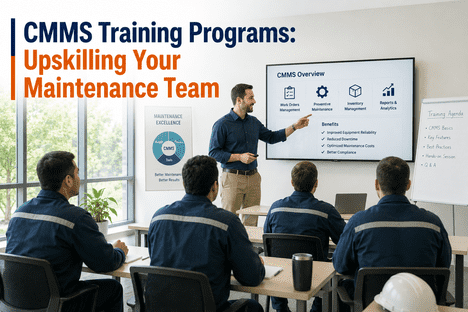
The skilled technician shortage is one of the most structurally difficult challenges facing industrial maintenance operations in 2026. Experienced maintenance engineers are retiring faster than facilities can develop replacements, and the complexity of modern processing equipment means the traditional apprenticeship model — watch an expert, then do it yourself — takes years to produce a fully competent technician. AR-integrated CMMS platforms compress that timeline significantly by delivering expert knowledge at the point of execution, not just during classroom instruction.
Facilities using AR-guided maintenance training report onboarding time reductions of 25 to 60 percent across complex equipment types. The mechanism is straightforward: instead of memorizing procedure sequences from a manual, trainees execute actual procedures guided step by step by AR overlays on the physical asset or its digital twin equivalent. Retention improves because learning happens in context. Errors are caught immediately by the AR guidance system rather than discovered during post-task inspection. And the knowledge embedded in the AR procedure library is derived from the facility's best engineers, captured once and delivered consistently to every technician, on every shift, at every asset location.
Digital Twin Practice Environment
New technicians practice full maintenance procedures on physics-accurate digital twin models before any contact with live equipment. Procedures run in real sequence with correct torque specs and safety interlocks enforced virtually.
AR-Guided First Live Execution
The first live equipment execution is AR-guided step by step, with the CMMS work order, asset history, sensor readings, and safety flags all visible in the technician's device. Expert knowledge is delivered at the asset, not recalled from memory.
Competency Verification and CMMS Record
Each completed AR-guided procedure is automatically logged to the CMMS with step-level completion records and visual proof. Competency progression is tracked against certification requirements without manual assessment administration.
Continuous Model Improvement
Deviation patterns, error frequencies, and procedure completion times feed back into iFactory's AI models. Procedures that generate consistent errors are flagged for revision. High-performing technician execution patterns are incorporated into AR guidance updates.
Results AR-Integrated CMMS Delivers Across Industrial Maintenance Operations
These outcomes reflect documented results from AR-guided maintenance and AI-powered CMMS deployments across upstream, midstream, and downstream industrial operations — not projections or theoretical benchmarks.
What Industrial Operations Leaders Say About AR in CMMS Maintenance Training
The fundamental value of AR in CMMS maintenance training is not the technology itself — it is the elimination of the knowledge transfer gap. When a retiring senior engineer's expertise is captured in an AR procedure library and delivered to every technician at every asset, the facility stops being dependent on individual knowledge holders. That structural resilience is worth more than any individual productivity improvement, especially in operational environments where a single misstep triggers an unplanned shutdown costing hundreds of thousands of dollars per hour.
The combination of IoT predictive alerts and AR-guided maintenance execution is where the real operational leverage emerges. AI identifies a degradation signature on a compressor bearing three weeks before failure. The CMMS generates the work order and pre-loads the AR repair sequence. The technician arrives at the asset with full context — sensor history, failure mode, step-by-step guidance — and executes a planned intervention at standard maintenance rates. The alternative is an emergency shutdown at three in the morning with expedited parts procurement. The economics are not close. Book a Demo to see how iFactory connects predictive alerts to AR-guided work order execution in a single operational workflow.
Compliance documentation in industrial maintenance has historically been a post-task burden that adds no value to the execution itself. AR-guided CMMS workflows invert that entirely — every step completed through an AR-guided work instruction is automatically recorded with visual proof attached to the asset record. The audit trail is a byproduct of the guided execution, not a separate documentation task. Facilities that deploy this architecture are building a compliance infrastructure that gets more complete and more accurate with every maintenance event, not less.
Building a Maintenance Training Infrastructure That Compounds Value with Every Technician and Every Asset
Augmented Reality tools in CMMS for maintenance training deliver compounding operational returns. Each AR-guided procedure execution adds to the facility's institutional knowledge base. Each completed digital twin training session produces a more competent technician with documented procedure proficiency. Each IoT-triggered predictive work order that connects to an AR-guided repair sequence prevents an unplanned shutdown that would have cost multiples of the entire platform investment. The facilities that build this infrastructure now — connecting AR guidance, predictive maintenance AI, computer vision anomaly detection, and CMMS work order automation into a single operational layer — will carry a structural competency and cost advantage that widens every year against facilities still relying on paper procedures and reactive maintenance cycles.
iFactory is the platform purpose-built for this architecture. The AI Vision module connects computer vision to live CMMS records. The predictive maintenance layer identifies failures 3 to 4 weeks before they occur. The digital twin provides the physics-accurate training environment for AR procedure practice. The workforce analytics module connects technician competency data to every work order assignment. All eight modules operate from a single unified platform with a 4-week deployment timeline against existing SCADA, DCS, and historian infrastructure. Book a Demo to assess where iFactory delivers the fastest measurable ROI for your specific maintenance training and asset reliability objectives.
AI Vision + Predictive Maintenance + CMMS — One Platform. Operational in 4 Weeks.
See how iFactory's unified AI platform connects computer vision anomaly detection, AR-guided work order execution, IoT predictive maintenance, and digital twin simulation into a single operational intelligence layer across your asset portfolio.