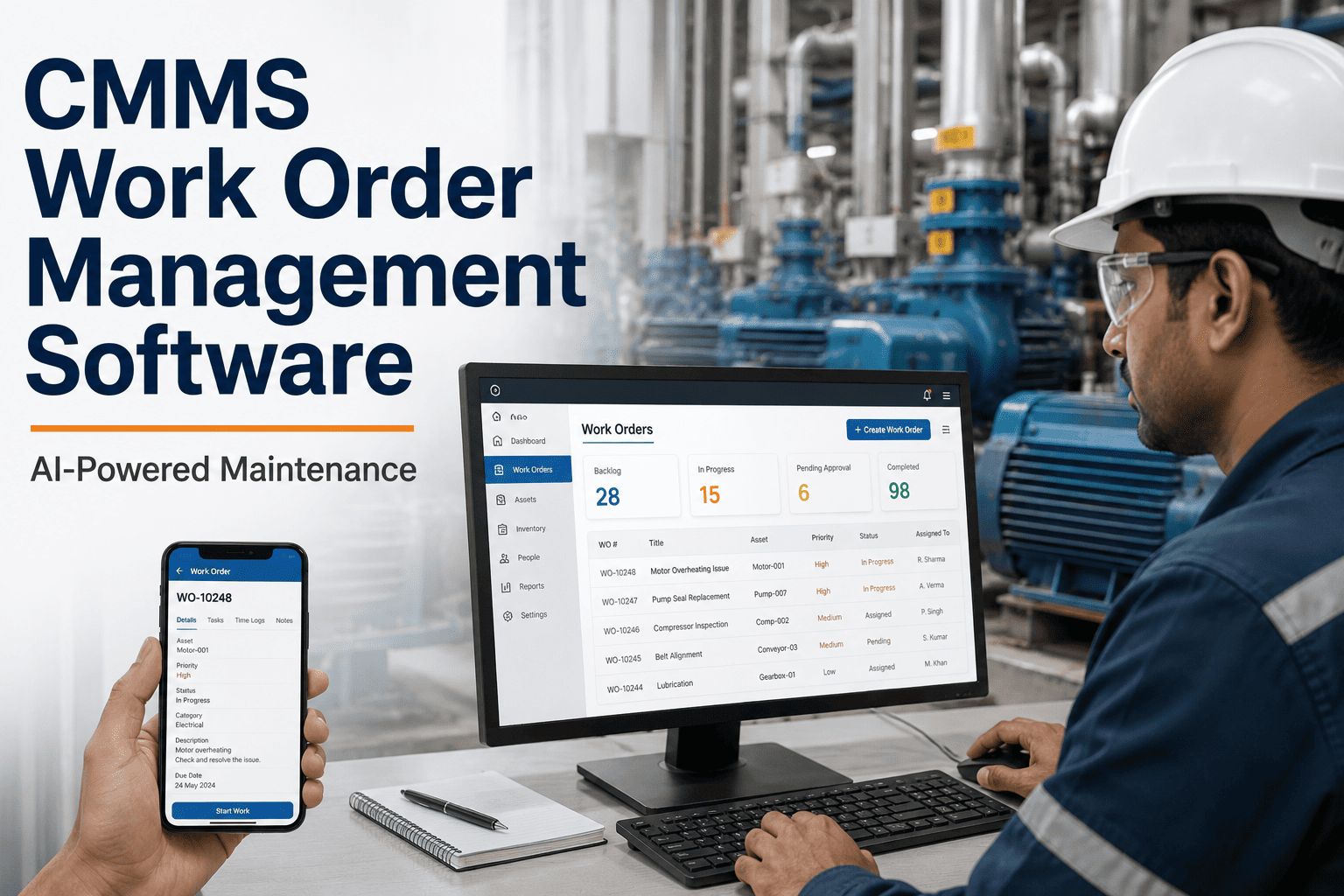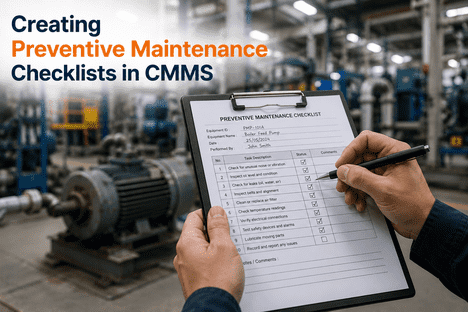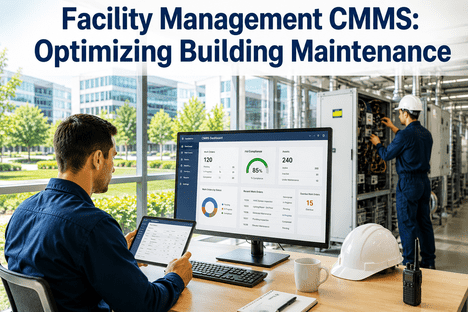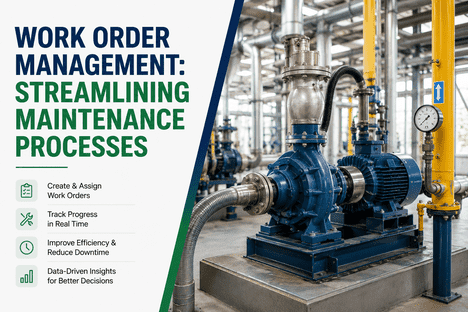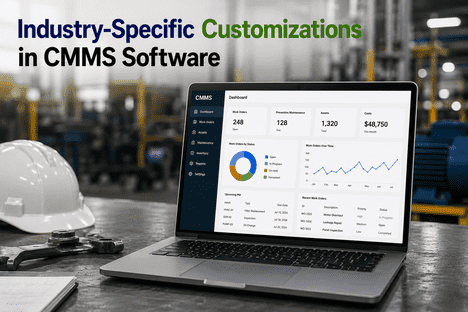
Industry-specific customizations in CMMS software have become the defining differentiator for maintenance operations in 2026. A standardized, one-size-fits-all maintenance management platform simply cannot address the compliance, safety, and operational complexity that varies across manufacturing, oil and gas, pharmaceuticals, food and beverage, cement, steel, and power generation. The shift toward tailored CMMS configurations is being driven by three converging forces: escalating regulatory requirements that differ by sector, the need to integrate domain-specific IoT sensor ecosystems, and the growing expectation that the CMMS should reflect how each industry actually manages its assets rather than forcing every operation into the same workflow template. iFactory AI's AI Vision Camera platform embeds industry-specific customization at the hardware and model layer, ensuring that a pharmaceutical line, a refinery compressor train, and a food processing conveyor each receive maintenance intelligence calibrated to their specific failure modes, regulatory obligations, and production economics. Book a Demo to see how AI Vision Camera adapts to your specific operational context.
What Industry-Specific CMMS Customization Means in Practice
A general-purpose CMMS treats every asset as essentially the same — a pump is a pump, a motor is a motor, a conveyor is a conveyor. But in practice, a pharmaceutical-grade stainless steel pump operating under FDA validation has fundamentally different maintenance requirements than a slurry pump in a copper mine or a cryogenic pump on an LNG facility. Industry-specific CMMS customization addresses these differences at multiple layers: asset hierarchy and metadata structures that reflect sector taxonomies, preventive maintenance templates derived from industry standards, compliance reporting modules aligned with sector-specific regulators, and condition monitoring thresholds calibrated to the failure physics of the dominant asset class. iFactory AI Vision Camera takes this further by embedding visual inspection models trained on industry-specific defect libraries — surface crack detection for metal processing, blister and fill-level inspection for pharma, corrosion and fugitive emissions monitoring for oil and gas, and belt tear and idler fault detection for mining and cement. Each deployment inherits a model library purpose-built for the sector, reducing the calibration period from months to weeks.
How CMMS Customization Differs Across Key Industrial Sectors
The following comparison illustrates how industry-specific CMMS requirements vary across the major industrial sectors that iFactory AI Vision Camera serves, and how tailored AI vision models address each sector's unique maintenance and compliance challenges.
| Industry | Primary Maintenance Challenge | Key Regulatory Driver | AI Vision Model Focus | CMMS Customization Priority |
|---|---|---|---|---|
| Oil & Gas | Corrosion, fugitive emissions, pipeline integrity | EPA OOOOb, PHMSA, OSHA PSM | Corrosion detection, OGI, flare monitoring | Emissions compliance reporting, risk-based inspection scheduling |
| Pharmaceutical | FDA validation, contamination prevention, equipment sterilization | 21 CFR Part 11, cGMP, EU Annex 11 | Fill level, blister pack integrity, foreign object detection | Validation lifecycle management, audit trail, electronic signatures |
| Food & Beverage | Sanitary design, washdown cycles, allergen cross-contact | FSMA, HACCP, SQF / BRCGS | Fill level, label placement, seal integrity, foreign material | Sanitation scheduling, allergen changeover workflows, COA generation |
| Steel & Metals | Surface defects, hot strip quality, roll wear | ISO 9001, customer-specific quality specs | Surface cracks, coating uniformity, weld bead quality | Real-time quality integration, roll management, dimensional tracking |
| Cement & Mining | Conveyor belt health, kiln refractory, dust emissions | MSHA, EPA NESHAP, local air quality | Belt tear, kiln hotspot, idler bearing fault, dust cloud | Conveyor asset hierarchy, condition-based PM, emissions logs |
| Power Generation | Thermal fatigue, turbine blade erosion, transformer health | NERC CIP, EPA MATS, local grid codes | Thermal anomaly, substation IR, turbine blade inspection | Critical asset criticality matrix, NERC compliance reporting, outage planning |
| Automotive | Paint finish defects, weld quality, torque verification | IATF 16949, customer-specific traceability | Paint QC, gap analysis, weld validation, torque mark verification | Station-level quality gates, VIN traceability, PPAP documentation |
The AI Vision Camera Role in Industry-Specific CMMS Customization
Traditional CMMS customization has been limited to software configuration — field labels, dropdown values, report templates, and workflow rules. While these remain valuable, they do not change the fundamental challenge of maintenance data quality: most inspection data in traditional CMMS platforms is entered manually, inconsistently, and after the fact. iFactory AI Vision Camera addresses this by converting visual inspection into structured, real-time data that populates the CMMS automatically, with the defect classification, severity scoring, and asset tagging all aligned to the sector-specific hierarchy. For an oil and gas operator, this means a camera detecting corrosion on a pipe fitting generates a work order tagged with the API 581 corrosion loop, risk-based inspection priority, and equipment criticality class. For a pharmaceutical manufacturer, the same camera detecting a fill-level deviation generates a work order with the equipment validation status, batch ID linkage, and deviation classification required for 21 CFR Part 11 compliance. The CMMS customization is not in the software configuration alone — it is embedded in how the AI model interprets what it sees and maps that observation to the correct maintenance and compliance context. Book a Demo to see how AI Vision Camera maps visual defects to your CMMS hierarchy automatically.
The ROI of Industry-Specific CMMS Customization With AI Vision
The measurable return from industry-specific CMMS customization powered by AI Vision Camera compounds across four dimensions. First, detection accuracy improves because AI models trained on sector-specific defect libraries achieve higher precision and lower false-positive rates than generic models — iFactory AI Vision Camera delivers 99.4% detection accuracy across industrial use cases. Second, technician adoption increases because work orders arrive pre-populated with industry-relevant context — asset hierarchies, failure codes, and compliance tags that match how the maintenance team already thinks about their equipment. Third, regulatory compliance becomes a byproduct of routine maintenance operations rather than a separate audit preparation activity, because the CMMS configuration embeds the reporting fields and documentation requirements specific to each sector's regulatory framework. Fourth, the cost of customization drops dramatically — instead of weeks of professional services configuring dropdown lists and report templates, the AI Vision Camera adapts to the deployed industry context through pre-trained model libraries and automated asset mapping. Organizations implementing iFactory AI Vision Camera with industry-specific CMMS configuration report 30-50% reduction in unplanned downtime within the first 90 days and full platform ROI within 12-18 months.
Expert Perspective: Why Industry-Specific CMMS Configuration Is the 2026 Competitive Standard
The CMMS market has spent twenty years building platforms that claim to work for every industry. The result is that they work adequately for none. When a maintenance manager in a pharmaceutical plant has to manually map a cGMP deviation into a generic work order form originally designed for facility maintenance, the system is actively working against them. The industry-specific customization trend in 2026 is not about adding more configuration options — it is about embedding domain intelligence into the platform so that the right workflows, compliance fields, and asset hierarchies are present from day one. iFactory AI Vision Camera represents the first generation of CMMS-integrated visual inspection that understands the industry context before the first image is captured. That is not a feature enhancement. It is a structural shift in what maintenance software can deliver.
Frequently Asked Questions
Industry-specific customization embeds domain knowledge — regulated asset hierarchies, sector failure codes, compliance reporting structures, and inspection workflows — into the platform core rather than requiring manual configuration. iFactory AI Vision Camera deploys with pre-trained AI models and CMMS mappings specific to each industrial sector.
Yes. iFactory AI Vision Camera integrates with SAP PM, Oracle EAM, IBM Maximo, and all major CMMS platforms via OPC-UA, MQTT, and REST API connectors. Detected defects are automatically converted into work orders with industry-specific asset tags and compliance fields — no manual data entry required.
Typical deployment takes 1-2 weeks for initial camera installation and AI model calibration, with the CMMS integration and industry-specific workflow mapping completed concurrently. Most operations begin receiving automated defect detection alerts and work orders within 14 days of project start.
iFactory AI Vision Camera supports oil and gas, pharmaceutical, food and beverage, steel and metals, cement and mining, power generation, automotive, chemical, and general manufacturing. Each industry receives pre-trained AI model libraries, asset hierarchy templates, and compliance reporting configurations specific to the sector.
No. iFactory AI Vision Camera works with existing IP cameras via ONVIF and RTSP protocols. Cameras can be installed in under 30 minutes each. Edge AI processing runs on-premise with NVIDIA GPU, requiring no cloud dependency and ensuring zero latency for time-critical defect detection and safety monitoring.