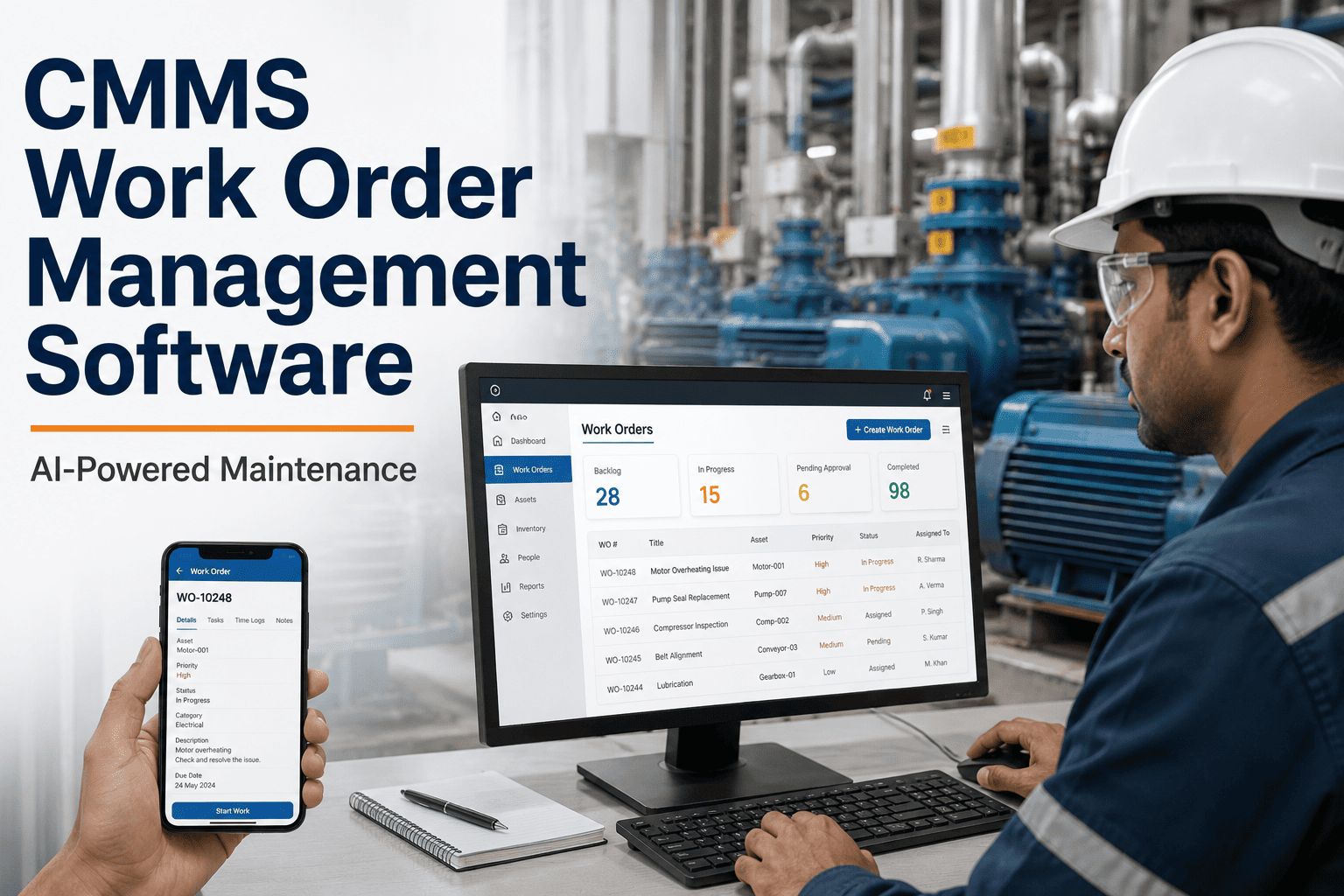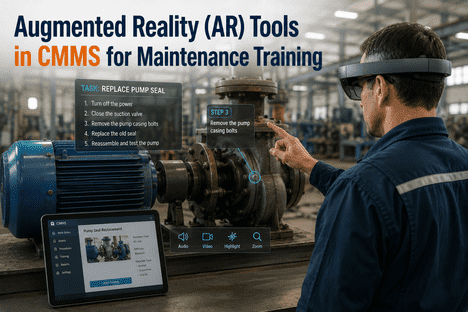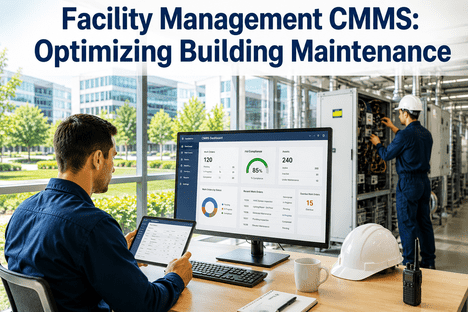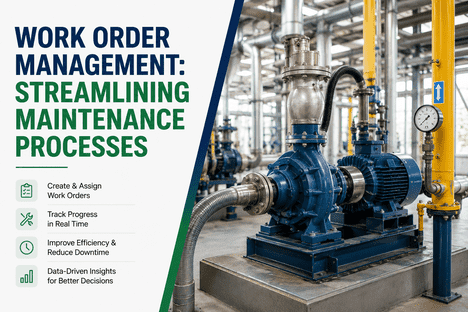
The foundation of any high-performing maintenance operation is not the tools or the spare parts inventory — it is the data architecture that connects asset condition signals to maintenance execution workflows. Traditional maintenance scheduling relies on fixed intervals that are convenient for planning but blind to actual asset condition. A bearing running 15°C above baseline at 800 operating hours will not survive to the 1,000-hour inspection mark, and a component still within specification at 650 tons does not need replacement at 500. Real-time data transforms this equation by replacing calendar-based schedules with event-driven work orders triggered by actual equipment state. Operations that Book a Demo of iFactory's AI vision platform discover how real-time condition monitoring closes the gap between asset degradation and maintenance intervention before unplanned failures occur.
From Fixed Schedules to Condition-Driven Maintenance Operations
iFactory AI Vision transforms maintenance scheduling from time-based guesswork to data-driven precision — so your maintenance team acts on asset condition, not calendar intervals.
Why Fixed Maintenance Schedules Undermine Operational Performance
The most common maintenance scheduling strategy in industrial operations is time-based or usage-based: replace the bearing every 6 months, lubricate the gearbox every 500 hours, inspect the drive train every 10,000 cycles. These schedules persist because they are simple to administer and easy to budget. But they carry a hidden cost that compounds across every asset class. Time-based schedules are inherently conservative — intervals are set to protect the worst-case asset operating in the worst conditions, which means the average asset is serviced before it needs to be. This wastes maintenance labor, consumes spare parts prematurely, and introduces human error through unnecessary interventions. More critically, time-based schedules cannot adapt to the actual degradation trajectory of individual assets. A pump operating in clean, temperature-controlled conditions may run reliably for 8,000 hours, while an identical pump in a dusty, high-temperature environment may fail at 4,000 hours. A fixed 6,000-hour maintenance interval over-services the first and under-protects the second. The result is a maintenance program that simultaneously wastes resources on healthy assets and fails to protect against failures in stressed assets. Book a Demo to see how real-time condition data replaces fixed intervals with dynamic maintenance triggers.
How AI Vision and IoT Data Enable Condition-Based Maintenance Scheduling
Condition-based maintenance replaces fixed intervals with maintenance actions triggered by actual equipment condition data. The enabling technology is continuous real-time monitoring — and the most comprehensive monitoring combines IoT sensor telemetry with AI-powered visual inspection. iFactory's AI Vision Camera platform integrates with existing IP cameras, thermal imagers, and IoT sensor networks to create a unified condition monitoring layer across every asset class. Thermal cameras detect bearing overheating and electrical panel hot spots before they reach critical temperature thresholds. RGB cameras identify surface cracks, corrosion progression, belt wear, and fluid leaks. Vibration sensors capture imbalance and misalignment trends that mechanical models use to forecast remaining useful life. All of these data streams converge into a single analytics engine that generates condition-based work orders automatically — with annotated images, asset identification, and recommended repair actions. The shift from "inspect every 90 days" to "inspect when asset health score drops below 75%" is not a theoretical concept. It is a scheduling model that iFactory deploys in under two weeks, using existing plant camera infrastructure and edge AI processing that delivers sub-50ms inference latency without cloud dependency.
The Maintenance Maturity Model: From Reactive to Predictive
Every maintenance organization operates somewhere on a maturity spectrum. The lowest tier is purely reactive — equipment runs until it fails, then gets repaired. The highest tier is predictive, where AI models forecast failures days or weeks in advance and schedule interventions at the optimal point in the production cycle. Moving up this maturity curve requires a deliberate data infrastructure strategy, and the transition from preventive to predictive is where most industrial operations are investing in 2026. The table below compares the four tiers of maintenance maturity across the dimensions that matter most to operational performance.
| Maturity Tier | Trigger Mechanism | Data Source | Cost Profile | Failure Prevention Rate |
|---|---|---|---|---|
| Reactive (Run-to-Failure) | Equipment breakdown | None | Highest — emergency repair, expedited parts, lost production | 0% |
| Preventive (Time-Based) | Calendar or usage interval | Manual logs, CMMS records | Moderate — over-maintenance waste on healthy assets | 40–60% — misses unexpected failures |
| Condition-Based | Sensor threshold or trend deviation | IoT telemetry, AI vision, thermal imaging | Lower — targeted intervention at the right time | 70–85% |
| Predictive (AI-Driven) | Model-predicted failure probability and RUL | AI vision + IoT + historical failure data integrated with CMMS | Lowest — optimal intervention timing with minimal disruption | 90%+ |
The jump from preventive to predictive is not incremental — it is transformational. Organizations operating at the predictive tier report 45% less unplanned downtime, 32% higher OEE, and 60% fewer quality defects according to iFactory deployment data across steel, automotive, and food processing facilities. The common thread across every successful deployment is the integration of real-time visual and sensor data into a unified maintenance scheduling platform that generates work orders from asset condition rather than calendar dates. Book a Demo to see how iFactory's AI vision platform accelerates your maintenance maturity journey.
How Real-Time Data Transforms Maintenance Scheduling: The End-to-End Workflow
The path from raw sensor data to a completed maintenance action involves four distinct stages. Understanding this workflow is essential for operations leaders who want to evaluate where their current process breaks down and how a unified platform like iFactory closes those gaps.
The Unified Maintenance Operations Dashboard: Connecting Real-Time Data to Scheduling Decisions
Most industrial operations run maintenance data in disconnected systems: condition monitoring in the IoT platform, work orders in the CMMS, asset history in a spreadsheet, spare parts inventory in the ERP, and production schedules on a whiteboard. These systems do not share data, and the gaps between them are where scheduling errors, missed interventions, and unnecessary downtime originate. A thermal anomaly detected by an AI vision camera may trigger an alert in the monitoring system, but if that alert does not automatically generate a prioritized work order in the CMMS with the correct parts reservation and technician assignment, the scheduling gap remains open until a human notices and acts — which may be too late.
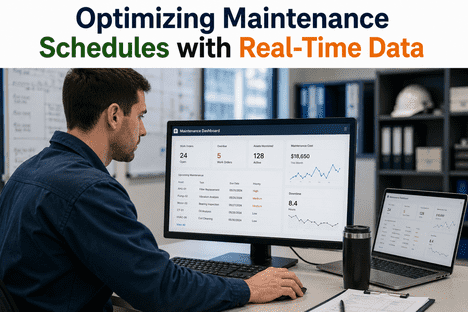
iFactory's unified maintenance operations dashboard closes these gaps by aggregating every data stream — AI vision camera feeds, IoT sensor telemetry, CMMS work order history, spare parts inventory levels, and production scheduling — into a single real-time analytics layer. The dashboard surfaces asset health scores, pending work orders by priority, schedule compliance rates, and maintenance cost trends in a single view that every stakeholder — from the maintenance technician to the plant manager — can act on with confidence. The result is a maintenance scheduling process that is no longer a weekly planning exercise but a continuous, data-driven operation that adjusts in real time to changing asset conditions and production priorities.
Replace Disconnected Maintenance Systems with One Real-Time Operations Dashboard
iFactory connects AI vision cameras, IoT sensors, CMMS, and production scheduling into a single dashboard — so your maintenance team schedules by asset condition, not calendar guesswork.
The Financial Case for Real-Time Maintenance Optimization
The decision to transition from time-based to condition-based maintenance scheduling is ultimately a financial one. The investment in AI vision cameras, IoT sensors, and a unified analytics platform must be justified against measurable cost reduction and production improvement. The data from iFactory deployments across steel, automotive, and food processing operations provides a clear picture of the return profile.
The cost structure of unplanned downtime in manufacturing is well documented — averaging $260,000 per hour across discrete manufacturing sectors, and exceeding $2 million per hour in automotive final assembly. A mid-sized plant operating 10–30 critical assets typically loses 8–12% of production time to unplanned maintenance events. Deploying a real-time condition monitoring platform reduces this loss by 35–50% within 12 months, with top-performing plants achieving 71% reduction after 18 months of continuous operation. The annual benefit ranges from $150,000 to $400,000 for mid-market facilities, with platform investment recovered within 8–18 months and cumulative three-year ROI of 3–6x. These returns are driven not only by downtime reduction but by optimized spare parts consumption, extended asset life through targeted intervention, and reduced overtime labor from emergency call-ins.
Optimizing Maintenance Schedules with Real-Time Data — Frequently Asked Questions
Build a Real-Time, Condition-Driven Maintenance Operation with iFactory AI
iFactory connects AI vision cameras, IoT sensor networks, and your existing CMMS into a single real-time maintenance scheduling platform that generates work orders from asset condition — not calendar intervals.