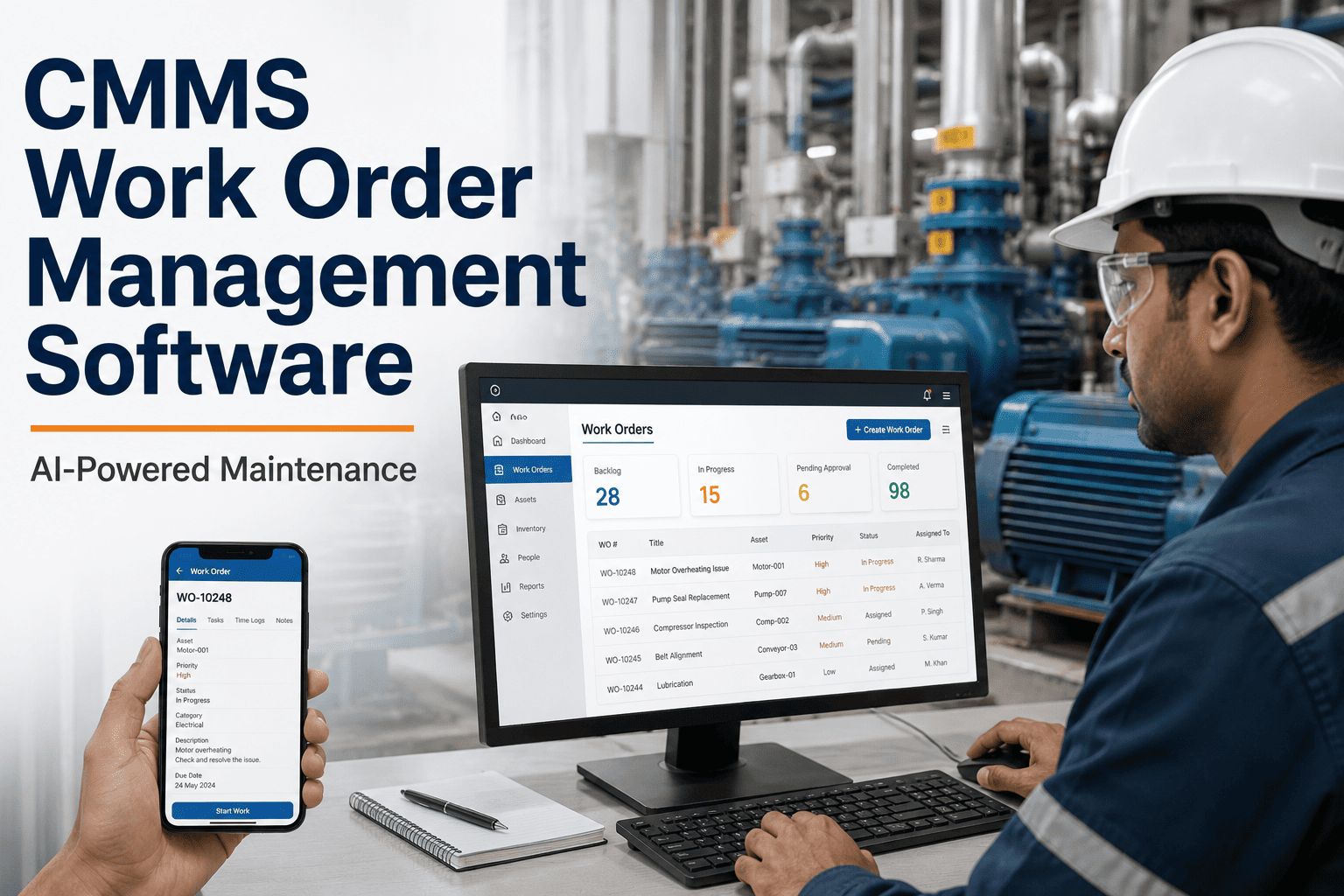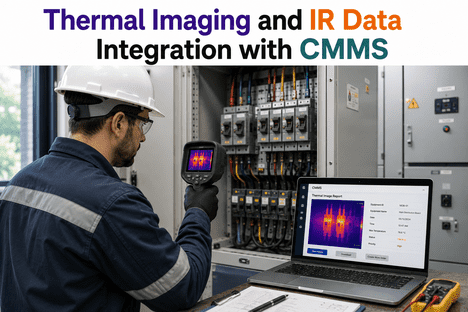
Thermal imaging and infrared (IR) data integration with Computerized Maintenance Management Systems (CMMS) is redefining how industrial facilities approach asset reliability and predictive maintenance. Traditional thermography programs rely on periodic manual sweeps where technicians capture thermal images during scheduled rounds and later reconcile findings with spreadsheets or disconnected work order systems — a process riddled with latency, transcription errors, and missed anomalies. A bearing overheating by 15°C may go unnoticed until the weekly report is reviewed, by which time irreversible damage has occurred. iFactory'sAI Vision Camera platform eliminates this gap by streaming continuous IR temperature data directly into your CMMS engine, converting raw thermal vectors into automated work orders, severity-ranked alerts, and asset health trend analysis. This transforms thermal data from a quarterly inspection artifact into a living, action-driven maintenance intelligence stream. Reliability engineers exploring this shift often begin by choosing to Book a Demo to see how our platform automates thermography-to-CMMS workflows across diverse asset portfolios.
Automate Thermal Anomaly Detection with iFactory AI Vision
Stream real-time IR camera data into your CMMS, auto-generate corrective work orders from thermal threshold breaches, and eliminate manual inspection latency — purpose-built for reliability-centered maintenance programs.
The "Thermal Intelligence Gap": Why Siloed IR Data Undermines Reliability
The fundamental failure in traditional thermography programs is the lack of "Workflow Integration." Most facilities own high-resolution IR cameras and perform scheduled sweeps, but the thermal data rarely flows directly into the maintenance execution system. This creates a visibility gap where a reliability engineer might see a hotspot on a transformer bushing but cannot immediately correlate it with the asset's maintenance history, load profile, or criticality rating. This disconnect leads to "Reactive Thermography," where corrective action is taken only after the quarterly report is compiled, by which time the component may have already failed. iFactory bridges this divide by creating a unified thermal data lake that ingests IR camera streams alongside vibration, current, and CMMS work order history. Maintenance managers exploring automated IR workflows often Book a Demo to see how our AI Vision Camera platform delivers continuous thermal governance across diverse asset classes.
Manual IR Sweeps
Technicians capture thermal images on handheld cameras. Data is stored locally or on SD cards. No direct link to asset records or CMMS work orders.
Delayed Reporting
Findings are compiled into PDF reports days or weeks later. Hotspots are assigned to no one and tracked nowhere until the next review meeting.
Reactive Repairs
By the time corrective work orders are created, temperature deltas have often crossed critical thresholds. Emergency shutdowns replace planned interventions.
AI-Integrated CMMS
Continuous thermal streaming with AI anomaly detection auto-creates priority work orders in the CMMS. Repairs happen before failure, not after.
Automated Work Order Generation from Thermal Thresholds
iFactory establishes dynamic temperature baselines for every critical asset. When the AI detects that a motor bearing or electrical connection has exceeded its thermal delta threshold — for example, ΔT > 15°C above ambient — it autonomously creates a priority-coded corrective work order in the CMMS, assigns it to the appropriate technician, and includes the thermal image and temperature trend data as evidence. This eliminates the days-long gap between detection and action.
Multi-Parameter Asset Health Correlation
Thermal anomalies rarely occur in isolation. iFactory correlates IR temperature vectors with real-time vibration, current draw, and lubrication data from the same asset. If a pump shows rising bearing temperature alongside increased vibration amplitude, the AI flags the compound failure risk and escalates the CMMS work order priority — preventing catastrophic failure that thermal data alone might not fully characterize.
Trend-Based Predictive Maintenance Scheduling
iFactory's ML models analyze historical thermal data to predict when an asset will breach its critical temperature threshold. By projecting the thermal degradation curve forward, the system recommends optimal maintenance windows — allowing planners to schedule interventions during planned outages rather than emergency shutdowns. This transforms the CMMS from a reactive logging tool into a predictive orchestration platform.
The Economic Engine of Predictive IR: iFactory vs. Traditional Thermography
The ROI of AI-integrated thermal imaging is measured not just in avoided failures, but in "Maintenance Margin." By converting IR data from a periodic inspection report into a continuous CMMS data stream, iFactory enables organizations to optimize labor, reduce spare parts emergency procurement, and extend asset life. The table below compares the core capabilities of traditional thermography programs with iFactory's autonomous AI Vision Camera platform.
| Thermal Control Area | Traditional Thermography | iFactory AI Autonomous Approach | Reliability Benefit |
|---|---|---|---|
| Inspection Frequency | Quarterly or semi-annual manual sweeps | Continuous real-time IR streaming | Immediate anomaly detection |
| Work Order Trigger | Manual entry after report review | Auto-generated from thermal threshold breach | Minutes to action, not weeks |
| Data Correlation | Isolated thermal images in spreadsheets | Multi-parameter (vibration, current, temp) | Compound fault detection |
| Temperature Trending | Manual comparison of PDF reports | Automated trend lines with ML prediction | Failure forecasting capability |
| Asset History | Scattered across email and file shares | Unified in CMMS asset record | Complete lifecycle visibility |
| Compliance Audit | Manual evidence gathering | Automated ISO 55001 / NFPA 70B logs | 100% Digital Certification |
Asset-Level Thermal Optimization Scenarios
iFactory's thermal governance extends from the high-voltage switchyard to the precision-controlled production line. By treating every critical asset as a temperature-monitored "Digital Twin," we provide reliability teams with the exact data needed to maintain thermal integrity. Engineering managers looking to deploy enterprise-wide IR integration often Book a Demo to view our multi-site thermal heatmap dashboards.
iFactory monitors every electrical distribution asset — from MV switchgear to panel boards — using fixed-mount IR cameras. The AI detects rising connection resistance by correlating surface temperature with load current, identifying loose terminations or corroded contacts before they cause arc flash events. Auto-generated CMMS work orders include exact hotspot coordinates and priority classification per NFPA 70B.
Our ML models track surface temperature gradients on motor and pump bearing housings. By analyzing thermal rise rates during startup and steady-state operation, iFactory distinguishes between lubrication degradation, bearing wear, and alignment issues. Each thermal signature triggers a specific CMMS work order template with the recommended corrective action and required spare parts.
iFactory deploys high-temperature IR cameras to monitor furnace shell temperatures, refractory condition, and insulation integrity. When surface temperature exceeds design specifications, the system calculates energy loss and predicts refractory remaining useful life. Corrective work orders are generated for targeted refractory repair before widespread degradation occurs, preventing production stoppages and reducing energy waste.
Compliance & Predictive Maintenance Roadmap
The path to "Zero-Unplanned Downtime" requires a multi-year strategy built on reliable thermal data. iFactory provides the "Phased IR Integration Roadmap" that helps sites prioritize thermal imaging investments with the highest reliability ROI. From initial digital thermography to fully autonomous CMMS-integrated thermal governance, we provide the platform for the future of industrial maintenance.
Thermal Data Unification
Goal: Transparency
- Continuous IR camera data ingestion
- Digital asset temperature baselines
- Automated thermal threshold alerts
- CMMS asset-to-thermal mapping
Predictive Thermal Governance
Goal: Failure Prevention
- ML-driven temperature trend forecasting
- Multi-parameter anomaly correlation
- Auto-generated corrective work orders
- Priority-based CMMS routing
Autonomous Reliability Mill
Goal: Zero Unplanned Downtime
- AI-driven thermal health scores
- Self-optimizing inspection schedules
- Closed-loop CMMS orchestration
- Cross-site thermal benchmarking
"Our facility was struggling with delayed thermal anomaly detection across 2,000+ critical electrical assets. iFactory's AI Vision Camera platform transformed our IR data from quarterly inspection reports into a continuous CMMS workflow. We now auto-generate corrective work orders within minutes of a thermal threshold breach, and our unplanned electrical downtime has dropped by 37% in the first year. It's the most effective reliability tool we've ever deployed."
Thermal Imaging & CMMS Integration — Frequently Asked Questions
How does iFactory connect thermal cameras to my existing CMMS?
iFactory's AI Vision Camera platform supports standard industrial protocols including Modbus-TCP, OPC-UA, and MQTT for IR camera connectivity. Our IoT gateways act as protocol translators, streaming thermal data into your CMMS via REST API or direct database integration — compatible with all major CMMS platforms including SAP, Maximo, and Infor EAM.
What temperature threshold triggers an automatic work order?
Thresholds are fully configurable per asset class and criticality rating. Typical configurations use NETA and NFPA 70B severity classifications: ΔT 1-10°C (monitor), ΔT 11-20°C (priority work order), ΔT 21-40°C (high priority), ΔT 41°C+ (immediate emergency work order with supervisor notification). All thresholds are adjustable through the iFactory dashboard.
Can the system monitor both fixed and portable thermal cameras?
Yes. iFactory supports fixed-mount IR cameras for continuous monitoring of critical assets and portable camera integration for periodic sweeps. Thermal images from handheld cameras are automatically uploaded via the iFactory mobile app, tagged with asset QR codes, and appended to the asset's thermal history in the CMMS.
How does the platform handle emissivity and ambient temperature variations?
Our AI models automatically compensate for emissivity differences across material types (copper, steel, ceramic) and ambient condition changes (solar loading, wind, humidity). Each asset has a calibrated thermal baseline that accounts for its unique surface properties and operating environment, ensuring accurate and repeatable temperature measurements.
Is the thermal dashboard available on mobile devices for field technicians?
Yes — the iFactory mobile app provides every technician with real-time thermal health scores for their assigned assets. Field personnel receive instant notifications when a thermal anomaly is detected in their zone, along with the exact location, temperature data, and required corrective action — enabling immediate response without returning to the control room.
How does iFactory help with regulatory compliance and audits?
iFactory automatically generates auditable thermal inspection logs, temperature trend reports, and work order histories required for ISO 55001, NFPA 70B, and OSHA compliance. Each thermal event is permanently linked to its asset record with timestamps, technician assignments, and corrective action documentation — eliminating manual evidence gathering for regulatory audits.
What is the typical ROI timeline for an IR-to-CMMS deployment?
Most facilities achieve full ROI within 6-9 months. The primary savings come from: 1) elimination of emergency repairs (avg. $12,000-50,000 per avoided failure), 2) reduced manual inspection labor (up to 60% reduction), 3) extended asset life through early intervention, and 4) lower insurance premiums from documented thermal inspection programs.
Can we start with a pilot deployment before scaling enterprise-wide?
Absolutely. iFactory's deployment model supports phased rollout starting with a single substation, production line, or critical asset group. Our onboarding team configures the thermal baselines, threshold rules, and CMMS integration within 2-3 weeks. Most clients begin with 10-20 critical assets and expand to enterprise-wide deployment after validating the ROI.
Transform Your IR Thermography Program into an Autonomous Reliability Engine
iFactory's AI Vision Camera platform delivers continuous thermal monitoring, automated CMMS work order generation, and multi-parameter asset health analytics — built for reliability teams ready to eliminate unplanned downtime and lead in predictive maintenance.