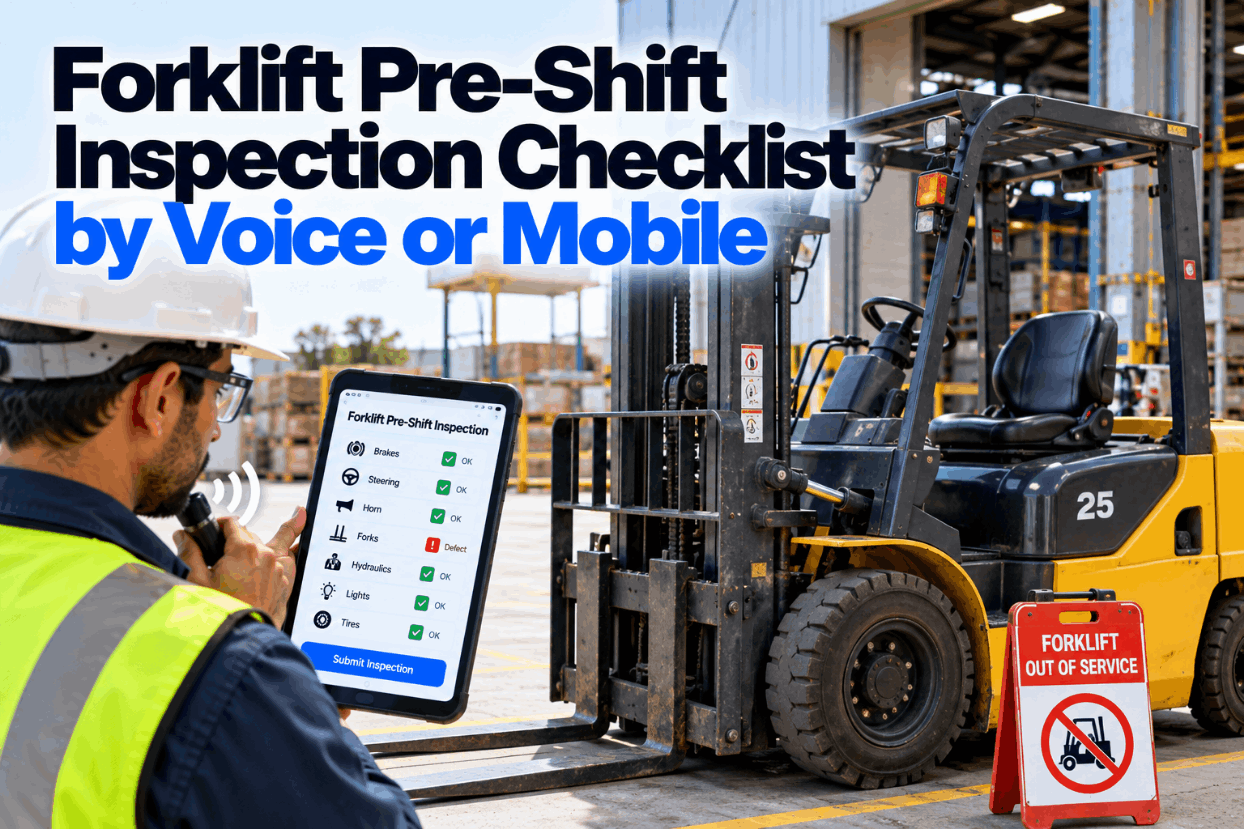
The horn on truck 7 stopped working on Tuesday. Three operators noticed, and two ticked OK on the paper sheet because it was the only way to start the shift. This guide gives you a forklift pre-shift inspection checklist done by voice or mobile, where a failed item takes the truck out of service and opens a repair job. Hear a voice check.
Forklift Pre-Shift Inspection Checklist by Voice or Mobile
Operators speak or tap each item before the shift. A failed brake, horn, fork or hydraulic check tags the truck out of service and opens a repair work order, so unsafe trucks do not go back to work.
- Why paper pre-shift sheets fail
- A tick-box checklist for every truck
- Which failures take a truck out of service
Why Paper Pre-Shift Checks Fail
A ticked box is not an inspection.
Under OSHA 1910.178(q)(7), trucks must be examined before being placed in service, at least daily, and after each shift when used around the clock. Under (q)(1), a truck with a defect that affects safe operation must be taken out of service until repaired. Powered industrial trucks were again on OSHA’s most-cited list in FY2025. Paper sheets make it easy to tick and drive. Our fleet engineers can review your current sheet.
Pencil-whipping
Every box ticked in ten seconds.
No follow-up
Defects noted, nobody told maintenance.
Repeat defects
The same fault logged for weeks.
No record
Sheets lost or filed unread.
Forklift Pre-Shift Inspection Checklist
Tick each item before the truck moves.
This checklist covers the items most manufacturers and OSHA guidance expect for sit-down counterbalance trucks. Adjust it for your fleet using the manufacturer’s manual. In the voice version, the operator speaks each item and any fail stops the truck. Get a version for your fleet in a fleet session.
Forks wear at the heel, where they meet the shank. Manufacturer and ISO 5057 guidance commonly use a 10% loss in blade thickness as the point to remove a fork from service. A fork caliper makes this a quick, objective check.
Voice or Mobile: How Each Item Is Logged
Scan, speak, done.
The operator scans the truck’s code, then speaks each item. The system knows which truck and which checklist, records each answer with a time stamp and acts on a fail at once. Ask our support desk how it handles noise and gloves.
Scan
QR code on the truck opens its checklist.
Speak
Each item answered by voice or tap.
Flag
A fail is described in a sentence.
Tag out
Truck locked out of use in the system.
Repair
Work order sent, truck back after sign-off.
Stop Unsafe Trucks Before the Shift
Start with one shift and one fleet. Supervisors see every check and every failed item from the first day.
Which Failures Take a Truck Out of Service
If it affects safe operation, the truck stops.
Not every defect stops a truck, but anything that affects safe operation must. Agree the list with your safety and maintenance teams so operators are never left to decide alone. Review your list in a criteria session.
From Defect to Repair Work Order
The operator reports, maintenance fixes, the truck returns.
The handoff between operators and maintenance is where most paper systems break. A digital check closes it: the fail raises the job, maintenance sees the operator’s note, and the truck stays locked until a technician signs it back. Our planning team can show how this links to your CMMS.
The operator
- Scans and checks the truck
- Describes any fail in a sentence
- Is offered a truck that passed
- Sees when the truck is back
Maintenance
- Gets the work order with the note
- Sees repeat defects on that truck
- Signs the truck back into service
- Tracks fleet readiness by shift
Measuring Fleet Readiness
Three numbers that show the checks are real.
A check that always passes is a warning sign. Track measures that show whether checks find real defects and whether repairs happen fast. Agree them in a pilot planning call.
Checks completed on time
Share of trucks checked before first use each shift.
Defects found per 100 checks
A rate near zero often means checks are not real.
Time out of service
Hours from tag-out to repair sign-off, by defect type.
Pre-Shift Check Mistakes to Avoid
Habits matter more than forms.
Pre-shift checks only work when operators trust that a fail leads to a fix and not to blame. A short readiness check looks at both the checklist and the culture around it.
What works
- Truck-specific checklists
- Voice or tap in under three minutes
- Automatic tag-out on a fail
- Repairs tracked to sign-off
What fails
- One sheet for every truck type
- Fails that need a supervisor to act
- Operators blamed for finding defects
- Paper sheets never reviewed
How iFactory Runs Voice Pre-Shift Checks
Daily routines that trigger maintenance.
iFactory’s Voice Pre-Shift Checks let operators speak each item. Failed items tag the truck out of service and open a repair work order for maintenance automatically, all on an on-prem server tied to the asset record. Fit questions go to our solutions team.
Truck checklists
Items set per truck type and manufacturer.
Voice entry
Each item answered hands-free in plain language.
Auto tag-out
A fail locks the truck out of use.
Repair order
Work order raised with the operator’s note.
Fleet board
Ready, tagged out and in repair by shift.
Records
Every check kept by truck, operator and time.
Check quality depends on operator habits and supervision. We measure completion, defect rates and repair times on your own fleet during the pilot.
Turnkey AI: Delivered, Connected and Live in 6–12 Weeks
You do not build this. It arrives ready.
iFactory ships as a pre-configured NVIDIA AI server with the software pre-loaded, racked and ready. Rack it, plug in power and Ethernet, and the AI is live on your network. Our team handles cabling, network setup, PLC, SCADA and CMMS integration, truck QR tagging and checklist set-up, operator training and 24×7 remote monitoring. Data stays on your network. For a scope matched to your plant, request a turnkey quote.
Ship, network and data
Server installed. Fleet list, truck types and QR codes in place.
Checklists and pilot
Voice checks run for one shift with tag-out and work orders.
Go-live and training
Live for all shifts. Operators and supervisors trained. 24×7 monitoring begins.
Frequently Asked Questions
How often must forklifts be inspected?
Before being placed in service and at least daily. If trucks run around the clock, after each shift.
What happens when an item fails?
The truck is tagged out of service and a repair work order is sent to maintenance. It returns only after a technician signs it off.
Can operators do the check by voice?
Yes. They scan the truck and speak each item. A tap option is there for quiet areas.
How long does a check take?
Usually two to three minutes for a sit-down counterbalance truck.
Does it cover electric and LPG trucks?
Yes. Checklists are set per truck type, including battery or LPG items.
How often must operators be evaluated?
At least once every three years under 1910.178(l)(4)(iii), and sooner after an incident or unsafe operation.
How do we start?
Tag a group of trucks with QR codes, load their checklists and run one shift as a pilot. To plan it, contact our team.
Make Every Pre-Shift Check Count
In thirty minutes we look at your fleet, your current checklist and how defects reach maintenance today. You keep the notes either way.
- 1Your fleet list by truck type
- 2Your current pre-shift sheet
- 3Last month’s repair orders for trucks
- 4Your tag-out procedure
- 5One defect that was missed