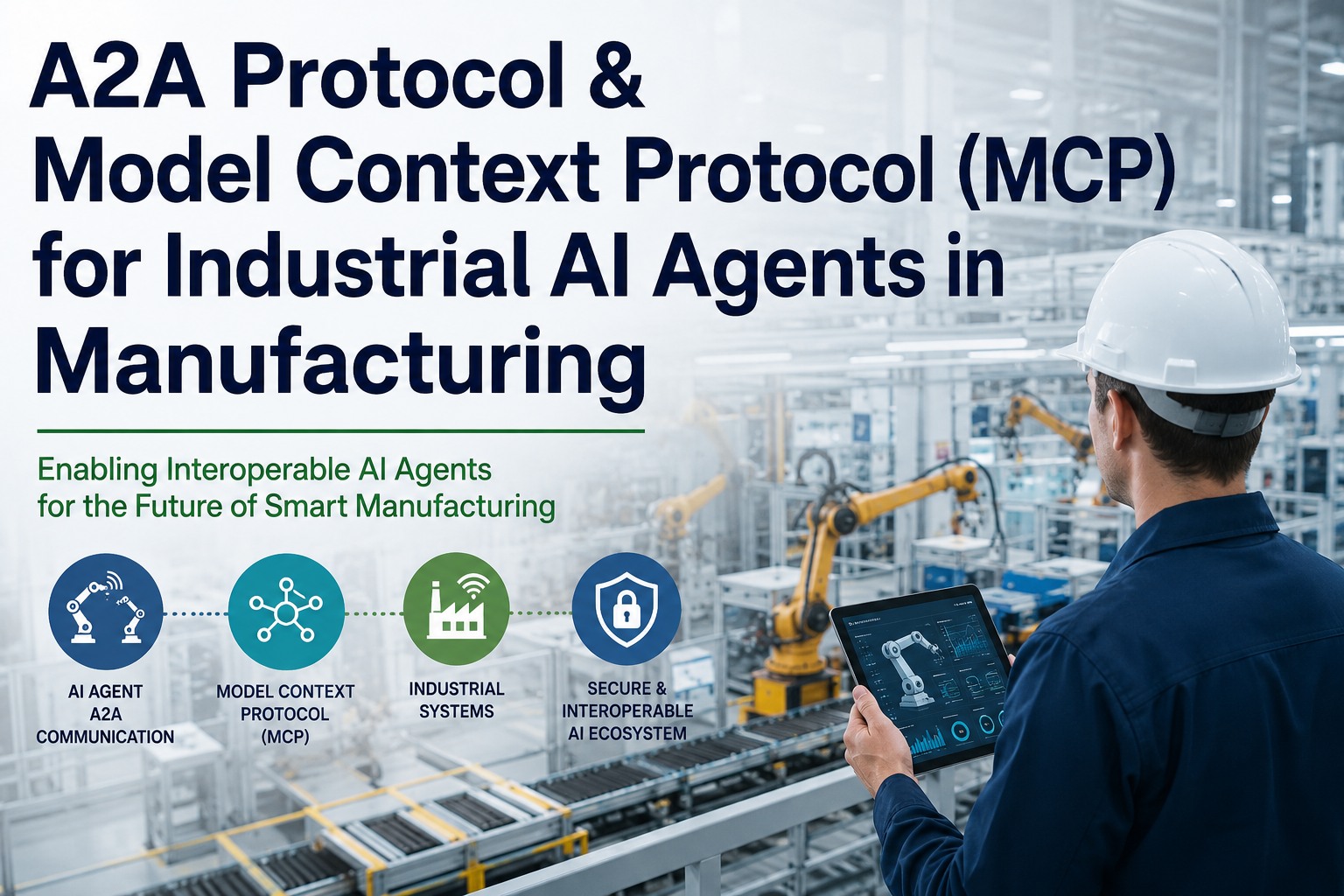
AI agents are only as useful as the things they can reach and the agents they can work with. An agent that can plan a maintenance job but cannot read the historian, write to the CMMS, or hand a parts order to a procurement agent is a clever dead end. Two open standards solve exactly this: the Model Context Protocol connects an agent to tools and data, and the Agent-to-Agent protocol lets agents collaborate across vendors. Together they are becoming the plumbing of industrial AI. This guide explains what A2A and MCP are, how they fit together on the factory floor, and how to build on them in a greenfield plant.
Designing an AI agent architecture for a new plant? Book a 30-minute interoperability consultation to build it on open standards from day one.
How A2A and MCP Fit Together
Two Protocols, Two Jobs: MCP and A2A
The protocols look similar from a distance, but they solve different problems at different layers of the stack — which is exactly why they are designed to work together rather than compete. In short, MCP is how an agent reaches its tools, and A2A is how agents reach each other. Build on both and your agents are not locked to one vendor. If you want that architecture mapped to your systems, you can review it with a specialist.
MCP
VerticalA universal adapter connecting an AI agent to tools, data sources, and APIs — the standard interface between an agent and its hands. In a plant, that means the MES, SCADA, CMMS, ERP, and historian.
A2A
HorizontalA standard for secure communication and task delegation between agents. Using an Agent Card that advertises each agent's skills, agents from different vendors can discover one another and collaborate.
Both are now governed as open standards under the Linux Foundation — a signal that the industry has settled on complementary layering rather than a single winner. MCP handles vertical integration down to the tool layer; A2A handles horizontal collaboration between agents.
Why Industrial AI Agents Need Open Standards
A factory runs dozens of systems and will soon run agents from more than one vendor. Without shared standards, every agent-to-tool and agent-to-agent link is a brittle custom integration that locks you in and breaks on the next upgrade. Open protocols turn that tangle into a fabric.
Interoperability, no lock-in
Agents and tools from different vendors plug into the same fabric, so you are never trapped with one supplier's stack.
One connection model
MCP gives every agent one way to reach tools; A2A gives every agent one way to collaborate. New agents slot in without bespoke wiring.
Built-in security
Modern specs standardize OAuth 2.1 and access controls, so agents authenticate, stay in scope, and leave an audit trail.
Want to avoid integration debt on a new plant? Book an architecture workshop and we will design your agent fabric on open standards.
How A2A and MCP Work Together on the Factory Floor
The clearest way to see the two protocols is to watch one event move through a multi-agent system. Here a bearing starts to fail, and the agents handle it end to end — using MCP to touch systems and A2A to hand off between each other.
A monitoring agent reads vibration and historian data and confirms a bearing is degrading.
MCP · reads historianIt opens a work order in the CMMS, then hands the job to the Maintenance Agent.
MCP · writes CMMS A2A · hands offThe Maintenance Agent finds the part is out of stock and delegates the order to the Procurement Agent.
MCP · checks inventory A2A · delegatesThe Procurement Agent issues the purchase order in the ERP and confirms back up the chain.
MCP · writes ERP A2A · confirmsThe Scheduling Agent books the lowest-impact maintenance window and updates the plan.
A2A · coordinates MCP · updates scheduleNo human reads a dashboard and re-keys data between four systems. The agents coordinate over A2A and act through MCP, turning a days-long chain into a closed loop.
Designing a Greenfield Agent Architecture on Open Standards
A greenfield plant gets to choose its agent architecture deliberately, before any legacy integration sets the pattern. A few principles keep it future-proof and safe.
Building a new plant and want it agent-ready? Book an implementation session and leave with an open-standards agent architecture for your project.
An Agent Fabric Built on Open Standards
iFactory connects industrial AI agents to your MES, SCADA, CMMS, and ERP through open protocols — so agents reach the tools they need and collaborate with each other securely, with OT data kept inside your perimeter.
Expert Perspective
A year ago every industrial AI project rebuilt the same plumbing — a one-off connector to the historian, another to the CMMS, a brittle script to pass a task from one model to the next. MCP and A2A end that. One is the standard for how an agent talks to a tool, the other for how agents talk to each other, and the major vendors have agreed on both. For a greenfield plant the lesson is simple: do not hard-wire agents to one platform. Build the fabric on the open standards now, and every agent you add for the next decade plugs into the same sockets.
— Industrial AI Architecture Practice, iFactory Engineering Team
community MCP servers already connecting agents to tools
enterprise partners behind A2A at launch
projected AI agents market by 2034
The Bottom Line
MCP and A2A are the two halves of one answer to a simple question: how do industrial AI agents reach everything they need to do their job? MCP connects them down to tools and data; A2A connects them across to each other. Neither competes with the other, and both are now open standards backed by the whole industry. For a greenfield plant, that turns agentic AI from a stack of fragile custom integrations into a durable fabric — build on the open protocols from day one, secure them properly, and every agent you deploy from here plugs into the same architecture.
Make Your Plant Agent-Ready From Day One
From MCP tool connections to A2A agent coordination and the security layer around them, iFactory helps greenfield teams build an industrial AI architecture on open standards — interoperable, auditable, and free of vendor lock-in.
Frequently Asked Questions
What is the Model Context Protocol (MCP)?
MCP is an open standard, introduced by Anthropic in November 2024, that defines how an AI agent connects to external tools, data sources, and APIs. It acts as a universal adapter — the interface between an agent and its hands — so an agent can read a historian, query a database, or write to a CMMS through one consistent method instead of a custom integration for each system.
What is the A2A protocol?
A2A, the Agent-to-Agent protocol introduced by Google in April 2025, is a standard for secure communication and task delegation between AI agents. Each agent publishes an Agent Card describing its skills, so agents built by different vendors or frameworks can discover one another and collaborate — for example, a maintenance agent handing a parts order to a procurement agent.
How do A2A and MCP work together?
They cover different layers and are complementary, not competing. MCP is vertical — it connects an agent down to tools and data. A2A is horizontal — it connects agents across to each other. A production multi-agent system uses MCP so each agent can act on systems, and A2A so the agents can coordinate, together forming a complete interoperability architecture.
Why do these protocols matter for manufacturing?
A plant runs many systems and will run agents from several vendors. Without shared standards, every connection is a brittle custom integration that creates lock-in. MCP and A2A let agents and tools from different suppliers work on one fabric, with standardized authentication and audit trails, which is essential in operational-technology environments where security and traceability are non-negotiable.
How does iFactory use A2A and MCP for greenfield plants?
iFactory connects industrial agents to plant systems through open protocols and secures the fabric with scoped permissions and audit trails, so agents act on tools and coordinate with each other without vendor lock-in. Designed in from day one, the architecture scales as you add agents. You can book an interoperability consultation to plan it for your build.