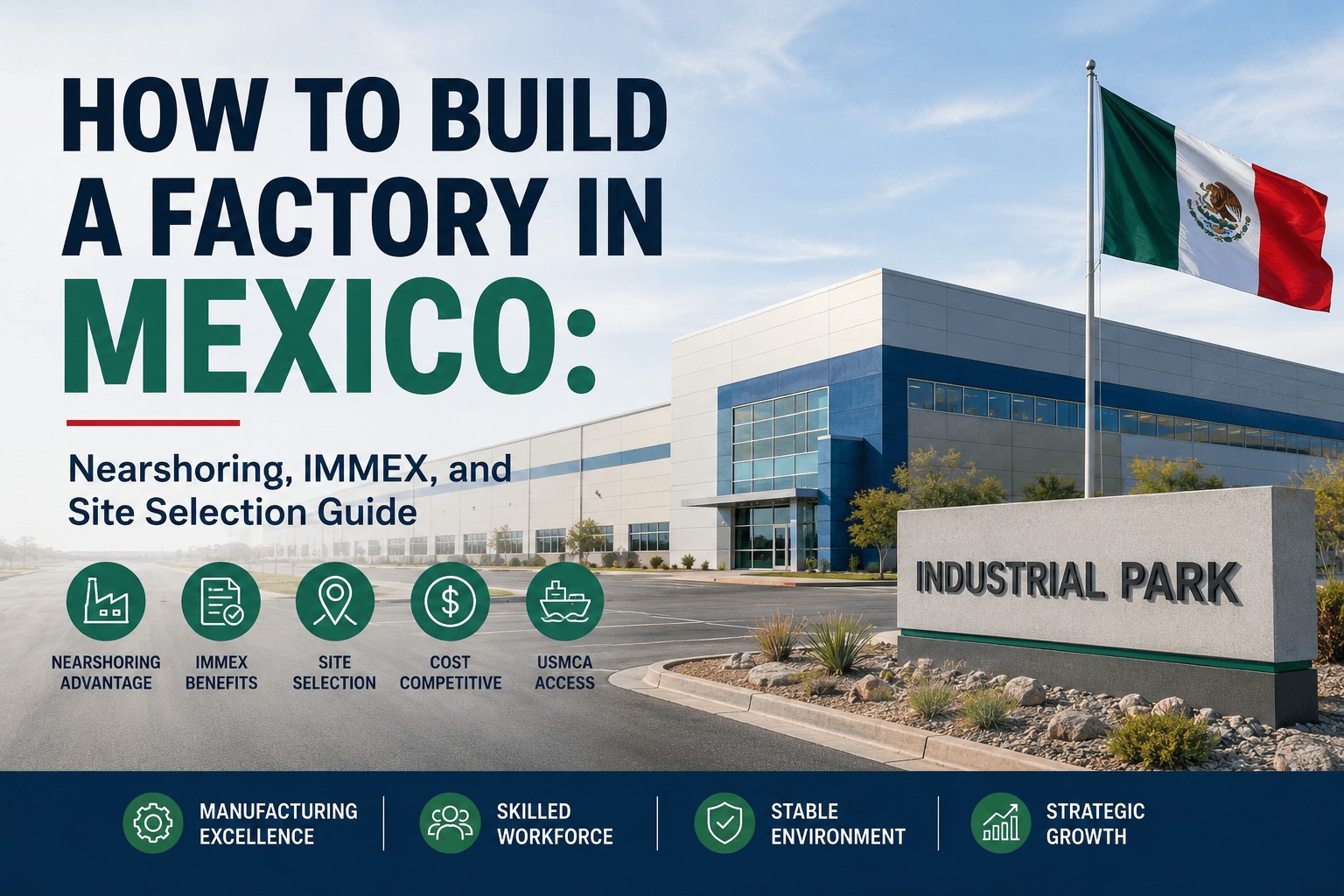
5,220 companies operate under IMMEX, employing 2.94 million Mexican manufacturing workers. National industrial vacancy dropped below 1%. Over 450 foreign firms entered Mexico in the last 24 months. Fully-fringed assembly labor runs $4.80-$7.84/hour vs $20-30+ in the US. With USMCA preserving duty-free access to North American markets and IMMEX deferring duties on imported components, the math has rarely been clearer for US manufacturers evaluating nearshoring. The hard part isn't whether to build in Mexico — it's where, how, and how fast. Northern Border for speed-to-US? Monterrey for automotive depth? Bajío for aerospace + balanced costs? Shelter structure for 3-5 month launch or standalone for 12-18 month full control? This guide breaks down the 4 manufacturing regions, the IMMEX program, the shelter-vs-standalone decision, the 6 site selection criteria, and the mistakes that derail Mexico greenfield projects. Book a Mexico greenfield assessment for your project.
Far North · Border
Northern Border
Tijuana · Juárez · Reynosa · Mexicali
Highest-volume maquila corridor. Same-day truck delivery to US distribution centers. Electronics, medical devices, automotive, appliances.
$5.66-$7.84/hr fully fringed
Northeast · Industrial Capital
Monterrey / NL
Monterrey · Saltillo · Apodaca
"Industrial Capital of Mexico." Kia 300K vehicles/yr, steel, heavy mfg. 3.5 hrs to Laredo (largest US land port). Tec de Monterrey engineering talent.
8.8% of H1 2025 FDI captured
Central · Bajío
Bajío Region
Querétaro · Guanajuato · SLP · Aguascalientes
Aerospace capital (Bombardier, GE Aviation, Safran, Honeywell). GM Silverado assembly, BMW, Nissan. Lowest labor costs in central corridor.
$4.80-$5.80/hr · aerospace cluster +15%
West · Tech Corridor
Pacific / GDL
Guadalajara · Manzanillo · Jalisco
"Mexico's Silicon Valley." $30B electronics exports/yr. HP, IBM, Intel, Oracle operations. Manzanillo Pacific port for Asia trade.
$30B electronics exports/yr
Why Mexico Now · The Nearshoring Math
Five compounding forces have made Mexico the default nearshoring choice for US manufacturers since 2023. Each one alone would have moved the needle — together they're driving the largest manufacturing capital reallocation in North America since NAFTA. The math is no longer theoretical.
01
Labor Cost Arbitrage
$4.80-$7.84/hr fully-fringed Mexican manufacturing labor vs $20-30+/hr equivalent US labor. The 3-5x wage gap funds the cost of relocation in 18-24 months on most products.
02
USMCA Duty-Free Access
Goods meeting USMCA rules of origin (75% RVC for passenger vehicles) move duty-free across the US, Mexico, and Canada. China-origin components face tariff stacks that Mexico-origin doesn't.
03
Supply Chain Resilience
Trans-Pacific shipping costs spiked 4-10x during COVID. Lead times tripled. A truck from Monterrey to Dallas is 12 hours. From Shanghai to Long Beach is 14-30 days plus inland transit.
04
IMMEX Duty Deferral
Import raw materials, components, and equipment duty-free into Mexico for export manufacturing. No import tariff paid upfront on temporary imports. Massive working capital advantage.
05
Vacancy Below 1%
National industrial vacancy dropped below 1% by end of 2025 with 450+ foreign firms entering. Early commitment is now a competitive requirement — late entrants face waiting lists and rising rents.
Mexico's 4 Manufacturing Regions Compared
Mexico's manufacturing base isn't uniform. Different regions developed specializations based on workforce skills, supply chain proximity, and historical investment. The comparison below summarizes the trade-offs across the four major manufacturing corridors. Match your sector and logistics requirements to the right region.
Dimension
Northern Border
Monterrey / NL
Bajío
Pacific / GDL
Best Sector Fit
Electronics · medical · maquila
Automotive · steel · heavy
Aerospace · auto · advanced mfg
Electronics · tech · software
Labor Cost (Fringed)
$5.66-$7.84/hr
$5.20-$6.80/hr
$4.80-$5.80/hr
$5.00-$6.50/hr
US Delivery Speed
Same/next-day truck
3.5 hrs to Laredo
12-24 hrs to border
2-3 days to border
Anchor Companies
Foxconn · medical device OEMs
Kia · Caterpillar · Whirlpool
GM · BMW · Bombardier · Honeywell
HP · IBM · Intel · Oracle
Engineering Depth
Moderate · maquila supervisors
Deep · Tec Monterrey, UANL
Deep · UNAQ aerospace
Deep · tech + electronics
Best For
Speed-to-US critical
Auto/heavy/engineering
Balanced cost + cluster
Tech/electronics + Asia ties
Pick the Right Mexican Region for Your Manufacturing Strategy
iFactory's nearshoring practice runs site selection studies across Mexico's 4 regions — sector fit analysis, labor benchmark studies, infrastructure verification, IMMEX setup, shelter-vs-standalone modeling, and 3-18 month launch planning. Built for US manufacturers expanding production into Mexico.
IMMEX Program · The Duty-Free Foundation
IMMEX (Industria Manufacturera, Maquiladora y de Servicios de Exportación) is the fiscal mechanism that makes Mexican manufacturing economics work for foreign companies. 5,220 companies operate under it. Without IMMEX, the labor cost advantage gets eaten by import duties on every component. With it, the full nearshoring math activates.
01
Duty-Free Component Imports
Raw materials, components, and sub-assemblies enter Mexico duty-free as temporary imports under IMMEX. No import tariff paid upfront. Returned to working capital instead of locked in customs duties.
02
Duty-Free Equipment Imports
Production equipment, tooling, and capital goods enter under temporary import status. No 15-20% import duty paid at the border. Massive CAPEX advantage on greenfield projects.
03
IVA (VAT) Certification
Certified IMMEX operators defer 16% IVA (Mexican VAT) on temporary imports. Without certification, the IVA is paid upfront and refunded later — millions tied up in working capital for months.
04
Simplified Customs Treatment
Pre-cleared customs procedures, dedicated customs brokers, and streamlined documentation for export shipments. Speeds border crossings from days to hours for IMMEX certified shipments.
05
USMCA Compliance Framework
IMMEX operations align with USMCA rules of origin. Mexican value-added properly documented for duty-free US/Canada market access. Single framework covers both regimes.
Need help structuring your IMMEX registration? Book an IMMEX strategy session with our nearshoring team.
Shelter vs Standalone · Choose Your Setup Path
Two distinct paths exist for entering Mexico — and the path you pick determines your timeline, control level, and risk profile. Shelter gets you producing in 3-5 months but trades operational autonomy. Standalone gives full control but adds 12-18 months and full legal entity overhead. Pick wrong and you'll spend the next two years either waiting to launch or fighting your shelter operator.
Path A · Fastest Launch
Shelter Structure
Operate under an existing Mexican shelter company's legal entity and IMMEX permit. Shelter handles HR, payroll, customs, tax filings, compliance. You focus on production. Production in 3-5 months from engagement.
Pros
Fastest launch · lower legal risk · shelter expertise · scale-up flexibility
Cons
Higher per-unit overhead · less control · shelter dependency · vendor lock
Timeline: 3-5 months to first production
Path B · Full Control
Standalone Entity
Incorporate your own Mexican entity (SA de CV typically), apply for IMMEX, hire your own staff, manage all compliance directly. Full operational and financial control. Production in 12-18 months from decision.
Pros
Full control · lower long-run cost · IP protection · scaling autonomy
Cons
12-18 month setup · legal complexity · compliance overhead · upfront CAPEX
Timeline: 12-18 months to first production
Need help running the shelter-vs-standalone trade-off model? Connect with our nearshoring advisors for a tailored framework.
Site Selection · 6 Weighted Criteria
Within your chosen region, the specific industrial park selection matters more than most US executives realize. Power availability, water reliability, and security profile vary dramatically across municipalities. The 6-criteria framework below — weighted for nearshoring decisions — separates high-performing sites from costly mistakes.
Selection Criterion
Weight
What to Verify
Sector Cluster Density
25%
Tier 1/2 supplier proximity · existing peer operations · talent pool with sector experience · component logistics
Labor Depth & Skills
20%
Available workforce at required skill levels · bilingual engineering · technical school proximity · attrition rates
Infrastructure (Power, Water, Telecom)
20%
CFE electricity contract timeline · municipal water reliability · industrial park dedicated substation · fiber connectivity
Logistics & US Border Access
15%
Distance to nearest US land port · highway quality · rail access · proximity to Pacific port for Asia trade
Security & Safety
10%
Industrial park security infrastructure · crime trends · employee commute safety · regional stability
Incentives & Total Landed Cost
10%
State/local tax incentives · IMMEX benefits · USMCA rules of origin · real estate cost · transportation cost
Need a weighted site selection matrix for your specific Mexico project? Book a site selection workshop with our nearshoring team.
5 Common Build-in-Mexico Mistakes
The same five mistakes appear in nearly every Mexico greenfield project that underperforms. Each is preventable with proper diligence — and each costs months of delay, millions of dollars, or strategic failure when it lands. Avoid all five and your Mexico build delivers on the nearshoring math.
01
Picking the Wrong Region for Your Sector
Locating an aerospace plant in the Northern Border misses the Querétaro cluster. Locating a maquila in Bajío misses the same-day US truck advantage. Match region to sector before scoring parks.
02
Skipping Power & Water Verification
CFE electricity contracts can take months. Municipal water systems vary dramatically. Verify capacity at the specific park BEFORE signing the lease — not after groundbreaking.
03
Underestimating Workforce Ramp-Up
Training a new workforce to quality standards is the biggest schedule variable. Plan 6-12 weeks of overlapping training while construction completes. Use shelter's HR team or local recruiters early.
04
Misjudging USMCA Rules of Origin
75% RVC for passenger vehicles. Sector-specific thresholds elsewhere. Importing Asian components and assuming USMCA duty-free access fails compliance audits. Map ROO at design stage.
05
Treating IMMEX as a Box-Check
IMMEX without IVA certification leaves working capital trapped. Without proper inventory tracking, audits can revoke status. Treat IMMEX as core operating process, not a registration formality.
Expert Perspective
The US executives who succeed in Mexico share one trait: they treat Mexico as a country, not as a low-cost annex of their US operation. The country has world-class engineering universities, sophisticated supplier networks, and decades of manufacturing maturity. The teams that fail try to copy-paste their US operating playbook — same management style, same vendor relationships, same operational rhythms — and then blame "Mexico" when it doesn't work. The teams that win bring their US technical standards but adopt Mexican business norms, hire bilingual leadership, partner with local advisors who know the IMMEX nuances, and respect the talent depth. Mexico isn't cheaper US manufacturing. It's a different manufacturing ecosystem that happens to be 3.5 hours from Laredo — and that distinction determines whether the nearshoring math actually delivers.
— Mexico Greenfield Manufacturing Best Practice
3-5 mo
Shelter launch timeline (first production)
12-18 mo
Standalone entity setup timeline
75%
USMCA Regional Value Content · passenger vehicles
16%
IVA deferred via IMMEX certification
Bottom Line · The Math Works · Execute Carefully
Building a factory in Mexico in 2026 is no longer a question of whether — it's a question of where, how, and how fast. The 4 manufacturing regions cluster around distinct industries. IMMEX makes the duty math work. Shelter structures launch in 3-5 months; standalone entities take 12-18. Site selection within the chosen region is more important than most US executives realize — power, water, and security vary dramatically by park. Get all of this right and the labor arbitrage, USMCA duty-free access, supply chain resilience, and proximity to US customers compound into one of the most attractive manufacturing moves available to North American operators. Get any of it wrong and you'll spend two years grinding through what should have been a 3-5 month shelter launch. The math works. Execute carefully.
Build Your Mexico Greenfield Right · From Region Selection to First Production
iFactory's nearshoring team designs and executes Mexico greenfield programs — region selection, industrial park scoring, IMMEX setup, shelter-vs-standalone modeling, workforce planning, infrastructure verification, and 3-18 month launch programs across all 4 manufacturing corridors.
Frequently Asked Questions
What is IMMEX and why does it matter for building a factory in Mexico?
IMMEX (Industria Manufacturera, Maquiladora y de Servicios de Exportación) is Mexico's primary fiscal program for export manufacturers. It allows duty-free temporary import of raw materials, components, and equipment. With IVA certification, 16% Mexican VAT is deferred on temporary imports. 5,220 companies operate under it employing 2.94M workers. Without IMMEX, duties on imported components erode the labor cost advantage.
Which Mexican region is best for manufacturing?
Depends on your sector. Northern Border (Tijuana, Juárez, Reynosa) for electronics, medical devices, and speed-to-US delivery. Monterrey/Nuevo León for automotive, steel, and engineering-heavy operations. Bajío (Querétaro, Guanajuato, SLP, Aguascalientes) for aerospace, automotive, and balanced cost+cluster benefits. Guadalajara/Pacific for electronics, tech, and Asia trade. Match region to sector first.
What's the difference between shelter and standalone setup in Mexico?
Shelter: Operate under existing Mexican shelter company's legal entity + IMMEX permit. Production in 3-5 months. Lower legal risk but higher per-unit overhead and less control. Standalone: Incorporate your own Mexican entity (SA de CV), apply for IMMEX, hire your own staff. Production in 12-18 months. Full control, lower long-run cost, but legal complexity and compliance overhead. Most companies start with shelter, transition to standalone at scale.
What does Mexican manufacturing labor cost in 2026?
$4.80-$7.84/hr fully fringed for assembly labor, varying by region. Bajío (Guanajuato): $4.80-$5.80/hr (lowest). Northern Border: $5.66-$7.84/hr (highest border-side). Mexico City: $4.91/hr production (35% above national average). Compared to $20-30+/hr equivalent US labor, the 3-5x gap funds relocation cost in 18-24 months on most products.
What are the most important site selection criteria for Mexico?
Six weighted criteria:
Sector cluster density (25%),
Labor depth & skills (20%),
Infrastructure - power/water/telecom (20%),
Logistics & US border access (15%),
Security & safety (10%),
Incentives & total landed cost (10%).
CFE electricity contracts can take months and water reliability varies dramatically — verify capacity at the specific industrial park before signing leases.
Book a Mexico site selection workshop with our nearshoring team.