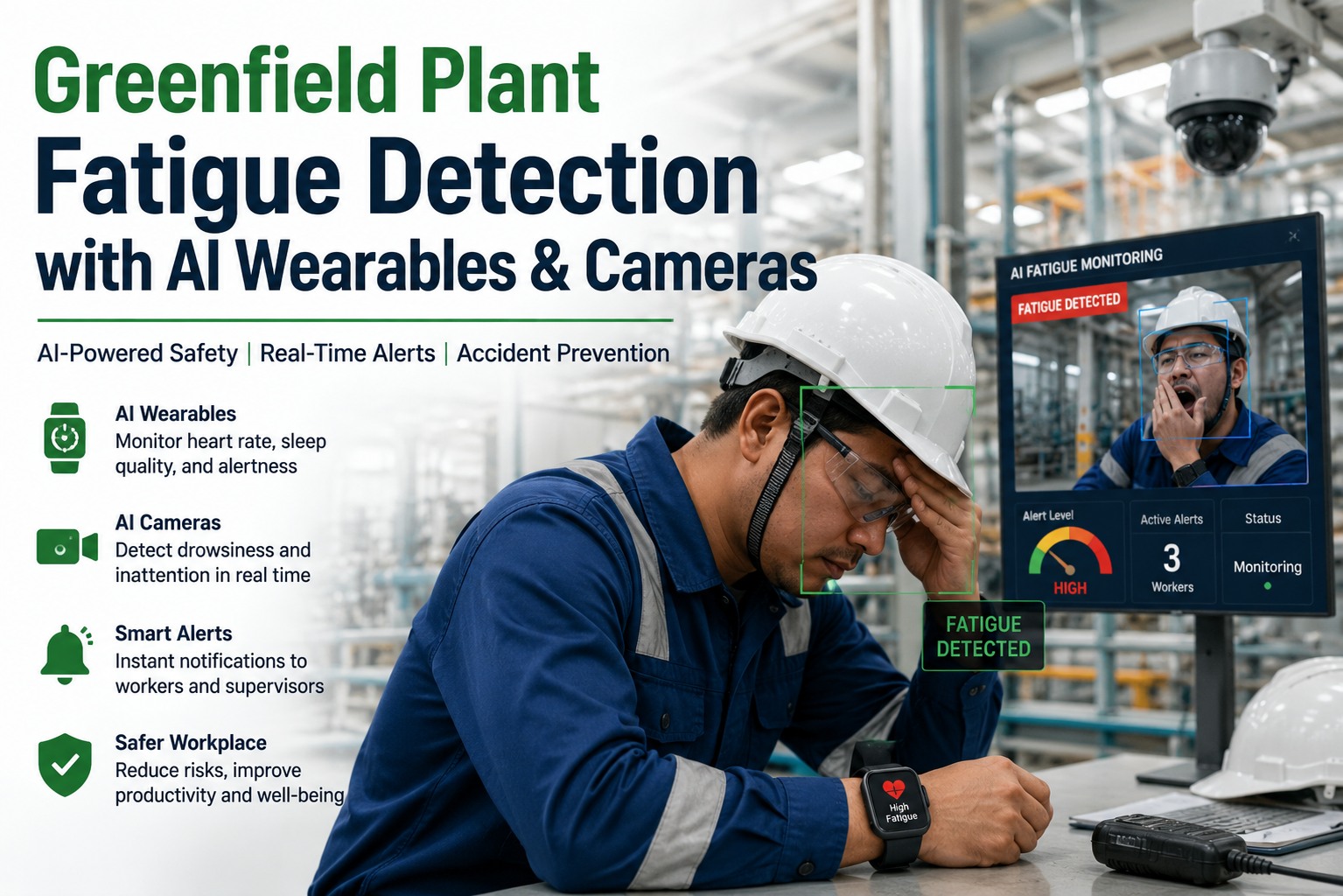
A worker who has been awake for seventeen hours is, by the numbers, about as impaired as one who has been drinking — but there is no breathalyzer for tiredness. Fatigue builds quietly across a long shift, peaks on nights, and shows up as a missed alarm, a slow reaction, or a microsleep at the controls of a forklift. It is one of the few major safety risks with no simple test, which is exactly why it so often goes unmanaged. AI fatigue detection changes that by reading two windows into the same problem — what a worker looks like, and what their body is telling them. This guide covers how it works and how to deploy it.
Building safety into a new plant? Book a 30-minute fatigue-detection consultation to design wearable and camera monitoring in from day one.
How AI Reads Fatigue From the Outside and the Inside
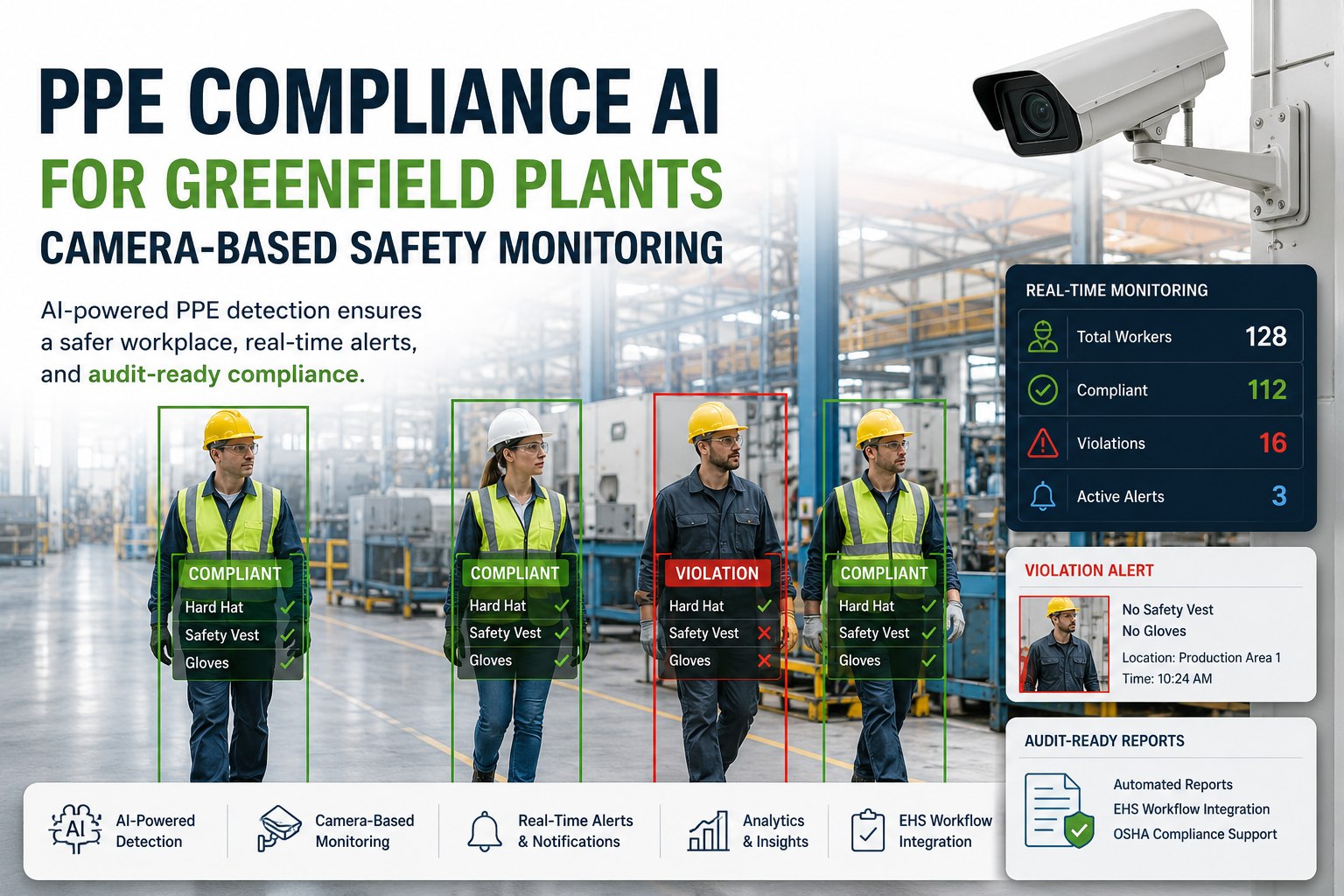
Cameras
Sees fatigue as it shows
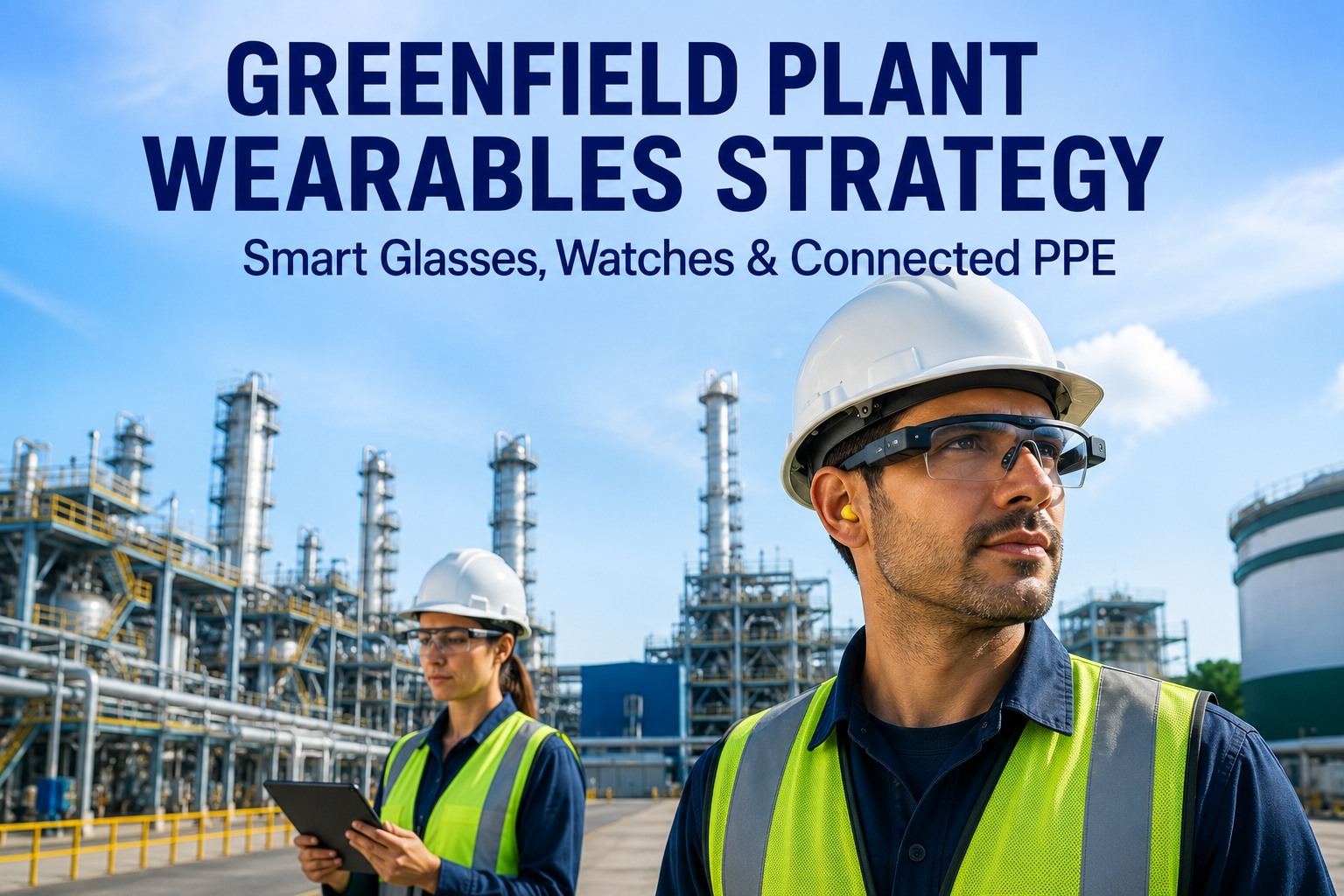
Wearables
Senses fatigue before it shows
A camera catches the droop of an eyelid; a wearable feels the strain in a heartbeat and the debt of a short night. Fused together, they give each worker a live fatigue-risk score the moment it starts to matter.
Why Fatigue Is a Safety Blind Spot
Fatigue is a baseline risk factor for nearly every error and accident, and it is uniquely hard to manage because it leaves no obvious trace. It impairs reaction time, attention, and judgment the way alcohol does, yet a worker rarely recognizes how impaired they are. On night and rotating shifts the risk climbs higher still. Because fatigue has no breathalyzer, the only way to manage it is to measure it continuously — and a greenfield plant can build that in rather than bolt it on. If you want it scoped for your shifts and high-risk roles, you can map it with a safety specialist.
awake leaves you about as impaired as a 0.05% blood-alcohol level
fatal vehicle crashes are linked to driver fatigue
earlier a wearable can flag fatigue, before it shows on a camera
Two Windows on Fatigue: Cameras and Wearables
The two detection methods look at fatigue from opposite directions, and their real power is in combination — one is fast and visible, the other is early and physiological.
Cameras can be thrown off by dust, glare, and lighting; wearables depend on being worn and charged. Together they cover each other's blind spots.
Deciding between wearables, cameras, or both for your roles? Book a fatigue-monitoring workshop and we will match the right mix to each high-risk job.
From Signal to Intervention: How the System Works
A fatigue-detection system is a short, fast loop that turns raw signals into a decision a supervisor or the worker can act on, continuously through the shift.
Capture
Operator-facing cameras and worn sensors stream visual and physiological signals.
Analyze
Models compute PERCLOS, heart-rate variability, and sleep debt, adding shift and task context.
Score
The system classifies a live fatigue-risk level for each monitored worker.
Intervene
An alert, a break, a task rotation, or a supervisor nudge — before an incident.
Want this loop mapped to your highest-risk roles? Book a safety design review and we will plan camera coverage and wearable rollout for your plant.
Deploying Fatigue Detection Responsibly
Fatigue monitoring touches workers' bodies and faces, so it only works if it is built on trust. These four principles separate a system people accept from one they quietly defeat.
Privacy & Consent
Be transparent about what is sensed, minimize and protect biometric data, and earn worker buy-in before rollout.
Fatigue Risk Management
Fit detection into a broader fatigue risk management system with shift design, training, and policy under ISO 45001.
Day-One Infrastructure
Design camera coverage, wearable programs, and data pipelines into the greenfield build, not as a costly retrofit.
Support, Not Surveillance
Use fatigue data to intervene and protect, never to discipline — or workers will route around the system.
Catch Fatigue Before It Becomes an Incident
iFactory helps greenfield teams bring computer-vision and wearable fatigue detection together with the rest of plant safety on one platform — turning silent fatigue into a live, actionable risk score for the workers and roles that need it most.
Expert Perspective
The mistake teams make is treating cameras and wearables as competing options when they answer different questions. A camera tells you a worker is drowsy right now, which is vital but late — the eyelids are already drooping. A wearable, reading heart-rate variability and the sleep debt someone walked in with, can flag a dangerous decline hours earlier, before performance slips at all. Run them together and you get both the early warning and the real-time catch. But the technology is only half of it. If workers believe the data will be used to write them up, they will defeat it. The plants that succeed treat fatigue detection as a tool to protect people, build it in from day one, and are completely transparent about it.
— Industrial Safety Practice, iFactory Engineering Team
the eye-closure measure that anchors camera-based detection
awake is roughly a 0.10% blood-alcohol level of impairment
when fatigue and incident risk climb the highest
The Bottom Line
Fatigue is a major safety risk hiding in plain sight, impairing workers like alcohol while leaving no easy test behind. AI fatigue detection finally gives it one — cameras to read the visible signs of drowsiness in real time, wearables to sense the physiological decline before it shows, and AI to fuse them into a live risk score. Build that into a greenfield plant from day one, wrap it in a real fatigue risk management system, and treat the data as a way to protect people rather than police them. Done that way, fatigue detection turns one of the hardest safety risks to manage into one you can actually see coming.
Make Worker Fatigue Visible From Day One
From camera and wearable selection to AI fusion, alerting, and fatigue risk management, iFactory helps greenfield teams design a safety system that sees fatigue coming and protects the people most at risk — built in from the first shift.
Frequently Asked Questions
How does AI detect worker fatigue?
It uses two kinds of signals. Cameras with computer vision watch for the visible signs of drowsiness — slow eyelid closures measured as PERCLOS, blink patterns, yawning, and head nodding. Wearables track physiological signals like heart-rate variability, skin temperature, movement, and accumulated sleep debt. Machine-learning models turn those signals into a fatigue-risk level, and the most capable systems fuse both sources together with shift context for a more reliable result than either gives alone.
What is PERCLOS?
PERCLOS stands for the percentage of eyelid closure over the pupil across a set time window. It captures the slow eye closures and droops that signal drowsiness, rather than ordinary fast blinks, and it is widely regarded as the benchmark measure for camera-based fatigue detection. A rising PERCLOS value is one of the clearest visible indicators that an operator is approaching a microsleep.
Are wearables or cameras better for fatigue detection?
Neither is simply better; they are complementary. Cameras detect drowsiness as it happens and require nothing to be worn, but they only see fatigue once it is already affecting behavior and can be disrupted by dust or poor lighting. Wearables can predict a decline hours earlier from physiology and sleep debt, but depend on being worn and charged. The strongest systems combine both so each covers the other's weakness.
Is fatigue detection a privacy concern?
It can be, because it involves cameras and biometric data, so it has to be handled carefully. Good practice is to be transparent about what is collected, minimize and secure the data, gain worker consent, and use the results to intervene and protect rather than to discipline. When fatigue detection is framed as a safety tool within a fair fatigue risk management program, workers are far more likely to accept and rely on it.
How does iFactory help deploy fatigue detection?
iFactory's greenfield advisory helps design camera coverage, wearable programs, and the supporting data pipelines into the plant from day one, and its platform brings fatigue signals together with the rest of plant safety into one live view with alerting. That lets teams act on fatigue risk in the moment while keeping the data governed and worker-friendly. You can book a consultation to plan it for your facility.