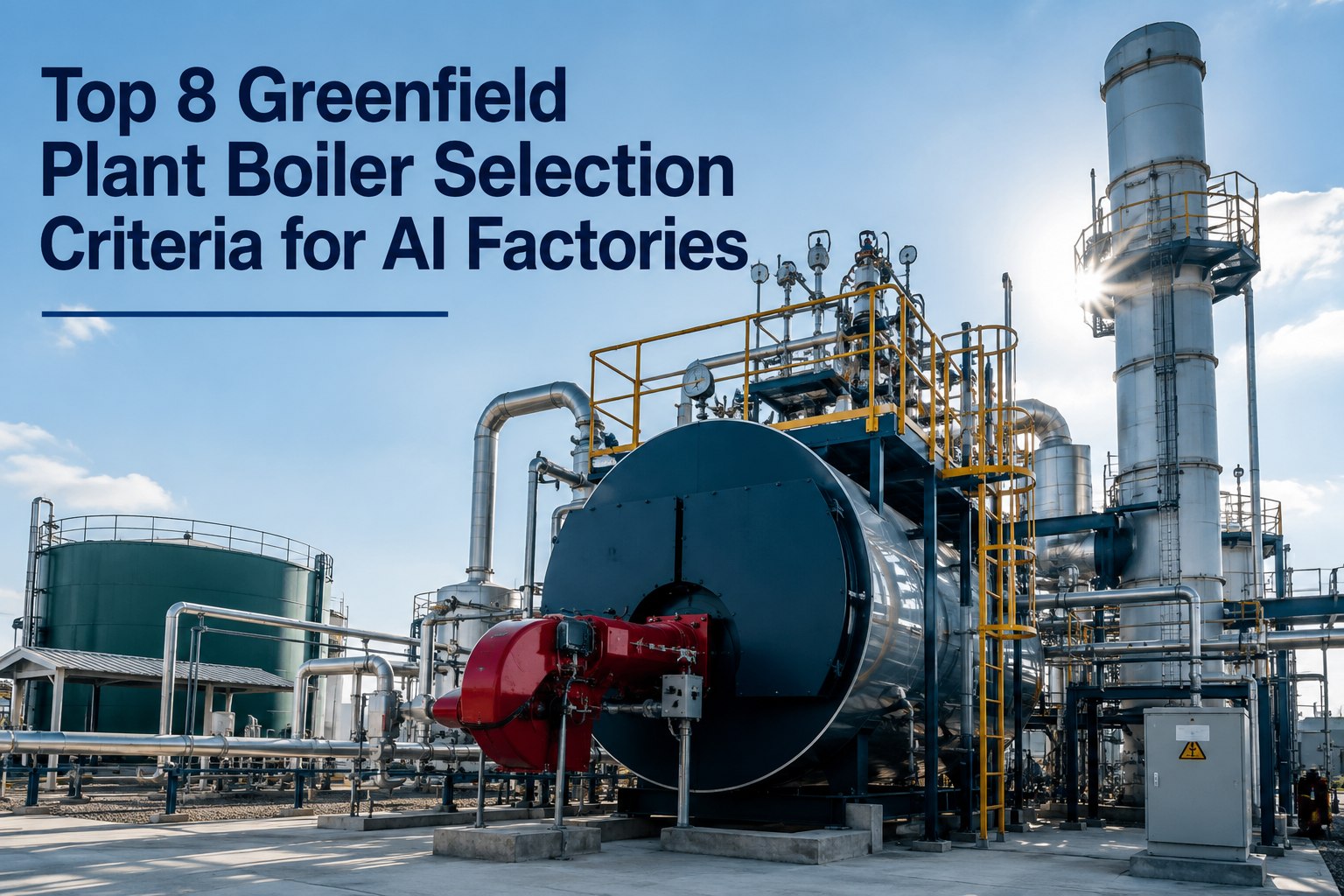
Selecting the wrong boiler for a greenfield AI factory is not a recoverable mistake. Boilers are 20–30 year assets — the fuel type you specify locks your emissions trajectory, the redundancy architecture determines whether a tube failure halts production, and the combustion control system determines whether your fuel cost is managed or wasted for years. With lead times now running 12–18 months for bespoke industrial units, the specification must be right at FEED. These eight criteria are the ones that determine whether your boiler performs for the life of the plant or becomes the first major retrofit project.
Get your greenfield boiler specification validated by iFactory — all 8 criteria scoped and documented before your utility engineer issues the RFQ.
Greenfield Boiler Selection — 8 Criteria
From Sizing to AI Combustion: What Every Specification Must Cover
Each criterion maps to a specific cost, risk, or compliance obligation. Missing any one at specification stage creates a retrofit problem measured in years and millions.
Steam Demand Sizing
kg/hr · bar · pressure class
Size at peak demand + 20% margin using 15-min interval data. Wrong sizing is irreversible — boilers are 20–30 year assets.
Fuel Type & H₂ Readiness
NG · biomass · H₂-blend · electric
Fuel type locks your emissions trajectory for the life of the boiler. Specify H₂-ready burners at no significant premium — avoids future burner replacement.
Boiler Type & Configuration
Firetube · watertube · modular
Modular watertube is the greenfield AI default — 10:1 turndown, 10–20 min cold start, native N+1 by adding one module.
Redundancy Architecture
N+1 · lead-lag · standby sizing
Two units at 75% in lead-lag restores steam in 60–90 sec on failure. Single unit + cold standby = 30–60 min production stop.
AI Combustion Control
O₂ trim · flame AI · efficiency drift
AI combustion delivers 3–7% annual fuel savings through continuous excess air correction and 4–14 week early warning on fouling events.
Emissions Compliance
NOx · CEMS · Scope 1 ESG
CEMS mandatory under EPA MACT / EU IED. Ultra-low NOx burners achieve 9–25 ppm vs. conventional 50–100 ppm. AI auto-generates permit reports.
Predictive Tube PM
Sensor suite · water chemistry · AI baseline
12-sensor suite (O₂, pH, conductivity, vibration, temp) gives AI the inputs to flag fouling and pump degradation weeks before forced outage.
DCS / CMMS Integration
OPC-UA · alarm routing · work orders
OPC-UA connects all boiler parameters to plant DCS. AI alerts auto-generate CMMS work orders with context, trend data, and linked spare parts.
C1 & C2 — Steam Sizing and Fuel Type: The 20-Year Decisions
These two criteria are the most consequential and the most permanent. Steam pressure class constrains every downstream equipment selection. Fuel type locks your carbon trajectory, burner configuration, and operating cost exposure to commodity markets for the life of the boiler. Both must be specified before boiler type selection — they determine what configurations are even available.
Steam Demand Sizing
Size at peak demand + 20% margin using 15-minute interval load data — not monthly averages. AI factories have highly variable steam demand: cleanroom HVAC requires constant pressure while process loads fluctuate with production schedules. Size for Year 5 load, not Day 1.
Fuel Type & Hydrogen Readiness
Fuel type is a 20-year commitment to an emissions trajectory and utility cost structure. Specify hydrogen-ready burners (20–30% H₂ blend) for any natural gas boiler with a long design life — at minimal cost premium — enabling compliance transition without burner replacement.
C3 & C4 — Boiler Type and Redundancy: Configuration for Production Continuity
Boiler type determines turndown capability, startup time, footprint, and maintenance access. Redundancy architecture determines the consequence of any single boiler failure — the question that matters most when steam supply interruption halts an entire production line.
On failure: 30–60 min steam-off before standby reaches pressure. Production stops.
On failure: lag unit picks up load in 60–90 seconds. Production continues at full output.
Not sure which boiler type and redundancy config fits your steam load? Book a boiler configuration session with iFactory — we match pressure class, peak demand, and redundancy requirement to the right setup before your P&ID is drawn.
Already know your boiler type and need the redundancy architecture reviewed? Talk to iFactory's plant utilities team — we specify lead-lag sizing and N+1 configuration for your steam demand profile.
C5 & C6 — AI Combustion Control and Emissions Compliance
A well-specified AI combustion control system simultaneously reduces fuel cost and maintains emissions compliance — because excess air, the most common combustion inefficiency, also increases NOx and stack losses. Specifying both at commissioning delivers 3–7% annual fuel savings and eliminates the manual CEMS reporting burden.
All 8 Criteria. One Specification. Before Your RFQ Closes.
iFactory specifies steam sizing, fuel strategy, boiler configuration, redundancy, AI combustion, emissions compliance, predictive PM, and DCS integration — delivered as a complete procurement document before your 12–18 month lead time starts.
C7 & C8 — Predictive Tube PM and DCS Integration
The final two criteria determine whether the boiler becomes a monitored, improving asset from day one — or a source of unplanned shutdowns and reactive spend. The sensor suite for C7 costs a fraction of retrofitting later, and the CMMS integration in C8 converts every AI alert into a structured work order before the boiler team even notices the anomaly.
Predictive Tube PM Sensor Suite
Specify at boiler procurement — retrofitting is 3–5× the greenfield cost
DCS / CMMS Integration Architecture
The chain from sensor anomaly to closed work order — all automated
annual fuel savings from AI combustion optimization and excess air correction
advance warning on efficiency-degrading conditions vs. zero from periodic stack testing
AI accuracy detecting degradation conditions before losses become financially significant
documented annual excess fuel cost at one plant running 11 months of undetected heat exchanger fouling
Need C7 and C8 scoped for your boiler spec? Book a predictive PM design session with iFactory — we specify the sensor suite, CMMS work order architecture, and AI monitoring config before your vendor finalizes the instrumentation package.
Expert Perspective
A boiler may keep producing steam while excess air increases, stack temperature rises, condensate return drops, heat-transfer surfaces foul, and feed pumps lose efficiency — for months before anyone notices. The consequence is not only a higher fuel bill. It is unstable steam pressure, higher emissions, more frequent maintenance, reduced equipment life, and lower production reliability. The greenfield window is the one opportunity to instrument a boiler correctly from first firing. The sensor suite and AI monitoring integration costs a fraction of the fuel you will waste in the first five years without it.
boiler asset life — every wrong specification decision compounds across this window
lead time for bespoke industrial boilers — spec must be right at FEED, not at commissioning
higher cost to retrofit sensors and AI monitoring post-commissioning vs. specifying at procurement
Your Greenfield Boiler Spec — Right Before the Lead Time Starts
iFactory's plant utilities team covers all 8 boiler selection criteria — steam sizing, fuel strategy, boiler type, redundancy, AI combustion, emissions compliance, predictive PM sensor suite, and DCS/CMMS integration — delivered as a complete procurement specification before your 12–18 month lead time begins.
Frequently Asked Questions
What boiler type is best for a greenfield AI factory?
Modular watertube is the preferred default for most greenfield AI factories — 10:1 turndown, 10–20 min cold start, and native N+1 redundancy by adding one module. For high-pressure processes above 30 bar, full watertube units are required. Firetube suits low-pressure, budget-sensitive applications with stable demand but offers limited expansion headroom and slower standby response.
How much does AI combustion control save on boiler fuel?
AI combustion control delivers 3–7% annual fuel savings through continuous O₂ trim, excess air correction, and early fouling detection. On a boiler consuming $500K/year in gas, that is $15K–$35K annually. AI systems achieve 91–96% accuracy detecting efficiency-degrading conditions 4–14 weeks before losses become financially significant — compared to zero predictive capability from periodic stack testing alone.
Should we specify hydrogen-ready burners in 2026?
Yes — for any NG boiler with a 15+ year design life. H₂-ready burners (rated for 20–30% H₂ blend) cost minimally more than conventional NG burners and avoid a full burner replacement when hydrogen supply infrastructure matures. Plants with long asset lives, high-temperature steam requirements, and carbon-reduction pressure are the strongest candidates — which describes most new greenfield manufacturing facilities.
What redundancy configuration should a greenfield plant specify?
Two units at 75% capacity in lead-lag is superior to one 100% unit plus cold standby. With lead-lag, when the lead unit fails the lag unit picks up full load in 60–90 seconds — production continues. With a cold standby, the plant has 30–60 minutes of steam-off time while the standby comes to pressure. N+1 is the minimum for any facility where steam supply interruption halts production.
What sensors must be specified for predictive boiler maintenance?
The minimum predictive suite is 12 measurement points: flue gas O₂, CO/CO₂ stack analyzers, stack temperature, flame scanner, conductivity/TDS, pH, silica/hardness online analyzer, feedwater flow, steam drum pressure and level, feed pump vibration, and blowdown conductivity. These give the AI model the inputs to detect fouling, combustion drift, water chemistry problems, and pump degradation weeks before any condition causes a forced outage or appears in the monthly fuel bill.