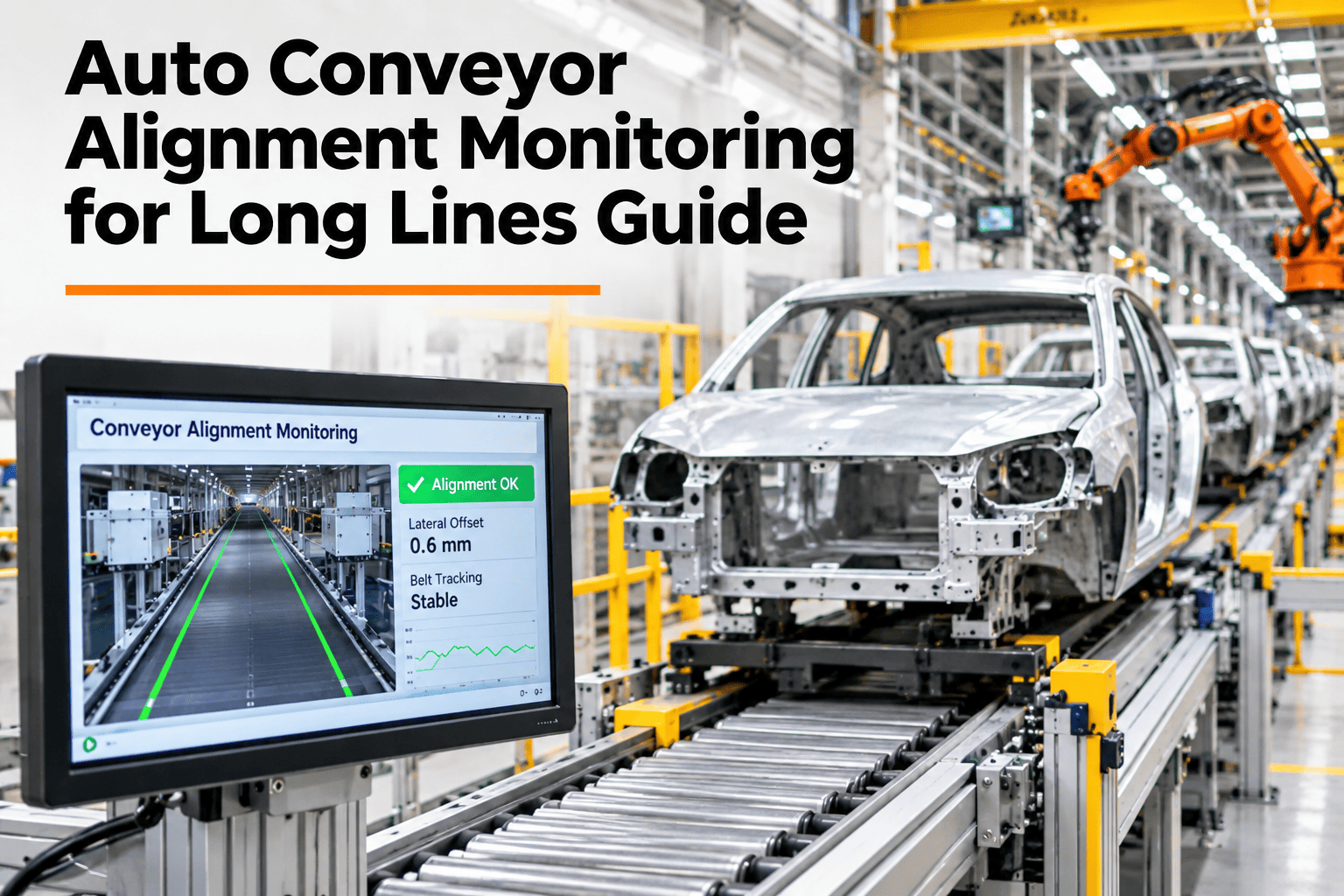
A conveyor belt that's drifted a few millimeters off-center a hundred meters upstream doesn't announce itself; it just quietly chews at the belt edge, shaft by shaft, until that edge wear turns into a tear or a jam far downstream from where the real problem started. On a long automotive assembly conveyor, the distance between where misalignment begins and where its consequence finally shows up makes manual spot-checks nearly useless for catching it early. Tracking sensor networks, drift detection and correction alerts close that gap by watching the whole line continuously instead of a few inspection points. iFactory AI's automotive conveyor team can map your own line's alignment sensor coverage before the next belt-edge incident.
By the Time Misalignment Is Visible, It's Already Done Its Damage
A tracking sensor network, continuous drift detection and early correction alerts catch belt misalignment where it starts, not where it finally shows up as edge damage or a jam further down the line.
Why Long Lines Make Misalignment Especially Costly
A short conveyor segment lets an operator notice edge wear during a routine walk-by, but a long automotive assembly conveyor running the length of a building means the point of initial drift and the point where damage finally becomes visible can be separated by a hundred meters and several hours of running time. By the time a torn belt edge or a jam forces a stop, the root misalignment has often been quietly running for days, and tracing the stop back to its actual starting point without continuous data is close to guesswork.
Gradual damage from sustained off-center running, invisible until it's severe.
A misaligned belt is more prone to catching and jamming at transfer points.
Drift starting point and visible consequence can be far apart on a long line.
A periodic walk-by only catches drift that happens to be visible at that moment.
Building Continuous Alignment Coverage
Coverage needs to be continuous along the line's length, not concentrated at a few known trouble spots. Our team can review your current sensor placement against the line's full length.
Sensors placed along the full line length, not just at known problem zones.
Normal belt position per zone, accounting for load and speed variation.
Gradual movement away from baseline flagged before it reaches a damage threshold.
An early correction alert lets maintenance adjust before edge wear or a jam occurs.
Detection Methods Compared
| Method | Coverage | Catches Drift Before Damage? |
|---|---|---|
| Manual visual spot-check | Limited to inspection points and timing | Rarely — depends on timing luck |
| Fixed trip-switch at known points | Only at the switch location | Only after drift is already severe |
| Continuous tracking sensor network | Full line length, continuous | Yes — trend detected before damage threshold |
See Where Drift Is Building on Your Own Line
Share your current conveyor layout and any existing alignment switches, and see where continuous tracking would add the earliest warning.
A Composite Scenario: The Jam That Started Two Shifts Earlier
Picture a long assembly conveyor where a belt-edge tear finally forced a stop, with the maintenance team initially unable to explain why that specific section had failed since nothing had looked unusual on the last walk-by.
Reviewing continuous sensor data from a nearby zone showed the belt had actually been drifting steadily for roughly two shifts before the tear occurred, well before the point any scheduled visual check would have been due. The same drift, caught early by a correction alert, would have meant an adjustment instead of an unplanned stop and a damaged belt section. The scenario illustrates why continuous monitoring matters on long lines; actual drift timelines vary by line and load.
Where iFactory AI Fits
iFactory AI deploys a tracking sensor network along the full length of a conveyor line, detects drift as a trend against each zone's baseline, and issues correction alerts before belt-edge damage or a jam occurs.
Sensors along the whole line, not concentrated at a few known trouble spots.
Drift flagged as it develops, not only once it crosses a damage threshold.
Maintenance gets a window to adjust before edge wear or a jam forms.
Frequently Asked Questions
Enough to cover the full line length without large unmonitored gaps, which depends on the line's layout and known high-risk zones — our team can map a sensor layout against your specific conveyor length and transfer points. Get a sensor placement plan for your line.
Yes, a proper baseline accounts for the normal position variation that comes with different load conditions and speeds, so the system flags genuine drift rather than reacting to expected operational variation. Ask how baselines are built for your line's product mix.
Early enough that maintenance can schedule an adjustment within a normal shift rather than responding to an emergency, since the alert is based on a drift trend rather than waiting for a fixed threshold to be crossed. Review typical alert lead times for your line type.
No, tracking sensors are typically added onto the existing conveyor structure without requiring the belt or drive hardware itself to be replaced. Confirm installation requirements for your conveyor type.
Alignment drift is one of several root causes that can eventually produce a jam, so alignment monitoring works alongside jam detection and accumulation analysis as part of a complete picture of conveyor health rather than replacing either of them. Discuss how these layers fit together for your conveyor system.
Catch Belt Drift Where It Starts, Not Where It Finally Shows Up
iFactory AI tracks belt alignment continuously along the full line length, flagging drift early enough to correct it before damage occurs.