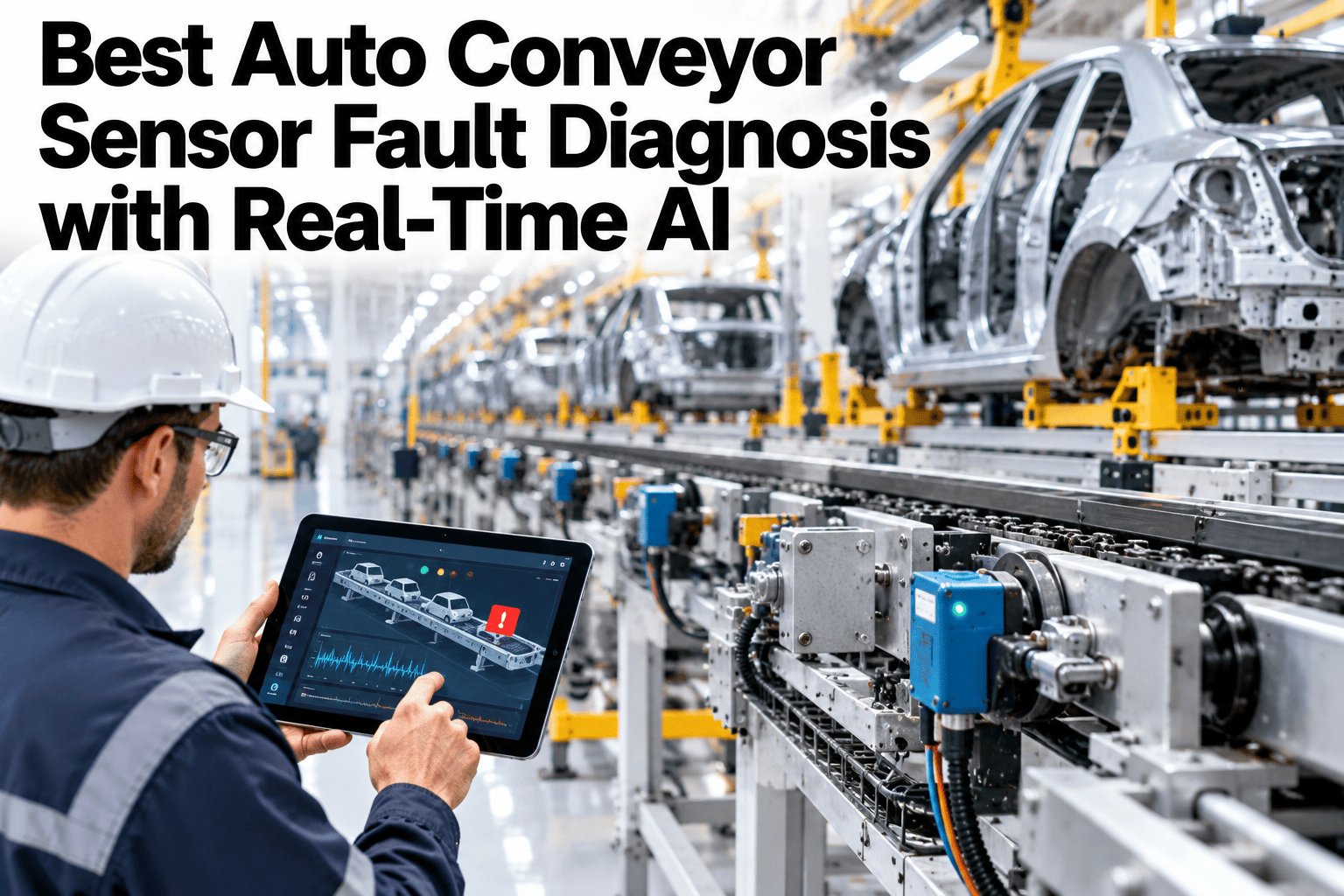
An automotive assembly conveyor relies on dozens of small sensors doing their job silently all shift long, and the failure mode that causes the most confusion is not the sensor that stops working outright, it is the one that starts drifting, reporting values that are close enough to normal to pass a casual glance but wrong enough to trigger false stops or miss real ones. A proximity sensor reading slightly early, a photoelectric sensor losing sensitivity, or an encoder accumulating small errors over a long shift can each quietly degrade conveyor reliability long before anyone traces the problem back to the sensor itself. See sensor drift detection running on your own assembly conveyor.
Catch the Sensor Drifting, Not Just the One That Stopped
iFactory AI detects proximity, photoelectric, and encoder sensor drift in real time, keeping assembly conveyor sensing reliable through a full long shift.
A Dead Sensor Is the Easy Case
A sensor that stops reporting entirely is obvious and gets fixed quickly, but a sensor that drifts gradually, reporting values that are subtly wrong rather than clearly broken, can run for an entire shift generating false triggers or missed detections before anyone identifies it as the actual source of the problem, usually after several other systems have already been blamed first.
Proximity Sensors
Drift shows as detection timing shifting earlier or later than the calibrated point.
Photoelectric Sensors
Drift shows as reduced sensitivity, missing detections under normal conditions.
Encoder Sensors
Drift shows as small positional errors accumulating over a long shift's operation.
Diagnose Drift on Your Own Sensor Fleet
Book a 30-minute session and see real-time sensor drift detection running on your own assembly conveyor sensors.
Spotting Drift Before It Causes a Stop
Each sensor type drifts in its own characteristic way, and detection is tuned to that specific pattern.
| Sensor Type | Drift Pattern | Early Signal |
|---|---|---|
| Proximity | Detection point shifting gradually over time | Trigger timing trending away from calibrated baseline |
| Photoelectric | Sensitivity declining, especially in dust or vibration | Rising rate of marginal or missed detections |
| Encoder | Small positional error accumulating across a shift | Drift growing relative to known reference points |
From Drift Signal to Diagnosis
Detection runs continuously against each sensor's own calibrated baseline, not a one-time factory setting.
Sensor Reliability Across a Shift
A composite view of sensor drift risk across one assembly conveyor, scored by sensor type.
Rolling Out Across Assembly Conveyors
iFactory AI connects to existing sensor networks at each conveyor station without requiring new sensor hardware in most cases.
Expert Review
Photoelectric sensors tend to show the most shift-dependent drift of the three, since dust and vibration accumulate over the course of a long run, which is why their drift pattern often looks fine at shift start and only becomes apparent by the final hours, exactly when a maintenance team has the least patience to diagnose it manually.
Frequently Asked Questions
Does this require replacing our existing sensors?
No, it connects to your existing proximity, photoelectric, and encoder sensors rather than requiring replacement, reading the same data those sensors already produce. Support can confirm compatibility with your current sensors.
How is a sensor's calibrated baseline established?
A baseline is built from an initial monitoring period under normal operating conditions, capturing each sensor's expected behavior before drift detection begins comparing against it.
Can this distinguish sensor drift from an actual process issue?
Yes, the pattern of a sensor reading diverging from its own historical baseline, independent of actual conveyor events, is what distinguishes drift from a genuine process change. See this distinction demonstrated on a call.
What happens when a sensor is flagged for drift?
A work order is generated identifying the specific sensor and its drift pattern, so the technician goes directly to the right component rather than troubleshooting the whole station.
Does this work across multiple assembly lines at once?
Yes, drift detection scales across every connected conveyor station and line, with a plant-wide view available alongside individual sensor detail. Ask support about multi-line deployment.
Keep Every Sensor Honest, All Shift Long
iFactory AI detects proximity, photoelectric, and encoder sensor drift in real time. Book a demo to see it on your own assembly conveyor sensors.