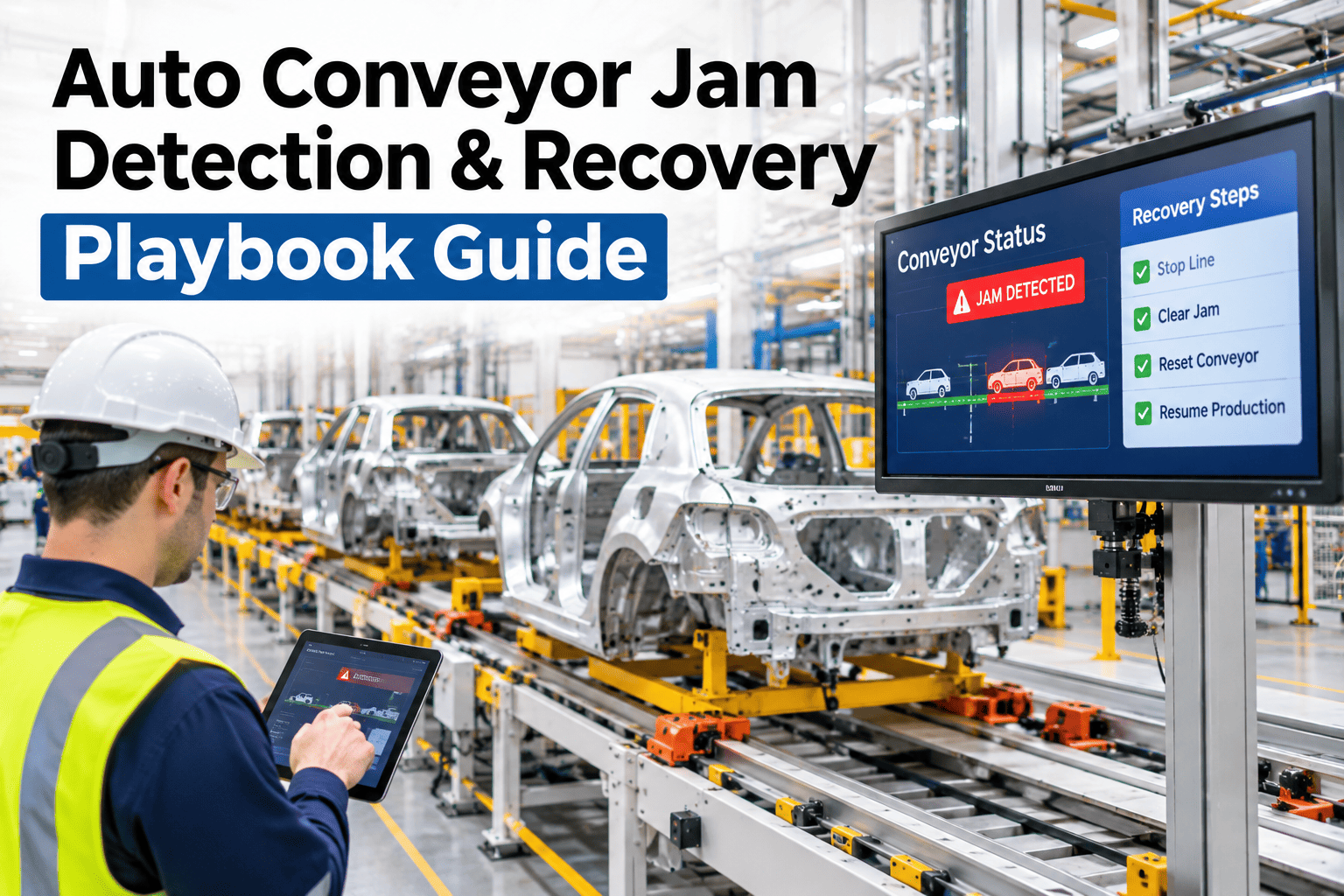
Photo eyes and accumulation sensors report a jam once product has backed up far enough to block a beam, which on a longer accumulation zone can be minutes after the first part actually caught — minutes during which the jam gets worse, the recovery gets harder, and the real cause gets buried under the mess it caused. A recovery playbook built around automatic detection triggers, a safe recovery workflow and root-cause capture shrinks that daily time loss instead of treating every jam as a fresh surprise. iFactory AI's automotive conveyor team can review your current jam recovery process against this playbook before your next shift.
A Jam Caught Early Is a Correction. A Jam Caught Late Is a Shutdown.
Automatic detection triggers, a safe recovery workflow and root-cause capture shrink jam-recovery time daily and stop the same jam cause from quietly repeating shift after shift.
Why the Gap Between Jam Start and Jam Detection Matters
A sensor that only reports a jam once product has physically blocked a beam is reporting the consequence, not the event, and on a long accumulation zone that gap can run minutes — long enough for a tipped case to become a pile-up, or for a stuck part to drag and damage a second part behind it. Shrinking that detection gap is the single biggest lever in reducing total jam-recovery time, because every minute of earlier detection is a minute less mess to clear.
A beam-block trigger fires after the jam has already grown, not at onset.
Rushed recovery without a safe-stop protocol creates injury risk.
A cleared jam with no cause logged is a jam waiting to repeat.
The same jam type recurring at the same zone, unaddressed because nobody tracked the pattern.
The Checklist: Six Steps From Detection to Prevention
Work through these in order every time, so a jam becomes a logged, trending data point instead of a one-off story. Our team can review your current recovery steps against this sequence.
Vision or flow-rate monitoring flags a developing jam before product fully backs up.
A targeted zone stop avoids halting the entire line unnecessarily.
A documented lockout and clearing sequence, not an improvised rush.
Tipped product, roller debris, merge pile-up — each is a distinct category.
A quick cause note while the scene is fresh beats a guess reconstructed later.
A recurring cause at one zone is the signal to fix the zone, not just the next jam.
Detection Method vs Typical Lag
| Detection Method | Typical Lag | What It Catches |
|---|---|---|
| Beam-block / photo eye | Minutes, once backed up | Confirms a jam already formed |
| Flow-rate deviation | Seconds to a minute | A slowdown before full backup |
| Vision-based jam detection | Near real-time | Tipped, fallen or jammed product as it happens |
See Your Own Average Jam-Recovery Time by Zone
Bring your recent jam log and see where detection lag and recovery time are adding up the most.
A Composite Scenario: The Merge Point That Jammed Every Week
Picture an assembly line where a merge point jammed roughly once a week, each time cleared and restarted without anyone logging why, since the line needed to get moving again as fast as possible.
Once root cause was logged at each recovery instead of skipped, a pattern emerged after a few events pointing to a specific guide rail at the merge point that had drifted slightly out of alignment. Adjusting that guide rail stopped the weekly recurrence entirely. The scenario illustrates why logging the cause matters even under time pressure; actual recurring causes vary by line.
Where iFactory AI Fits
iFactory AI detects developing jams through vision and flow-rate monitoring well before a beam-block trigger would fire, guides a safe zone-stop and clearing sequence, and logs jam type, location and likely cause automatically so patterns surface in a weekly review instead of staying buried in memory.
Vision and flow monitoring catch a jam forming, not just once it's blocked.
A documented clearing sequence replaces improvised manual response.
Jam records and root-cause trends tracked without extra paperwork.
Frequently Asked Questions
Vision-based detection can flag tipped, fallen or jammed product near real-time as it happens, compared to a beam-block sensor that only triggers once product has physically backed up enough to block the beam, which on a long accumulation zone can be several minutes later. Compare detection timing for your specific zones.
Vision-based jam detection can often run on existing facility cameras rather than requiring new hardware at every conveyor, merge and divert point, though coverage gaps should be reviewed before assuming full detection. Check what your current cameras already cover.
A documented lockout sequence, a defined zone boundary for the stop, and clear steps for manually clearing product before restart, so recovery doesn't depend on whoever happens to be nearest to the jam improvising a response under time pressure. Review a sample safe-clear protocol for your line.
A brief, structured note — jam type, location and likely cause — captured while the scene is fresh is far more useful than a lengthy report reconstructed later from memory, and it's the structured part that makes weekly pattern review actually possible. See a sample root-cause capture format.
Weekly is a practical cadence for most lines, since a recurring cause at the same zone usually becomes visible within a few events, and catching it early prevents the cost of continuing to clear the same jam over and over. Set a review cadence for your jam logs.
Stop Treating Every Jam Like a Fresh Surprise
iFactory AI detects jams earlier, guides a safe recovery sequence and logs root cause automatically, so patterns surface instead of repeating.