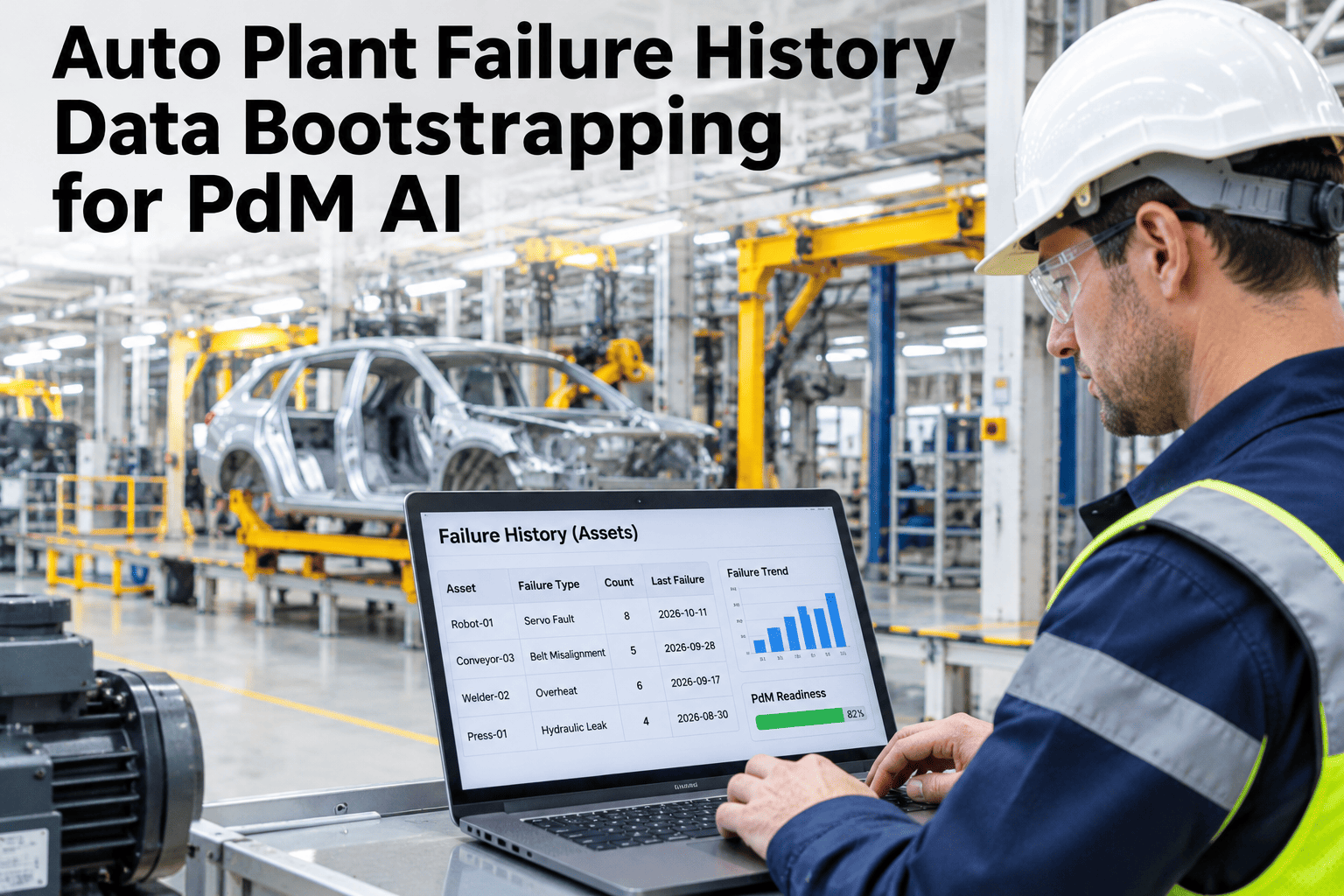
Most automotive plants find out they have a failure history problem only after a predictive maintenance pilot stalls. Models trained on thin data flag normal variance as risk or stay quiet right up to the stop, and the plant that was excellent at preventive maintenance often has the least run-to-failure history to learn from, since parts were replaced long before they ever broke. iFactory AI, an on-premise AI platform for predictive maintenance, bootstraps that missing history through event mining, synthetic-data augmentation and expert-labeled samples, and teams can review a failure history bootstrap plan against their own asset register before committing a pilot to a thin dataset.
Your Plant's Failure History Is Thinner Than Your PdM Vendor Assumed
iFactory AI combines historical event mining, synthetic-data augmentation and expert-labeled samples to bootstrap the failure history an automotive PdM model needs, without waiting a year for enough real failures to happen.
Why Automotive Plants Hit the Cold-Start Problem
Machine learning is hungry for the past, and automotive assembly, stamping and body shop equipment is maintained aggressively on schedule, which means failures are rare by design. A model needs examples of things going wrong, and a disciplined preventive program has starved it of exactly that. The result is a predictable stall: the pilot launches, the dashboard shows high confidence on paper, and the first real degradation event either gets missed or buried under false alerts, because the model has never actually seen what a bearing failure, a servo drift or a weld-tip wear-out looks like on this specific line.
Sensor and CMMS gaps leave holes the model fills with guesses.
Stuck readings and miscalibrated sensors teach the model the wrong baseline.
CMMS, MES and sensor history never meet, so context is lost.
Preventive-first plants simply lack run-to-failure examples.
Three Ways to Bootstrap History You Don't Have Yet
A plant does not need to wait a year to start, because missing failure history can be approximated from three directions at once, each filling a different gap, and the combination is what shortens the runway. Our data science team can walk through which source fits your asset mix before a pilot begins.
CMMS work orders, SCADA alarm logs and operator shift notes are mined for near-misses, minor stops and unplanned repairs that were never formally labeled as failures but carry the same signature.
Physics-informed simulation and signal perturbation generate plausible degradation curves for asset classes with too few real examples, anchored to the equipment's known failure modes rather than invented numbers.
Maintenance technicians review ambiguous events and label them against a shared failure taxonomy, turning tribal knowledge into training data the model can actually use.
What Each Source Is Good and Bad At
| Source | Strength | Limit | Best For |
|---|---|---|---|
| Historical event mining | Grounded in real plant behavior | Only as good as the logs kept | Assets with 6+ months of CMMS history |
| Synthetic augmentation | Fills rare-event gaps fast | Needs validation against real data | New lines, low-failure-rate assets |
| Expert labeling | Captures context no sensor sees | Slow, needs technician time | Ambiguous or ties-to-cause events |
A Composite Scenario: Six Months Instead of Eighteen
Picture a body shop with excellent preventive compliance and almost no logged failures on its weld cells. A straight data-wait approach would have meant waiting for enough real failures to accumulate on its own.
Mining five years of minor-stop records, augmenting the thin servo-wear class with physics-informed synthetic curves, and having technicians label forty ambiguous stops brought a usable training set together far sooner, with the synthetic share flagged and down-weighted as real events caught up. Figures here are illustrative of the pattern, not a specific plant's results.
Map the Data You Already Have
Bring your CMMS export and sensor inventory to a 30-minute session and see which bootstrap source closes your biggest gap first.
Guardrails: Where Synthetic Data Goes Wrong
Blend ratios must be tracked and disclosed, not hidden inside a combined training set.
Every synthetic class needs comparison against the first real events that arrive.
Synthetic data should shrink in share as real history accumulates, not stay static.
A model that never sees expert-labeled edge cases repeats the same blind spots.
A Readiness Checklist Before the Pilot Starts
The Data Maturity Ladder for an Automotive Asset Class
Every asset class sits somewhere on a four-rung ladder between no usable history and a model the maintenance team actually trusts. Knowing which rung an asset class occupies today is what decides whether it is pilot-ready now or needs a bootstrap pass first, and most plants are surprised to find their most critical equipment sitting on a lower rung than their least critical one, simply because it has been maintained too well to fail on record.
How the Synthetic Share Should Shrink Over Time
Synthetic data earns its place only as a bridge, not a destination, and a healthy bootstrap program tracks the synthetic share of its training set falling every quarter as real events accumulate and confirm or correct the model's early assumptions.
Where This Fits Inside a Wider PdM Rollout
Bootstrapping is rarely the whole program. It is the step that makes an asset selection matrix honest, because a critical press with no usable history should not be scored the same as one with five years of clean records. Plants that skip this step tend to discover the gap only when a pilot's confidence scores look suspiciously uniform across very different equipment, which is usually a sign the model never had enough real signal to differentiate between them in the first place.
Where iFactory AI Fits
iFactory AI runs this bootstrap on-premise, so plant data never has to leave the site to build the training set, which matters in automotive where production rates and failure history are commercially sensitive.
CMMS and SCADA history scanned for mineable near-misses without manual review.
Asset classes needing synthetic augmentation are surfaced before the pilot starts.
Ambiguous events route to a short labeling queue, not a buried report.
Frequently Asked Questions
Most asset classes need roughly 12 to 18 months of structured failure records before a model's confidence can be trusted, though well-mined near-miss data can shorten that. See a readiness check for your own asset classes before scoping a pilot.
Synthetic curves are useful for filling rare-event gaps, but they should always be anchored to known failure physics and validated against the first real events, never treated as a stand-in for ground truth. Ask our team how blend ratios are tracked for safety-relevant equipment.
Minor stops, unplanned repairs, near-misses and even some preventive tasks completed early can carry the same signature as a full failure once labeled correctly. Walk through a sample mining pass on your own export.
A weekly review of ambiguous events, typically a few dozen per asset class, is enough to build a usable labeled set over a quarter without pulling technicians off the floor for long. Discuss a labeling cadence that fits your maintenance team's schedule.
No. Bootstrapping shortens the runway to a usable model, but synthetic and mined data should shrink in share as real failure events accumulate and confirm or correct the model's early assumptions. Plan a data maturity timeline for your plant.
Start the PdM Pilot on Data That Can Actually Support It
iFactory AI bootstraps the failure history automotive plants rarely have on day one, so the first pilot asset list is backed by real signal, not hope.