Every vision AI model is only as reliable as the labels it was trained on, and in automotive that reliability has to hold up for years, not just through a pilot. A scratch labeled inconsistently by two different annotators teaches the model to be unsure about exactly the defect it needs to catch most confidently. Most quality teams discover this the hard way, when accuracy drifts months after launch and the root cause turns out to be labeling drift rather than the model itself. A real annotation program treats labeling as an engineering discipline, with standards, agreement checks and audits, not a one-time task handed to whoever is free. Teams building or buying vision AI can see how iFactory AI structures its annotation and QA pipeline before trusting a model with production decisions.
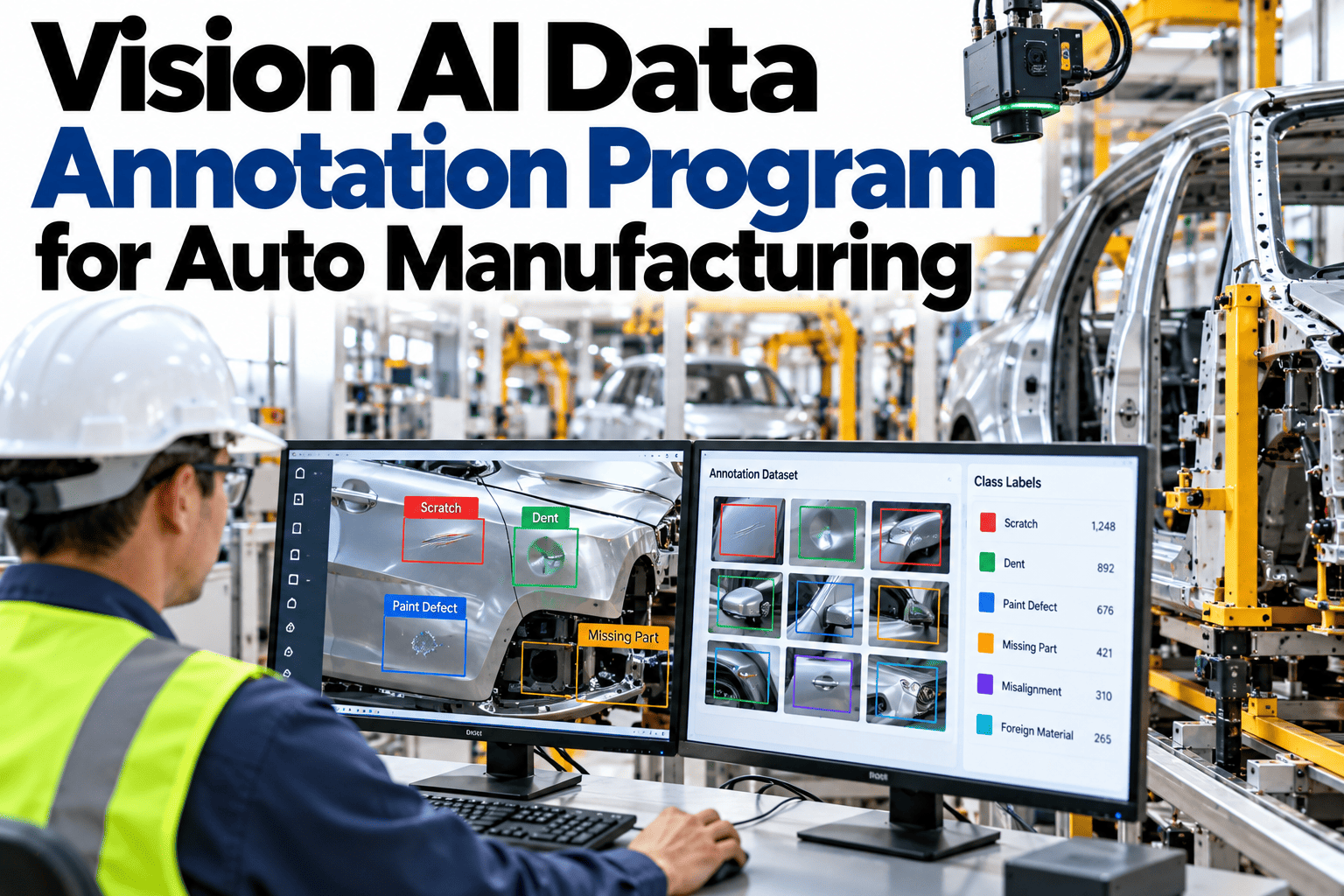
Vision AI Data Annotation Program for Auto Manufacturing
Labeling standards, inter-annotator agreement and QA protocols that keep OEM-grade models trustworthy over years, not weeks.
Why Labeling Quality Decides Model Quality
Three gaps in a typical annotation process quietly undermine model accuracy long after training is done.
Different annotators drawing defect boundaries differently teaches the model conflicting signals.
Labeling standards applied loosely over months slowly shift what the model considers normal.
Without a record of who labeled what and when, a bad batch is hard to trace and fix.
None of these show up in a demo. They show up months into production, which is exactly why the annotation process needs its own standards from day one.
What Inter-Annotator Agreement Actually Measures
Agreement rate shows how often independent annotators label the same image the same way, which is the clearest signal of label quality.
Check Your Current Dataset's Agreement Rate
Book a 30-minute session and bring a sample of labeled images. iFactory AI will show where agreement is strong and where it needs rework.
The QA Protocol, Stage by Stage
A defensible annotation program runs every batch through the same checks before it ever reaches model training.
What iFactory AI Supports
Annotation quality is treated as an ongoing program, not a one-time setup step.
Written Labeling Standards
Defect boundaries and categories are defined precisely, with example images for each class.
Automated Agreement Scoring
Every batch is scored for inter-annotator agreement before it reaches training.
Rolling Audits
Approved labels are re-checked on a schedule to catch drift before it affects accuracy.
Full Audit Trail
Every label is stored with who created it, when, and which standard version applied.
iFactory AI sets up the annotation program alongside model deployment. Scope covers standard documentation, annotator onboarding, QA tooling and ongoing audit support.
Expert Review
Teams that skip inter-annotator agreement checks almost always find out the hard way, usually as an unexplained accuracy dip three to six months after launch. By then the root cause is buried in thousands of labels, and retraining from scratch costs far more than the agreement check would have.
A 95 percent agreement target is achievable with a clearly written standard and example images per defect class. Below that, the issue is almost never the annotators; it is usually an ambiguous standard that needs rewriting, not retraining.
Frequently Asked Questions
How many annotators are needed to measure agreement?
At minimum two annotators need to label the same image independently to calculate agreement, though a third reviewer is useful for resolving disagreements. Most programs rotate which annotators double-label a given batch so no single pair becomes the bottleneck. See a sample agreement report in a live session.
What happens when annotators disagree on a label?
A disagreement is routed to a senior reviewer who makes the final call and, where needed, updates the written standard to prevent the same ambiguity recurring. This keeps disagreements from being treated as random noise and instead uses them to sharpen the standard. Ask support about disagreement resolution workflows.
How often should approved labels be re-audited?
A rolling audit of a small percentage of approved batches, run monthly or quarterly depending on volume, is usually enough to catch drift before it affects model accuracy. Re-auditing everything constantly is rarely necessary once the initial agreement calibration is solid. Request a sample audit schedule based on your batch volume.
Can we use our existing annotators with this program?
Yes, the program is built around standards and QA checks rather than requiring a specific annotation team. Existing annotators go through a calibration round against the written standard before labeling production batches. Contact support to discuss onboarding your current team.
Does this slow down how fast new defect types get added?
Adding a new defect category does take an initial round of standard writing and calibration, but this is usually faster than discovering inconsistent labels months later and having to retrain. Most teams find the upfront time pays for itself the first time a new defect type is added cleanly. Book a session on adding a new defect class to your program.
Build a Vision AI Model on Labels You Can Trust
iFactory AI runs annotation as a measured, audited program, not a one-time task. Book a walkthrough of the QA pipeline.