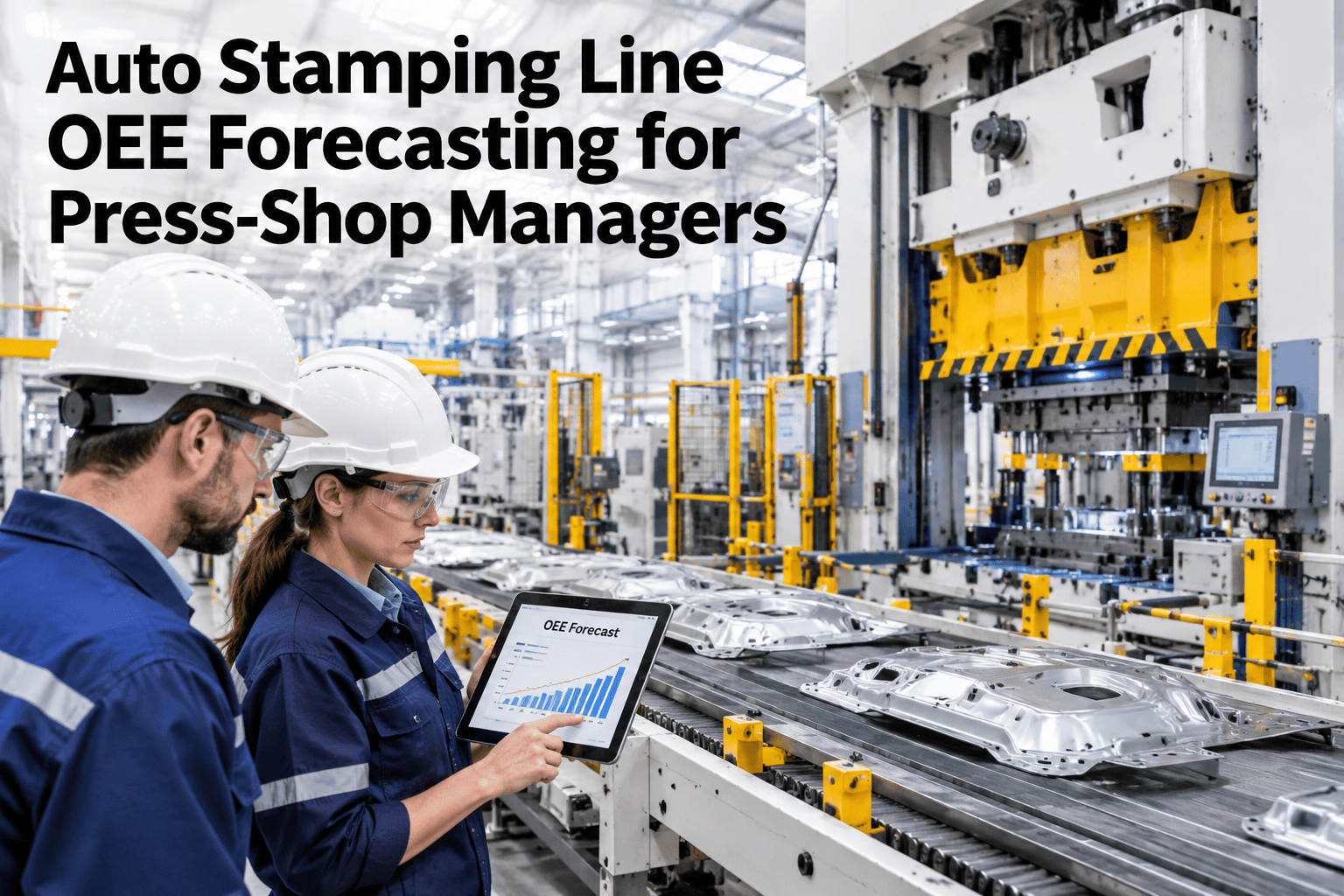
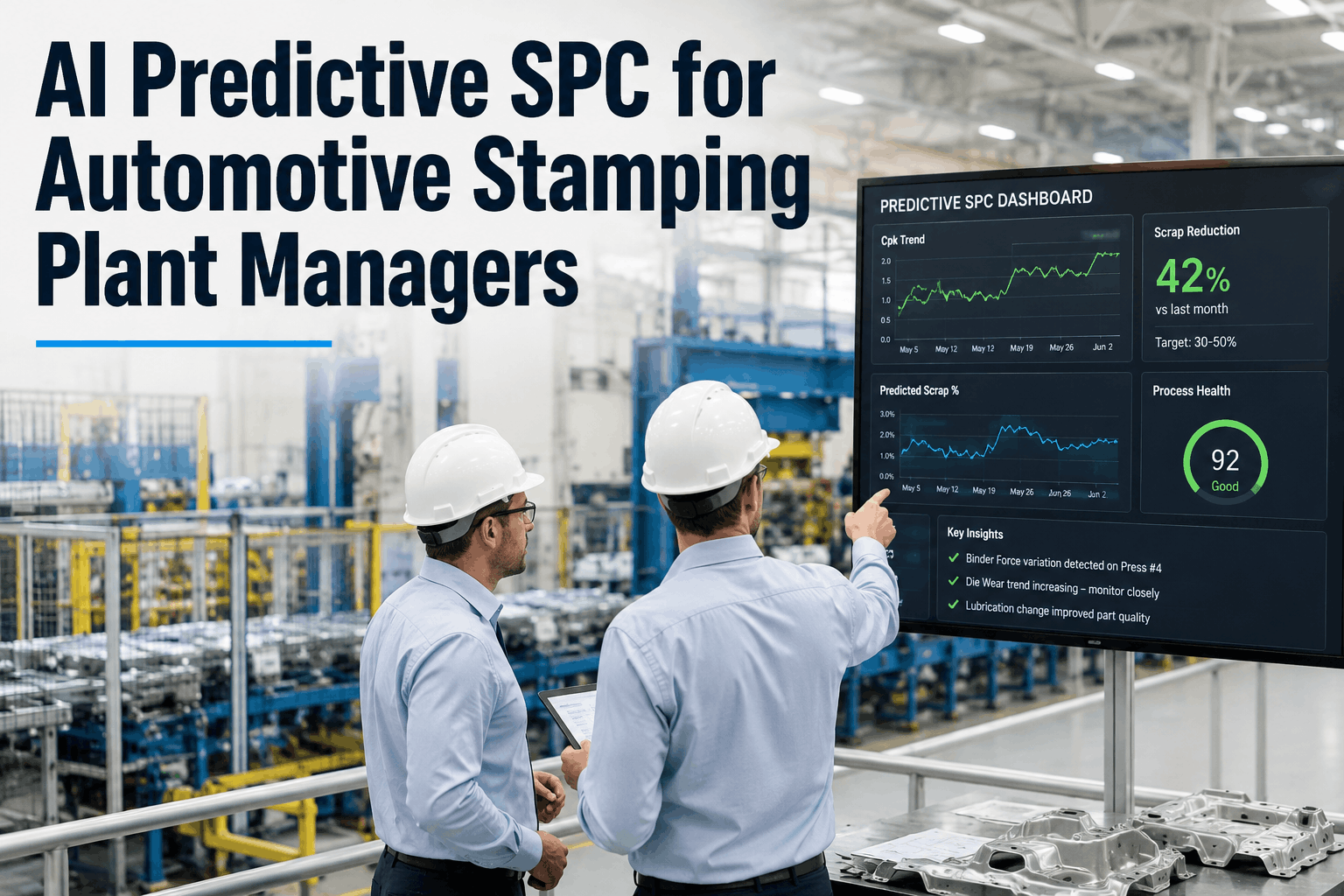
A daily OEE report tells a press-shop manager what already happened. It cannot tell them whether tomorrow's production campaign will hit the customer's ship date, or whether a die approaching its wear limit will push next week's OEE below plan. iFactory, an on-premise AI platform with predictive maintenance and OEE analytics built in, forecasts press-line OEE seven days out with a confidence band around the number. Press-shop managers who want this ahead of their next production planning meeting can discuss their plant data and use case with our team.
Stamping Line OEE Forecasting · Press-Shop Managers, 2026
Know Where OEE Is Headed, With a Range You Can Plan Around
iFactory AI forecasts stamping line OEE seven days ahead, with a confidence band that shows how certain the prediction is — not just a single number pulled from a model.
Forecast OEEConfidence band
Why a lagging number isn't enough
Yesterday's OEE Doesn't Tell You About Next Week's Campaign
A production campaign that starts tomorrow draws on a specific press, a specific die, and a specific coil batch — each with its own current condition and recent performance trend. A single trailing OEE percentage averages all of that away, which is exactly the information a press-shop manager needs intact when deciding whether a campaign is actually on track to hit its ship date.
What feeds the forecast
Four Inputs Behind a Seven-Day OEE Prediction
Die wear trend
Current die condition and its trajectory toward the next scheduled maintenance point.
Recent micro-stop rate
The station-level pattern already in progress, projected forward if nothing changes.
Scheduled changeovers
Known coil and tooling changes already on the production schedule for the forecast window.
Historical campaign pattern
How this specific press-die-material combination has historically performed over similar run lengths.
Reading the confidence band
Why the Range Matters as Much as the Number
| Band width | What it signals | Planning response |
|---|
| Narrow | Stable, well-understood press-die-material combination | Plan the campaign with confidence against the forecast |
| Widening over the week | A condition — often die wear — is approaching an uncertain threshold | Build in schedule buffer or bring maintenance forward |
| Wide from day one | Limited history for this specific combination, or recent volatility | Treat the forecast as directional, monitor closely |
See What Next Week Looks Like for Your Press Lines
Share your current production schedule and press performance history, and iFactory AI will walk through what a seven-day forecast would show for your lines.
Campaign-level view
Forecasting a Whole Campaign, Not Just a Daily Average
A production campaign often runs for days against a single customer order, and a campaign-level forecast trends OEE across the full run rather than resetting to a daily snapshot each morning — which is the view that actually answers the question a press-shop manager is asking: will this campaign finish on schedule.
The planning conversation it enables
From Forecast to a Different Production Decision
1
Forecast flags a risk
The confidence band widens or the OEE trend dips below the campaign's required rate.
2
Manager reviews the driver
The forecast shows which input — die wear, micro-stop rate, changeover — is driving the risk.
3
A plan decision is made
Bring maintenance forward, reassign the campaign to another press, or accept the risk with a buffer.
4
Forecast updates daily
The seven-day window rolls forward each day, reflecting the decision made and any new data.
Expert review
What a Press-Shop Manager Checks First
A forecast earns a place in the planning meeting when it changes what gets decided that day, not when it simply restates yesterday's trend as tomorrow's prediction.
Verdict
Strong when the confidence band is shown alongside the number, so a manager knows how much to trust a given forecast.
Watch for
Treating a wide confidence band as a model flaw rather than useful information about genuine uncertainty in that specific campaign.
Do next
Pick your next scheduled campaign and check whether die age, recent micro-stop rate, and coil batch history are even being tracked together today.
Frequently asked questions
What Press-Shop Managers Ask About OEE Forecasting
How accurate is a seven-day OEE forecast really?
Accuracy varies by press-die-material combination and how much run history exists for it — the confidence band is designed to communicate that uncertainty honestly rather than presenting a single falsely precise number.
See what accuracy looks like for your specific lines.
Does this replace our current production planning process?
No — the forecast is designed to feed into the existing planning meeting as one more input, flagging which campaigns carry schedule risk rather than replacing the scheduling decision itself.
Ask support how this fits your planning workflow.
What data do we need before a forecast is trustworthy?
Press performance history, die condition tracking, and changeover scheduling data all feed the forecast — the more run history available for a given press-die combination, the narrower and more reliable the confidence band.
Discuss your current data readiness.
Can the forecast tell us which specific press to assign a campaign to?
How does this handle a brand-new die or press with no history?
A new combination starts with a wider confidence band reflecting the limited history, narrowing as actual run data accumulates — the forecast becomes more reliable the longer that specific press-die-material combination has been tracked.
Talk through forecasting for a new die or press.
Plan against where OEE is headed, not just where it was
Get a Seven-Day OEE Forecast for Every Press Line
Book a session with iFactory AI to see what campaign-level forecasting would show for your press shop's upcoming schedule.
{"@context":"https://schema.org","@type":"FAQPage","mainEntity":[
{"@type":"Question","name":"How accurate is a seven-day OEE forecast really?","acceptedAnswer":{"@type":"Answer","text":"Accuracy varies by press-die-material combination and available run history; a confidence band communicates that uncertainty rather than a single falsely precise number."}},
{"@type":"Question","name":"Does this replace our current production planning process?","acceptedAnswer":{"@type":"Answer","text":"No, the forecast feeds into the existing planning meeting as one more input rather than replacing the scheduling decision."}},
{"@type":"Question","name":"What data do we need before a forecast is trustworthy?","acceptedAnswer":{"@type":"Answer","text":"Press performance history, die condition tracking, and changeover scheduling data all feed the forecast."}},
{"@type":"Question","name":"Can the forecast tell us which specific press to assign a campaign to?","acceptedAnswer":{"@type":"Answer","text":"Yes, comparing forecasts across candidate presses for the same campaign is a direct use case."}},
{"@type":"Question","name":"How does this handle a brand-new die or press with no history?","acceptedAnswer":{"@type":"Answer","text":"A new combination starts with a wider confidence band reflecting limited history, narrowing as actual run data accumulates."}}
]}